Living
Which is the better choice overall?
For most households the Cocker is the more practical dog -- smaller, more apartment-friendly, and easier for a first-time owner. The Great Dane makes sense only with real space and Dane-specific experience.

Quick answer
Which is the better choice overall?
For most households the Cocker is the more practical dog -- smaller, more apartment-friendly, and easier for a first-time owner. The Great Dane makes sense only with real space and Dane-specific experience.
Cocker Spaniel or Great Dane? On paper they differ most on grooming need, and on the scales Great Dane is the heavier at 110–175 lbs. Here is how the two compare on everything that shapes an ordinary week.
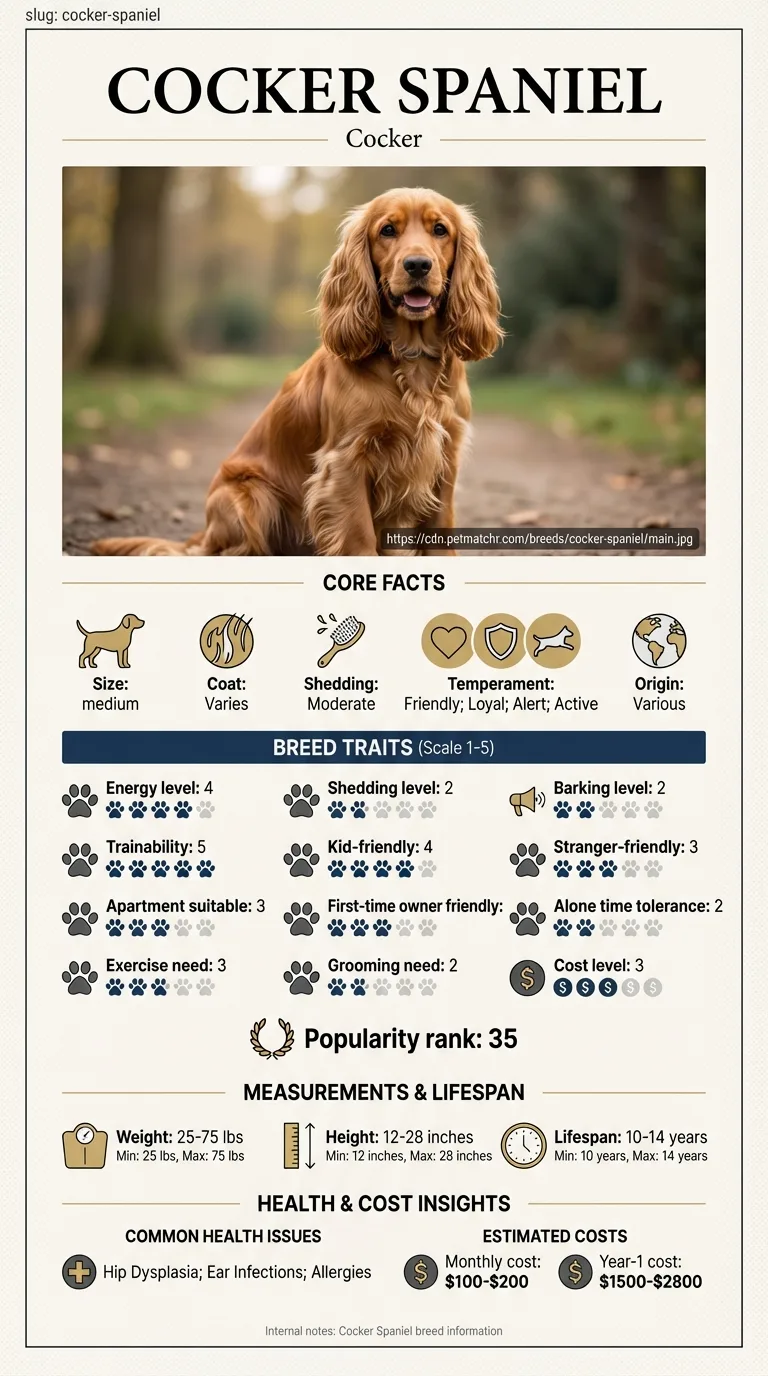
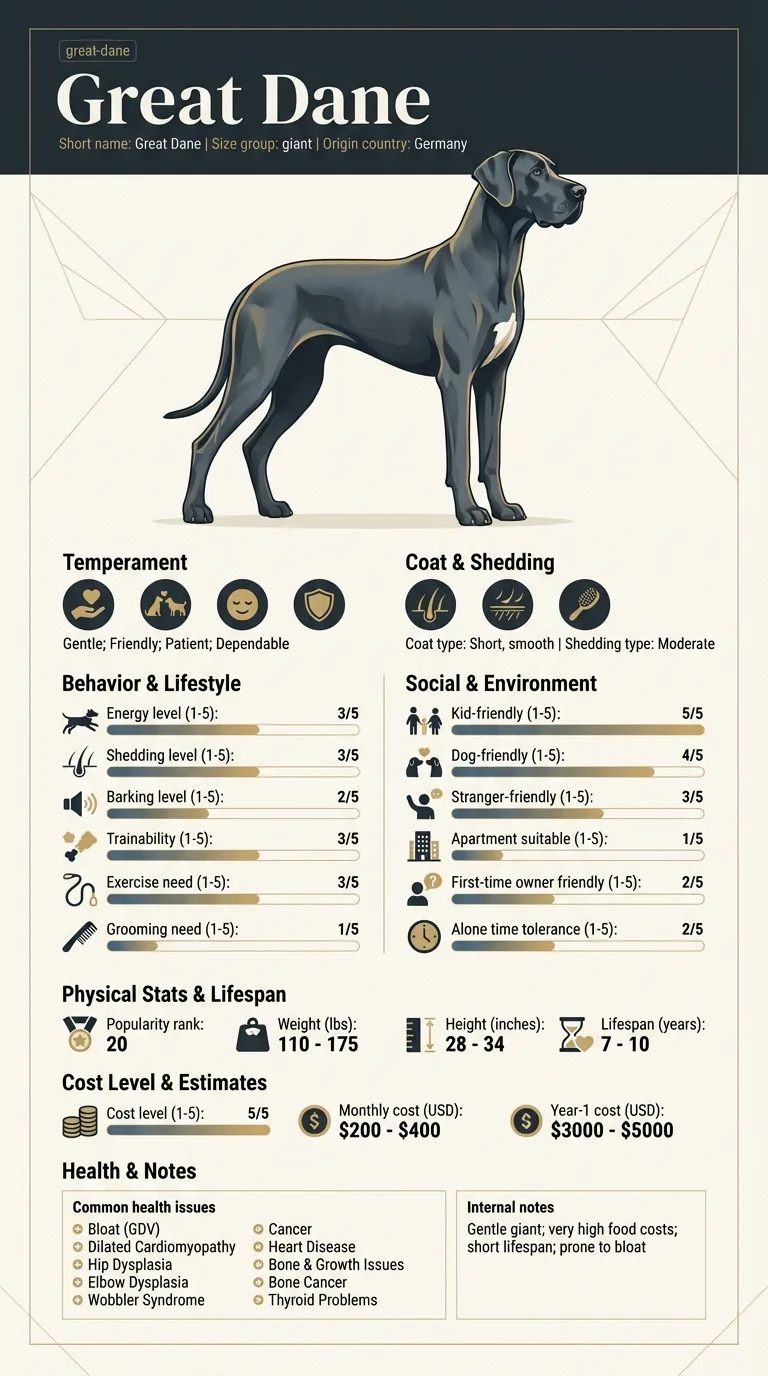
This is for someone already down to Cocker Spaniel and Great Dane and deciding between them. For this pair the decision usually turns on grooming need and apartment suitability, so those are covered first and in most detail. Anyone choosing from a flat has a clear answer here: Cocker Spaniel rates 4/5 against 1/5. There is no origin story here — only what changes about your week.
Between Cocker Spaniel and Great Dane, grooming need is what separates them, and Cocker Spaniel is the lower-effort dog of the two to keep.
Choose Cocker Spaniel if you are in a flat or a smaller home, this is your first dog and you want a dog that picks up training quickly.
Choose Great Dane if you do not want a standing grooming appointment and you want a dog that is more watchful with visitors.
| Feature | cocker spaniel | great dane | Winner |
|---|---|---|---|
| Size class | small | giant | Equal |
| Weight | 20–30 lbs | 110–175 lbs | Equal |
| Height | 13–16 in | 28–34 in | Equal |
| Lifespan | 10–14 years | 7–10 years | cocker spaniel |
| Exercise need | Moderate (3/5) | Moderate (3/5) | Equal |
| Grooming need | Very high (5/5) | Very low (1/5) | great dane |
| Shedding | Moderate (3/5) | Moderate (3/5) | Equal |
| Energy level | Moderate (3/5) | Moderate (3/5) | Equal |
| Barking | Moderate (3/5) | Low (2/5) | great dane |
| Apartment suitability | High (4/5) | Very low (1/5) | cocker spaniel |
| Good for first-time owners | High (4/5) | Low (2/5) | cocker spaniel |
| Tolerates being alone | Low (2/5) | Low (2/5) | Equal |
| Trainability | High (4/5) | Moderate (3/5) | cocker spaniel |
| Good with kids | Very high (5/5) | Very high (5/5) | Equal |
| Good with other dogs | High (4/5) | High (4/5) | Equal |
| Friendly to strangers | High (4/5) | Moderate (3/5) | cocker spaniel |
| Cost level | Moderate (3/5) | Very high (5/5) | cocker spaniel |
| Coat | Silky and feathered | Short, smooth | Equal |
| Origin | Various | Germany | Equal |
| Typical monthly cost | $80–$150 | $200–$400 | Equal |
| Typical first-year cost | $1,100–$2,300 | $3,000–$5,000 | Equal |
Twenty pounds versus roughly 150 -- there's no other pairing in this comparison where the size gap is this stark. The Cocker Spaniel stands 13-16 inches at the shoulder; the Great Dane reaches 28-34 inches and can weigh six times what a Cocker does. This isn't a decision about temperament so much as square footage and vet-visit logistics.
Despite the size gap, both breeds land at the same moderate 3/5 for exercise need -- Great Danes are famously not marathon runners, content with a couple of walks rather than constant activity. The practical difference is space, not stamina: a Dane needs room to stretch out, even if it isn't demanding miles.
This is where the Great Dane wins outright. Its short, smooth coat needs almost no grooming (1/5) and sheds at a moderate 3/5 -- identical shedding to the Cocker but without the ear cleaning and coat trimming that come with the Cocker's silky, feathered coat (5/5 grooming need). More dog, less coat maintenance.
Neither breed thrives left alone (2/5 for both), but apartment suitability is where they diverge hard: the Cocker rates a strong 4/5, the Great Dane a rock-bottom 1/5. It's not about barking -- the Dane is actually quieter (2/5 versus the Cocker's 3/5) -- it's simply that a 150-lb dog and a studio apartment don't mix well long-term.
The Cocker is the easier first dog on paper: 4/5 for first-time owners and 4/5 trainability, against the Dane's 2/5 and 3/5. That gap matters more than it looks -- untrained, a Cocker is a nuisance, but an untrained 150-lb Great Dane is a safety issue for the dog and everyone around it.
Both breeds score a perfect 5/5 with kids, so families aren't choosing on that alone -- supervision around a giant breed's size is more the issue than temperament. The Cocker is friendlier to strangers (4/5 versus 3/5), while good-with-other-dogs is tied at 4/5, so the practical edge for a busy household with lots of visitors leans Cocker.
This is the sharpest tradeoff in the comparison: the Cocker lives 10-14 years, the Great Dane typically 7-10. Giant-breed health risks fill the Dane's ten-condition list -- bloat, Wobbler syndrome, dilated cardiomyopathy, and bone cancer among them -- and none of them appear on the Cocker's shorter five-condition list. There's no overlap between the two lists at all.
The Cocker runs $80-150 a month and $1,100-2,300 in year one. The Great Dane costs roughly double to triple that: $200-400 monthly and $3,000-5,000 in the first year, driven by food volume and bigger everything. At cost level 5/5, the Dane is about as expensive as dogs get.
Cocker Spaniel weighs 20–30 lbs and lives 10–14 years; Great Dane weighs 110–175 lbs and lives 7–10 years. The two diverge most on grooming need, apartment suitability and good for first-time owners and 1 other rated axes. They are level on tolerates being alone, good with other dogs and energy level, so those cannot decide it. Where the table declares a winner it means less work for the owner, nothing more; descriptive rows are left as ties on purpose. The value here is in the differences between the two columns; treat any single score as approximate.

Considerably -- a Cocker weighs 20-30 lbs and stands 13-16 inches, while a Great Dane weighs 110-175 lbs and stands 28-34 inches. It's one of the largest size gaps you'll find in a breed comparison.
Neither, really -- both rate a moderate 3/5 for shedding. The difference is grooming effort: the Great Dane's short coat needs almost none (1/5), while the Cocker's feathered coat needs constant upkeep (5/5).
Not really -- it rates just 2/5 for first-time owners, mostly because its size makes training mistakes higher-stakes. The Cocker, at 4/5, is the more forgiving choice for someone new to dog ownership.
The Cocker can (4/5) -- the Great Dane really can't (1/5). It's less about noise, since the Dane is actually the quieter of the two, and more about a 150-lb dog needing room to move.
Close to double the Cocker on a monthly basis -- $200-400 versus $80-150 -- and its first year runs $3,000-5,000 against $1,100-2,300 for the Cocker.
No overlap at all. The Cocker's issues are things like ear infections, cataracts, and hip dysplasia; the Great Dane's are giant-breed problems like bloat, Wobbler syndrome, and bone cancer.
It's a near-universal pattern in giant breeds -- the data here shows 7-10 years for the Dane against 10-14 for the Cocker. Larger dogs simply age faster and carry more strain on organs and joints.
For most households the Cocker is the more practical dog -- smaller, more apartment-friendly, and easier for a first-time owner. The Great Dane makes sense only with real space and Dane-specific experience.
$80-150 for a Cocker Spaniel versus $200-400 for a Great Dane -- more than double.
Neither, surprisingly -- both rate a moderate 3/5. The Dane needs room more than mileage.
The Cocker, by a wide margin: 10-14 years against the Great Dane's 7-10, a typical giant-breed tradeoff.
Secure checkout on Stripe. We never see your card.
7-day money-back guarantee. Instant access.
Health information here is general and is not veterinary advice. If your dog shows pain, sudden behaviour change, or worsening symptoms, consult a licensed veterinarian.
Some links on this site are affiliate links. We may earn a commission at no extra cost to you, and we only suggest products we believe are helpful for dog owners.
We research and check what we publish, but we do not warrant that any figure, date, price, or statement is accurate, complete, or current, and we accept no liability for any loss, cost, injury, or other harm arising from the use of this site. Use it as one reference among several. You remain responsible for your own decisions and for your dog's care - confirm anything that matters with a licensed veterinarian or another qualified professional before you act on it. Full disclaimer.
Match your lifestyle to the right dog.
Take quizNot sure which breed is right for you? Take our 2-minute quiz to find out.
Take the quiz