Akita or Shar-Pei: Two Reserved Breeds, One Much Smaller
Quick answer
Akita vs Chinese Shar-Pei: which should I choose?
The Shar-Pei if you want the Akita's reserved character in a smaller, low-shedding dog that suits a flat. The Akita if you want the sounder body and have the space — no daily skin care, no entropion risk, and a longer life.
Six rows on this comparison tie exactly, and they are all the ones about character: barking, dog tolerance, stranger tolerance, children, energy and time alone. Of every breed in this batch, the Chinese Shar-Pei is the closest temperamental relative the Akita has.
This page is for someone who has been drawn to reserved, dignified, low-drama breeds and is choosing between two of them. It covers where the temperaments genuinely match, the Shar-Pei's skin, eyelid and kidney problems, size and apartment fit, shedding, and cost.
Quick verdict
The Shar-Pei gives you a very similar temperament in a package half the size and a third of the shedding, and charges for it in skin, eyelids and kidneys.
Choose akita if...
Choose the Akita if you want the sounder body and have the space for it. It lives 10 to 13 years against 8 to 12, needs no daily skin care, and trains at 3/5 against the Shar-Pei's 2/5. You are accepting 5/5 shedding, up to 130 pounds, a 2/5 apartment rating and $110–$240 a month.
Choose chinese shar pei if...
Choose the Shar-Pei if you want the same reserved character in a 45 to 60 pound dog that fits a flat. It rates 4/5 for apartments against 2/5, sheds at 2/5 against 5/5 and needs only 2/5 exercise. You are accepting daily wrinkle care, a real risk of entropion needing surgery, and familial Shar-Pei fever with its kidney consequences.
Head-to-head comparison
Feature
akita
chinese shar pei
Winner
Weight
70–130 lbs
45–60 lbs
Equal
Height
24–28 in
18–20 in
Equal
Lifespan
10–13 years
8–12 years
akita
Coat
Dense double coat
Short and harsh
Equal
Grooming need
Moderate (3/5)
Low (2/5)
chinese shar pei
Shedding
Very high (5/5)
Low (2/5)
chinese shar pei
Energy level
Moderate (3/5)
Low (2/5)
Equal
Exercise need
Moderate (3/5)
Low (2/5)
chinese shar pei
Trainability
Moderate (3/5)
Low (2/5)
akita
Barking
Low (2/5)
Low (2/5)
Equal
Good with kids
Moderate (3/5)
Moderate (3/5)
Equal
Good with other dogs
Low (2/5)
Low (2/5)
Equal
Friendly to strangers
Low (2/5)
Low (2/5)
Equal
Apartment suitability
Low (2/5)
High (4/5)
chinese shar pei
Good for first-time owners
Very low (1/5)
Low (2/5)
chinese shar pei
Tolerates being alone
Moderate (3/5)
Moderate (3/5)
Equal
Typical monthly cost
$110–$240
$100–$200
chinese shar pei
Typical first-year cost
$1,700–$3,200
$1,400–$2,900
chinese shar pei
Deep dive
Reserve without noise, in both directions
Neither of these breeds greets people. That needs saying plainly, because owners coming from retriever-type dogs find it disconcerting.
A Shar-Pei meeting a stranger will typically stand, watch, and decline to engage. An Akita will do the same thing more slowly. Neither is nervous; both are assessing. Once a decision is made, both settle completely and stop caring.
The cost of this is that socialisation has to be deliberate and sustained. Both breeds firm up their adult opinions at social maturity rather than in puppyhood, both are frequently intolerant of same-sex dogs, and both can carry serious prey drive toward cats and small animals.
Training differs slightly. The Akita at 3/5 considers a request and forms a view. The Shar-Pei at 2/5 is more simply stubborn — it learns quickly and complies selectively, and it responds badly to repetition and worse to correction.
For both, short sessions, food, and absolute consistency are the approach. Neither will work for someone who wants a dog that is eager to please, because neither breed has that setting.
Wrinkles are a maintenance job, not a look
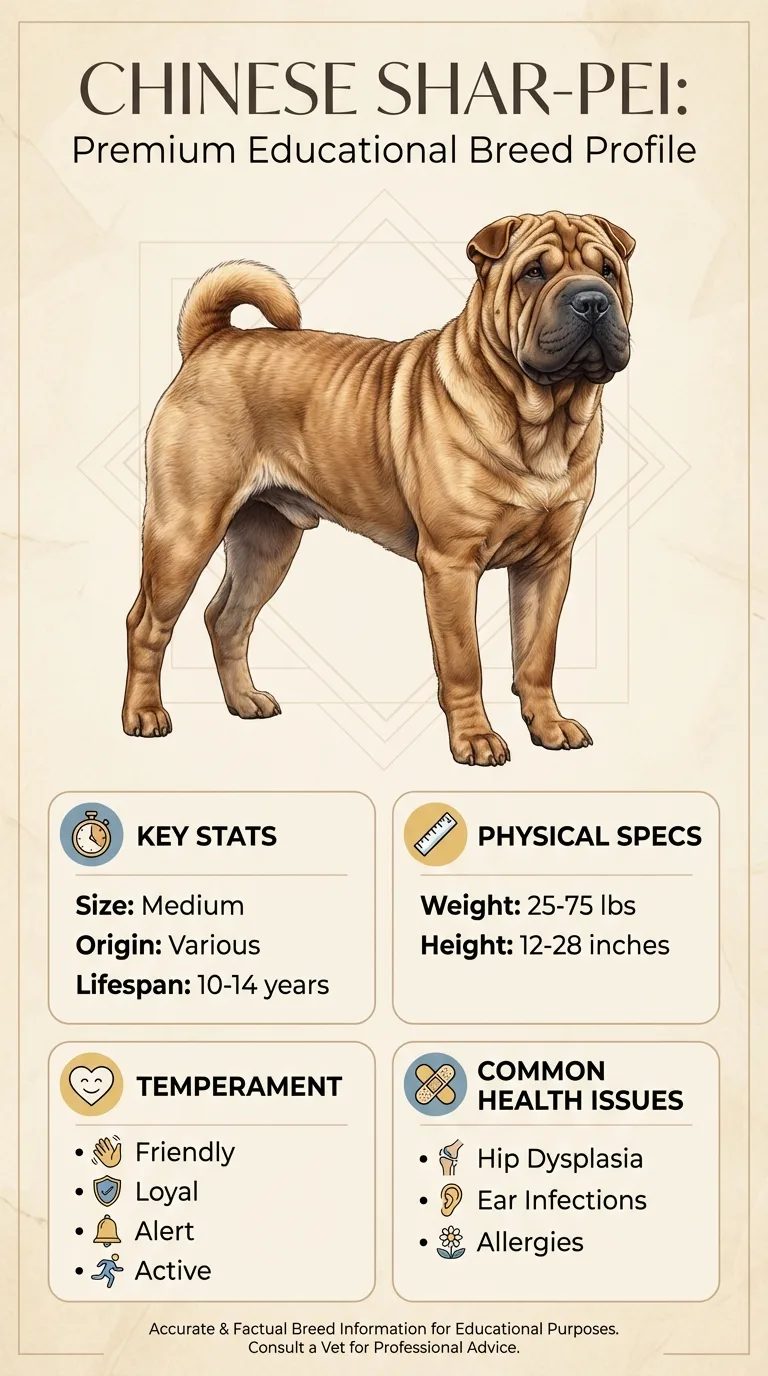
Skin fold dermatitis heads the Shar-Pei's condition list, and it is the daily reality of the breed.
The folds trap moisture, warmth and debris, which is a reliable recipe for bacterial and yeast infection. Wrinkles need wiping and — importantly — drying, especially after baths, swimming and rain. A Shar-Pei that smells is usually telling you about a fold, not a coat.
Entropion is the second and more serious skin consequence. The eyelid rolls inward and the lashes abrade the cornea, which is painful and damages sight. It is common enough in the breed that many puppies have their eyelids temporarily tacked, and permanent surgical correction is frequently needed later. Ask any breeder directly about entropion in the line and in the individual puppy.
Ear infections are the third: the ear canal in this breed is unusually narrow, which is a problem no amount of cleaning fixes and every owner has to manage.
The Akita's coat needs an undercoat rake twice a year and nothing daily. Its skin issues, when they come, are autoimmune rather than architectural.
Familial Shar-Pei fever and what it leads to
Familial Shar-Pei fever is a breed-specific inflammatory condition and it is the item on this page most worth understanding before buying.
It presents as episodes of high fever, often with a swollen hock joint, lasting a day or two and then resolving on their own. Owners frequently dismiss the first few episodes because the dog recovers without treatment.
The reason it matters is what it can lead to. Repeated inflammatory episodes are associated with amyloidosis, in which a protein deposits in the kidneys and liver and progressively destroys function. Renal failure is the usual endpoint and it is not reversible.
Episodes can be treated and the frequency reduced, which is why recognising them early matters. A Shar-Pei with an unexplained fever and a puffy hock should be seen, and the words familial Shar-Pei fever should be said out loud to the vet.
Hypothyroidism completes the list. The Akita's own burden — autoimmune disorders, hypothyroidism, progressive retinal atrophy, hip dysplasia and bloat — is a different shape, but the two breeds share a tendency toward immune-mediated disease that is worth noting.
Space, heat and running costs
The Shar-Pei rates 4/5 for apartments and earns it: 2/5 exercise, 2/5 barking, 2/5 shedding, and a dog that sleeps for most of the day. Two moderate walks cover it.
Both breeds struggle in real heat. The Shar-Pei's harsh coat and heavy skin do not shed heat well and it is prone to overheating; the Akita's dense double coat has the same limitation, though it copes better than most people expect because the coat insulates in both directions. Neither should be clipped and neither should be exercised at midday in summer.
On money the two are close: $100–$200 a month against $110–$240, and $1,400–$2,900 against $1,700–$3,200 in the first year.
The Shar-Pei's real cost is veterinary and recurring. Skin infections, ear infections, eyelid surgery and fever episodes are common enough that its lifetime spend often exceeds an Akita's despite the lower monthly figure and the smaller body. Insure it early, and check whether skin conditions are excluded.
Lifespan runs 10 to 13 years against 8 to 12.
Akita vs Chinese Shar-Pei: where the two breeds actually meet
Barking 2/5 and 2/5. Other dogs 2/5 and 2/5. Strangers 2/5 and 2/5. Children 3/5 and 3/5. Time alone 3/5 and 3/5.
That is an unusual amount of agreement, and it is not an artefact of the scoring. Both breeds are quiet, self-contained, tightly bonded to their own household and indifferent to visitors. Both are described by owners in the same language: dignified, catlike, undemonstrative, and entirely uninterested in performing affection on request.
Both are also clean and easy to house-train, which is a genuine and rarely mentioned advantage of the older Asian breeds.
The real separations are physical. The Shar-Pei is 45 to 60 pounds against 70 to 130, sheds at 2/5 against 5/5, needs 2/5 exercise against 3/5, and rates 4/5 for apartments against 2/5. If the temperament is what you want and the size is what stops you, the Shar-Pei is the answer to that specific problem.
Akita or Shar-Pei: Two Reserved Breeds, One Much Smaller - Akita vs Chinese Shar-Pei: where the two breeds actually meet
Frequently asked questions
Are Akitas and Shar-Peis really similar in temperament?
Yes, unusually so. Both rate 2/5 for barking, 2/5 with other dogs, 2/5 with strangers, 3/5 with children and 3/5 for time alone. Both are quiet, self-contained, tightly bonded to their own household and indifferent to visitors. Owners of both describe them in the same terms: dignified, catlike and undemonstrative.
How much daily care do Shar-Pei wrinkles need?
Daily wiping and, more importantly, drying — after baths, rain and swimming especially. Folds trap moisture and warmth and reliably become infected if left. A Shar-Pei that smells is usually telling you about a fold rather than a coat. This is a genuine daily commitment, not an occasional grooming task.
What is familial Shar-Pei fever?
A breed-specific inflammatory condition producing episodes of high fever, often with a swollen hock, that resolve on their own in a day or two. It matters because repeated episodes are linked to amyloidosis, in which protein deposits progressively destroy kidney function. Episodes can be treated and their frequency reduced, so recognising them early is what counts.
Which is better for an apartment?
The Shar-Pei at 4/5 against the Akita's 2/5. It weighs 45 to 60 pounds, needs only 2/5 exercise, barks at 2/5 and sheds at 2/5 — a genuinely quiet, low-output flat dog. The Akita's problem is size in shared corridors, 5/5 shedding and a guarding instinct at communal entrances.
Which sheds more?
The Akita, by a wide margin — 5/5 against the Shar-Pei's 2/5. It blows a dense double coat in clumps twice a year and needs an undercoat rake through those weeks. The Shar-Pei's harsh short coat sheds lightly, though the individual hairs are stiff and prickly and stick into fabric.
What should I ask a Shar-Pei breeder?
Entropion first — whether it has appeared in the line, whether this puppy's eyelids have been tacked, and what the breeder's policy is on correction. Then ask directly about fever episodes in the parents and grandparents, about kidney disease in the line, and about thyroid testing.
Which is easier to train?
The Akita marginally, at 3/5 against 2/5, though neither is eager to please. The Akita considers a request and forms a view; the Shar-Pei learns quickly and complies selectively, and responds badly to repetition and worse to correction. Short sessions, food and consistency are the only approach that works for either.
The Shar-Pei if you want the Akita's reserved character in a smaller, low-shedding dog that suits a flat. The Akita if you want the sounder body and have the space — no daily skin care, no entropion risk, and a longer life.
Costs
How much does each cost per month?
The Shar-Pei runs $100–$200 a month and the Akita $110–$240, with first-year totals of $1,400–$2,900 and $1,700–$3,200. The Shar-Pei's lifetime veterinary spend often exceeds the Akita's despite the lower figure.
Behavior
Do either of these breeds like strangers?
No — both rate 2/5. Neither greets visitors. Both stand, watch and decline to engage, then settle once they have decided. Owners coming from retriever-type breeds find this disconcerting at first.
Health
What is the most common Shar-Pei health problem?
Skin fold dermatitis, which is a daily management issue rather than an occasional illness. Entropion, narrow ear canals and familial Shar-Pei fever follow. Insure early and check whether skin conditions are excluded.
Related DogBreedCompass guides
Akita breed guide – The Akita profile covers guardian temperament and the long socialisation window the breed needs.
Chinese Shar-Pei breed guide – The Shar-Pei profile covers wrinkle care, eyelid problems and the breed's reserve.
Akita vs Chow Chow – The Chow Chow is the other aloof Asian breed most often weighed against these two.
Akita vs Shiba Inu – The Shiba Inu is the smaller Japanese spitz with a very similar temperament to the Akita.
Shar-Pei genetic disorders – The inherited conditions worth screening for before buying a Shar-Pei puppy.
Akita autoimmune diseases – Autoimmune disease is the Akita's most distinctive burden and the first question for a breeder.
Health information here is general and is not veterinary advice. If your dog shows pain, sudden behaviour change, or worsening symptoms, consult a licensed veterinarian.
Some links on this site are affiliate links. We may earn a commission at no extra cost to you, and we only suggest products we believe are helpful for dog owners.
We research and check what we publish, but we do not warrant that any figure, date, price, or statement is accurate, complete, or current, and we accept no liability for any loss, cost, injury, or other harm arising from the use of this site. Use it as one reference among several. You remain responsible for your own decisions and for your dog's care - confirm anything that matters with a licensed veterinarian or another qualified professional before you act on it. Full disclaimer.