Living
Bigger breed?
The Chinese Shar-Pei, weighing 45-60 lbs versus the Dachshund's 11-32 lbs.

Quick answer
Bigger breed?
The Chinese Shar-Pei, weighing 45-60 lbs versus the Dachshund's 11-32 lbs.
Chinese Shar-Pei or Dachshund? On paper they differ most on tolerates being alone, and on the scales Chinese Shar-Pei is the heavier at 45–60 lbs. Here is how the two compare on everything that shapes an ordinary week.
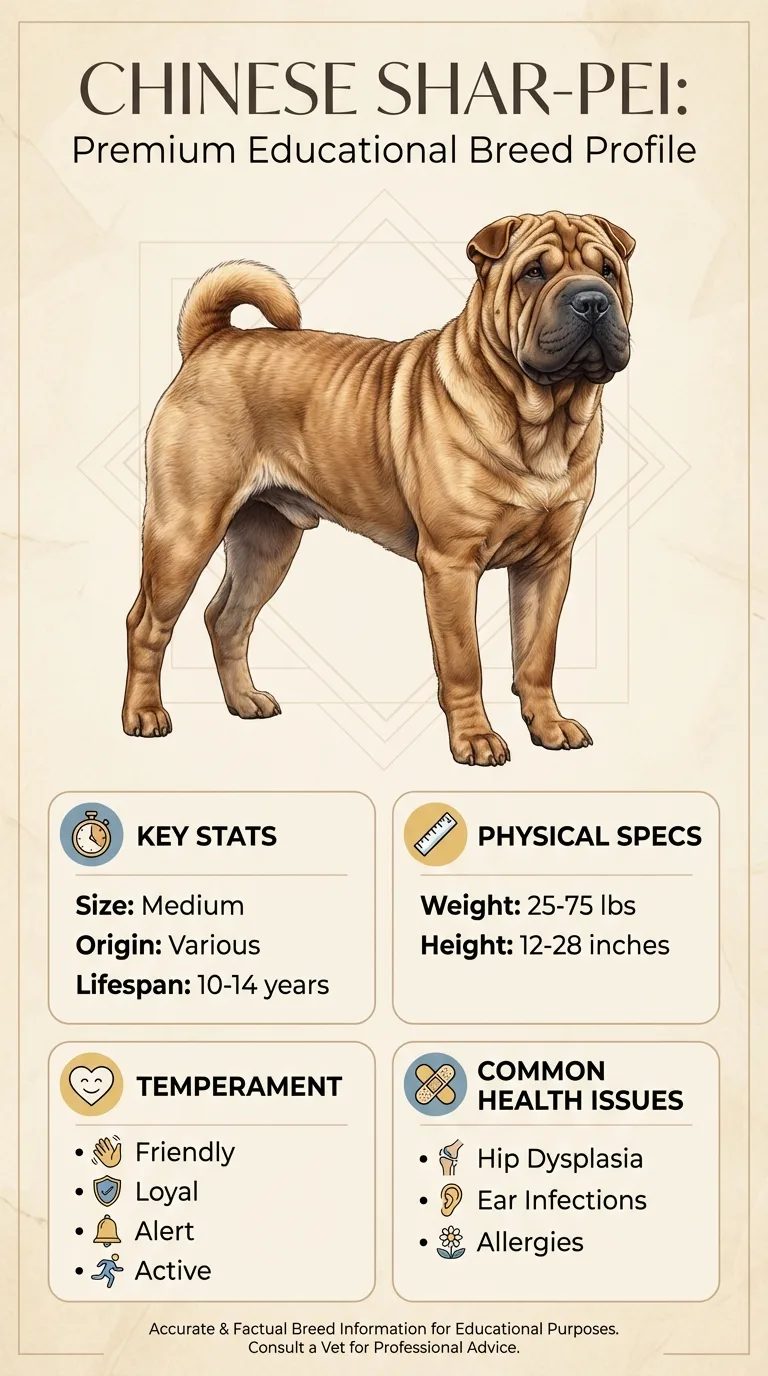
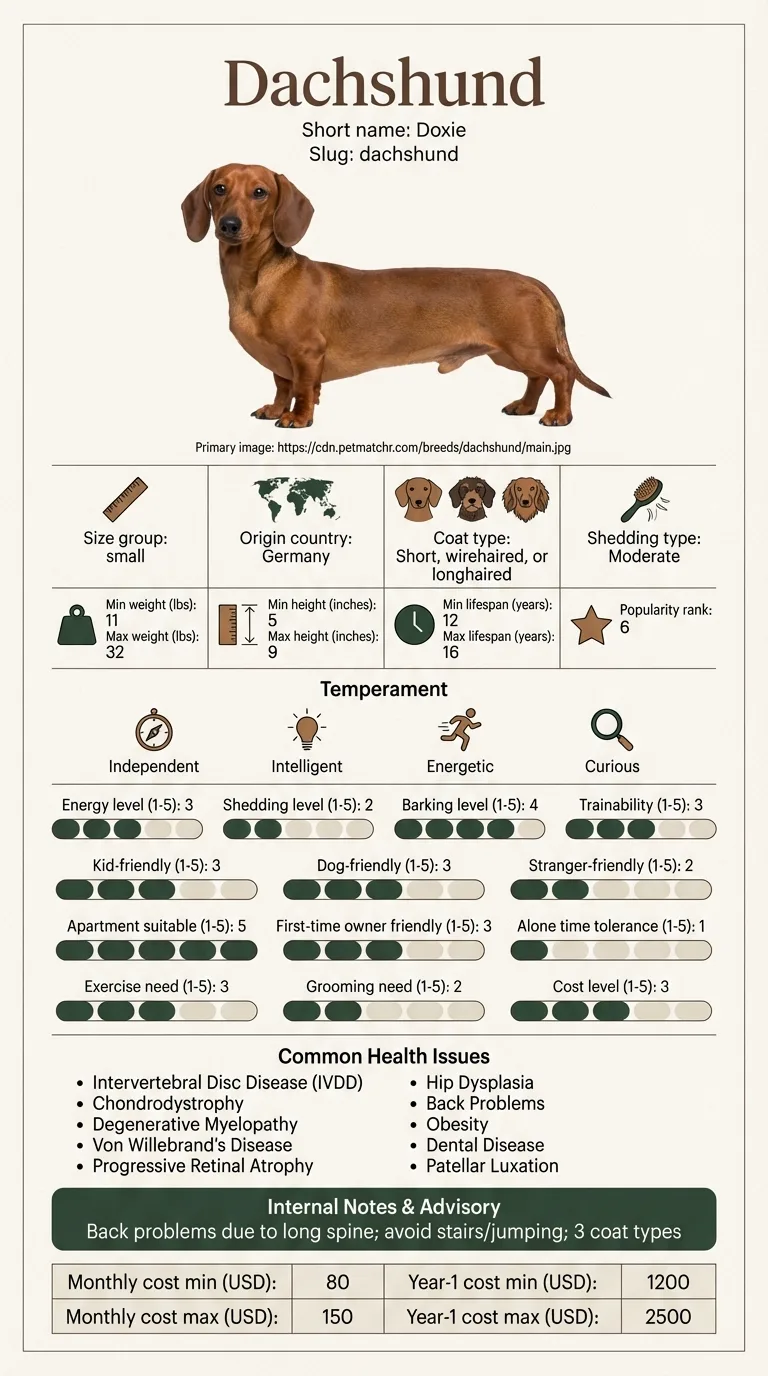
This is for someone already down to Chinese Shar-Pei and Dachshund and deciding between them. For this pair the decision usually turns on tolerates being alone and barking, so those are covered first and in most detail. Anyone choosing from a flat has a clear answer here: Dachshund rates 5/5 against 4/5. Breed history is left out; what follows is what you will actually live with.
Between Chinese Shar-Pei and Dachshund, tolerates being alone is what separates them, and Chinese Shar-Pei is the lower-effort dog of the two to keep.
Choose Chinese Shar-Pei if your walking routine is modest and the dog will be alone during the working day.
Choose Dachshund if you are in a flat or a smaller home, this is your first dog and you already have another dog.
| Feature | chinese shar pei | dachshund | Winner |
|---|---|---|---|
| Size class | medium | small | Equal |
| Weight | 45–60 lbs | 11–32 lbs | Equal |
| Height | 18–20 in | 5–9 in | Equal |
| Lifespan | 8–12 years | 12–16 years | dachshund |
| Exercise need | Low (2/5) | Moderate (3/5) | chinese shar pei |
| Grooming need | Low (2/5) | Low (2/5) | Equal |
| Shedding | Low (2/5) | Low (2/5) | Equal |
| Energy level | Low (2/5) | Moderate (3/5) | Equal |
| Barking | Low (2/5) | High (4/5) | chinese shar pei |
| Apartment suitability | High (4/5) | Very high (5/5) | dachshund |
| Good for first-time owners | Low (2/5) | Moderate (3/5) | dachshund |
| Tolerates being alone | Moderate (3/5) | Very low (1/5) | chinese shar pei |
| Trainability | Low (2/5) | Moderate (3/5) | dachshund |
| Good with kids | Moderate (3/5) | Moderate (3/5) | Equal |
| Good with other dogs | Low (2/5) | Moderate (3/5) | dachshund |
| Friendly to strangers | Low (2/5) | Low (2/5) | Equal |
| Cost level | High (4/5) | Moderate (3/5) | dachshund |
| Coat | Short and harsh | Short, wirehaired, or longhaired | Equal |
| Origin | Various | Germany | Equal |
| Typical monthly cost | $100–$200 | $80–$150 | Equal |
| Typical first-year cost | $1,400–$2,900 | $1,200–$2,500 | Equal |
The numbers here are almost comic in their mismatch: the Chinese Shar-Pei's 45-to-60-pound, 18-to-20-inch medium frame towers over the Dachshund's 11-to-32-pound, 5-to-9-inch small build. The Dachshund's famously long, low body — a shape bred for tunneling into badger dens — couldn't look more different from the Shar-Pei's compact, dense, wrinkled silhouette. Even the upper end of the Dachshund's weight range barely reaches the Shar-Pei's lower bound. Anyone picturing a dog that can curl up in a lap will find that in the Dachshund; anyone wanting a sturdier, ground-level presence with real heft will find it in the Shar-Pei instead.
The Dachshund rates moderate (3/5) for exercise need against the Chinese Shar-Pei's low (2/5), a modest gap that belies the Dachshund's genuinely energetic, curious temperament — this is a breed bred to dig and hunt, and it shows in its drive for exploring and sniffing even on short outings. The Shar-Pei's lower exercise need suits a more sedentary household comfortably. Both are manageable for owners without acres of space, but the Dachshund's energetic streak means it benefits from more mentally engaging walks and play, while the Shar-Pei is content with simpler, shorter routines. Neither breed needs marathon exercise sessions, making this one of the gentler contrasts on the page.
Grooming and shedding tie exactly here, both breeds rated low (2/5) on each measure. The Chinese Shar-Pei's short, harsh coat and the Dachshund's short, wirehaired, or longhaired coat options (depending on variety) all keep maintenance minimal, with occasional brushing covering most weeks for either dog. This is a rare case on this comparison page where coat care simply isn't a deciding factor — buyers choosing between these two breeds can cross grooming off the list of considerations and focus instead on size, temperament, and health, where the real differences actually lie.
The Dachshund edges out an even higher apartment-suitability score, very high (5/5), against the Chinese Shar-Pei's already-strong high (4/5) — both are solid choices for small spaces. But the Dachshund barks at a high (4/5) rate, noticeably louder than the Shar-Pei's low (2/5), a byproduct of its alert, curious nature and history as a den-hunting breed quick to vocalize. More striking is the alone-time gap: the Dachshund rates very low (1/5) for tolerating solitude, the lowest score anywhere on this table, while the Shar-Pei rates a comparatively comfortable moderate (3/5). Anyone working long hours away from home should weigh that alone-tolerance difference heavily before choosing the Dachshund.
The Dachshund rates moderate (3/5) for both trainability and first-time-owner suitability, a step above the Chinese Shar-Pei's low (2/5) on both measures, though its independent, curious temperament still means training sessions require patience rather than instant compliance. The Shar-Pei's reserved, independent nature makes it a similarly deliberate training project, just starting from a slightly lower baseline. Neither breed is the easiest option for a first-time owner hoping for effortless obedience, but the Dachshund's moderate rating suggests it's somewhat more forgiving of training mistakes than the Shar-Pei. Both benefit from early, consistent socialization and reward-based methods rather than a heavy-handed approach.
Kids and other dogs land at moderate (3/5) for the Dachshund versus moderate (3/5) with kids but low (2/5) with other dogs for the Chinese Shar-Pei — a small edge to the Dachshund for multi-dog households. Both breeds score low on friendliness to strangers, 2/5 for the Shar-Pei and also low (2/5) for the Dachshund, so neither is naturally outgoing with unfamiliar visitors. Given the Dachshund's long back and delicate spine, families with small children should supervise play carefully regardless of its moderate compatibility score, since rough handling risks injury. Overall, this is a closer household-fit matchup than some other pairings on the site, with neither breed standing out as dramatically family-forward.
The Dachshund's 12-to-16-year lifespan comfortably beats the Chinese Shar-Pei's 8-to-12, but its health list is longer and centers heavily on its signature body shape: intervertebral disc disease (IVDD), chondrodystrophy, degenerative myelopathy, and back problems all trace back to its long spine and short legs, alongside von Willebrand's disease, progressive retinal atrophy, hip dysplasia, obesity, dental disease, and patellar luxation. The Shar-Pei's shorter five-item list — skin fold dermatitis, entropion, familial Shar-Pei fever, hypothyroidism, and ear infections — is dominated by its wrinkled skin instead. Dachshund owners should take spinal health seriously, avoiding jumps and stairs where possible, while Shar-Pei owners should plan for regular skin-fold cleaning as routine maintenance.
The Chinese Shar-Pei carries a higher cost rating, high (4/5), against the Dachshund's moderate (3/5), and the dollar figures track that gap: the Shar-Pei runs $100 to $200 monthly and $1,400 to $2,900 in year one, while the Dachshund runs lower at $80 to $150 monthly and $1,200 to $2,500 for the first year. The smaller Dachshund's lower food and preventive-care costs largely explain the difference, though owners should note that Dachshund-specific health issues like IVDD can bring significant unplanned veterinary costs later in life that aren't reflected in these baseline estimates. Budget-conscious buyers should weigh the smaller sticker price against that potential long-term risk.
Chinese Shar-Pei weighs 45–60 lbs and lives 8–12 years; Dachshund weighs 11–32 lbs and lives 12–16 years. The two diverge most on tolerates being alone and barking. They are level on grooming need, good with kids and shedding, so those cannot decide it. The comparison marks an easier option only where one exists. Facts like weight and country of origin are not scored. Both dogs are rated from the same dataset, which is what makes the numbers comparable with each other even though any individual dog sits somewhere inside its breed's range.

The Dachshund, by far — it rates very low (1/5) for tolerating being alone, the lowest score on this comparison, versus the Shar-Pei's moderate (3/5).
The Chinese Shar-Pei, rated low (2/5) for barking versus the Dachshund's high (4/5).
No — both rate low (2/5) for grooming and shedding, making coat care a non-issue in this comparison.
The Dachshund, with a 12-to-16-year lifespan versus the Shar-Pei's 8-to-12 years.
Yes, it rates very high (5/5) for apartment suitability, even slightly above the Shar-Pei's high (4/5), though its barking and alone-time struggles can be a bigger apartment challenge than space.
The Dachshund, at roughly $1,200-$2,500 in year one versus $1,400-$2,900 for the Shar-Pei.
Intervertebral disc disease (IVDD) tied to its long spine, along with chondrodystrophy, degenerative myelopathy, and general back problems.
The Chinese Shar-Pei, weighing 45-60 lbs versus the Dachshund's 11-32 lbs.
The Dachshund, rated high (4/5) versus the Shar-Pei's low (2/5).
Neither is ideal, but the Shar-Pei tolerates alone time better (moderate) than the Dachshund (very low).
The Dachshund, given its energetic, curious temperament versus the Shar-Pei's calmer, independent nature.
Secure checkout on Stripe. We never see your card.
7-day money-back guarantee. Instant access.
Health information here is general and is not veterinary advice. If your dog shows pain, sudden behaviour change, or worsening symptoms, consult a licensed veterinarian.
Some links on this site are affiliate links. We may earn a commission at no extra cost to you, and we only suggest products we believe are helpful for dog owners.
We research and check what we publish, but we do not warrant that any figure, date, price, or statement is accurate, complete, or current, and we accept no liability for any loss, cost, injury, or other harm arising from the use of this site. Use it as one reference among several. You remain responsible for your own decisions and for your dog's care - confirm anything that matters with a licensed veterinarian or another qualified professional before you act on it. Full disclaimer.
Match your lifestyle to the right dog.
Take quizNot sure which breed is right for you? Take our 2-minute quiz to find out.
Take the quiz