Living
Friendlier to strangers?
The English Cocker Spaniel, rated high (4/5) versus the Shar-Pei's low (2/5).

Quick answer
Friendlier to strangers?
The English Cocker Spaniel, rated high (4/5) versus the Shar-Pei's low (2/5).
Chinese Shar-Pei or English Cocker Spaniel? On paper they differ most on exercise need, and on the scales Chinese Shar-Pei is the heavier at 45–60 lbs. Here is how the two compare on everything that shapes an ordinary week.
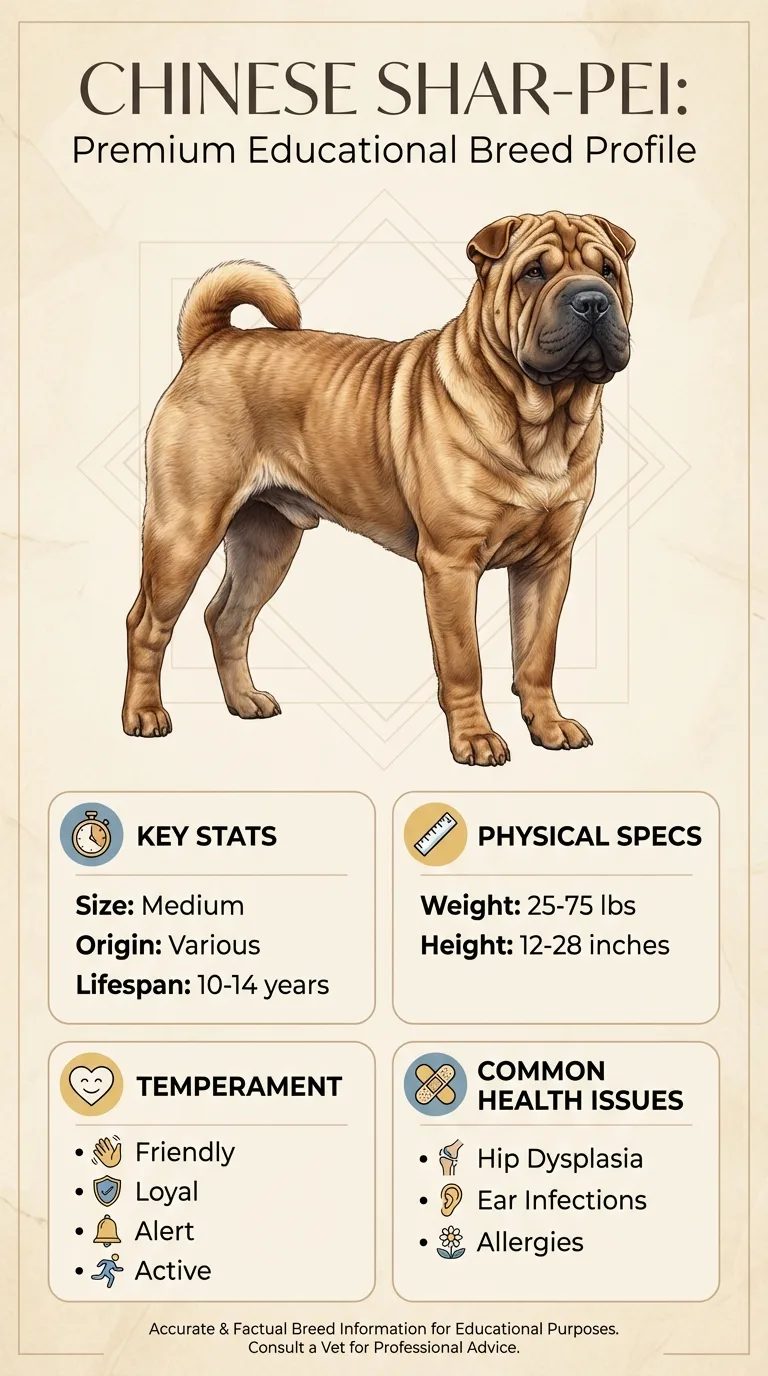
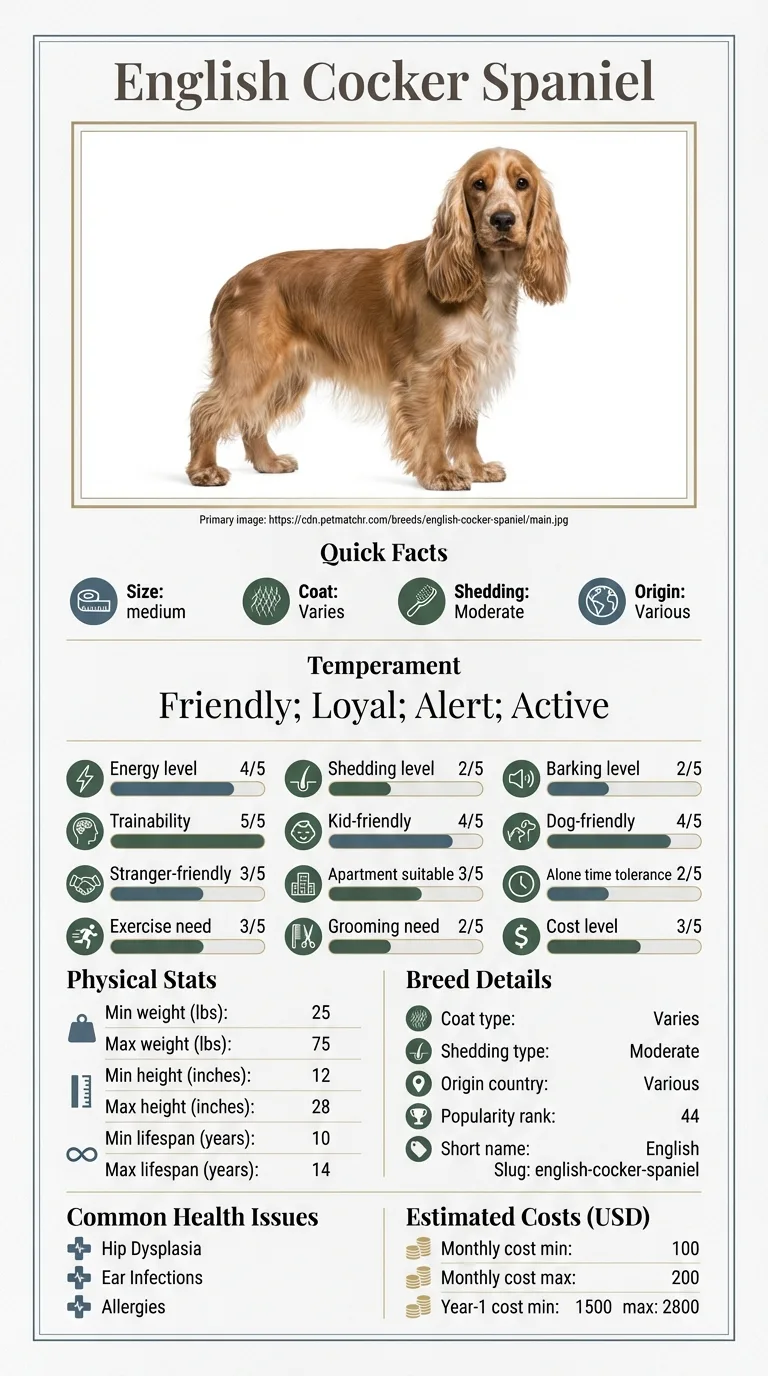
This is for someone already down to Chinese Shar-Pei and English Cocker Spaniel and deciding between them. For this pair the decision usually turns on exercise need and grooming need, so those are covered first and in most detail. Both rate 4/5 for flats, so housing does not settle this one. There is no origin story here — only what changes about your week.
Between Chinese Shar-Pei and English Cocker Spaniel, exercise need is what separates them, and Chinese Shar-Pei is the lower-effort dog of the two to keep.
Choose Chinese Shar-Pei if you do not want a standing grooming appointment, shedding is a problem in your house and your walking routine is modest.
Choose English Cocker Spaniel if this is your first dog, there are young children at home and you already have another dog.
| Feature | chinese shar pei | english cocker spaniel | Winner |
|---|---|---|---|
| Size class | medium | medium | Equal |
| Weight | 45–60 lbs | 26–34 lbs | Equal |
| Height | 18–20 in | 15–17 in | Equal |
| Lifespan | 8–12 years | 12–14 years | english cocker spaniel |
| Exercise need | Low (2/5) | High (4/5) | chinese shar pei |
| Grooming need | Low (2/5) | High (4/5) | chinese shar pei |
| Shedding | Low (2/5) | Moderate (3/5) | chinese shar pei |
| Energy level | Low (2/5) | High (4/5) | Equal |
| Barking | Low (2/5) | Moderate (3/5) | chinese shar pei |
| Apartment suitability | High (4/5) | High (4/5) | Equal |
| Good for first-time owners | Low (2/5) | High (4/5) | english cocker spaniel |
| Tolerates being alone | Moderate (3/5) | Low (2/5) | chinese shar pei |
| Trainability | Low (2/5) | High (4/5) | english cocker spaniel |
| Good with kids | Moderate (3/5) | Very high (5/5) | english cocker spaniel |
| Good with other dogs | Low (2/5) | High (4/5) | english cocker spaniel |
| Friendly to strangers | Low (2/5) | High (4/5) | english cocker spaniel |
| Cost level | High (4/5) | Moderate (3/5) | english cocker spaniel |
| Coat | Short and harsh | Medium, silky and feathered | Equal |
| Origin | Various | Various | Equal |
| Typical monthly cost | $100–$200 | $100–$200 | Equal |
| Typical first-year cost | $1,400–$2,900 | $1,400–$2,900 | Equal |
Despite the similar-sounding names, the English Cocker Spaniel and American Cocker Spaniel aren't the same dog, and this English variety actually falls into the medium size class here, 26 to 34 pounds and 15 to 17 inches, still lighter than the Chinese Shar-Pei's 45-to-60-pound, 18-to-20-inch frame but with a leaner, more athletic build suited to fieldwork. The Shar-Pei carries its weight in a dense, low, wrinkled package, while the English Cocker Spaniel has the longer legs and lighter frame typical of a sporting gundog. The size gap is real but less extreme than some other matchups on this site — both are comfortably medium-to-moderate dogs rather than occupying opposite ends of the scale.
The English Cocker Spaniel rates high (4/5) for both exercise need and energy level, a substantial step up from the Chinese Shar-Pei's low (2/5) on each measure. Bred as a flushing gundog, the English Cocker Spaniel genuinely wants daily activity — long walks, retrieving games, or scent work — to match its energetic, merry temperament, while the Shar-Pei is content with a shorter outing and a calmer pace. Owners drawn to an active lifestyle who want a dog that will happily join a run or a hike should find the English Cocker Spaniel a much better match than the Shar-Pei, which fits more naturally into a household with a slower daily rhythm.
Coat care splits clearly in the Shar-Pei's favor: its short, harsh coat needs only low (2/5) grooming and produces low (2/5) shedding, while the English Cocker Spaniel's medium, silky, feathered coat pushes grooming to high (4/5) and shedding to moderate (3/5). That feathered coat around the ears, chest, and legs needs regular brushing to prevent tangles, and many owners opt for periodic professional trims to keep it manageable. The Shar-Pei's coat, by contrast, is essentially wash-and-go. Anyone weighing the two breeds primarily on grooming time should expect the English Cocker Spaniel to demand noticeably more weekly upkeep than the low-maintenance Shar-Pei.
Both breeds tie at high (4/5) for apartment suitability, so raw space requirements won't decide this one. Barking runs moderate (3/5) for the English Cocker Spaniel against low (2/5) for the Shar-Pei, a small edge to the quieter Shar-Pei. The bigger practical concern is alone time: the English Cocker Spaniel rates low (2/5) for tolerating solitude, below the Shar-Pei's moderate (3/5), meaning it's more prone to distress during long stretches alone despite its otherwise easygoing, merry temperament. Combined with its high exercise needs, an apartment-bound English Cocker Spaniel left alone all day without a walk first is a tougher situation than the lower-energy Shar-Pei in the same spot.
The English Cocker Spaniel rates high (4/5) for both trainability and first-time-owner suitability, its biddable, eager temperament making it responsive to structured training sessions. The Chinese Shar-Pei rates low (2/5) on both, its independent, reserved nature requiring more patience and experience to train consistently. A new owner hoping for a dog that picks up commands with minimal frustration will likely find the English Cocker Spaniel far more forgiving, while someone choosing the Shar-Pei should be prepared for a slower process and possibly professional guidance, especially given its lower first-time-owner suitability score.
The English Cocker Spaniel rates very high (5/5) with kids, high (4/5) with other dogs, and high (4/5) with strangers — among the strongest family-fit scores on this site — powered by a merry, affectionate, biddable temperament built for close companionship. The Chinese Shar-Pei trails on every measure, moderate (3/5) with kids, low (2/5) with other dogs, and low (2/5) with strangers, consistent with its reserved, independent character. Families with young children, other pets, or a busy social calendar will generally find the English Cocker Spaniel the more natural fit, while the Shar-Pei suits owners looking for a calmer, more one-on-one companion rather than an instantly social family dog.
Lifespans are close, 12 to 14 years for the English Cocker Spaniel versus 8 to 12 for the Chinese Shar-Pei, giving the spaniel a meaningful longevity edge. Its five flagged conditions — ear infections, progressive retinal atrophy, hip dysplasia, familial nephropathy, and adult-onset neuropathy — include two conditions with a genetic component specific to the breed, familial nephropathy and adult-onset neuropathy, worth asking a breeder about directly. The Shar-Pei's own five-item list — skin fold dermatitis, entropion, familial Shar-Pei fever, hypothyroidism, and ear infections, a condition both breeds share — centers on its wrinkled skin. English Cocker Spaniel owners should also watch those long ears for infection given the breed's floppy, feathered ear shape.
Cost figures land almost identically here: both breeds carry moderate-to-high cost ratings with the Chinese Shar-Pei at high (4/5) versus the English Cocker Spaniel at moderate (3/5), yet the actual dollar ranges match exactly — $100 to $200 monthly and $1,400 to $2,900 in the first year for both. That parity is unusual on this site, where size differences typically create a cost gap. Given the English Cocker Spaniel's higher grooming needs, its costs may lean more toward coat maintenance, while the Shar-Pei's spending likely goes toward its higher overall cost-level rating tied to general upkeep and skin-fold care.
Chinese Shar-Pei weighs 45–60 lbs and lives 8–12 years; English Cocker Spaniel weighs 26–34 lbs and lives 12–14 years. The two diverge most on exercise need, grooming need and energy level and 5 other rated axes. Almost every rated axis separates them at least slightly. Where the table declares a winner it means less work for the owner, nothing more; descriptive rows are left as ties on purpose. The value here is in the differences between the two columns; treat any single score as approximate.

The Chinese Shar-Pei, rated low (2/5) versus the English Cocker Spaniel's moderate (3/5).
Yes, it rates very high (5/5) with kids, the strongest score on this comparison, versus the Shar-Pei's moderate (3/5).
The English Cocker Spaniel, rated high (4/5) for exercise need versus the Shar-Pei's low (2/5).
The English Cocker Spaniel, rated high (4/5) for first-time-owner suitability versus the Shar-Pei's low (2/5).
They're essentially identical — both run $100-$200 monthly and $1,400-$2,900 in the first year, despite differing size and grooming needs.
The English Cocker Spaniel, with a 12-to-14-year lifespan versus the Shar-Pei's 8-to-12 years.
Familial nephropathy and adult-onset neuropathy both appear on its health list alongside more common concerns like ear infections and hip dysplasia.
The English Cocker Spaniel, rated high (4/5) versus the Shar-Pei's low (2/5).
The Chinese Shar-Pei, rated low (2/5) versus the English Cocker Spaniel's high (4/5).
The Chinese Shar-Pei, rated moderate (3/5) versus the English Cocker Spaniel's low (2/5).
The English Cocker Spaniel, rated high (4/5) versus the Shar-Pei's low (2/5).
Secure checkout on Stripe. We never see your card.
7-day money-back guarantee. Instant access.
Health information here is general and is not veterinary advice. If your dog shows pain, sudden behaviour change, or worsening symptoms, consult a licensed veterinarian.
Some links on this site are affiliate links. We may earn a commission at no extra cost to you, and we only suggest products we believe are helpful for dog owners.
We research and check what we publish, but we do not warrant that any figure, date, price, or statement is accurate, complete, or current, and we accept no liability for any loss, cost, injury, or other harm arising from the use of this site. Use it as one reference among several. You remain responsible for your own decisions and for your dog's care - confirm anything that matters with a licensed veterinarian or another qualified professional before you act on it. Full disclaimer.
Match your lifestyle to the right dog.
Take quizNot sure which breed is right for you? Take our 2-minute quiz to find out.
Take the quiz