Living
Which is the bigger dog?
The Shar-Pei, at 45-60 lbs versus the Jack Russell's 13-17 lbs.

Quick answer
Which is the bigger dog?
The Shar-Pei, at 45-60 lbs versus the Jack Russell's 13-17 lbs.
Chinese Shar-Pei or Jack Russell Terrier? On paper they differ most on exercise need, and on the scales Chinese Shar-Pei is the heavier at 45–60 lbs. Here is how the two compare on everything that shapes an ordinary week.
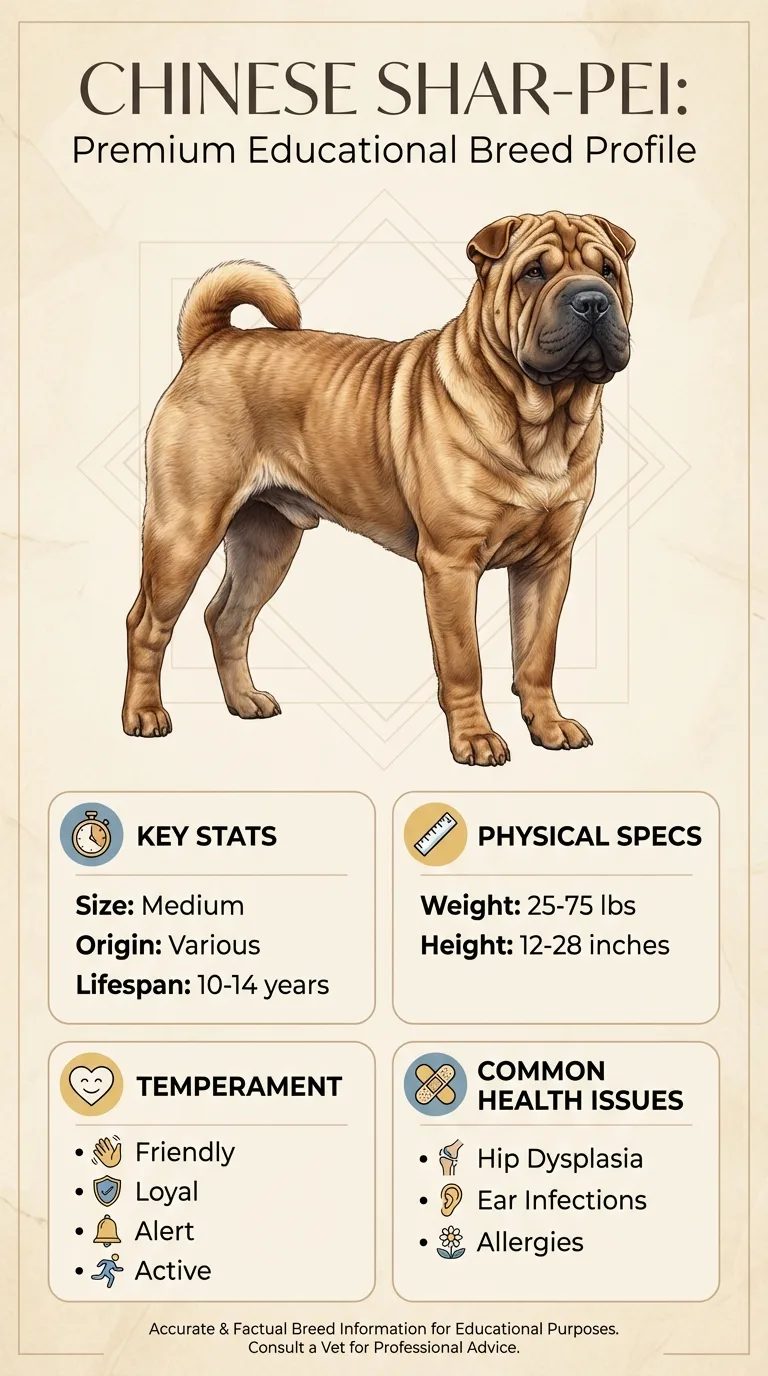
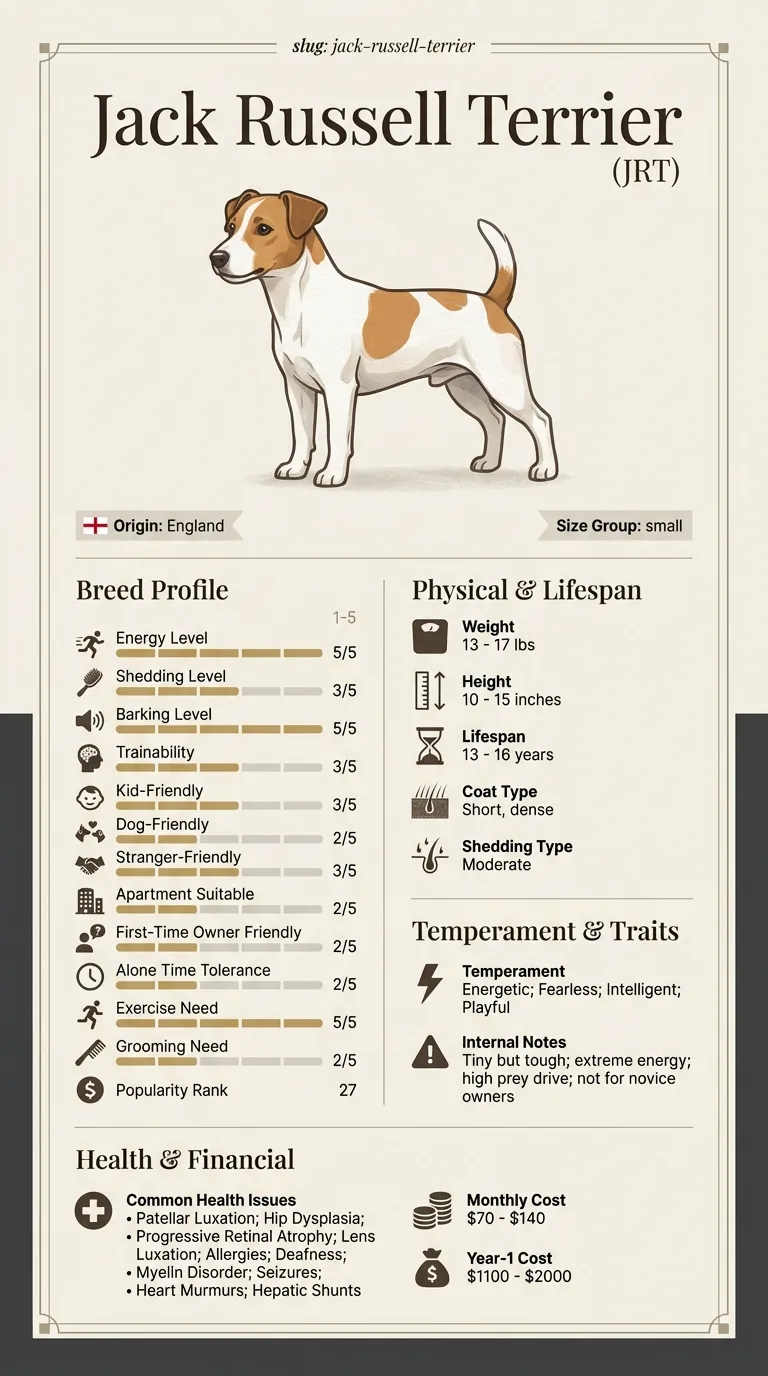
This is for someone already down to Chinese Shar-Pei and Jack Russell Terrier and deciding between them. For this pair the decision usually turns on exercise need and energy level, so those are covered first and in most detail. Anyone choosing from a flat has a clear answer here: Chinese Shar-Pei rates 4/5 against 2/5. It is written for the decision rather than the breed history.
Between Chinese Shar-Pei and Jack Russell Terrier, exercise need is what separates them, and Chinese Shar-Pei is the lower-effort dog of the two to keep.
Choose Chinese Shar-Pei if you are in a flat or a smaller home, shedding is a problem in your house and your walking routine is modest.
Choose Jack Russell Terrier if you want a dog that picks up training quickly, a smaller dog suits your car, your home or your back and you want a dog that can keep up with an active routine.
| Feature | chinese shar pei | jack russell terrier | Winner |
|---|---|---|---|
| Size class | medium | small | Equal |
| Weight | 45–60 lbs | 13–17 lbs | Equal |
| Height | 18–20 in | 10–15 in | Equal |
| Lifespan | 8–12 years | 13–16 years | jack russell terrier |
| Exercise need | Low (2/5) | Very high (5/5) | chinese shar pei |
| Grooming need | Low (2/5) | Low (2/5) | Equal |
| Shedding | Low (2/5) | Moderate (3/5) | chinese shar pei |
| Energy level | Low (2/5) | Very high (5/5) | Equal |
| Barking | Low (2/5) | Very high (5/5) | chinese shar pei |
| Apartment suitability | High (4/5) | Low (2/5) | chinese shar pei |
| Good for first-time owners | Low (2/5) | Low (2/5) | Equal |
| Tolerates being alone | Moderate (3/5) | Low (2/5) | chinese shar pei |
| Trainability | Low (2/5) | Moderate (3/5) | jack russell terrier |
| Good with kids | Moderate (3/5) | Moderate (3/5) | Equal |
| Good with other dogs | Low (2/5) | Low (2/5) | Equal |
| Friendly to strangers | Low (2/5) | Moderate (3/5) | jack russell terrier |
| Cost level | High (4/5) | Low (2/5) | jack russell terrier |
| Coat | Short and harsh | Short, dense | Equal |
| Origin | Various | England | Equal |
| Typical monthly cost | $100–$200 | $70–$140 | Equal |
| Typical first-year cost | $1,400–$2,900 | $1,100–$2,000 | Equal |
The Jack Russell Terrier is a small breed through and through, 13-17 lbs and 10-15 inches, dwarfed by the Shar-Pei's medium-class 45-60 lbs and 18-20 inches -- a fully grown Shar-Pei can outweigh a Jack Russell by three to four times. Despite its small frame, the Jack Russell's Fearless, Energetic reputation gives it an outsized presence that belies its size, a terrier trait that often surprises new owners expecting a small dog to act small. The Shar-Pei's compact but dense-boned build carries far more physical mass, meaning the size gap here is really as much about weight and muscle as it is about height.
The Jack Russell Terrier rates Very high (5/5) on exercise need, matching its Very high energy level and Energetic, Playful temperament -- this is a breed bred to work tirelessly, and it shows. The Shar-Pei's Low (2/5) exercise need sits at the complete opposite end of the scale, making this one of the widest exercise gaps in the entire comparison set despite both dogs sharing a similar overall size range. A Jack Russell denied sufficient outlet for its energy is famous for channeling it into digging, chewing, or relentless barking, while the Shar-Pei's Calm, Independent disposition means a quiet day genuinely satisfies it.
Grooming ties at Low (2/5) for both breeds, but shedding favors the Shar-Pei, rated Low (2/5) against the Jack Russell's Moderate (3/5) despite the terrier's short, dense coat. Neither breed demands intensive coat care, but the Jack Russell's coat sheds more noticeably year-round than its short length would suggest, while the Shar-Pei's harsh coat sheds less but comes with the added task of keeping its skin folds clean and dry. For households prioritizing minimal loose hair specifically, the Shar-Pei has a modest edge, even though both breeds are genuinely easy-care on the grooming front.
This is one of the clearest noise gaps in the entire comparison: the Jack Russell Terrier rates Very high (5/5) on barking, the maximum score, against the Shar-Pei's Low (2/5) -- a difference any neighbor sharing a wall will notice immediately. Apartment suitability also favors the Shar-Pei, Low (2/5) for the Jack Russell against High (4/5) for the Shar-Pei, driven by the terrier's Very high exercise need and vocal tendencies. Both breeds share a Low (2/5) rating for tolerating being alone, so neither is a great fit for owners gone long hours, but the Jack Russell's added barking makes solo time more disruptive to neighbors specifically.
The Jack Russell Terrier rates Moderate (3/5) on trainability, ahead of the Shar-Pei's Low (2/5), though its Intelligent, Fearless nature can just as easily produce stubborn, willful behavior as it can quick learning -- terriers are famous for training on their own terms. Both breeds share a Low (2/5) rating for first-time owners, reflecting that neither is a truly beginner-friendly choice: the Jack Russell needs an owner who can out-persist its terrier stubbornness and match its relentless energy, while the Shar-Pei needs one comfortable with a slower, trust-based approach to obedience work.
Social scores land closer together here than in most comparisons: both breeds tie at Moderate (3/5) with kids and Low (2/5) with other dogs, reflecting that neither is an automatically easygoing family dog. The Jack Russell edges ahead on strangers, Moderate (3/5) against the Shar-Pei's Low (2/5), consistent with its Playful, outgoing terrier personality even as its Fearless streak can mean confrontations with unfamiliar dogs. Families considering either breed should plan for supervised introductions with kids and other pets regardless of which dog they choose, since neither the Jack Russell's terrier drive nor the Shar-Pei's Reserved wariness makes for an automatically low-effort household fit.
Both breeds share a similar longevity edge over the Shar-Pei's own life stage curve, with the Jack Russell reaching 13-16 years against the Shar-Pei's 8-12 -- a meaningful longevity difference despite their similar smaller-to-medium sizes. The Jack Russell's ten flagged conditions include patellar luxation, hip dysplasia, progressive retinal atrophy, lens luxation, allergies, deafness, myelin disorder, seizures, heart murmurs, and hepatic shunts, a list skewed toward neurological and eye issues common in terrier lines. None of these directly overlap the Shar-Pei's five conditions -- skin fold dermatitis, entropion, Familial Shar-Pei Fever, hypothyroidism, and ear infections -- making this one of the few pairs in this batch with essentially no shared health risks.
The Jack Russell Terrier is notably the budget option here, rated Low (2/5) on cost level against the Shar-Pei's High (4/5), with a monthly cost of just $70-$140 and a first-year cost of $1,100-$2,000 -- both meaningfully below the Shar-Pei's $100-$200 and $1,400-$2,900. The gap reflects the Jack Russell's smaller size, simpler coat care, and generally lower veterinary costs relative to the Shar-Pei's specialized skin-fold maintenance and higher ear-infection risk. For budget-conscious buyers who can meet a terrier's substantial exercise demands, the Jack Russell is the meaningfully cheaper breed to own across nearly every cost category tracked here.
Chinese Shar-Pei weighs 45–60 lbs and lives 8–12 years; Jack Russell Terrier weighs 13–17 lbs and lives 13–16 years. The two diverge most on exercise need, energy level and barking and 2 other rated axes. They are level on good with other dogs, good for first-time owners and grooming need, so those cannot decide it. In the table, a "winner" means easier for an ordinary household — not better. Size, coat and origin are recorded without a verdict. Because both breeds are scored the same way, the gaps are reliable even where the absolute numbers are rough.

The Jack Russell Terrier, rated Very high (5/5) on barking, the maximum score, against the Shar-Pei's Low (2/5).
The Jack Russell Terrier, rated Low (2/5) on cost level with a first-year cost of $1,100-$2,000, against the Shar-Pei's High (4/5) and $1,400-$2,900.
The Jack Russell Terrier by far, rated Very high (5/5) versus the Shar-Pei's Low (2/5).
Essentially no -- their flagged conditions don't overlap at all, with the Jack Russell prone to neurological and eye issues and the Shar-Pei to skin and ear conditions.
The Jack Russell Terrier, typically 13-16 years compared to the Shar-Pei's 8-12 years.
Not really -- both rate Low (2/5) for first-time owners, the Jack Russell for its stubborn energy and the Shar-Pei for its independent, reserved nature.
Neither scores well -- both tie at Low (2/5) with other dogs, so early socialization matters for either choice.
The Shar-Pei, at 45-60 lbs versus the Jack Russell's 13-17 lbs.
The Shar-Pei, rated Low (2/5) on barking against the Jack Russell's Very high (5/5).
The Shar-Pei, rated High (4/5) on apartment suitability versus the Jack Russell's Low (2/5).
The Jack Russell Terrier, with a first-year cost of $1,100-$2,000 versus the Shar-Pei's $1,400-$2,900.
Secure checkout on Stripe. We never see your card.
7-day money-back guarantee. Instant access.
Health information here is general and is not veterinary advice. If your dog shows pain, sudden behaviour change, or worsening symptoms, consult a licensed veterinarian.
Some links on this site are affiliate links. We may earn a commission at no extra cost to you, and we only suggest products we believe are helpful for dog owners.
We research and check what we publish, but we do not warrant that any figure, date, price, or statement is accurate, complete, or current, and we accept no liability for any loss, cost, injury, or other harm arising from the use of this site. Use it as one reference among several. You remain responsible for your own decisions and for your dog's care - confirm anything that matters with a licensed veterinarian or another qualified professional before you act on it. Full disclaimer.
Match your lifestyle to the right dog.
Take quizNot sure which breed is right for you? Take our 2-minute quiz to find out.
Take the quiz