Training
Which is more trainable?
The Labradoodle, rated Very high (5/5) against the Shar-Pei's Low (2/5).

Quick answer
Which is more trainable?
The Labradoodle, rated Very high (5/5) against the Shar-Pei's Low (2/5).
Chinese Shar-Pei or Labradoodle? On paper they differ most on exercise need, and on the scales Chinese Shar-Pei is the heavier at 45–60 lbs. Here is how the two compare on everything that shapes an ordinary week.
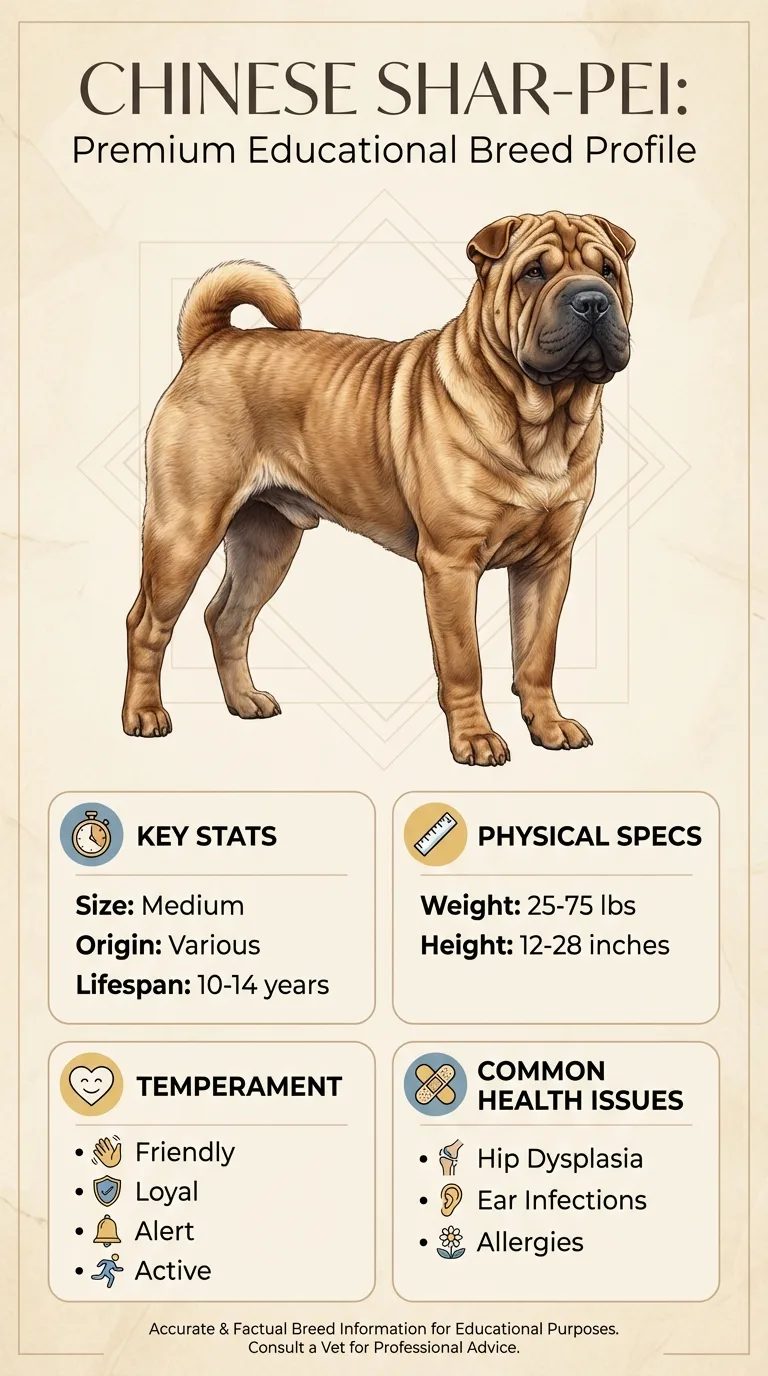
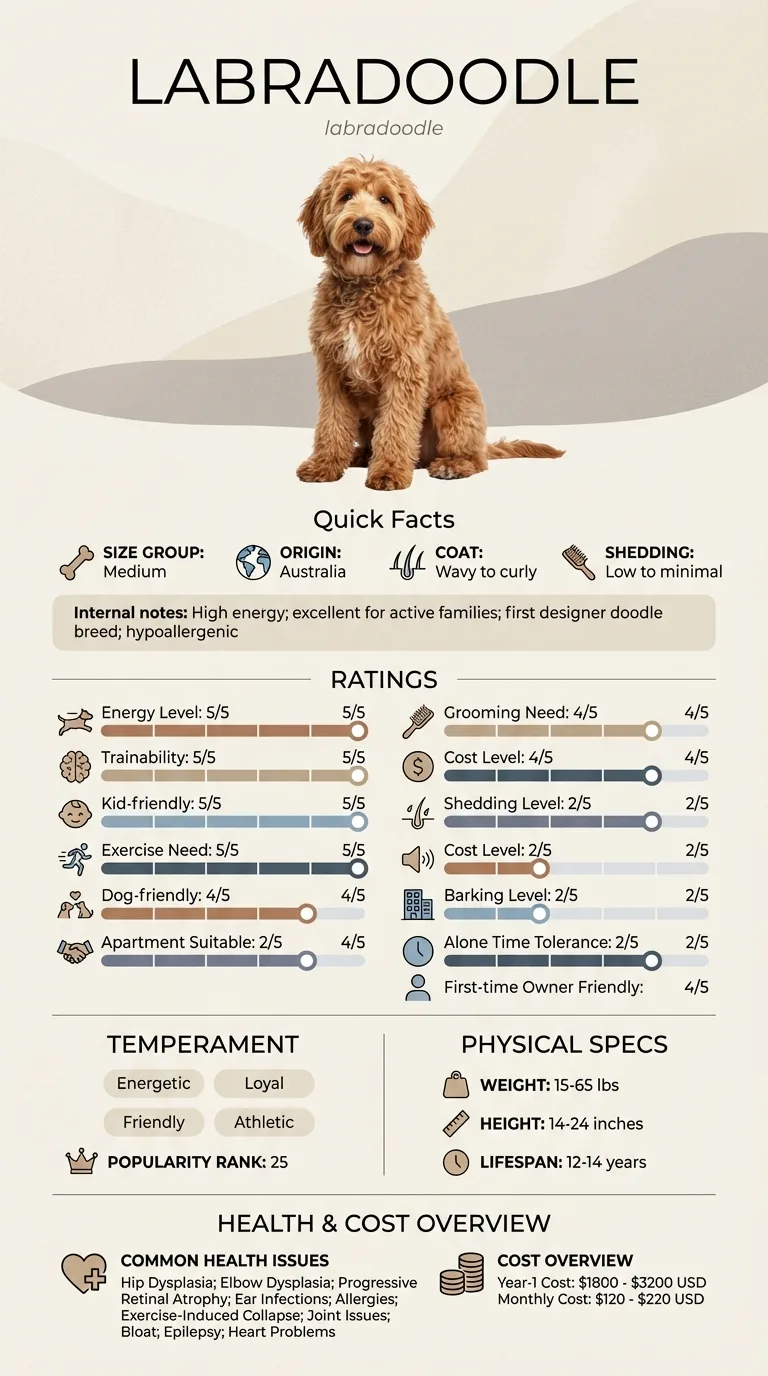
This is for someone already down to Chinese Shar-Pei and Labradoodle and deciding between them. For this pair the decision usually turns on exercise need and energy level, so those are covered first and in most detail. Anyone choosing from a flat has a clear answer here: Chinese Shar-Pei rates 4/5 against 2/5. The focus throughout is on daily consequences rather than breed background.
Between Chinese Shar-Pei and Labradoodle, exercise need is what separates them, and Chinese Shar-Pei is the lower-effort dog of the two to keep.
Choose Chinese Shar-Pei if you are in a flat or a smaller home, you do not want a standing grooming appointment and your walking routine is modest.
Choose Labradoodle if this is your first dog, there are young children at home and you already have another dog.
| Feature | chinese shar pei | labradoodle | Winner |
|---|---|---|---|
| Size class | medium | medium | Equal |
| Weight | 45–60 lbs | 15–65 lbs | Equal |
| Height | 18–20 in | 14–24 in | Equal |
| Lifespan | 8–12 years | 12–14 years | labradoodle |
| Exercise need | Low (2/5) | Very high (5/5) | chinese shar pei |
| Grooming need | Low (2/5) | High (4/5) | chinese shar pei |
| Shedding | Low (2/5) | Low (2/5) | Equal |
| Energy level | Low (2/5) | Very high (5/5) | Equal |
| Barking | Low (2/5) | Low (2/5) | Equal |
| Apartment suitability | High (4/5) | Low (2/5) | chinese shar pei |
| Good for first-time owners | Low (2/5) | High (4/5) | labradoodle |
| Tolerates being alone | Moderate (3/5) | Low (2/5) | chinese shar pei |
| Trainability | Low (2/5) | Very high (5/5) | labradoodle |
| Good with kids | Moderate (3/5) | Very high (5/5) | labradoodle |
| Good with other dogs | Low (2/5) | High (4/5) | labradoodle |
| Friendly to strangers | Low (2/5) | High (4/5) | labradoodle |
| Cost level | High (4/5) | High (4/5) | Equal |
| Coat | Short and harsh | Wavy to curly | Equal |
| Origin | Various | Australia | Equal |
| Typical monthly cost | $100–$200 | $120–$220 | Equal |
| Typical first-year cost | $1,400–$2,900 | $1,800–$3,200 | Equal |
Both breeds fall under the medium size class, but the Labradoodle's range is far wider -- 15-65 lbs and 14-24 inches -- spanning from small mini doodles to dogs well above the Shar-Pei's steadier 45-60 lbs and 18-20 inches. A standard-size Labradoodle at the top of that range can outweigh and outsize a Shar-Pei noticeably, while a mini Labradoodle might be half the Shar-Pei's weight, so the actual physical matchup depends heavily on which Labradoodle a buyer selects. The Shar-Pei's build stays far more predictable across the breed, dense and low-slung regardless of which individual dog a buyer meets.
The Labradoodle rates Very high (5/5) on exercise need and Very high (5/5) on energy level, driven by its Athletic, Energetic makeup that blends Labrador retrieving drive with Poodle agility. The Shar-Pei's Low (2/5) rating on both measures puts it at the opposite extreme, and its Independent, Calm nature means it won't self-generate the activity a Labradoodle needs. A Labradoodle under-exercised for even a few days tends to show it through restlessness or destructive chewing, a risk that essentially doesn't exist with the naturally low-drive Shar-Pei. Anyone drawn to the Labradoodle's Friendly personality should plan for at least an hour of vigorous activity most days.
Shedding ties at Low (2/5) for both breeds, but grooming diverges considerably: the Labradoodle's wavy-to-curly coat rates High (4/5), typically needing regular brushing and periodic professional trims to prevent matting, while the Shar-Pei's Low (2/5) grooming score reflects its short, harsh coat's minimal upkeep. The tradeoff is that the Shar-Pei's skin folds require targeted cleaning the smooth-coated Labradoodle never needs, so low grooming doesn't mean zero specialized care for the Shar-Pei owner. For households that want low shedding without the coat-care time investment, neither breed is a perfect match, but the Shar-Pei comes closer overall.
The Shar-Pei is the clearer apartment choice, rating High (4/5) on apartment suitability against the Labradoodle's Low (2/5), largely a function of the Labradoodle's Very high exercise needs rather than excess noise -- both breeds actually tie at Low (2/5) on barking. Tolerance for being alone also favors the Shar-Pei, Moderate (3/5) against the Labradoodle's Low (2/5), consistent with the Labradoodle's Friendly, people-oriented temperament that thrives on company. A Labradoodle confined to a small space without adequate daily exercise is likely to struggle regardless of how quiet it stays, making living space and lifestyle the real deciding factor here.
Trainability strongly favors the Labradoodle, rated Very high (5/5) against the Shar-Pei's Low (2/5), and the Labradoodle also rates High (4/5) for first-time owners compared to the Shar-Pei's Low (2/5) -- a meaningfully friendlier profile for someone new to dog ownership. Its Intelligent, Loyal, eager-to-please temperament, inherited from both parent breeds, makes obedience work generally straightforward. The Shar-Pei's Independent nature means training progresses more slowly and rewards patience over repetition. A first-time owner willing to commit to the Labradoodle's exercise needs will likely find its training far more forgiving than what the Shar-Pei typically offers.
The Labradoodle rates Very high (5/5) with kids, High (4/5) with other dogs, and High (4/5) with strangers, all comfortably ahead of the Shar-Pei's Moderate (3/5), Low (2/5), and Low (2/5) in the same categories. Its Friendly, Athletic temperament makes it a dog that generally welcomes chaos -- kids, guests, other pets -- rather than being unsettled by it, while the Shar-Pei's Loyal but Reserved nature tends to keep its warmth more selective. Busy, socially active households will typically find the Labradoodle the easier fit, while quieter homes with fewer moving pieces may suit the Shar-Pei's more measured temperament just as well.
The Labradoodle has a meaningful lifespan edge, 12-14 years against the Shar-Pei's 8-12. Its ten flagged conditions include hip and elbow dysplasia, progressive retinal atrophy, allergies, exercise-induced collapse, joint issues, bloat, epilepsy, and heart problems, a list that reflects both its athletic build and its mixed parentage. Ear infections is the one condition it shares with the Shar-Pei's shorter five-item list, which also includes skin fold dermatitis, entropion, Familial Shar-Pei Fever, and hypothyroidism. Notably, the Labradoodle's exercise-induced collapse is worth flagging specifically for owners planning the vigorous daily activity this breed's Very high exercise rating demands.
Both breeds tie at High (4/5) on overall cost level, and the dollar figures track closely: the Labradoodle runs $120-$220 monthly and $1,800-$3,200 in year one, against the Shar-Pei's $100-$200 and $1,400-$2,900. The Labradoodle's costs lean toward grooming appointments and higher food volume to fuel its Very high activity level, while the Shar-Pei's costs concentrate more around skin-fold maintenance and ear-infection treatment. Buyers should expect the Labradoodle to run somewhat higher overall, though neither breed qualifies as a low-cost option by this site's standards.
Chinese Shar-Pei weighs 45–60 lbs and lives 8–12 years; Labradoodle weighs 15–65 lbs and lives 12–14 years. The two diverge most on exercise need, energy level and trainability and 6 other rated axes. They are level on barking, cost level and shedding, so those cannot decide it. The table below marks a winner only where one breed is genuinely easier for a typical owner; size and origin are facts rather than merits and stay level. Ratings come from one source applied to both breeds, so they are meaningful against each other rather than as absolute scores.

The Labradoodle by a wide margin, rated Very high (5/5) versus the Shar-Pei's Low (2/5).
The Labradoodle, rated High (4/5) for first-time owners against the Shar-Pei's Low (2/5).
They tie -- both breeds rate Low (2/5) on shedding, though the Labradoodle needs considerably more grooming time to maintain its coat.
The Labradoodle, rated Very high (5/5) with children versus the Shar-Pei's Moderate (3/5).
The Labradoodle, typically 12-14 years compared to the Shar-Pei's 8-12 years.
Only one directly -- both are prone to ear infections -- though most of their other conditions differ.
The Shar-Pei, rated High (4/5) on apartment suitability against the Labradoodle's Low (2/5).
The Labradoodle, rated Very high (5/5) against the Shar-Pei's Low (2/5).
The Labradoodle, rated High (4/5) versus the Shar-Pei's Low (2/5).
The Shar-Pei, rated Low (2/5) against the Labradoodle's Very high (5/5).
The Shar-Pei, with Low (2/5) energy versus the Labradoodle's Very high (5/5).
Secure checkout on Stripe. We never see your card.
7-day money-back guarantee. Instant access.
Health information here is general and is not veterinary advice. If your dog shows pain, sudden behaviour change, or worsening symptoms, consult a licensed veterinarian.
Some links on this site are affiliate links. We may earn a commission at no extra cost to you, and we only suggest products we believe are helpful for dog owners.
We research and check what we publish, but we do not warrant that any figure, date, price, or statement is accurate, complete, or current, and we accept no liability for any loss, cost, injury, or other harm arising from the use of this site. Use it as one reference among several. You remain responsible for your own decisions and for your dog's care - confirm anything that matters with a licensed veterinarian or another qualified professional before you act on it. Full disclaimer.
Match your lifestyle to the right dog.
Take quizNot sure which breed is right for you? Take our 2-minute quiz to find out.
Take the quiz