DogBreedCompass

Akita or Brittany: The Dog That Asks, or the Dog That Decides

The Brittany rates 5/5 with other dogs and 4/5 with strangers. The Akita rates 2/5 and 2/5. On sociability these are close to the two ends of the scale, and no amount of training moves either of them far from where it started.

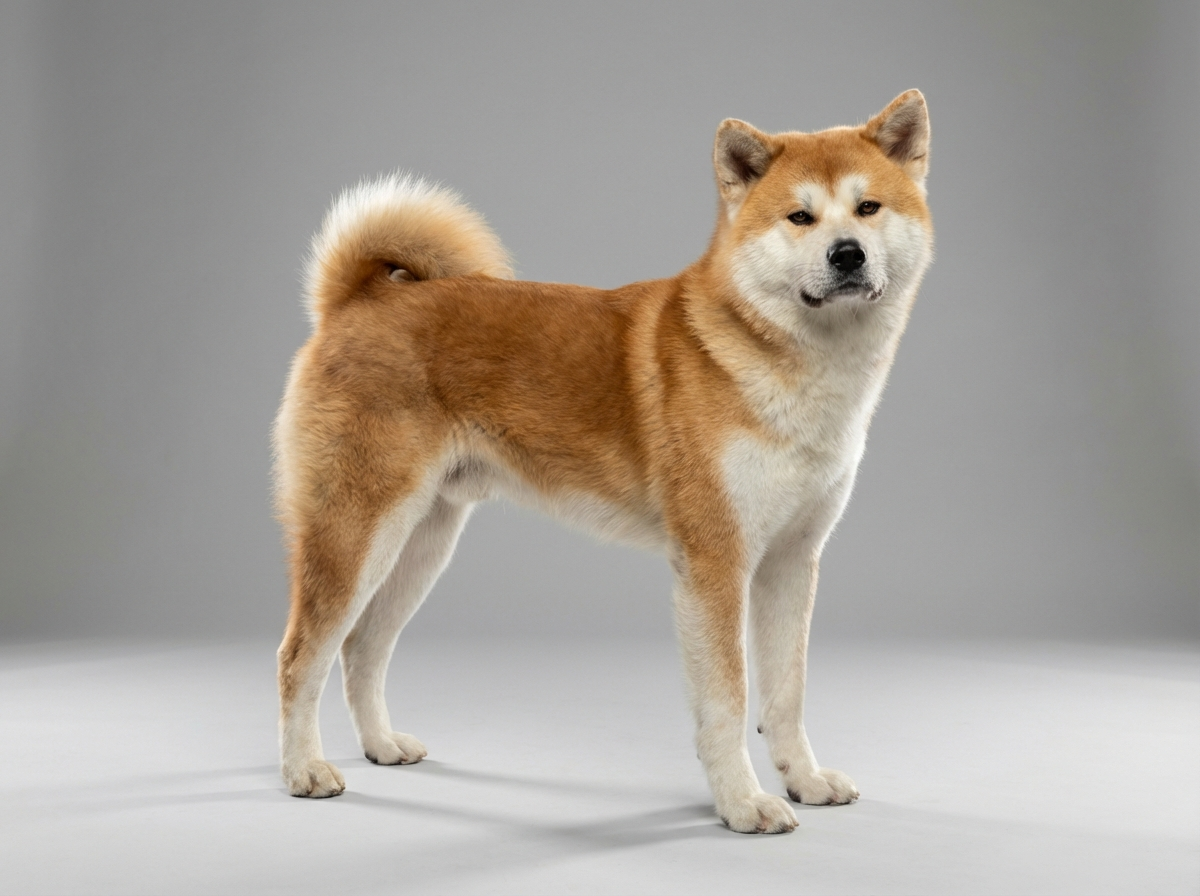
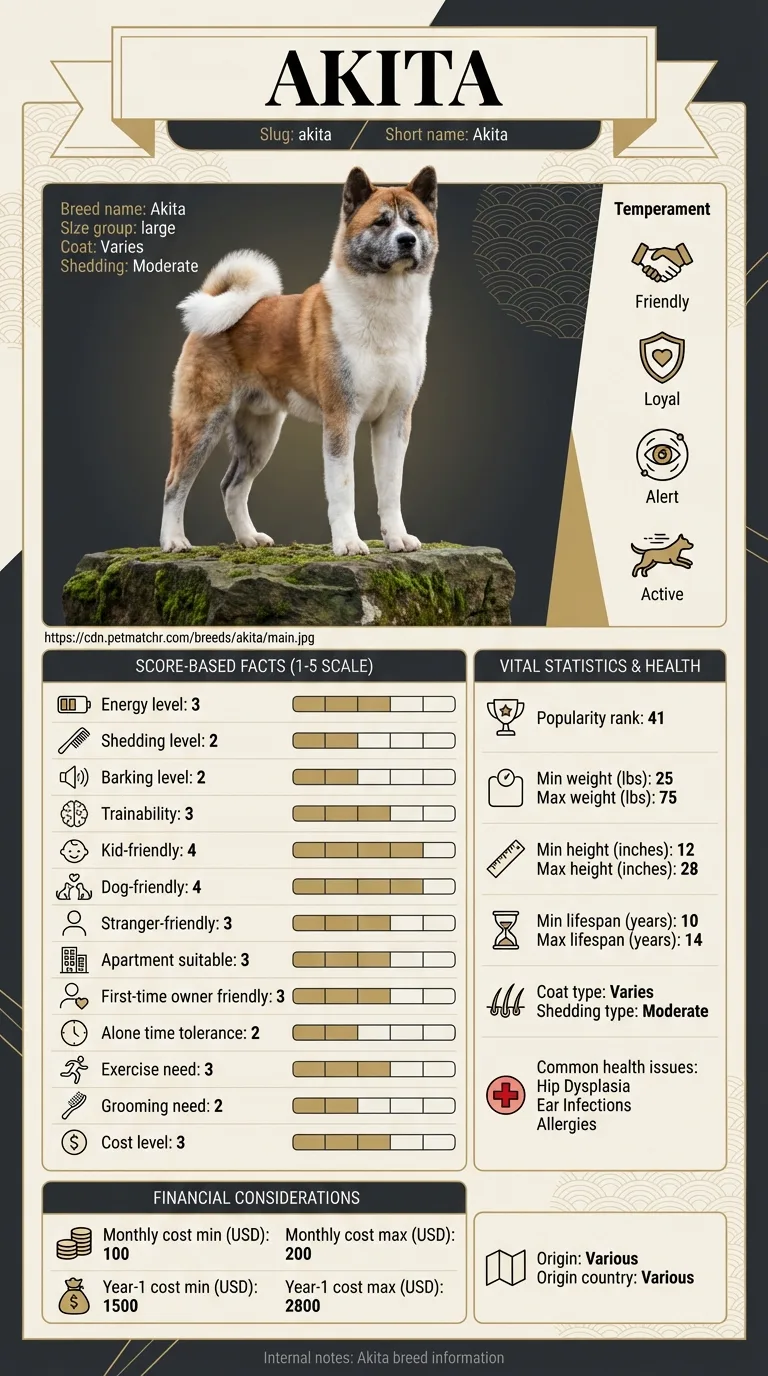
akita infographic
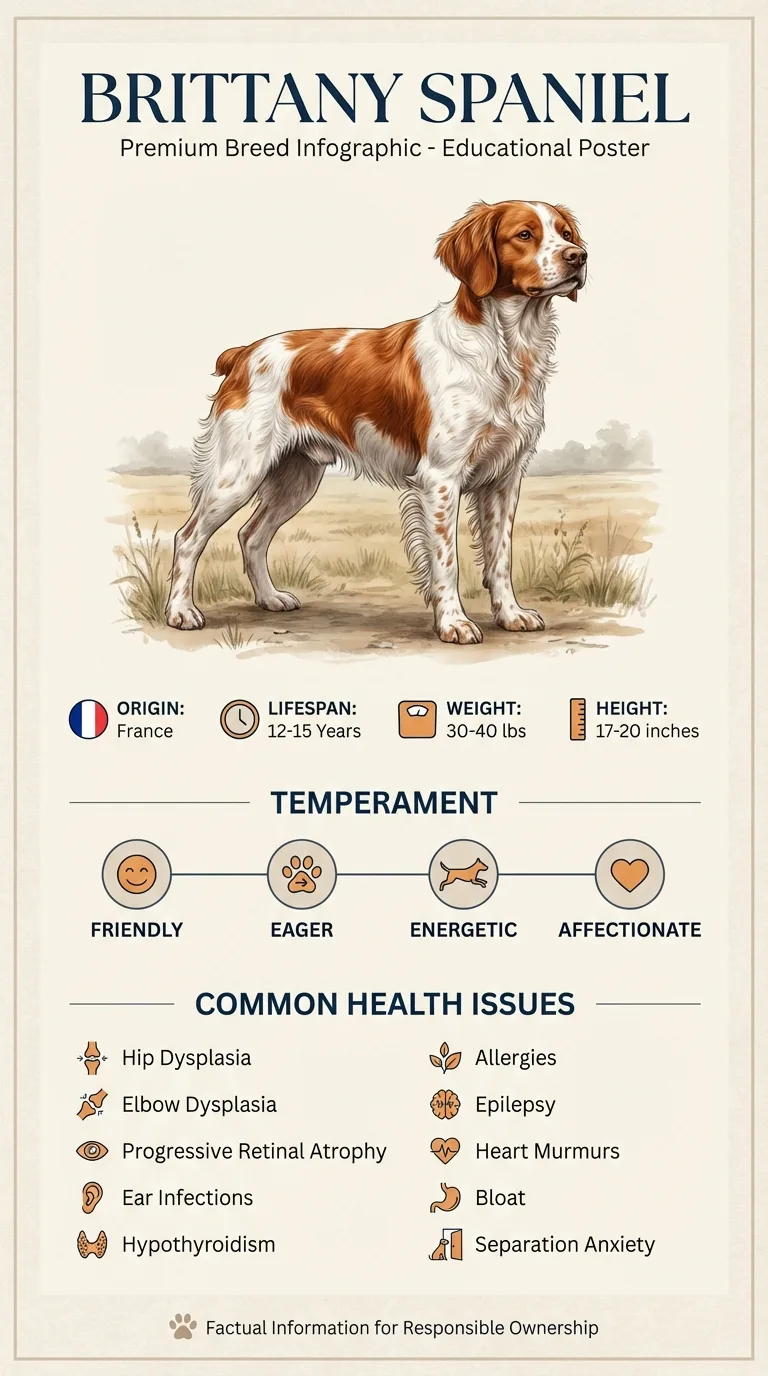
brittany infographic

This page is for someone who wants an active dog and is deciding whether that activity should be shared work or shared quiet. It covers the trainability gap, the Brittany's separation anxiety, prey drive in both breeds, size and shedding, and what each costs.

Quick verdict

The Brittany is the easier dog in almost every social and training respect but needs company and real exercise; the Akita costs you far less time and far more judgement.

Choose akita if...

Choose the Akita if the house is empty during the day and you want a quiet guardian. It rates 3/5 for exercise against the Brittany's 4/5, 3/5 for tolerating time alone against 2/5, and barks at 2/5. You are accepting 1/5 for first-time owners, 2/5 with other dogs, 5/5 shedding and up to 130 pounds.

Choose brittany if...

Choose the Brittany if someone is usually home and you want a sociable, biddable dog. It rates 5/5 for trainability, 5/5 with children and other dogs, 4/5 with strangers, and costs $90–$180 a month. You are accepting 4/5 exercise, a strong prey drive, and a breed that is genuinely prone to separation anxiety.

Head-to-head comparison

FeatureakitabrittanyWinner
Weight70–130 lbs30–40 lbsEqual
Height24–28 in17–20 inEqual
Lifespan10–13 years12–15 yearsbrittany
CoatDense double coatMedium, wavyEqual
Grooming needModerate (3/5)Low (2/5)brittany
SheddingVery high (5/5)Moderate (3/5)brittany
Energy levelModerate (3/5)High (4/5)Equal
Exercise needModerate (3/5)High (4/5)akita
TrainabilityModerate (3/5)Very high (5/5)brittany
BarkingLow (2/5)Low (2/5)Equal
Good with kidsModerate (3/5)Very high (5/5)brittany
Good with other dogsLow (2/5)Very high (5/5)brittany
Friendly to strangersLow (2/5)High (4/5)brittany
Apartment suitabilityLow (2/5)Moderate (3/5)brittany
Good for first-time ownersVery low (1/5)High (4/5)brittany
Tolerates being aloneModerate (3/5)Low (2/5)akita
Typical monthly cost$110–$240$90–$180brittany
Typical first-year cost$1,700–$3,200$1,300–$2,500brittany

Deep dive

5/5 against 3/5: cooperation versus judgement

The Brittany's 5/5 trainability comes from what it was built for. A pointing dog works at range, has to check in constantly, take direction at distance and hold position under pressure. Cooperation is not a nicety in that job; it is the job.

The practical result is a dog that is easy to teach, wants the feedback, and finds training rewarding in itself. Brittanys do well in obedience, agility, scent work and, obviously, field work.

The Akita's 3/5 is not slowness. It is independence. Guardian breeds were selected to act without a handler present, and the Akita understands a request, considers it, and arrives at a position. Positive, consistent, early work succeeds. Heavy-handed correction of a hundred-pound dog does not, and is unwise for reasons that need no explanation.

What the Akita most needs is not obedience but socialisation, sustained from eight weeks well past two years — because its dog-intolerance usually appears at social maturity, not in puppyhood.

The separation anxiety problem

Separation anxiety appears explicitly on the Brittany's condition list, which is unusual — most breed health lists are structural or systemic rather than behavioural.

It is there because the breed genuinely struggles. A dog bred to spend entire days working alongside a person does not find eight hours in an empty house neutral. The signs are the usual ones: vocalising, destruction focused on exit points, house-soiling in a clean dog, and refusing food while alone.

It is manageable — gradual absence training from the first week, a genuinely tired dog before you leave, and for many households a dog walker in the middle of the day. It is not manageable by hoping.

The Akita at 3/5 is more self-contained. It will sleep. What it will not tolerate is a fence it can see through into a neighbouring garden with a dog in it, which is a different problem and one solved with carpentry rather than behaviour work.

Exercise, prey drive and the recall question

The Brittany rates 4/5 for exercise and 4/5 for energy against the Akita's 3/5 and 3/5. In hours that is roughly ninety minutes of real activity a day against forty-five to sixty, with the Brittany's time needing to include running rather than walking.

Both breeds carry serious prey drive, which is the one behavioural trait they share. The Brittany's is a bird-finding drive — quartering ground, freezing on scent, and being extremely difficult to call off once committed. The Akita's is large-game ancestry and is more of a problem around cats and small dogs than around fields.

The recall conclusion is different for each. A Brittany can be trained to an excellent recall because 5/5 trainability makes it possible, but it needs to be proofed against live game before you trust it. An Akita's recall should be treated as conditional at all times, and a securely fenced space is not optional.

On apartments, 3/5 against 2/5. Neither is ideal; the Brittany is at least small enough to be practical.

Coat, ears and the health questions worth asking

Grooming is 2/5 for the Brittany against 3/5 for the Akita, shedding 3/5 against 5/5. The Brittany's medium wavy coat needs brushing through the feathering to keep burrs and mats out. The Akita blows a dense double coat in clumps twice a year and needs an undercoat rake through those weeks. Neither coat should be clipped.

The Brittany's drop ears are the recurring maintenance item — ear infections are on its list, and a dog that swims and works in cover needs its ears dried and checked as routine rather than when something smells wrong.

Ask a Brittany breeder about hip and elbow scores, eye testing for progressive retinal atrophy, thyroid results, and epilepsy in the line, which appears in the breed.

The Akita's burden is autoimmune and endocrine — immune-mediated disease of skin, eyes and blood, hypothyroidism, progressive retinal atrophy — plus hip dysplasia, bloat as a deep-chested breed, and a known sensitivity to some anaesthetic protocols.

What each costs to run

The Brittany runs $90–$180 a month against the Akita's $110–$240, with first-year totals of $1,300–$2,500 and $1,700–$3,200.

The gap is mostly weight. A thirty-five pound dog eats a fraction of what a hundred-pound dog eats, and parasite treatments, joint supplements and many medications are dosed and priced by body weight. Boarding is banded by size at most kennels.

The Brittany's hidden cost is time rather than money — if the household is out all day, a midday walker for a breed with separation anxiety is a recurring line item that can exceed the food difference entirely.

The Akita's hidden cost is veterinary. Autoimmune disease is expensive to diagnose and often lifelong to manage, and bloat surgery in a large deep-chested breed is a four-figure emergency.

Neither is a cheap dog, but the Brittany is the more predictable one.

Akita vs Brittany: two rows decide it

Strip out everything else and this comparison comes down to sociability and solitude.

The Brittany rates 5/5 with children, 5/5 with other dogs and 4/5 with strangers — among the most uniformly friendly profiles on this site. The Akita rates 3/5, 2/5 and 2/5. If your life involves dog parks, visiting friends, or a second dog, the Brittany is not merely easier, it is a different experience entirely.

The Akita's one clear win in that area is time alone: 3/5 against 2/5. The Brittany is a breed with separation anxiety written into its notes, and that is not a minor caveat for anyone working out of the house five days a week.

On size the gap is large — 30 to 40 pounds against 70 to 130 — and the Brittany lives longer, 12 to 15 years against 10 to 13.

Frequently asked questions

Which is easier to train, an Akita or a Brittany?

The Brittany, at 5/5 against the Akita's 3/5. It was bred as a pointing dog that works at range and checks in constantly, so cooperation is built in. The Akita is not slow — it is independent, and was selected to make decisions without a handler present. It will understand a request and then form its own view of it.

Does the Brittany really get separation anxiety?

Yes, and it is listed as a breed condition rather than an individual quirk. A dog bred to work alongside a person all day does not find an empty house neutral. Expect vocalising, destruction at doors and windows, and refusal to eat while alone. Gradual absence training from week one and a midday walker for full-time workers are the usual answers.

Which is better with other dogs?

The Brittany, overwhelmingly — 5/5 against the Akita's 2/5. Akita dog-intolerance is frequently same-sex and typically appears at social maturity around two years old, in a dog that was fine as a puppy. If you already have a dog or want off-lead park life, this row settles the comparison on its own.

How much exercise does a Brittany need?

About ninety minutes of genuine activity a day at 4/5 exercise and 4/5 energy, and it needs to include running rather than only walking. The Akita at 3/5 is content with forty-five to sixty minutes of walking. Both have strong prey drive, so where that exercise happens matters as much as how long it lasts.

Which sheds more?

The Akita at 5/5 against the Brittany's 3/5, blowing a dense double coat twice a year. Grooming is 3/5 against 2/5. The Brittany's ongoing job is brushing through the feathering to keep burrs and mats out, and drying its drop ears after swimming, since ear infections are common in the breed.

Which lives longer?

The Brittany, at 12 to 15 years against the Akita's 10 to 13. Size accounts for most of that, but the Akita's autoimmune and endocrine disease burden contributes as well. A Brittany at the top of its range will be with you five years longer than an Akita at the bottom of its.

Can I let either off the lead?

A Brittany can be trained to a reliable recall because 5/5 trainability makes it achievable, but it must be proofed around live game before you trust it in open country. An Akita's recall should be treated as conditional at all times, and secure fencing should be treated as a requirement rather than a preference.

Quick answers

View more answers
Living

Akita vs Brittany: which should I choose?

The Brittany if someone is usually home and you want a sociable, highly trainable dog. The Akita if the house is empty during the day and you want a quiet guardian, accepting a 1/5 first-time rating and 2/5 with other dogs.

Costs

How much does each cost per month?

The Akita runs $110–$240 a month and the Brittany $90–$180, with first-year totals of $1,700–$3,200 and $1,300–$2,500. Most of the gap is food and weight-dosed products.

Behavior

Which tolerates being left alone?

The Akita at 3/5 against the Brittany's 2/5. This is the Akita's clearest advantage — separation anxiety is a listed condition in the Brittany, not an occasional individual problem.

Health

What should I ask a Brittany breeder?

Hip and elbow scores, eye testing for progressive retinal atrophy, thyroid results, and whether epilepsy has appeared in the line. Ask about temperament around being left alone in the parents as well.

Related DogBreedCompass guides

  • Akita breed guideThe Akita profile covers guardian temperament and the long socialisation window the breed needs.
  • Brittany breed guideThe Brittany profile covers field drive, grooming and the breed's need for company.
  • Akita vs German Shorthaired PointerThe German Shorthaired Pointer is the breed most often cross-shopped against the Brittany.
  • Akita vs Alaskan MalamuteThe Malamute is the large northern alternative to the Akita and is far more sociable.
  • Brittany genetic disordersThe inherited conditions worth screening for before buying a Brittany puppy.
  • Akita autoimmune diseasesAutoimmune disease is the Akita's most distinctive burden and the first question for a breeder.

Related guides

Important reminder

Health information here is general and is not veterinary advice. If your dog shows pain, sudden behaviour change, or worsening symptoms, consult a licensed veterinarian.

Some links on this site are affiliate links. We may earn a commission at no extra cost to you, and we only suggest products we believe are helpful for dog owners.

Find Your Perfect Breed

Match your lifestyle to the right dog.

Take quiz

Find your match

Not sure which breed is right for you? Take our 2-minute quiz to find out.

Take the quiz