Akita or Bloodhound: Two Heavy Dogs, Two Different Jobs
Quick answer
Akita vs Bloodhound: which should I choose?
The Bloodhound if you want a gentle, sociable dog and will accept drool, ear care and no reliable recall. The Akita if you want a quiet guardian with a dry mouth and three more years of life, and will do the socialisation work.
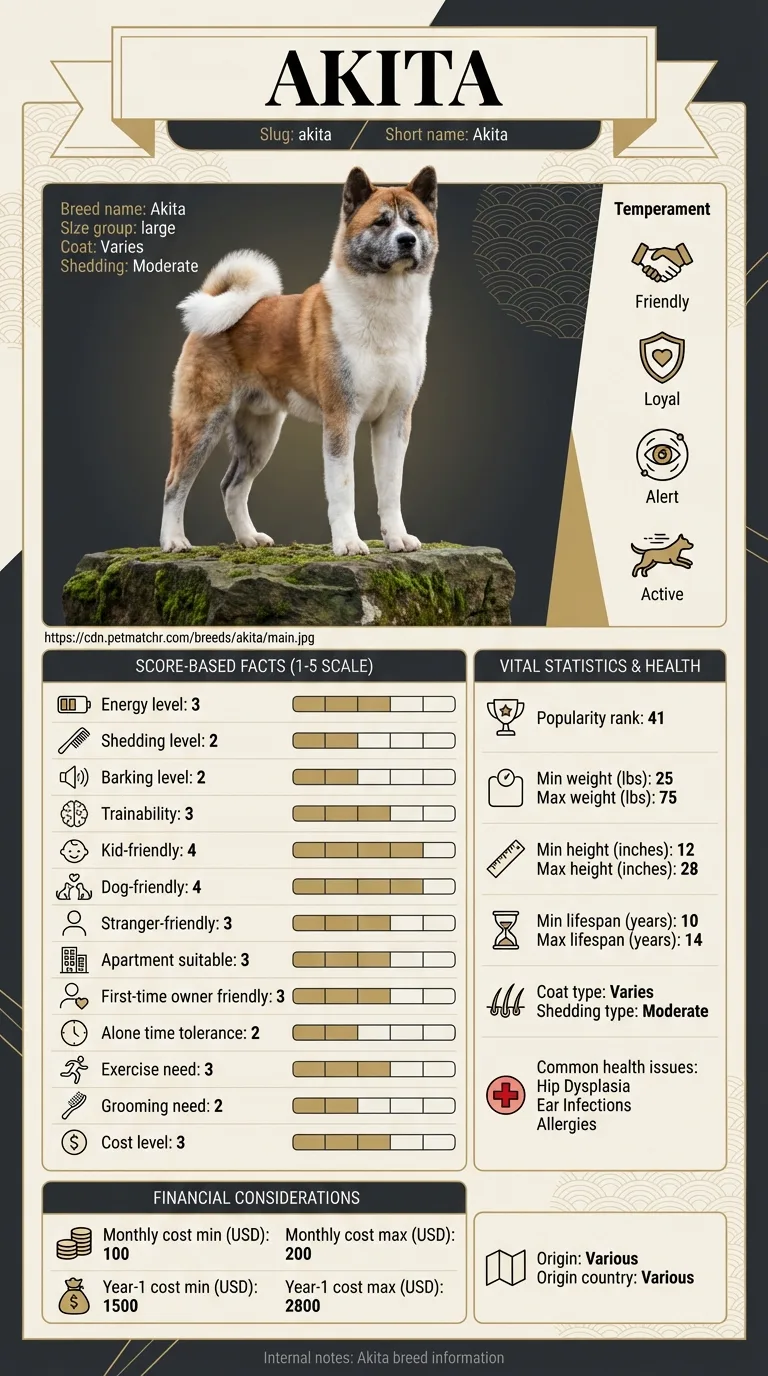
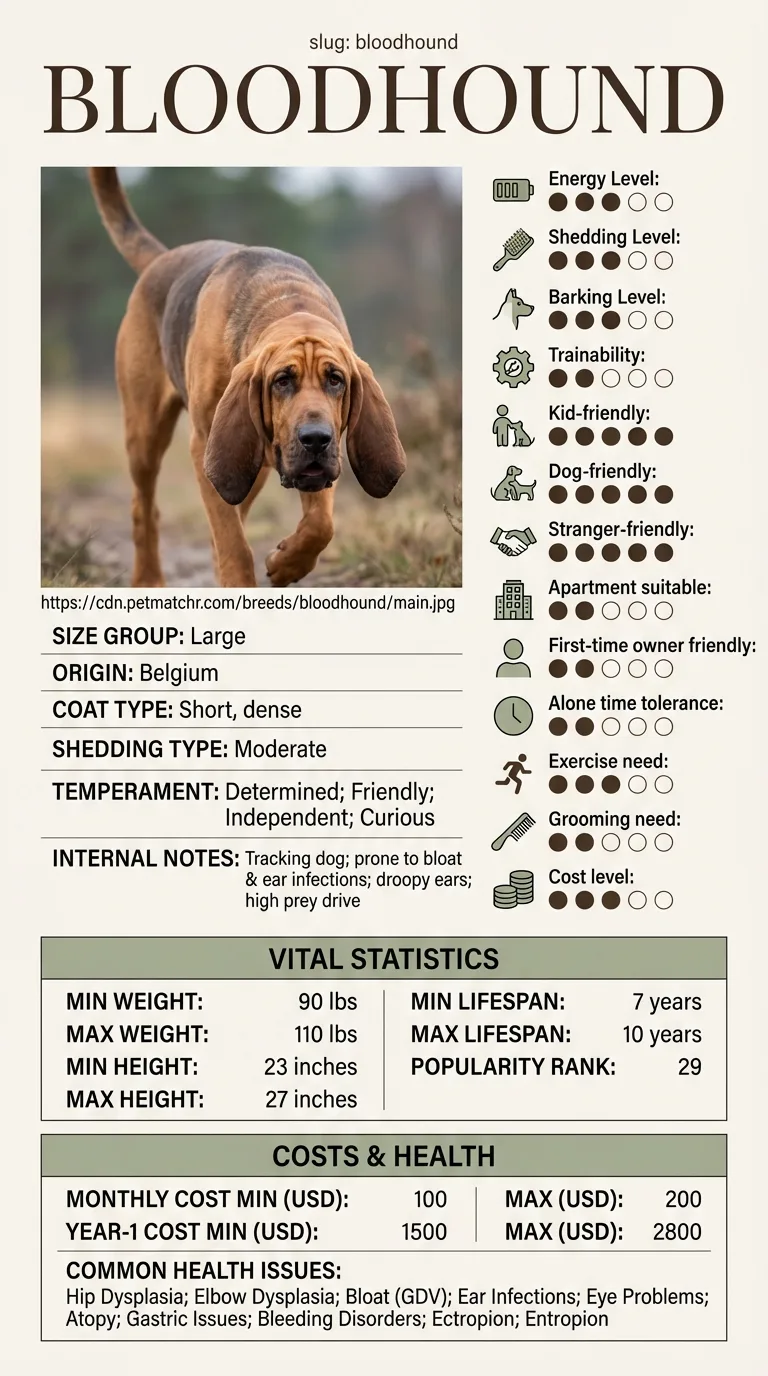
Both of these are ninety-plus-pound dogs that most households should think hard about. The Bloodhound is the friendlier by a distance — 4/5 with children, other dogs and strangers against the Akita's 3/5, 2/5 and 2/5 — but it lives only 7 to 10 years, drools relentlessly, and follows a nose you will never out-argue.
This is for someone weighing two large dogs with very different daily demands. It covers the lifespan gap, the sociability difference, what a working nose actually costs an owner, the drool and ear routine, bloat risk in both, and cost.
Quick verdict
The Bloodhound is the sociable one and the harder one to contain; the Akita is the reserved one and the easier one to live with day to day.
Choose akita if...
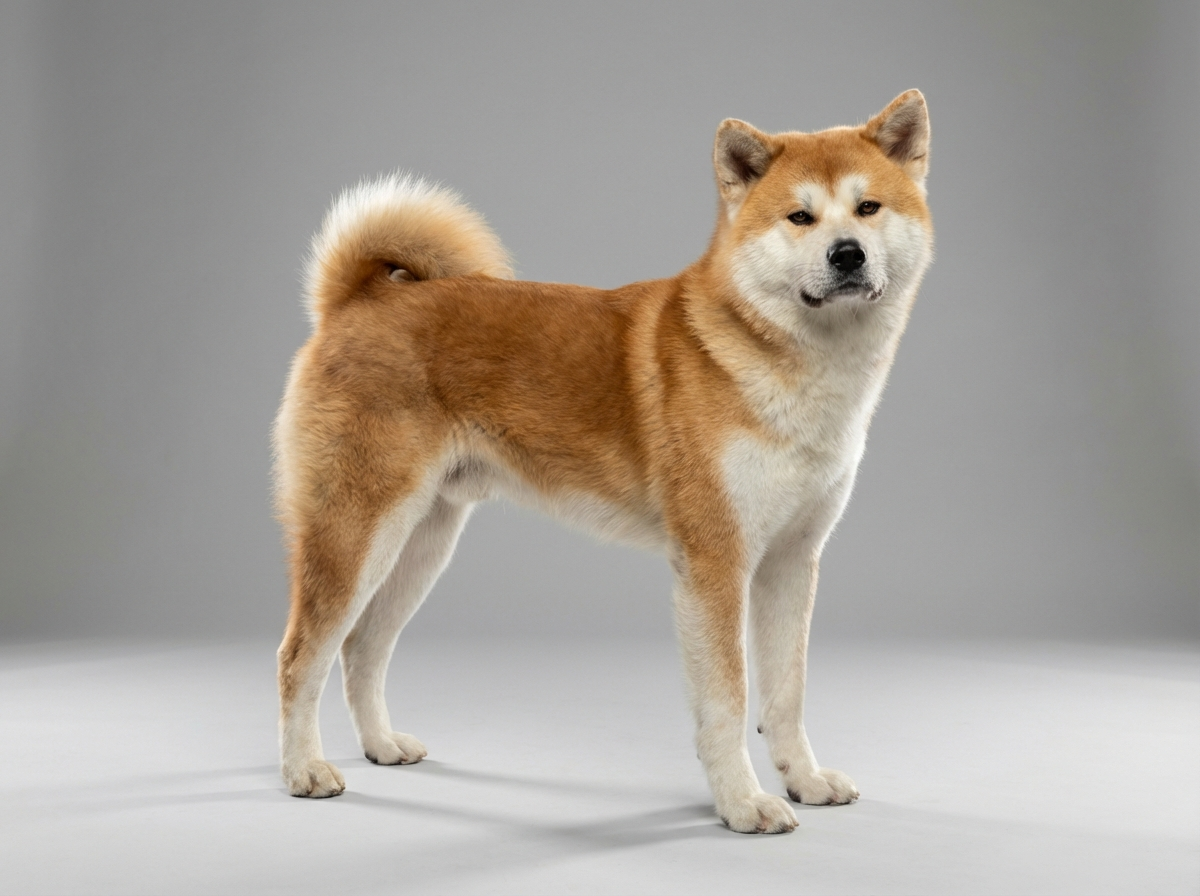
Choose the Akita if you want a guardian breed, a genuinely quiet house at 2/5 barking, a dry mouth, and three more years of life at 10 to 13 against 7 to 10. You are accepting 1/5 first-time suitability, 2/5 with strangers and other dogs, and a coat that sheds at 5/5.
Choose bloodhound if...
Choose the Bloodhound if you want a famously good-natured dog: 4/5 with children, other dogs and strangers, low grooming at 2/5, and a nose that makes tracking and scent work genuinely rewarding. Accept 7 to 10 years, constant drool, weekly ear care, 2/5 trainability, and a recall that effectively does not exist outdoors.
Head-to-head comparison
Feature
akita
bloodhound
Winner
Weight
70–130 lbs
90–110 lbs
Equal
Height
24–28 in
23–27 in
Equal
Lifespan
10–13 years
7–10 years
akita
Coat
Dense double coat
Short, dense
Equal
Grooming need
Moderate (3/5)
Low (2/5)
bloodhound
Shedding
Very high (5/5)
Moderate (3/5)
bloodhound
Energy level
Moderate (3/5)
Moderate (3/5)
Equal
Exercise need
Moderate (3/5)
Moderate (3/5)
Equal
Trainability
Moderate (3/5)
Low (2/5)
akita
Barking
Low (2/5)
Moderate (3/5)
akita
Good with kids
Moderate (3/5)
High (4/5)
bloodhound
Good with other dogs
Low (2/5)
High (4/5)
bloodhound
Friendly to strangers
Low (2/5)
High (4/5)
bloodhound
Apartment suitability
Low (2/5)
Low (2/5)
Equal
Good for first-time owners
Very low (1/5)
Low (2/5)
bloodhound
Tolerates being alone
Moderate (3/5)
Low (2/5)
akita
Typical monthly cost
$110–$240
$100–$200
bloodhound
Typical first-year cost
$1,700–$3,200
$1,500–$2,800
bloodhound
Deep dive
A nose that overrules everything
The Bloodhound's scenting ability is the most developed in dogs, to the point where trailing evidence from a properly worked Bloodhound has been accepted in court. That is not a marketing line, it is what the breed is for.
The cost of that to an owner is total. When the nose engages, the dog is gone — not in a disobedient sense but in a genuinely absorbed one. Trainability rates 2/5 for this reason, and it is not a comment on intelligence. Most Bloodhounds never have a usable recall in open ground. Fencing needs to be secure and high, a long line is the honest tool for open spaces, and a walk becomes a negotiation with whatever passed through six hours ago.
The flip side is that scent work is enormously rewarding for the breed and cheap to provide. Twenty minutes of tracking or hunting food around the garden satisfies a Bloodhound more than an hour of road walking.
The Akita at 3/5 is independent rather than absorbed. It hears you, considers, and decides — a different problem with a different solution.
The daily jobs nobody mentions before you buy
The Bloodhound's loose facial skin, heavy flews and long ears are all functional — they trap and hold scent around the nose — and all three create work.
Drool is constant and it travels. A Bloodhound shaking its head redecorates walls and ceilings, and owners keep cloths in every room. This is not an occasional inconvenience, it is the texture of daily life with the breed, and it is the single most common thing new owners underestimate.
The ears are long, heavy and poorly ventilated, and ear infections sit on the breed's condition list. Weekly cleaning and drying is a lifetime routine.
The facial folds need wiping and drying too, or the skin inside them becomes sore and infected.
Grooming rates 2/5 because the coat itself needs almost nothing — but the dog needs attention every day, just not with a brush. The Akita is the reverse: a dry-mouthed dog with tidy ears, whose 3/5 grooming is entirely about the twice-yearly coat blow.
Trailing hound against household guardian
The Bloodhound rates 4/5 with children, other dogs and strangers. Trailing hounds worked in kennels and were handled by whoever was on the search, so suspicion of people was selected out. The breed's reputation for being gentle and rather solemn with everyone is well earned, and it has essentially no guarding instinct.
It does bark and bay at 3/5, and the bay is loud and carrying — a working sound rather than a nuisance one, but neighbours notice it.
The Akita rates 3/5, 2/5 and 2/5. It assesses visitors, positions itself, and settles once satisfied. Its dog intolerance is a genuine breed trait, frequently same-sex, and typically emerges at social maturity around two years old. Deliberate socialisation makes it proportionate rather than removing it.
On time alone the Akita is the better bet at 3/5 against 2/5. A Bloodhound left alone will bay about it.
Bloat, joints, and a short life
Both are deep-chested and both carry bloat. Gastric dilatation-volvulus in a dog this size is measured in hours: unproductive retching, a hard swollen abdomen, restlessness and distress means the emergency vet immediately. For the Bloodhound in particular this is the single most likely cause of a sudden death, and many owners discuss preventive gastropexy with their vet at the time of neutering.
Both carry hip and elbow dysplasia and both should come from screened parents.
The Bloodhound additionally carries eye problems related to the loose lids — entropion and ectropion — and atopy, an allergic skin condition. Its 7 to 10 year lifespan is among the shortest here, and bloat, cancer and joint disease account for most of it.
The Akita's burden is autoimmune and endocrine: immune-mediated disease, hypothyroidism, progressive retinal atrophy, plus a known anaesthesia sensitivity worth telling any unfamiliar vet about.
Cost, and who each dog actually suits
The Bloodhound is slightly cheaper at $100–$200 a month against $110–$240, with first-year totals of $1,500–$2,800 against $1,700–$3,200. Both are large-dog budgets and neither is cheap.
The fit question is simpler than the ratings suggest. A Bloodhound suits someone who wants a gentle, sociable, undemanding-to-exercise dog and who will genuinely enjoy scent work, will keep cloths in every room, and has a garden fenced properly enough that a determined nose cannot get out.
An Akita suits someone who wants a quiet guardian, does not want drool or ear routines, and is prepared to run a socialisation programme for the first two years.
Neither belongs in a flat at 2/5, and neither is a first dog — 2/5 and 1/5 respectively.
Akita vs Bloodhound: heavy dogs, opposite social settings
On size, energy and exercise these two match almost exactly: both large, both 3/5 for energy and exercise, both 2/5 for apartments. Neither is a demanding dog to walk.
Where they part is social and structural. The Bloodhound takes children, other dogs and strangers at 4/5 each, against 3/5, 2/5 and 2/5. It also takes grooming and shedding, and costs slightly less.
The Akita takes trainability, barking, time alone, and three years of life — 10 to 13 against 7 to 10.
The rows that do not appear in the table are the ones that decide most Bloodhound ownerships: the drool, the ears, and the nose.
Akita or Bloodhound: Two Heavy Dogs, Two Different Jobs - Akita vs Bloodhound: heavy dogs, opposite social settings
Frequently asked questions
Which is friendlier, an Akita or a Bloodhound?
The Bloodhound, at 4/5 with children, other dogs and strangers against the Akita's 3/5, 2/5 and 2/5. Trailing hounds were handled by whoever was on the search and kennelled together, so suspicion was bred out. The Bloodhound has essentially no guarding instinct; the Akita's guarding instinct is the point of the breed.
Can a Bloodhound be trained to come back?
Rarely, in open ground. Trainability rates 2/5 and it is not about intelligence — when a Bloodhound's nose engages it becomes genuinely absorbed, and the recall stops working. Secure high fencing and a long line in open spaces are the practical answers. Scent work and tracking are hugely rewarding outlets and cheap to provide.
How bad is the drool?
Constant, and it travels. The heavy flews mean a Bloodhound shaking its head can mark walls and ceilings, and owners typically keep cloths in every room. It is the thing new owners most often underestimate. The Akita by comparison is a dry-mouthed breed.
Which lives longer?
The Akita, at 10 to 13 years against the Bloodhound's 7 to 10 — one of the shortest lifespans here. Bloat, cancer and joint disease account for much of the difference. Many Bloodhound owners discuss preventive gastropexy with their vet at the time of neutering for that reason.
What daily care does a Bloodhound need?
The coat needs almost nothing at 2/5 grooming, but the dog needs daily attention elsewhere: wiping drool, cleaning and drying the long ears weekly since ear infections are on its condition list, and cleaning the facial folds to prevent soreness. It is a low-brushing, high-maintenance dog.
Which sheds more?
The Akita, at 5/5 against the Bloodhound's 3/5, blowing a dense double coat in clumps twice a year and needing an undercoat rake through the moult. The Bloodhound's short coat sheds steadily at a lower volume and needs little more than a rubber mitt.
Is either suitable for a first-time owner?
Neither, though the Bloodhound at 2/5 is marginally more forgiving than the Akita at 1/5. The Bloodhound's difficulty is containment, drool and a recall that will not come; the Akita's is a guardian temperament that sharpens at maturity and needs years of deliberate socialisation.
The Bloodhound if you want a gentle, sociable dog and will accept drool, ear care and no reliable recall. The Akita if you want a quiet guardian with a dry mouth and three more years of life, and will do the socialisation work.
Costs
How much does each cost per month?
The Akita runs $110–$240 a month and the Bloodhound $100–$200, with first-year totals of $1,700–$3,200 and $1,500–$2,800.
Living
Do they need the same exercise?
Yes, both rate 3/5 for energy and exercise. The Bloodhound benefits far more from scent work than from distance — twenty minutes of tracking beats an hour of road walking.
Health
What emergency should both owners know?
Bloat. Both are deep-chested breeds carrying gastric dilatation-volvulus. Unproductive retching with a hard swollen abdomen and distress means the emergency vet immediately.
Related DogBreedCompass guides
Akita breed guide – The Akita profile covers guardian temperament and the socialisation the breed needs.
Bloodhound breed guide – The Bloodhound profile covers drool, ear care and scent work in more detail.
Basset Hound vs Bloodhound – The Basset is the other drop-eared scent hound buyers weigh, at half the weight.
Akita vs Alaskan Malamute – The Malamute is the large northern alternative to the Akita and is far more sociable.
Bloodhound anesthesia sensitivity – Anaesthesia sensitivity is worth raising with any vet who has not treated the breed.
Akita autoimmune diseases – Autoimmune disease is the Akita's most distinctive burden and the first question for a breeder.
Health information here is general and is not veterinary advice. If your dog shows pain, sudden behaviour change, or worsening symptoms, consult a licensed veterinarian.
Some links on this site are affiliate links. We may earn a commission at no extra cost to you, and we only suggest products we believe are helpful for dog owners.
We research and check what we publish, but we do not warrant that any figure, date, price, or statement is accurate, complete, or current, and we accept no liability for any loss, cost, injury, or other harm arising from the use of this site. Use it as one reference among several. You remain responsible for your own decisions and for your dog's care - confirm anything that matters with a licensed veterinarian or another qualified professional before you act on it. Full disclaimer.