Living
Which breed weighs more?
The Bloodhound, at 90-110 lbs, dwarfs the English Cocker Spaniel's 26-34 lbs.

Quick answer
Which breed weighs more?
The Bloodhound, at 90-110 lbs, dwarfs the English Cocker Spaniel's 26-34 lbs.
Bloodhound or English Cocker Spaniel? On paper they differ most on grooming need, and on the scales Bloodhound is the heavier at 90–110 lbs. Here is how the two compare on everything that shapes an ordinary week.
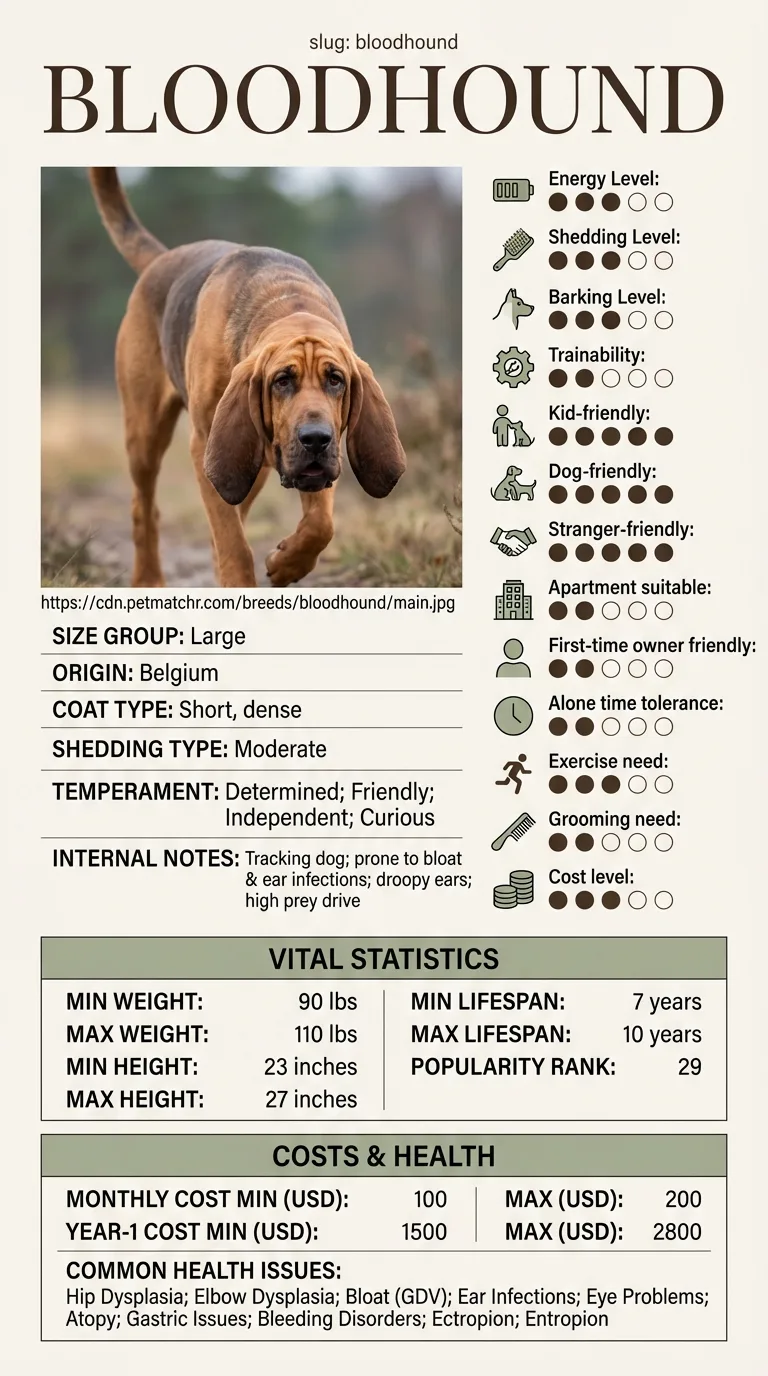
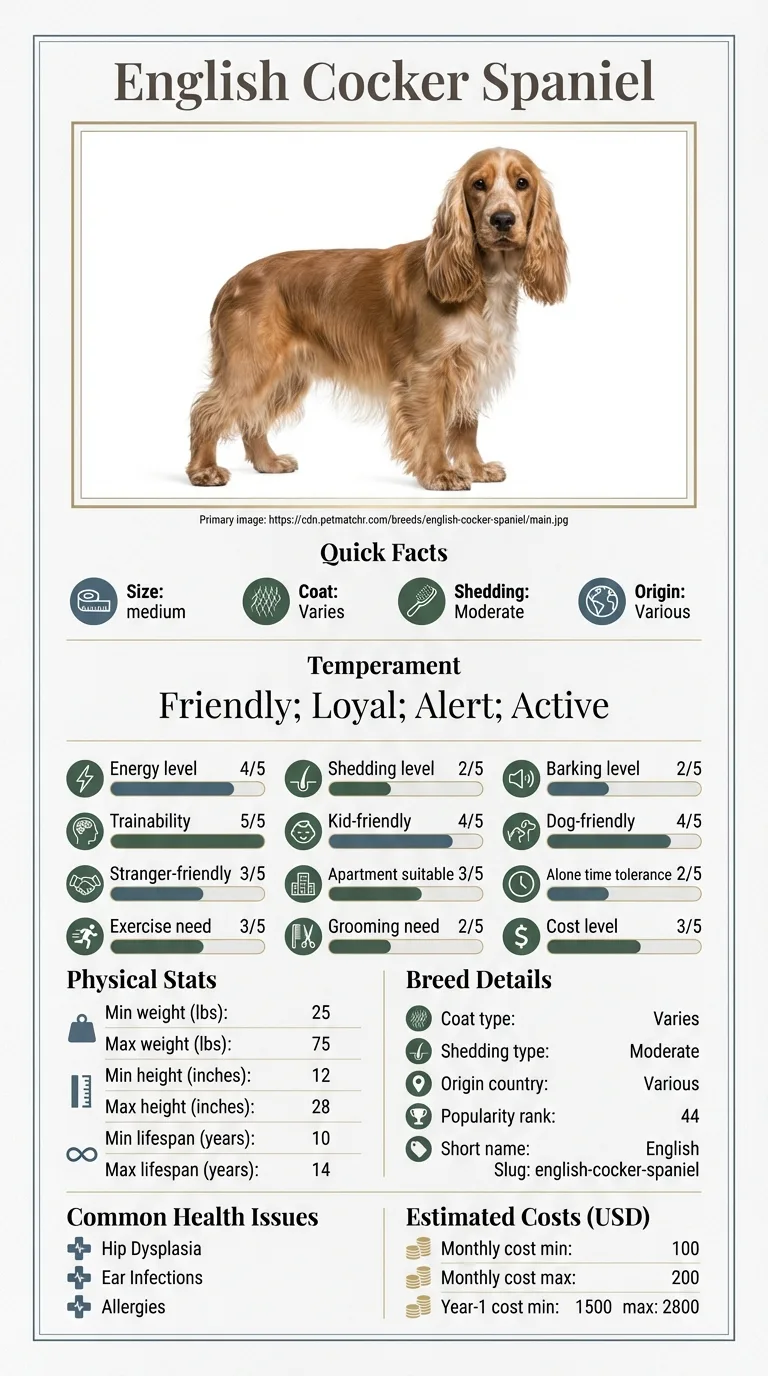
This is for someone already down to Bloodhound and English Cocker Spaniel and deciding between them. For this pair the decision usually turns on grooming need and apartment suitability, so those are covered first and in most detail. Anyone choosing from a flat has a clear answer here: English Cocker Spaniel rates 4/5 against 2/5. It is written for the decision rather than the breed history.
Between Bloodhound and English Cocker Spaniel, grooming need is what separates them, and English Cocker Spaniel is the lower-effort dog of the two to keep.
Choose Bloodhound if you do not want a standing grooming appointment and your walking routine is modest.
Choose English Cocker Spaniel if you are in a flat or a smaller home, this is your first dog and there are young children at home.
| Feature | bloodhound | english cocker spaniel | Winner |
|---|---|---|---|
| Size class | large | medium | Equal |
| Weight | 90–110 lbs | 26–34 lbs | Equal |
| Height | 23–27 in | 15–17 in | Equal |
| Lifespan | 7–10 years | 12–14 years | english cocker spaniel |
| Exercise need | Moderate (3/5) | High (4/5) | bloodhound |
| Grooming need | Low (2/5) | High (4/5) | bloodhound |
| Shedding | Moderate (3/5) | Moderate (3/5) | Equal |
| Energy level | Moderate (3/5) | High (4/5) | Equal |
| Barking | Moderate (3/5) | Moderate (3/5) | Equal |
| Apartment suitability | Low (2/5) | High (4/5) | english cocker spaniel |
| Good for first-time owners | Low (2/5) | High (4/5) | english cocker spaniel |
| Tolerates being alone | Low (2/5) | Low (2/5) | Equal |
| Trainability | Low (2/5) | High (4/5) | english cocker spaniel |
| Good with kids | High (4/5) | Very high (5/5) | english cocker spaniel |
| Good with other dogs | High (4/5) | High (4/5) | Equal |
| Friendly to strangers | High (4/5) | High (4/5) | Equal |
| Cost level | Moderate (3/5) | Moderate (3/5) | Equal |
| Coat | Short, dense | Medium, silky and feathered | Equal |
| Origin | Belgium | Various | Equal |
| Typical monthly cost | $100–$200 | $100–$200 | Equal |
| Typical first-year cost | $1,500–$2,800 | $1,400–$2,900 | Equal |
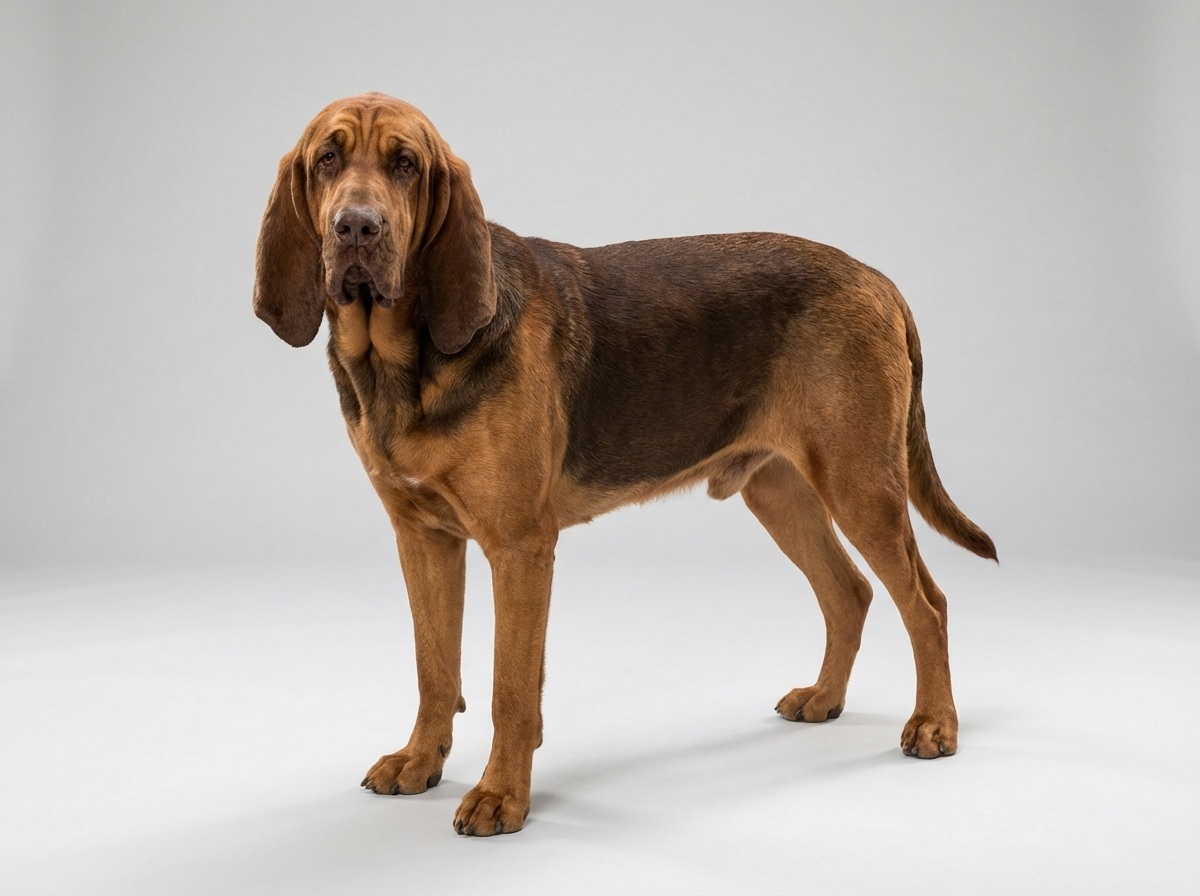
Ninety to a hundred ten pounds versus twenty-six to thirty-four - the Bloodhound outweighs the English Cocker Spaniel by roughly three to one, and the height gap (23-27 inches against 15-17) is just as stark. The Bloodhound's massive frame, loose skin and long ears are built for following a scent trail for miles without tiring, a job that requires bulk and stamina rather than speed. The Cocker's compact, athletic body suits a dog originally bred to flush game from dense brush. A household choosing between them is really choosing between managing a large, powerful dog on leash and handling a small-to-medium sporting breed that fits comfortably in a car back seat.
Moderate 3/5 for the Bloodhound against high 4/5 for the Cocker Spaniel looks like a small gap on paper, but the type of energy differs more than the number suggests. Bloodhounds are endurance trackers - content with a long, purposeful walk rather than fast bursts of play - while the Cocker's temperament list opens with energetic, describing a dog that wants active engagement daily, not just distance. Both need real exercise; neither is a couch-only breed. What changes is the shape of that exercise: a scent walk satisfies the Bloodhound, while the Cocker responds better to retrieving games, agility, or anything that keeps its brain and body busy together.
Low 2/5 versus high 4/5: the Bloodhound's short, dense coat needs little beyond a weekly wipe-down, while the Cocker's medium, silky, feathered coat requires regular brushing to prevent mats, especially around the ears and legs. Shedding ties at a moderate 3/5 for both, so the grooming gap here is really about coat texture and length rather than hair volume. Bloodhound owners trade coat care for skin-fold and ear maintenance instead, since those long ears and loose facial skin need regular cleaning to avoid infection. Cocker owners should expect a grooming appointment every six to eight weeks if they want the coat to stay tangle-free.
Apartment suitability splits clearly - low 2/5 for the Bloodhound, high 4/5 for the Cocker Spaniel - and the size difference alone explains much of it. A ninety-plus-pound dog needs room to turn around comfortably; a thirty-pound spaniel doesn't. Barking ties at moderate 3/5, so noise isn't the deciding factor, but both breeds tolerate being alone poorly, tied at 2/5, meaning neither is suited to owners gone all day regardless of unit size. The Bloodhound's size also makes hallways, elevators and small yards logistically harder to manage day to day, while the Cocker adapts more easily to compact living as long as its exercise needs are met.
Low 2/5 trainability for the Bloodhound against high 4/5 for the Cocker Spaniel is one of the widest gaps in this comparison, and it tracks directly with temperament: independent describes the Bloodhound, biddable describes the Cocker. A Bloodhound's nose can override its handler's cues the moment an interesting scent crosses its path, which is a feature for search-and-rescue work and a challenge for basic obedience. First-time-owner scores follow the same pattern, low 2/5 versus high 4/5. Anyone new to dog ownership will likely find the Cocker's eager-to-learn nature far more forgiving than the single-minded determination the Bloodhound's temperament list leads with.
Good-with-kids favors the Cocker slightly, a very high 5/5 against the Bloodhound's still-strong 4/5, while both breeds tie for compatibility with other dogs and with strangers, each at a high 4/5. The Bloodhound's size means supervision matters more around small children - not from aggression, since friendly appears on its temperament list too, but from sheer accidental bulk during play. The Cocker's merry, affectionate nature makes it an easy addition to busy households with frequent visitors. Neither breed shows red flags for family life; the practical difference is how much physical space and management a large, determined tracking dog requires compared with a responsive, people-oriented spaniel.
Seven to ten years against twelve to fourteen is a meaningful lifespan gap, and it runs in the Cocker's favor by a wide margin. The Bloodhound's ten-item health list includes bloat (GDV), a common risk for deep-chested large breeds, plus ectropion and entropion - eyelid conditions tied to its loose facial skin - alongside bleeding disorders and gastric issues. The Cocker's shorter five-condition list centers on ear infections, progressive retinal atrophy, hip dysplasia, familial nephropathy and adult-onset neuropathy, the last two being breed-specific concerns worth screening for in a reputable breeder's health testing. Both breeds share hip dysplasia and ear infection risk despite their size difference.
Cost level ties at moderate 3/5 for both breeds, and the dollar ranges land close together too - $1,500-2,800 for the Bloodhound's first year against $1,400-2,900 for the Cocker's, with monthly costs matching almost exactly at $100-200 each. That similarity might surprise anyone expecting the much larger Bloodhound to cost noticeably more; its low grooming needs offset the higher food bill that comes with its size. The Cocker's grooming costs, by contrast, help push its own total up despite the smaller body. In practice, whichever breed a household chooses, the annual budget lands in roughly the same range.
Bloodhound weighs 90–110 lbs and lives 7–10 years; English Cocker Spaniel weighs 26–34 lbs and lives 12–14 years. The two diverge most on grooming need, apartment suitability and good for first-time owners and 1 other rated axes. They are level on tolerates being alone, barking and cost level, so those cannot decide it. In the table, a "winner" means easier for an ordinary household — not better. Size, coat and origin are recorded without a verdict. Because both breeds are scored the same way, the gaps are reliable even where the absolute numbers are rough.

Yes - the Bloodhound weighs 90-110 lbs against the Cocker's 26-34 lbs, close to a three-to-one difference in body mass.
The English Cocker Spaniel, rated high 4/5 for trainability against the Bloodhound's low 2/5, reflecting its more biddable temperament.
The English Cocker Spaniel, typically twelve to fourteen years, compared with the Bloodhound's seven to ten.
Yes - both land at a moderate 3/5 cost level, with first-year estimates of $1,500-2,800 for the Bloodhound and $1,400-2,900 for the Cocker.
The Bloodhound, rated low 2/5 for grooming against the Cocker's high 4/5, thanks to its short, dense coat.
Not really - it scores a low 2/5 for apartment suitability, largely due to its size, while the Cocker scores a high 4/5.
Both are prone to hip dysplasia and ear infections, despite their very different sizes and coat types.
The Bloodhound, at 90-110 lbs, dwarfs the English Cocker Spaniel's 26-34 lbs.
The English Cocker Spaniel, scoring high 4/5 versus the Bloodhound's low 2/5.
The Bloodhound, with ten documented issues against the Cocker's five.
The English Cocker Spaniel, rated high 4/5 for first-time-owner suitability versus the Bloodhound's low 2/5.
Secure checkout on Stripe. We never see your card.
7-day money-back guarantee. Instant access.
Health information here is general and is not veterinary advice. If your dog shows pain, sudden behaviour change, or worsening symptoms, consult a licensed veterinarian.
Some links on this site are affiliate links. We may earn a commission at no extra cost to you, and we only suggest products we believe are helpful for dog owners.
We research and check what we publish, but we do not warrant that any figure, date, price, or statement is accurate, complete, or current, and we accept no liability for any loss, cost, injury, or other harm arising from the use of this site. Use it as one reference among several. You remain responsible for your own decisions and for your dog's care - confirm anything that matters with a licensed veterinarian or another qualified professional before you act on it. Full disclaimer.
Match your lifestyle to the right dog.
Take quizNot sure which breed is right for you? Take our 2-minute quiz to find out.
Take the quiz