Bloodhound vs Jack Russell Terrier: Which Suits Your Home?
Quick answer
Bloodhound or Jack Russell Terrier?
Choose based on temperament fit more than size: the Jack Russell is cheaper and lives longer but barks constantly and doesn't mix well with other dogs; the Bloodhound is calmer around other pets but pricier and shorter-lived.
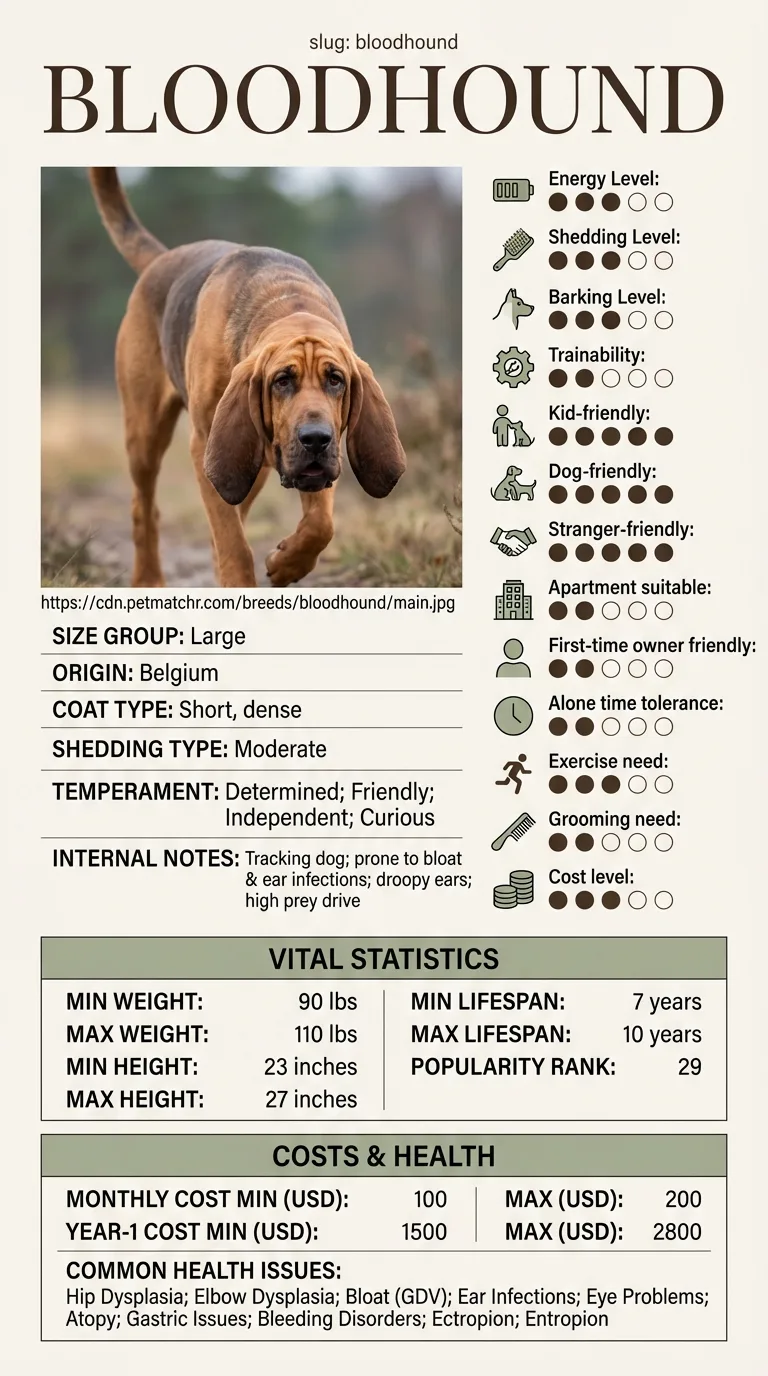
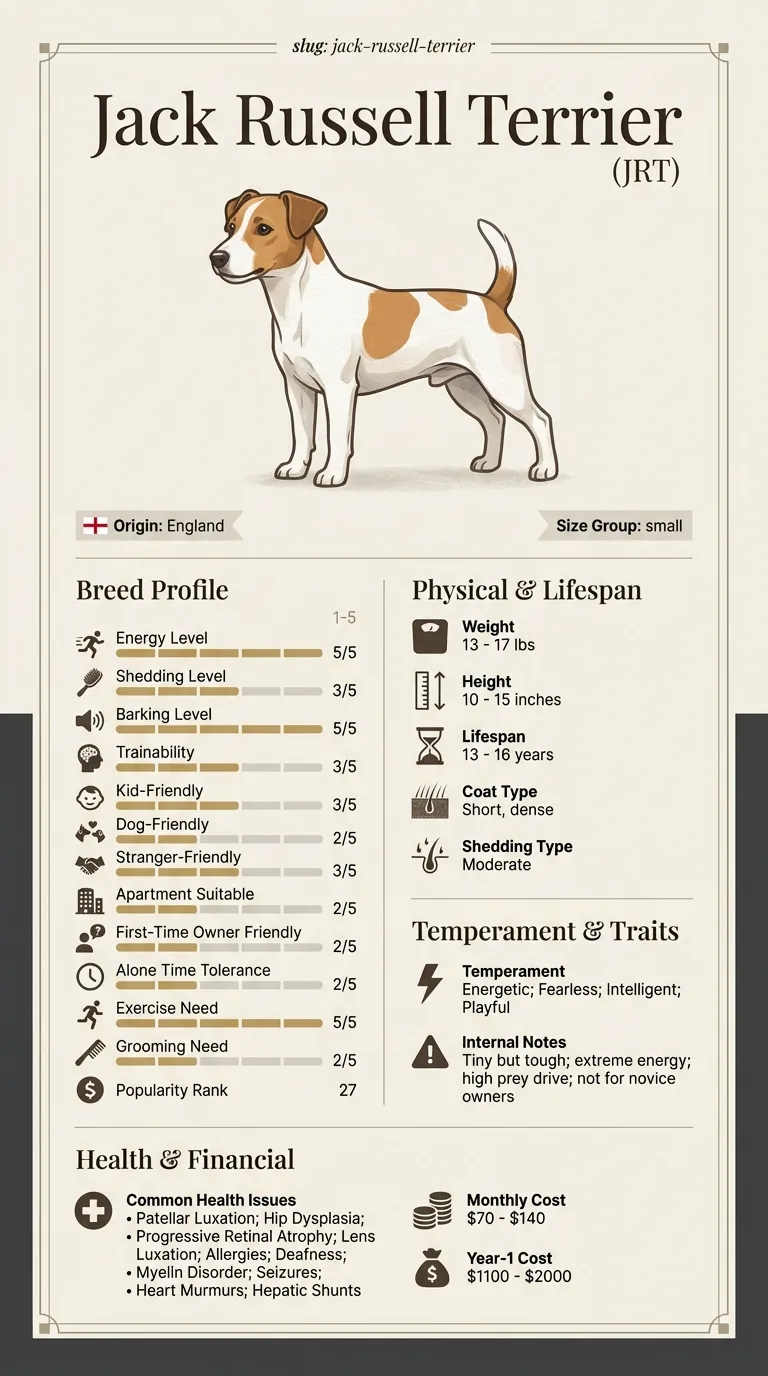
Bloodhound or Jack Russell Terrier? On paper they differ most on exercise need, and on the scales Bloodhound is the heavier at 90–110 lbs. Here is how the two compare on everything that shapes an ordinary week.
This is for someone already down to Bloodhound and Jack Russell Terrier and deciding between them. For this pair the decision usually turns on exercise need and energy level, so those are covered first and in most detail. Both rate 2/5 for flats, so housing does not settle this one. There is no origin story here — only what changes about your week.
Quick verdict
Between Bloodhound and Jack Russell Terrier, exercise need is what separates them, and Bloodhound is the lower-effort dog of the two to keep.
Choose bloodhound if...
Choose Bloodhound if your walking routine is modest, there are young children at home and you already have another dog.
Choose jack russell terrier if...
Choose Jack Russell Terrier if you want a dog that picks up training quickly, a smaller dog suits your car, your home or your back and you want a dog that can keep up with an active routine.
Head-to-head comparison
Feature
bloodhound
jack russell terrier
Winner
Size class
large
small
Equal
Weight
90–110 lbs
13–17 lbs
Equal
Height
23–27 in
10–15 in
Equal
Lifespan
7–10 years
13–16 years
jack russell terrier
Exercise need
Moderate (3/5)
Very high (5/5)
bloodhound
Grooming need
Low (2/5)
Low (2/5)
Equal
Shedding
Moderate (3/5)
Moderate (3/5)
Equal
Energy level
Moderate (3/5)
Very high (5/5)
Equal
Barking
Moderate (3/5)
Very high (5/5)
bloodhound
Apartment suitability
Low (2/5)
Low (2/5)
Equal
Good for first-time owners
Low (2/5)
Low (2/5)
Equal
Tolerates being alone
Low (2/5)
Low (2/5)
Equal
Trainability
Low (2/5)
Moderate (3/5)
jack russell terrier
Good with kids
High (4/5)
Moderate (3/5)
bloodhound
Good with other dogs
High (4/5)
Low (2/5)
bloodhound
Friendly to strangers
High (4/5)
Moderate (3/5)
bloodhound
Cost level
Moderate (3/5)
Low (2/5)
jack russell terrier
Coat
Short, dense
Short, dense
Equal
Origin
Belgium
England
Equal
Typical monthly cost
$100–$200
$70–$140
Equal
Typical first-year cost
$1,500–$2,800
$1,100–$2,000
Equal
Deep dive
Size and build
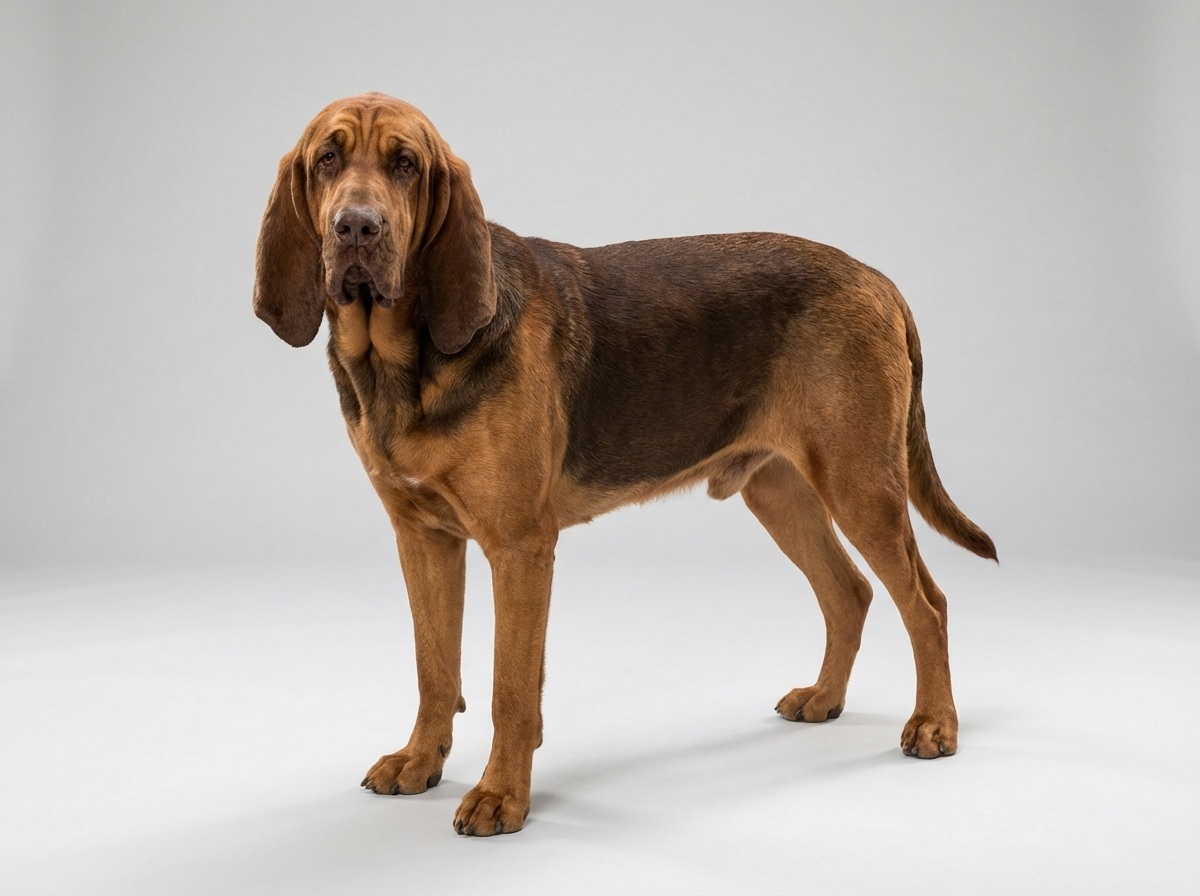
Weight difference is stark - the Bloodhound's 90-110 lbs against the Jack Russell's 13-17 lbs is nearly an 8-to-1 ratio - though the height gap is a bit less extreme relatively, 23-27 in versus 10-15 in. This is a dog whose entire physical presence, from exercise space needed to vet bill scale, sits at the opposite end of the spectrum from the Bloodhound.
Energy and exercise
Don't let the Jack Russell's size fool you: it rates a 5/5 for both exercise need and energy level, well above the Bloodhound's 3/5 on each. This is a terrier bred to work all day, and a bored one digs, barks and destroys things. The Bloodhound's moderate needs, by comparison, are far more manageable for a household without hours to spend on structured activity.
Grooming and shedding
Grooming is a wash - both breeds rate a low 2/5 - and shedding is nearly identical too, 3/5 for both. Short, dense coats on both dogs mean the same basic weekly brushing routine regardless of which one you bring home. This is one of the few categories where size doesn't change the answer at all.
Apartment living, noise and time alone
Barking is the standout number here: the Jack Russell rates a very high 5/5, compared to the Bloodhound's moderate 3/5 - a real consideration for apartment or close-neighbor living. Apartment suitability itself ties at a low 2/5 for both, and both tolerate being alone poorly (2/5). Small size doesn't buy the Jack Russell an apartment advantage once you factor in the noise.
Training and owner experience
Trainability tilts slightly toward the Jack Russell, 3/5 versus the Bloodhound's 2/5, though neither is a standout in this department. Both land at a low 2/5 for first-time owners - the Jack Russell's high energy and terrier stubbornness cause as many problems for novices as the Bloodhound's independent nose does, just in a smaller package. Experience with strong-willed dogs helps more than raw trainability scores suggest here.
Kids, other dogs and visitors
This category favors the Bloodhound clearly: 4/5 with kids against the Jack Russell's 3/5, and 4/5 with other dogs against a notably lower 2/5 for the terrier, whose prey drive and scrappiness don't always mesh well with other pets. Strangers get a warmer reception from the Bloodhound too, 4/5 versus 3/5. If you have a multi-dog household already, this section matters most.
Health and lifespan
Lifespan strongly favors the Jack Russell - 13 to 16 years versus the Bloodhound's 7 to 10, potentially double. Their health risks share little overlap: the Bloodhound deals with hip and elbow dysplasia, bloat, ear infections, eye problems, atopy, gastric issues, bleeding disorders, ectropion and entropion, while the Jack Russell's list includes patellar luxation, hip dysplasia, progressive retinal atrophy, lens luxation, allergies, deafness, myelin disorder, seizures, heart murmurs and hepatic shunts.
Cost to keep
The Jack Russell is noticeably cheaper to keep: a low 2/5 cost rating versus the Bloodhound's moderate 3/5, $70-140 monthly against $100-200, and a first-year range of $1,100-2,000 compared to $1,500-2,800. Smaller size generally means smaller food and medication bills, and that shows clearly in these numbers. Over a longer lifespan, that gap compounds - one more reason the Jack Russell tends to be the lower lifetime-cost option.
Bloodhound vs Jack Russell Terrier at a glance
Bloodhound weighs 90–110 lbs and lives 7–10 years; Jack Russell Terrier weighs 13–17 lbs and lives 13–16 years. The two diverge most on exercise need, energy level and barking and 1 other rated axes. They are level on tolerates being alone, apartment suitability and good for first-time owners, so those cannot decide it. Where the table declares a winner it means less work for the owner, nothing more; descriptive rows are left as ties on purpose. The value here is in the differences between the two columns; treat any single score as approximate.
Bloodhound vs Jack Russell Terrier: Which Suits Your Home? - Bloodhound vs Jack Russell Terrier at a glance
Frequently asked questions
How much bigger is a Bloodhound than a Jack Russell Terrier?
Enormously - the Bloodhound can weigh 6 to 8 times as much, 90-110 lbs versus 13-17 lbs, and stands more than double the height at the shoulder.
Which barks more?
The Jack Russell, by a lot - a 5/5 barking rating against the Bloodhound's moderate 3/5. That's a real factor in close-quarters living.
Is either good for a first-time owner?
Not especially - both score a low 2/5. The Jack Russell's terrier stubbornness and nonstop energy trip up novices just as much as the Bloodhound's independence does.
How do they compare with other dogs in the house?
The Bloodhound does better, rating 4/5 versus the Jack Russell's 2/5. The terrier's prey drive and feisty streak make multi-dog households trickier.
What's the cost difference?
The Jack Russell is cheaper on every measure - $70-140 monthly versus $100-200, and $1,100-2,000 in year one versus $1,500-2,800.
Do their health risks overlap?
Very little - the two lists share almost no conditions, reflecting how different these breeds are genetically and historically.
Which one lives longer?
The Jack Russell, often close to double the Bloodhound's lifespan - 13-16 years versus 7-10.
Choose based on temperament fit more than size: the Jack Russell is cheaper and lives longer but barks constantly and doesn't mix well with other dogs; the Bloodhound is calmer around other pets but pricier and shorter-lived.
Costs
Monthly cost?
$70-140 for the Jack Russell, $100-200 for the Bloodhound.
Living
Exercise need?
The Jack Russell needs much more - 5/5 versus the Bloodhound's 3/5, despite its small size.
Health
Lifespan?
13-16 years for the Jack Russell versus 7-10 for the Bloodhound.
Related DogBreedCompass guides
Bloodhound breed guide – Readers comparing the two usually want the full profile of Bloodhound before deciding.
Bloodhound vs Old English Sheepdog – Old English Sheepdog is the closest breed to Bloodhound on the measured axes, so it is the natural next comparison.
Health information here is general and is not veterinary advice. If your dog shows pain, sudden behaviour change, or worsening symptoms, consult a licensed veterinarian.
Some links on this site are affiliate links. We may earn a commission at no extra cost to you, and we only suggest products we believe are helpful for dog owners.
We research and check what we publish, but we do not warrant that any figure, date, price, or statement is accurate, complete, or current, and we accept no liability for any loss, cost, injury, or other harm arising from the use of this site. Use it as one reference among several. You remain responsible for your own decisions and for your dog's care - confirm anything that matters with a licensed veterinarian or another qualified professional before you act on it. Full disclaimer.