The Labradoodle is the more forgiving choice for most households - higher trainability, better with kids, longer lifespan - while the Bloodhound suits owners who specifically want its tracking instinct and calmer pace.
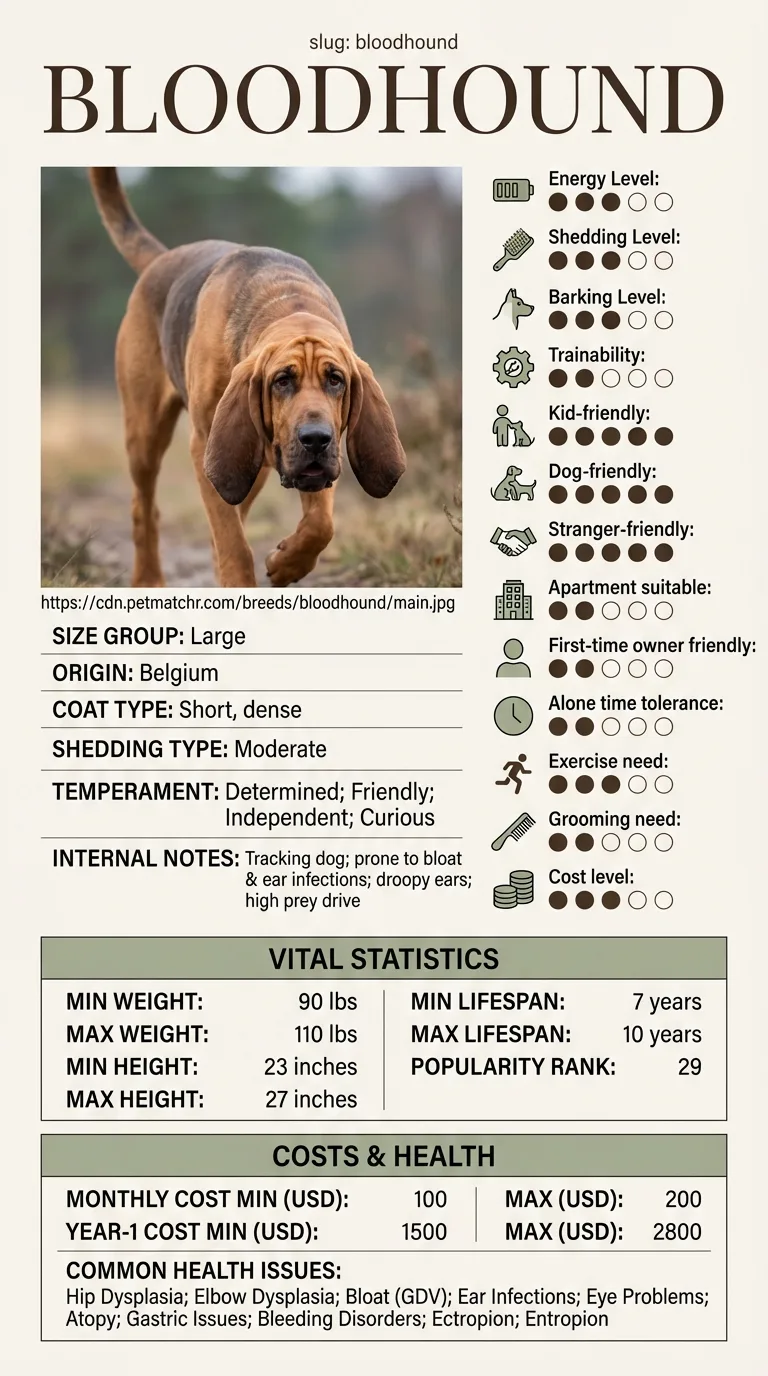
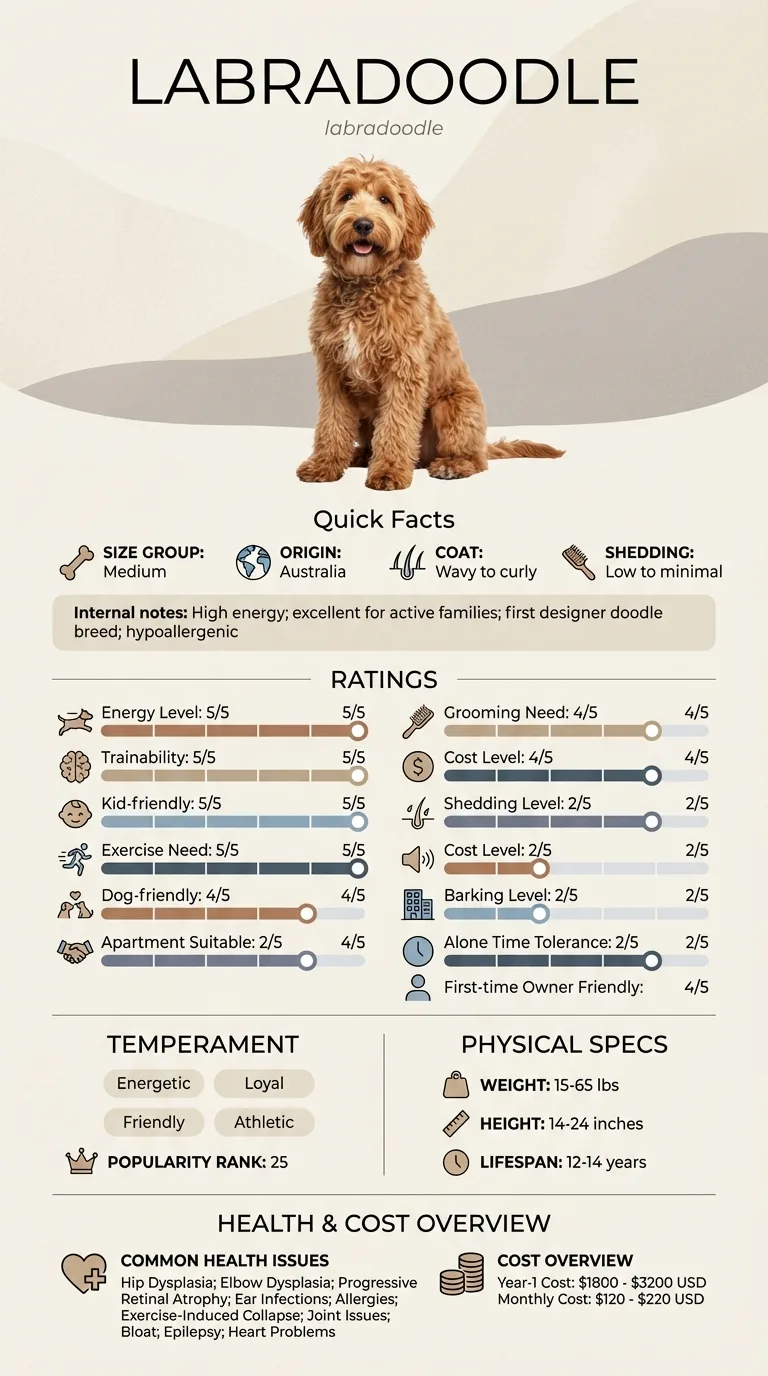
Bloodhound or Labradoodle? On paper they differ most on trainability, and on the scales Bloodhound is the heavier at 90–110 lbs. Here is how the two compare on everything that shapes an ordinary week.
This is for someone already down to Bloodhound and Labradoodle and deciding between them. For this pair the decision usually turns on trainability and exercise need, so those are covered first and in most detail. Both rate 2/5 for flats, so housing does not settle this one. It is written for the decision rather than the breed history.
Quick verdict
Between Bloodhound and Labradoodle, trainability is what separates them, and Bloodhound is the lower-effort dog of the two to keep.
Choose bloodhound if...
Choose Bloodhound if you do not want a standing grooming appointment and your walking routine is modest.
Choose labradoodle if...
Choose Labradoodle if this is your first dog, shedding is a problem in your house and there are young children at home.
Head-to-head comparison
Feature
bloodhound
labradoodle
Winner
Size class
large
medium
Equal
Weight
90–110 lbs
15–65 lbs
Equal
Height
23–27 in
14–24 in
Equal
Lifespan
7–10 years
12–14 years
labradoodle
Exercise need
Moderate (3/5)
Very high (5/5)
bloodhound
Grooming need
Low (2/5)
High (4/5)
bloodhound
Shedding
Moderate (3/5)
Low (2/5)
labradoodle
Energy level
Moderate (3/5)
Very high (5/5)
Equal
Barking
Moderate (3/5)
Low (2/5)
labradoodle
Apartment suitability
Low (2/5)
Low (2/5)
Equal
Good for first-time owners
Low (2/5)
High (4/5)
labradoodle
Tolerates being alone
Low (2/5)
Low (2/5)
Equal
Trainability
Low (2/5)
Very high (5/5)
labradoodle
Good with kids
High (4/5)
Very high (5/5)
labradoodle
Good with other dogs
High (4/5)
High (4/5)
Equal
Friendly to strangers
High (4/5)
High (4/5)
Equal
Cost level
Moderate (3/5)
High (4/5)
bloodhound
Coat
Short, dense
Wavy to curly
Equal
Origin
Belgium
Australia
Equal
Typical monthly cost
$100–$200
$120–$220
Equal
Typical first-year cost
$1,500–$2,800
$1,800–$3,200
Equal
Deep dive
Size and build
The Labradoodle's size range is broad - 15 to 65 lbs and 14 to 24 inches - reflecting the mix of standard and miniature lines bred into it. Even at the top of that range, it stays lighter than the Bloodhound's 90-110 lbs, and shorter too. If you want predictable size, neither breed is perfectly consistent, but the Bloodhound at least stays within a tighter, if heavier, band.
Energy and exercise
Exercise need and energy level both max out for the Labradoodle at 5/5, well above the Bloodhound's steady 3/5 on each. Labradoodles inherit Labrador retrieving drive and poodle athleticism in equal measure, and they need a real outlet for it daily. The Bloodhound's moderate needs are less demanding but still not nothing - this isn't a low-energy dog, just a lower-energy one by comparison.
Grooming and shedding
Shedding favors the Bloodhound only slightly - 3/5 versus the Labradoodle's 2/5 - but grooming demand flips hard the other way: 4/5 for the Labradoodle against the Bloodhound's easy 2/5. That curly-to-wavy coat needs regular brushing and professional grooming to avoid matting, so the lower shedding doesn't translate into less hands-on maintenance overall. Budget for grooming appointments if the low-shed coat is the main draw.
Apartment living, noise and time alone
Both breeds tie at a low 2/5 for apartment suitability, so size alone doesn't solve the space problem for the Labradoodle despite its smaller average build. It does bark less, though - 2/5 versus the Bloodhound's 3/5 - which matters more than square footage in some buildings. Both tolerate being alone poorly, at 2/5 each; neither dog is a good match for an owner gone ten hours a day.
Training and owner experience
Trainability heavily favors the Labradoodle, 5/5 against the Bloodhound's 2/5, and first-time-owner suitability follows a similar pattern - 4/5 versus 2/5. A Labradoodle responds well to consistent reward-based training; a Bloodhound's nose-driven independence makes even basic obedience a longer project, one better suited to an owner who's trained a strong-willed dog before. That gap alone probably decides this comparison for most new owners.
Kids, other dogs and visitors
With kids, the Labradoodle rates 5/5 against the Bloodhound's 4/5, and it ties with the Bloodhound with other dogs at 4/5 each. Both greet strangers warmly at 4/5. This is a comparison where the Labradoodle wins by degree rather than by a wide margin in the household categories, and either dog should integrate reasonably into a busy, social household.
Health and lifespan
Lifespan favors the Labradoodle by up to seven years - 12 to 14 versus the Bloodhound's 7 to 10. Shared risks include hip dysplasia, elbow dysplasia, bloat and ear infections. The Bloodhound's additional risks are eye problems, atopy, gastric issues, bleeding disorders, ectropion and entropion; the Labradoodle's list adds progressive retinal atrophy, allergies, exercise-induced collapse, joint issues and epilepsy. Joint health is worth watching in the Labradoodle given both hip and elbow dysplasia risk plus general joint issues on its list.
Cost to keep
The Labradoodle costs more to keep on every measure: a 4/5 cost rating versus the Bloodhound's 3/5, $120-220 monthly against $100-200, and $1,800-3,200 in the first year compared to $1,500-2,800. Grooming is likely the biggest driver of that gap, given the coat's upkeep demands. Factor recurring grooming visits into your monthly budget rather than treating them as an occasional expense.
Bloodhound vs Labradoodle at a glance
Bloodhound weighs 90–110 lbs and lives 7–10 years; Labradoodle weighs 15–65 lbs and lives 12–14 years. The two diverge most on trainability, exercise need and grooming need and 2 other rated axes. They are level on tolerates being alone, apartment suitability and good with other dogs, so those cannot decide it. In the table, a "winner" means easier for an ordinary household — not better. Size, coat and origin are recorded without a verdict. Because both breeds are scored the same way, the gaps are reliable even where the absolute numbers are rough.
Bloodhound vs Labradoodle: Which Suits Your Home? - Bloodhound vs Labradoodle at a glance
Frequently asked questions
How does Labradoodle size compare to a Bloodhound's?
Smaller, though variable - 15-65 lbs depending on the line, versus the Bloodhound's consistent 90-110 lbs. Even a large standard Labradoodle typically stays under the Bloodhound's weight.
Which sheds less?
The Labradoodle, rated 2/5 versus the Bloodhound's 3/5 - but it needs more grooming overall, 4/5 versus 2/5, to keep that coat from matting.
Which is better for a first-time owner?
The Labradoodle, with a 4/5 first-time-owner score and 5/5 trainability against the Bloodhound's 2/5 on both counts.
How do they compare for apartment living?
Both tie at a low 2/5 for apartment suitability, though the Labradoodle barks less (2/5 versus 3/5), which can matter more than space in shared buildings.
What's the cost difference?
The Labradoodle runs higher - $120-220 monthly versus $100-200 for the Bloodhound, and up to $3,200 in year one versus $2,800.
Do their health risks overlap?
On the basics, yes - hip dysplasia, elbow dysplasia, bloat and ear infections appear on both lists, though the Labradoodle's extends to allergies and exercise-induced collapse.
Which lives longer?
The Labradoodle, typically by several years - 12-14 years versus the Bloodhound's 7-10.
The Labradoodle is the more forgiving choice for most households - higher trainability, better with kids, longer lifespan - while the Bloodhound suits owners who specifically want its tracking instinct and calmer pace.
Costs
Monthly cost?
$100-200 for the Bloodhound, $120-220 for the Labradoodle.
Living
Exercise need?
The Labradoodle needs considerably more - 5/5 versus the Bloodhound's 3/5.
Health
Lifespan?
12-14 years for the Labradoodle versus 7-10 for the Bloodhound.
Related DogBreedCompass guides
Bloodhound breed guide – Readers comparing the two usually want the full profile of Bloodhound before deciding.
Labradoodle breed guide – The same for Labradoodle, so the comparison can be checked against the detail.
Bloodhound vs Old English Sheepdog – Old English Sheepdog is the closest breed to Bloodhound on the measured axes, so it is the natural next comparison.
Labradoodle vs Bernedoodle – Bernedoodle sits closest to Labradoodle, which makes it the alternative worth ruling out.
What Bloodhound costs to keep – Anyone weighing these two is usually also pricing them, and the cost pages carry city-level figures.
Labradoodle health problems – The health pages set out what each breed is actually screened for.
Health information here is general and is not veterinary advice. If your dog shows pain, sudden behaviour change, or worsening symptoms, consult a licensed veterinarian.
Some links on this site are affiliate links. We may earn a commission at no extra cost to you, and we only suggest products we believe are helpful for dog owners.
We research and check what we publish, but we do not warrant that any figure, date, price, or statement is accurate, complete, or current, and we accept no liability for any loss, cost, injury, or other harm arising from the use of this site. Use it as one reference among several. You remain responsible for your own decisions and for your dog's care - confirm anything that matters with a licensed veterinarian or another qualified professional before you act on it. Full disclaimer.