Akita or American Pit Bull Terrier: Which Suits Your Home?
Quick answer
Akita vs American Pit Bull Terrier: which should I choose?
Choose the Pit Bull for a smaller, cheaper, more trainable and more affectionate dog with almost no grooming, provided your insurer and local rules allow it. Choose the Akita if you want a quiet guardian breed and can handle up to 130 pounds plus a double coat.
These two share one difficult trait and almost nothing else. Both rate 2/5 with other dogs, which means both need managing around unfamiliar dogs for life. Everything else — size, coat, cost, how they treat visitors — runs in opposite directions, and the Akita is roughly twice the dog by weight.
This is for someone weighing two powerful breeds and trying to understand what each actually demands. It covers the substantial weight difference, the coat that one has and the other essentially does not, how each behaves with visitors and with other dogs, the housing and insurance realities, and the health conditions worth naming before you commit.
Quick verdict
The Pit Bull is the cheaper, lower-maintenance, more people-social dog; the Akita is the larger, quieter, more independent one that treats visitors as a decision rather than a pleasure.
Choose akita if...
Choose the Akita if you want a dignified, self-contained house dog that rates 2/5 for barking and 3/5 for time alone, and you specifically want a guardian temperament. Understand that it rates 1/5 for first-time owners, weighs up to 130 pounds, and carries a double coat that will bury your house in hair twice a year.
Choose american pit bull terrier if...
Choose the American Pit Bull Terrier if you want the more affectionate and more trainable of the two — 4/5 trainability against 3/5, 4/5 with children against 3/5 — with almost no grooming at 1/5 and the lowest running cost of the pair at $80–$150 a month. Expect an athletic dog needing 4/5 exercise, and check your insurer and local rules before committing.
Head-to-head comparison
Feature
akita
american pit bull terrier
Winner
Weight
70–130 lbs
30–65 lbs
Equal
Height
24–28 in
17–21 in
Equal
Lifespan
10–13 years
12–14 years
american pit bull terrier
Coat
Dense double coat
Short, glossy
Equal
Grooming need
Moderate (3/5)
Very low (1/5)
american pit bull terrier
Shedding
Very high (5/5)
Moderate (3/5)
american pit bull terrier
Energy level
Moderate (3/5)
High (4/5)
Equal
Exercise need
Moderate (3/5)
High (4/5)
akita
Trainability
Moderate (3/5)
High (4/5)
american pit bull terrier
Barking
Low (2/5)
Low (2/5)
Equal
Good with kids
Moderate (3/5)
High (4/5)
american pit bull terrier
Good with other dogs
Low (2/5)
Low (2/5)
Equal
Friendly to strangers
Low (2/5)
Moderate (3/5)
american pit bull terrier
Apartment suitability
Low (2/5)
Low (2/5)
Equal
Good for first-time owners
Very low (1/5)
Low (2/5)
american pit bull terrier
Tolerates being alone
Moderate (3/5)
Moderate (3/5)
Equal
Typical monthly cost
$110–$240
$80–$150
american pit bull terrier
Typical first-year cost
$1,700–$3,200
$1,200–$2,200
american pit bull terrier
Deep dive
The shared 2/5, and why it looks different in each
Both breeds rate 2/5 with other dogs, and in both cases it is a breed characteristic rather than a training failure. But the mechanism differs and so does the management.
Akita dog-intolerance is largely territorial and same-sex. It tends to sharpen with maturity, often appearing around eighteen months to two years in a dog that was fine with everyone as a puppy. Owners are frequently caught out by this because the puppy gave no warning.
Pit Bull dog-selectivity comes from a history of dogs bred for gameness, and it typically presents as an unwillingness to back down once something starts rather than as a tendency to start it. Many are entirely fine with a familiar household dog and unreliable with strange ones. The practical rule most experienced owners follow is simple: never leave dogs unsupervised together, and do not rely on the dog park.
For both breeds, the honest planning assumption is that you will manage introductions carefully for the dog's whole life. If you already own a dog, especially of the same sex, take this seriously for either.
Twice the dog, and vastly more coat
The Akita runs 70 to 130 pounds and stands 24 to 28 inches. The Pit Bull runs 30 to 65 pounds and stands 17 to 21. At the extremes that is a hundred-pound dog against a thirty-pound one, and the practical consequences are the obvious ones: lifting, car space, boarding fees, and whether one person can hold the lead if the dog decides otherwise.
The coat difference is even larger. The Pit Bull's short glossy coat rates 1/5 for grooming — a rubber mitt occasionally covers it — and 3/5 for shedding, mostly short bristly hairs that stick to fabric.
The Akita's dense double coat rates 5/5 for shedding and blows out spectacularly twice a year. Grooming rates 3/5, meaning an undercoat rake and real time during moult. It should never be shaved; the coat insulates against heat as well as cold.
If the deciding factor is how much hair you can tolerate, this is not a close comparison.
With people: one greets, one assesses
The Pit Bull rates 3/5 with strangers and 4/5 with children, and the breed's reputation with people who actually know it is of a dog that is enthusiastically, sometimes exhaustingly affectionate. Historically these dogs were selected to be safe to handle even in situations where they were highly aroused, and human-directed sociability is one of the traits that survived.
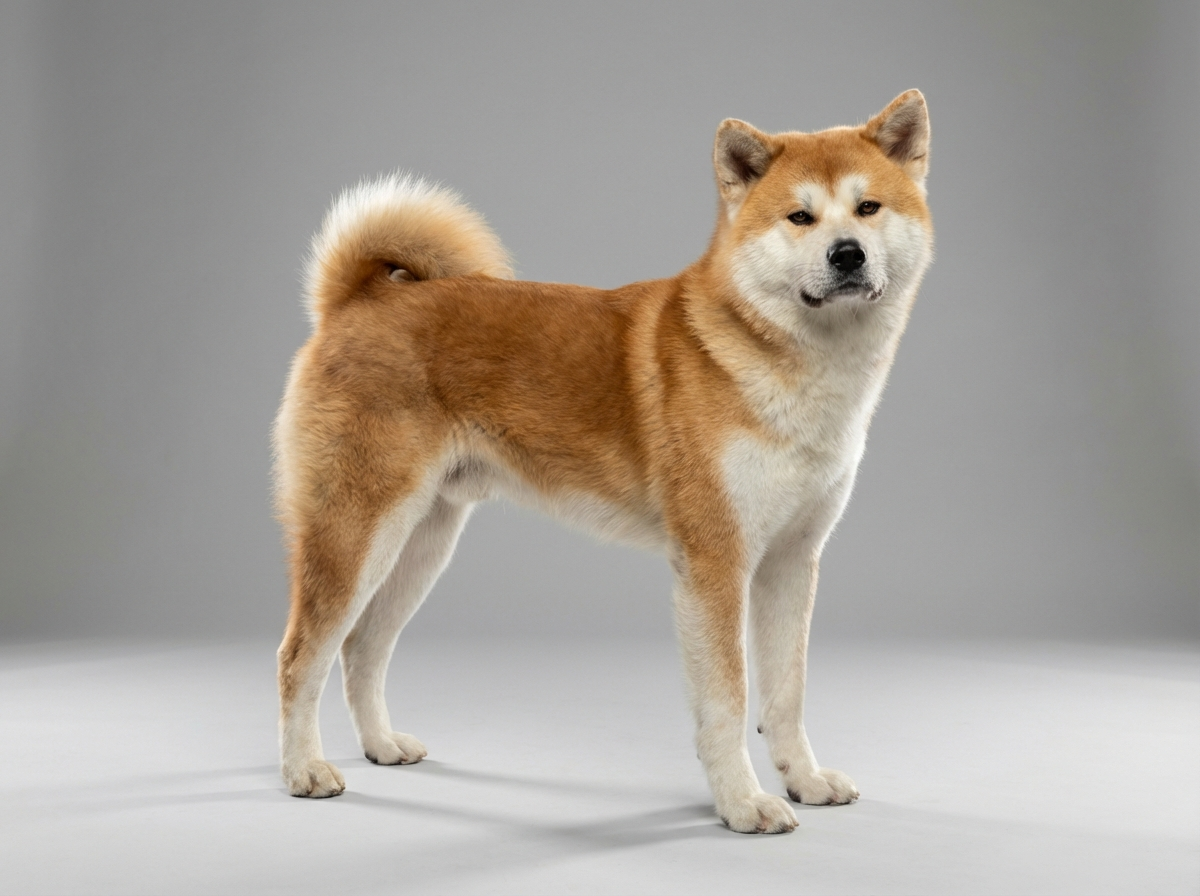
The Akita rates 2/5 with strangers and 3/5 with children. It is aloof rather than hostile — it will assess a visitor, position itself thoughtfully, and settle once satisfied. That is the guardian temperament working as intended, and it is what many Akita owners specifically want. It is also why the breed needs deliberate, sustained socialisation rather than a puppy class and a hope.
Both rate 2/5 for barking, so neither is noisy. Both rate 3/5 for time alone.
The practical issue that only affects one of them
American Pit Bull Terriers, and dogs identified as pit-bull-type, are subject to breed-specific legislation in a number of jurisdictions and appear on the restricted lists of many home insurance policies and rental agreements. In some places ownership is restricted outright; in others it is a matter of muzzling, insurance, or a landlord's refusal.
This varies enormously by country, state and city, and it is not something to take on trust from an article. Before committing, check your local rules and call your insurer, and if you rent, get the position in writing.
Akitas appear on some insurer lists too, but far less consistently. For most buyers this row will not be the deciding factor, but for some it is the only row that matters, and it is better discovered now than after the dog is home.
Health: shared joints, different systemic risks
Both carry hip and elbow dysplasia and both are at risk of bloat, so both should come from screened parents and both owners should know the signs of gastric dilatation-volvulus: unproductive retching, a tight swollen abdomen, and obvious distress means the emergency vet now, not in the morning.
The Akita's distinctive burden is autoimmune. Immune-mediated conditions affecting skin, eyes and blood appear in the breed more than in most, alongside hypothyroidism and progressive retinal atrophy. The breed is also known for sensitivity to anaesthesia, which is worth flagging to any vet who has not treated one before.
The Pit Bull's list runs to skin allergies, heart murmurs and cruciate-type injuries in an athletic dog, plus obesity, which is easy to miss on a muscular breed until it is well established.
The Pit Bull is the longer-lived of the two at 12 to 14 years against the Akita's 10 to 13 — the usual pattern where the smaller dog wins.
Cost and daily demand
The Pit Bull is the cheaper dog by a clear margin: $80–$150 a month against $110–$240, and $1,200–$2,200 in year one against $1,700–$3,200. Size explains most of it, and the near-absent grooming requirement explains the rest.
On exercise the Pit Bull asks more — 4/5 against the Akita's 3/5 — and it asks for it in a different form. This is an athletic, muscular dog that benefits from structured activity: weight-pull, flirt pole, spring pole, long walks with training built in. An under-exercised Pit Bull is a strong dog with nothing to do.
The Akita is genuinely content with less. It is a heavy, deliberate dog that lies down for long stretches and does not pace. That combination — 3/5 exercise, 2/5 barking, 3/5 alone — makes it the easier of the two to live around in a quiet household, provided the socialisation work is being done.
Akita vs American Pit Bull Terrier: what they share
Read the table and the shared row jumps out: both rate 2/5 with other dogs. That is the single most important thing these two have in common and the thing most likely to shape your daily life, because it means neither is a dog-park dog and both need a handler paying attention on every walk.
After that they separate hard. The Akita is 70 to 130 pounds against 30 to 65. It carries a dense double coat rated 5/5 for shedding against the Pit Bull's short coat at 3/5, and grooming 3/5 against 1/5. It costs more to keep, lives slightly less long, and is markedly less interested in people it does not know.
The Pit Bull is the more trainable, more affectionate and cheaper dog, with a legal and insurance problem the Akita mostly does not have.
Akita or American Pit Bull Terrier: Which Suits Your Home? - Akita vs American Pit Bull Terrier: what they share
Frequently asked questions
Which is bigger, an Akita or an American Pit Bull Terrier?
The Akita, by roughly double. It runs 70 to 130 pounds and stands 24 to 28 inches; the Pit Bull runs 30 to 65 pounds at 17 to 21 inches. At the extremes that is a hundred-pound dog against a thirty-pound one, which changes lifting, car space, boarding costs and who in the household can physically hold the lead.
Are both breeds bad with other dogs?
Both rate 2/5, and in both cases it is a breed trait rather than poor training. Akita intolerance is largely territorial and same-sex and often appears at social maturity around eighteen months to two years. Pit Bull selectivity tends to show as an unwillingness to disengage once something has started. For either, plan on managing introductions carefully for the dog's whole life and skipping dog parks.
Which sheds more?
The Akita, and it is not close — 5/5 against the Pit Bull's 3/5, with a dense double coat that blows out spectacularly twice a year and grooming rated 3/5 against 1/5. The Pit Bull's short coat needs almost nothing, though the short bristly hairs it does drop weave into fabric.
Which is better with children?
The Pit Bull, at 4/5 against the Akita's 3/5, and it is generally the more openly affectionate of the two with people. Size cuts the other way, though — a 130-pound Akita knocks over a small child without meaning to. Supervise either around young children, for different reasons.
Do Pit Bulls cause insurance or legal problems?
Often, yes. Pit-bull-type dogs are subject to breed-specific legislation in a number of jurisdictions and appear on many home insurance and rental restricted lists. The position varies enormously by country, state and city, so check local rules and call your insurer before committing, and get a landlord's position in writing if you rent. Akitas appear on some lists but far less consistently.
Which costs more to keep?
The Akita, at $110–$240 a month against the Pit Bull's $80–$150, with first-year totals of $1,700–$3,200 against $1,200–$2,200. Size accounts for most of the gap and grooming for the rest.
Which lives longer?
The American Pit Bull Terrier, typically 12 to 14 years against the Akita's 10 to 13, following the usual pattern where the lighter dog lives longer.
Akita vs American Pit Bull Terrier: which should I choose?
Choose the Pit Bull for a smaller, cheaper, more trainable and more affectionate dog with almost no grooming, provided your insurer and local rules allow it. Choose the Akita if you want a quiet guardian breed and can handle up to 130 pounds plus a double coat.
Costs
How much does each cost per month?
The Akita runs $110–$240 a month and the American Pit Bull Terrier $80–$150, with first-year totals of $1,700–$3,200 and $1,200–$2,200.
Living
Which needs more exercise?
The Pit Bull at 4/5 against the Akita's 3/5, and it benefits from structured activity rather than just distance. The Akita is genuinely content with a decent daily walk.
Training
Which is easier to train?
The Pit Bull at 4/5 against the Akita's 3/5. The Akita is described as strong-willed and independent, and it weighs whether it agrees with you rather than simply complying.
Related DogBreedCompass guides
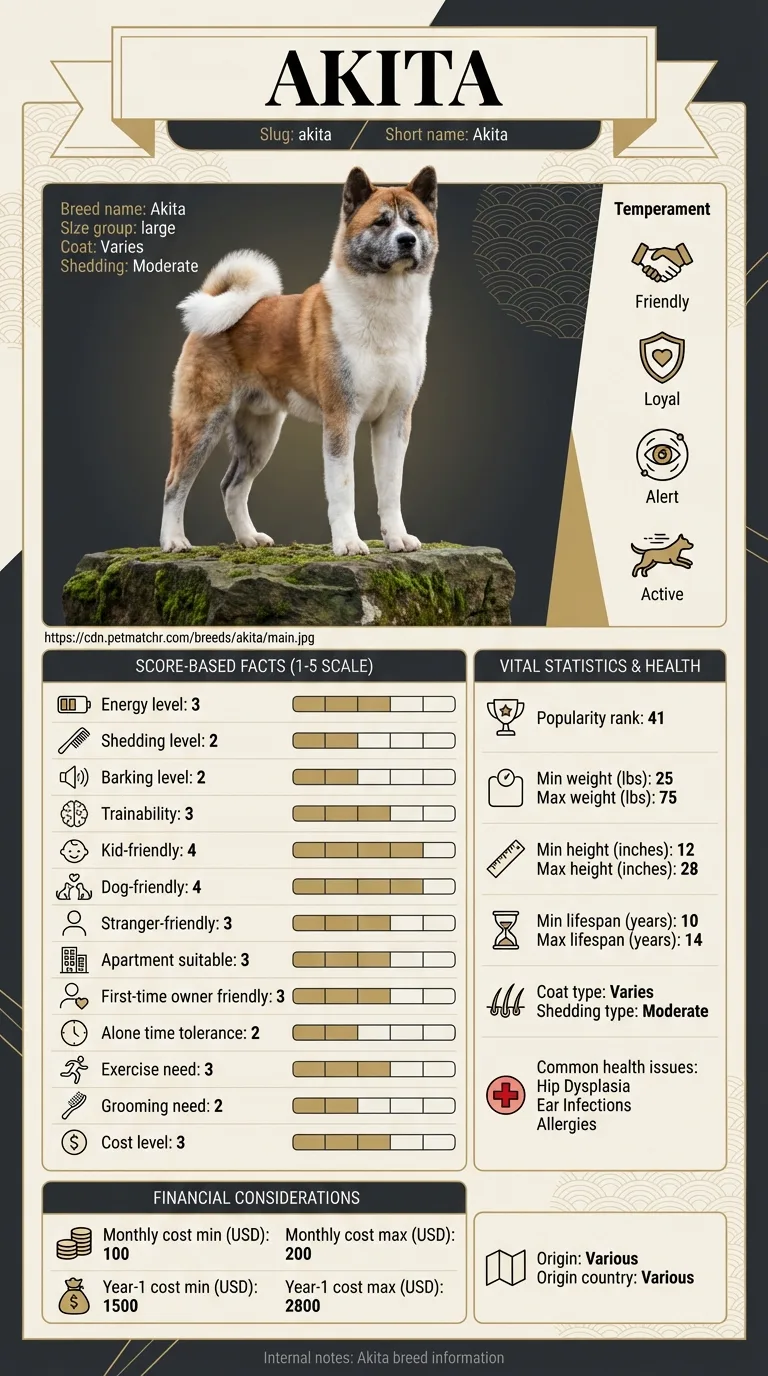
Akita breed guide – The Akita profile covers the guardian temperament and the socialisation work the breed needs.
American Pit Bull Terrier vs American Staffordshire Terrier – The AmStaff is the closely related breed buyers most often confuse with the Pit Bull, and it is rated more sociable.
Akita vs Alaskan Malamute – The Malamute is the other big northern dog people weigh against the Akita, and it is far friendlier.
Akita autoimmune diseases – Autoimmune disease is the health burden most specific to the Akita and the first thing to raise with a breeder.
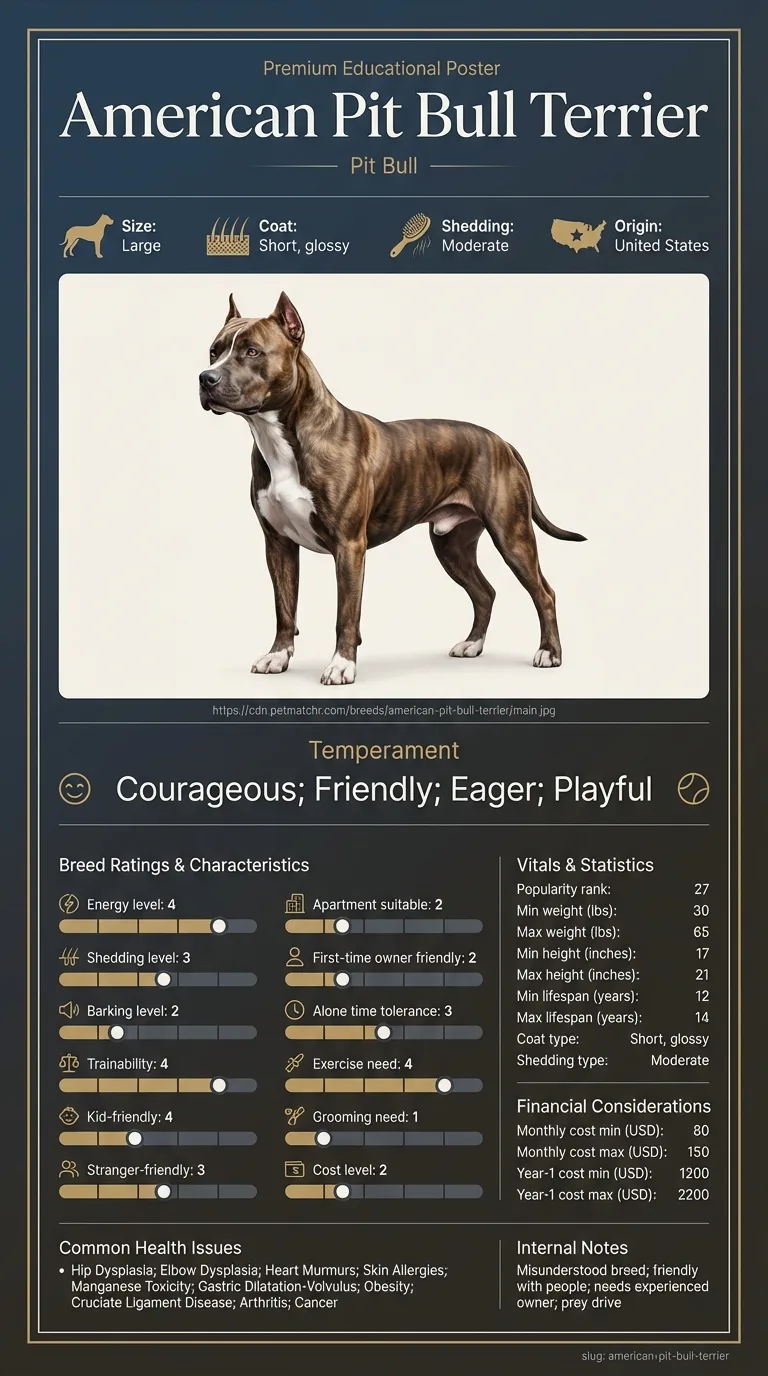
American Pit Bull Terrier skin allergies – Skin allergies are the most common ongoing complaint in the Pit Bull and the usual reason for repeat vet visits.
Health information here is general and is not veterinary advice. If your dog shows pain, sudden behaviour change, or worsening symptoms, consult a licensed veterinarian.
Some links on this site are affiliate links. We may earn a commission at no extra cost to you, and we only suggest products we believe are helpful for dog owners.
We research and check what we publish, but we do not warrant that any figure, date, price, or statement is accurate, complete, or current, and we accept no liability for any loss, cost, injury, or other harm arising from the use of this site. Use it as one reference among several. You remain responsible for your own decisions and for your dog's care - confirm anything that matters with a licensed veterinarian or another qualified professional before you act on it. Full disclaimer.