Living
Which one handles apartment life better?
The Cocker Spaniel, 4/5 versus the Pit Bull's 2/5 for apartment suitability.

Quick answer
Which one handles apartment life better?
The Cocker Spaniel, 4/5 versus the Pit Bull's 2/5 for apartment suitability.
American Pit Bull Terrier or English Cocker Spaniel? On paper they differ most on grooming need, and on the scales American Pit Bull Terrier is the heavier at 30–65 lbs. Here is how the two compare on everything that shapes an ordinary week.
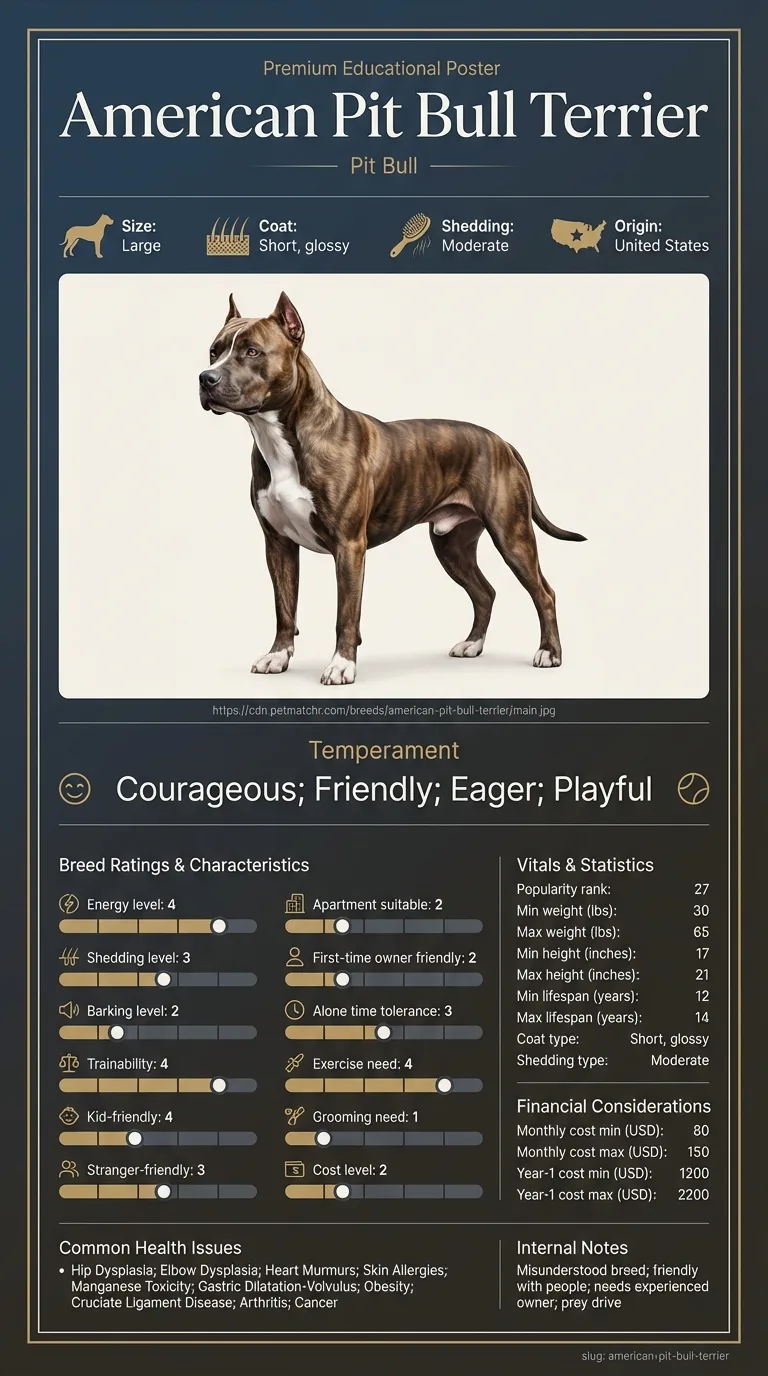
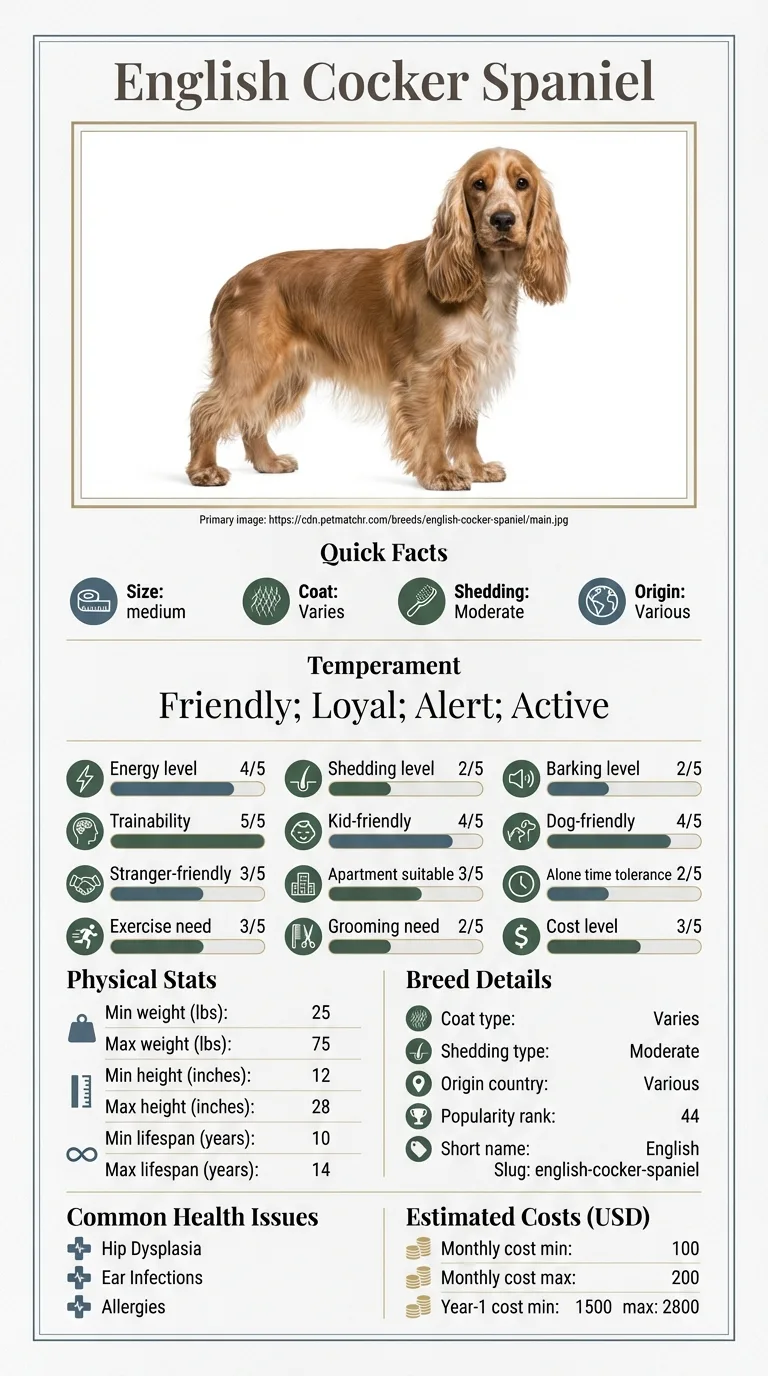
This is for someone already down to American Pit Bull Terrier and English Cocker Spaniel and deciding between them. For this pair the decision usually turns on grooming need and apartment suitability, so those are covered first and in most detail. Anyone choosing from a flat has a clear answer here: English Cocker Spaniel rates 4/5 against 2/5. It is written for the decision rather than the breed history.
Between American Pit Bull Terrier and English Cocker Spaniel, grooming need is what separates them; neither is the lower-effort dog overall.
Choose American Pit Bull Terrier if you do not want a standing grooming appointment, the dog will be alone during the working day and you want a dog that is more watchful with visitors.
Choose English Cocker Spaniel if you are in a flat or a smaller home, this is your first dog and there are young children at home.
| Feature | american pit bull terrier | english cocker spaniel | Winner |
|---|---|---|---|
| Size class | large | medium | Equal |
| Weight | 30–65 lbs | 26–34 lbs | Equal |
| Height | 17–21 in | 15–17 in | Equal |
| Lifespan | 12–14 years | 12–14 years | Equal |
| Exercise need | High (4/5) | High (4/5) | Equal |
| Grooming need | Very low (1/5) | High (4/5) | american pit bull terrier |
| Shedding | Moderate (3/5) | Moderate (3/5) | Equal |
| Energy level | High (4/5) | High (4/5) | Equal |
| Barking | Low (2/5) | Moderate (3/5) | american pit bull terrier |
| Apartment suitability | Low (2/5) | High (4/5) | english cocker spaniel |
| Good for first-time owners | Low (2/5) | High (4/5) | english cocker spaniel |
| Tolerates being alone | Moderate (3/5) | Low (2/5) | american pit bull terrier |
| Trainability | High (4/5) | High (4/5) | Equal |
| Good with kids | High (4/5) | Very high (5/5) | english cocker spaniel |
| Good with other dogs | Low (2/5) | High (4/5) | english cocker spaniel |
| Friendly to strangers | Moderate (3/5) | High (4/5) | english cocker spaniel |
| Cost level | Low (2/5) | Moderate (3/5) | american pit bull terrier |
| Coat | Short, glossy | Medium, silky and feathered | Equal |
| Origin | United States | Various | Equal |
| Typical monthly cost | $80–$150 | $100–$200 | Equal |
| Typical first-year cost | $1,200–$2,200 | $1,400–$2,900 | Equal |
The English Cocker Spaniel is the smaller, more compact dog here - 26-34 lbs and 15-17 inches against the Pit Bull's 30-65 lbs and 17-21 inches. It's not the dramatic gap you'd see against a toy breed, more a medium-versus-large distinction, but the Pit Bull's upper weight range still nearly doubles the Cocker's. If floor space or lifting the dog into a car matters to you, the Cocker is the far easier dog to manage physically.
These two tie on paper - both rate high (4/5) for exercise need and energy level. Don't let the Cocker's smaller frame fool you; it's a sporting breed bred for fieldwork, and it wants a real walk or play session daily, not a token trip around the yard. In practice this means neither dog is a good match for an owner who mostly wants a dog to nap beside them - both need a genuine daily outlet.
This is the biggest gap in the whole comparison: the Cocker rates high (4/5) for grooming need against the Pit Bull's very low (1/5), thanks to its medium, silky, feathered coat that mats and tangles without regular brushing. Shedding itself ties at moderate (3/5) for both, so the Cocker's grooming demand is about coat maintenance and occasional trimming, not the amount of hair you'll find on the couch.
The Cocker is the better fit for close quarters, scoring high (4/5) for apartment suitability against the Pit Bull's low (2/5). Barking leans slightly toward the Cocker too (3/5 versus 2/5), and it tolerates being alone worse - 2/5 against the Pit Bull's 3/5. So the more apartment-friendly dog is also the one that struggles more with an empty house.
Trainability ties at high (4/5) for both breeds. The bigger difference shows up in first-time-owner suitability, where the Cocker scores high (4/5) against the Pit Bull's low (2/5) - a meaningful gap if this is your first dog, since the Cocker's temperament (merry, biddable) is built to forgive a learning-curve owner in a way the Pit Bull's history and physical strength don't always allow for.
The Cocker wins across the board on social categories: good with kids (5/5 vs 4/5), good with other dogs (4/5 vs 2/5), and friendly to strangers (4/5 vs 3/5). None of these gaps are enormous individually, but stacked together they paint the Cocker as the more universally sociable dog, while the Pit Bull is still solid with people, just more selective with other dogs.
Lifespan ties at 12-14 years for both. Where they differ sharply is the length of the health list - the Cocker's is short, just five conditions (ear infections, PRA, hip dysplasia, familial nephropathy, adult-onset neuropathy), while the Pit Bull's runs to ten, including heart murmurs and bloat. Hip dysplasia is the one overlap worth watching in either dog, and a shorter list for the Cocker doesn't mean skip the vet checks.
The Pit Bull is the cheaper dog to keep on the overall rating (2/5 versus the Cocker's 3/5), though the monthly ranges are close - $80-150 versus $100-200. First-year costs diverge more, at $1,200-2,200 for the Pit Bull against $1,400-2,900 for the Cocker, likely reflecting that grooming bill from the coat difference above plus the occasional professional trim a feathered coat tends to need.
American Pit Bull Terrier weighs 30–65 lbs and lives 12–14 years; English Cocker Spaniel weighs 26–34 lbs and lives 12–14 years. The two diverge most on grooming need, apartment suitability and good for first-time owners and 1 other rated axes. They are level on energy level, exercise need and shedding, so those cannot decide it. In the table, a "winner" means easier for an ordinary household — not better. Size, coat and origin are recorded without a verdict. Because both breeds are scored the same way, the gaps are reliable even where the absolute numbers are rough.

The English Cocker Spaniel, at 26-34 lbs and 15-17 inches against the Pit Bull's 30-65 lbs and up to 21 inches.
They're tied at moderate (3/5) shedding, but the Cocker needs far more grooming effort (4/5 vs 1/5) because of its longer, feathered coat.
The Cocker, by a clear margin - 4/5 for first-time owners against the Pit Bull's 2/5. Its more universally sociable temperament backs that up.
The Cocker, rated 4/5 for apartment suitability versus the Pit Bull's 2/5, though it tolerates being alone slightly worse.
Modest - $100-200 monthly for the Cocker versus $80-150 for the Pit Bull, with the gap widening a bit in year one due to grooming costs.
Only at hip dysplasia. The Cocker's list is notably shorter overall - five conditions against the Pit Bull's ten - though a shorter list doesn't guarantee an easier medical history.
The Cocker, clearly - 4/5 versus the Pit Bull's 2/5. If you already have another dog at home, that gap matters.
The Cocker Spaniel, 4/5 versus the Pit Bull's 2/5 for apartment suitability.
$80-150 for the Pit Bull, $100-200 for the Cocker - a modest gap that widens somewhat in year one.
The Cocker Spaniel, rated 4/5 for first-time owners against the Pit Bull's 2/5.
The Cocker, by far - 4/5 versus the Pit Bull's 1/5, due to its longer feathered coat.
Secure checkout on Stripe. We never see your card.
7-day money-back guarantee. Instant access.
Health information here is general and is not veterinary advice. If your dog shows pain, sudden behaviour change, or worsening symptoms, consult a licensed veterinarian.
Some links on this site are affiliate links. We may earn a commission at no extra cost to you, and we only suggest products we believe are helpful for dog owners.
We research and check what we publish, but we do not warrant that any figure, date, price, or statement is accurate, complete, or current, and we accept no liability for any loss, cost, injury, or other harm arising from the use of this site. Use it as one reference among several. You remain responsible for your own decisions and for your dog's care - confirm anything that matters with a licensed veterinarian or another qualified professional before you act on it. Full disclaimer.
Match your lifestyle to the right dog.
Take quizNot sure which breed is right for you? Take our 2-minute quiz to find out.
Take the quiz