Costs
Weimaraner cost in Omaha
About $100–$218 a month and $1,547–$2,912 for year one at below-average Nebraska pricing — with the ability to visit a litter in person, and ask for health clearances, as the highest-leverage decision in the budget.

See Weimaraner price across all cities →
Quick answer
Weimaraner cost in Omaha
About $100–$218 a month and $1,547–$2,912 for year one at below-average Nebraska pricing — with the ability to visit a litter in person, and ask for health clearances, as the highest-leverage decision in the budget.
A Weimaraner in Omaha costs about $100 to $218 a month, with year one between $1,547 and $2,912 — comfortably under national norms, with a clearly seasonal prevention window keeping the annual vet line reasonable. The decision that moves this budget most is made before the dog exists: where the puppy comes from, and what documentation comes with it.
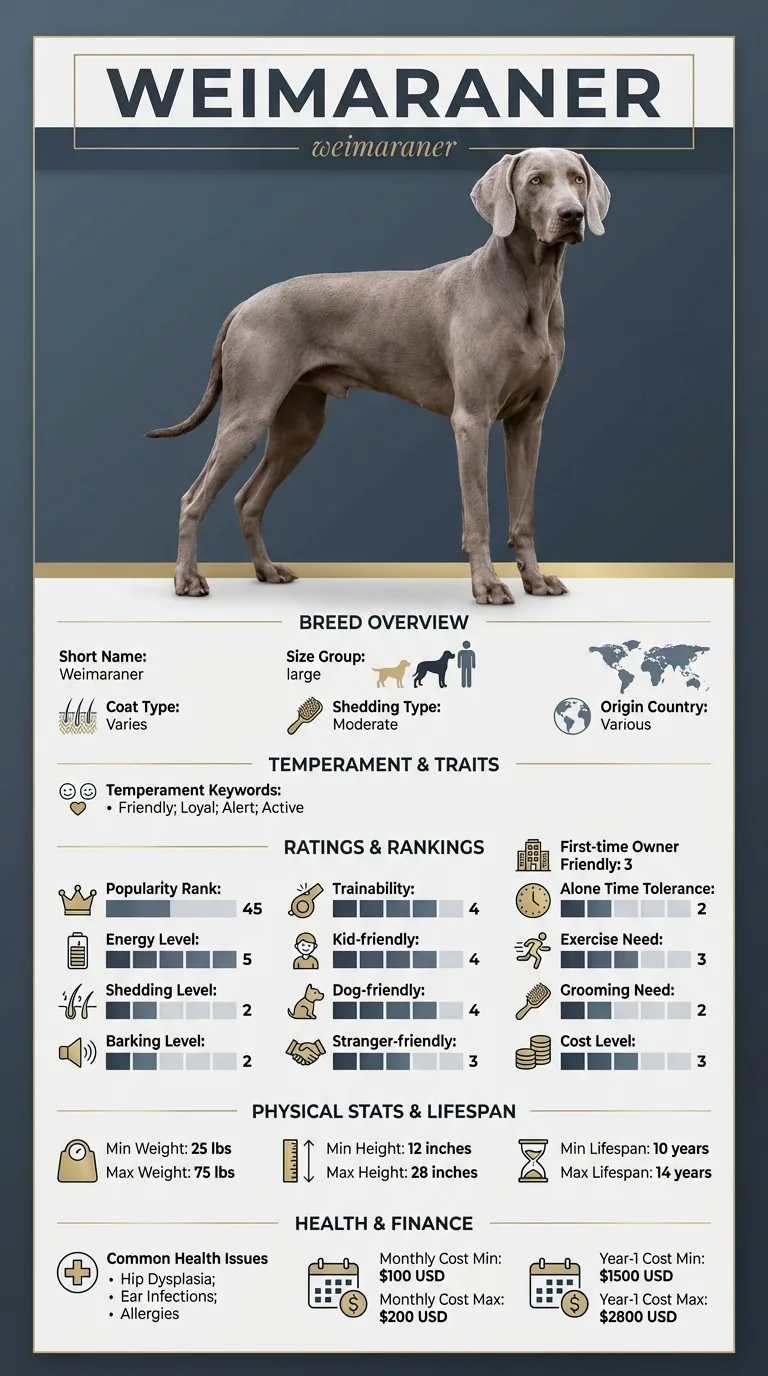
Bloat (GDV) is the surgical emergency this breed is best known for, and it is not something screening prevents. What screening does affect is the joint and clotting side of the list, and Separation Anxiety remains the entry most likely to become an ongoing monthly cost regardless of pedigree.
Omaha's ongoing costs are modest, which puts more weight than usual on the one-off decisions made at the start of the dog's life.
Estimate · source: estimation · confidence: medium · updated 2026-09-06 · not a quote
| Item | Cost range |
|---|---|
Visiting litters and reviewing health documentation Fuel and time rather than fees — the cheapest risk management available to a buyer of this breed. | $40 - $250 |
One-time setup: exam, spay or neuter, crate, gear and winter coat Large-breed sizing throughout, including insulation the short coat cannot supply itself. | $437 - $728 |
| Item | Cost range |
|---|---|
Food for a 55-to-90-pound sporting dog Priced at Nebraska's below-average retail for an athletic dog at this weight. | $50 - $86 |
Each range starts from a national baseline for this breed's size class and is then adjusted for local cost of living and veterinary pricing. The baselines, and the source each one came from, are listed on our sources page (dataset 2026.09). Two inputs, the purchase price and the emergency reserve, have no published national figure we could verify, so we leave them to you rather than invent them.
These are planning estimates, not quotes. Your own numbers will move with the individual dog, your vet and your insurer. Build a budget with your own figures.
Screening and insurance cover different parts of the same list — one shifts the odds on inherited conditions, the other pays for the emergency nobody can screen out.
Quote it in the puppy year, before any finding of any kind exists on the record.
Omaha's low ongoing costs make a funded reserve realistic for a disciplined household.
In Omaha the ongoing costs largely take care of themselves, so the decisions worth agonising over all happen before the puppy comes home.
Purchase price is the line most buyers compare and the least useful one in isolation. A cheaper puppy with no documentation and an expensive puppy with hip clearances on both parents are not the same product, and the difference does not show up for two or three years.
The questions worth asking are specific and reasonable: are the parents' hips evaluated, has clotting status been established, what does the breeder do about growth-stage feeding, and can you see where the litter is being raised. A breeder who welcomes those questions is the point of the exercise. One who deflects them has answered anyway.
Being within driving distance is what makes this practical rather than theoretical. Omaha sits in a region with plenty of dogs and plenty of breeders, and a Saturday round trip to see a litter in person costs a tank of fuel. Against a potential orthopedic bill years later, that is the highest-leverage money in this entire budget — and most of it is not money at all.
Nebraska's general costs run under national norms, and Omaha follows that pattern cleanly across food, routine care and the one-time setup a large dog requires. Nothing on this page is expensive by national standards.
The prevention window runs about seven months, which is a straightforward saving on weight-dosed products for a 55-to-90-pound dog. Combined with below-average local rates, the annual veterinary line here is one of the more comfortable on this list.
Winter still asks for the one purchase this breed cannot make for itself. The coat is documented as short and sleek with low to moderate shedding — no groomer, ever, which is a genuine saving, and no insulation either, which is a genuine cost. An insulated coat is what keeps a maximum-exercise dog properly worked through a Nebraska January instead of pacing indoors.

An Omaha household had a deposit ready on a puppy advertised several states away, sight unseen. Before sending it they drove two hours to see a smaller local litter instead. The breeder had hip evaluations for both parents on the table, answered the clotting question without hesitation, and explained exactly what the puppies were being fed and why. They paid slightly more than the online listing and went home with paperwork rather than promises — which, for a breed whose documented health list is this heavily inherited, was the point.
Key takeaway: Around Omaha the most valuable thing a buyer of this breed can do is turn up in person, because the questions that matter are ones you can only really ask face to face.
About $100 to $218, below national norms, helped by Nebraska's moderate costs and a seasonal prevention window.
Roughly $1,547 to $2,912 in care costs, covering the first exam, vaccine series, spay or neuter if chosen, and large-breed crate, gear and a winter coat — purchase price sits on top of that.
Hip evaluations on both parents, clotting status given this breed's documented inherited bleeding disorder, how the puppies are being fed during growth, and whether you can visit the litter in person.
It buys documentation rather than a guarantee. Health-screened parents shift the odds on the heritable parts of this breed's documented list, and those are the conditions with four-figure treatment costs.
Worth quoting while the dog is young. Screening does not touch bloat, which remains this breed's most expensive single event.
Around $760, sized against a single overnight surgical emergency rather than against routine care, which is inexpensive here.
About $100–$218 a month and $1,547–$2,912 for year one at below-average Nebraska pricing — with the ability to visit a litter in person, and ask for health clearances, as the highest-leverage decision in the budget.
This guide is not medical advice. If your dog shows pain, sudden behavior change, or worsening symptoms, consult a licensed veterinarian.
Some links may be affiliate links. We may earn a commission at no extra cost to you. We only suggest products we believe are helpful for dog owners.
We research and check what we publish, but we do not warrant that any figure, date, price, or statement is accurate, complete, or current, and we accept no liability for any loss, cost, injury, or other harm arising from the use of this site. Use it as one reference among several. You remain responsible for your own decisions and for your dog's care - confirm anything that matters with a licensed veterinarian or another qualified professional before you act on it. Full disclaimer.
One sheet with every line item, the emergency fund and when insurance pays off - unlocks on this page.
You get: 12-month budget sheet
No spam. One-click unsubscribe. See our privacy policy.
See a sample page before you decide.