Costs
Weimaraner cost in Honolulu
About $171–$372 a month and $2,635–$4,960 for year one, the highest on this site — plus advance import compliance for any dog arriving from the mainland, and no off-island fallback in an emergency.

See Weimaraner price across all cities →
Quick answer
Weimaraner cost in Honolulu
About $171–$372 a month and $2,635–$4,960 for year one, the highest on this site — plus advance import compliance for any dog arriving from the mainland, and no off-island fallback in an emergency.
Honolulu is the most expensive city on this site for a Weimaraner: roughly $171 to $372 a month, and $2,635 to $4,960 across year one. Shipping costs sit underneath the price of every bag of food and every piece of gear. But the two things that genuinely distinguish owning this breed here are not on the receipt at all — the island's import rules, and the fact that there is no next city to drive to.
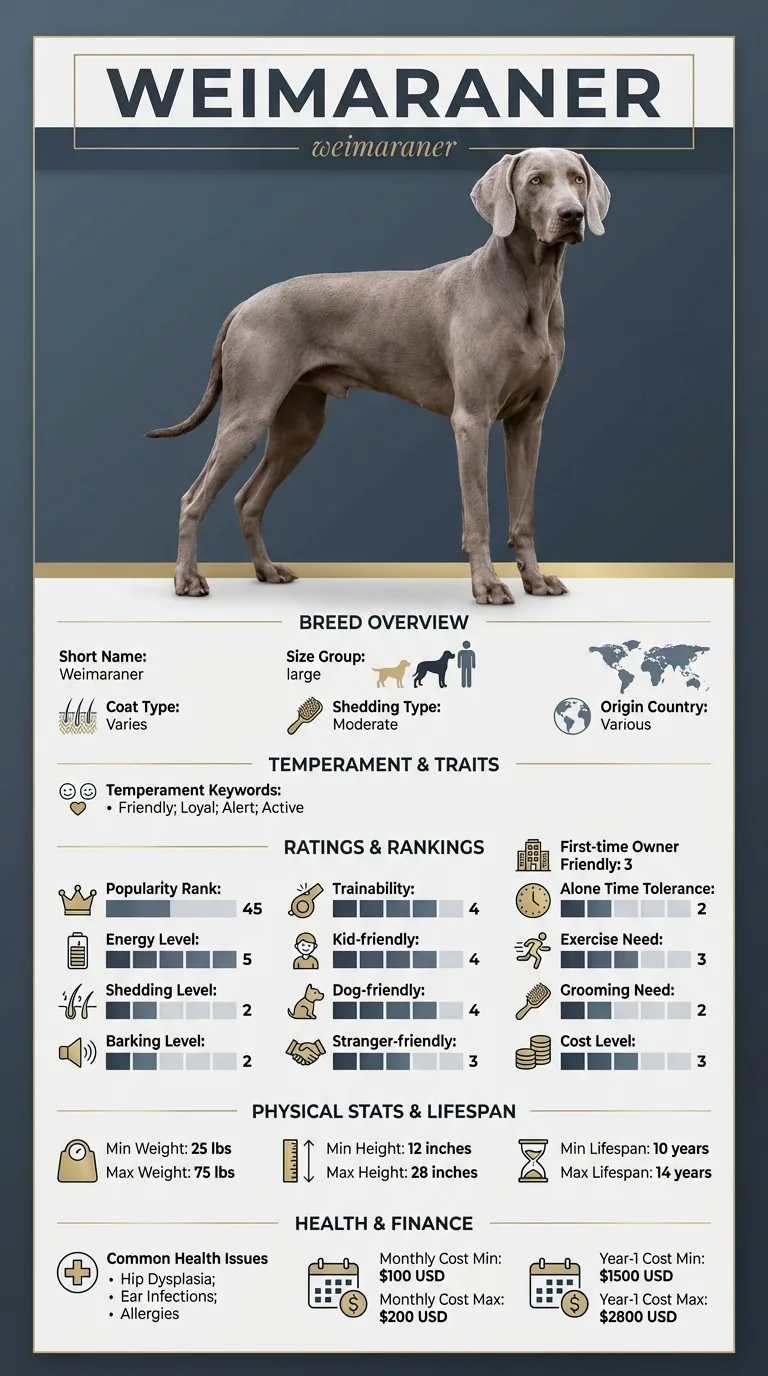
Bloat (GDV), Hip Dysplasia, Hypertrophic Osteodystrophy, Von Willebrand Disease and Separation Anxiety are documented in this breed. Hawaii's price level means every one of them generates a bigger invoice, and a twelve-month parasite season keeps the routine line permanently at full length.
Honolulu's figures are the highest on this site, with a twelve-month preventive schedule and, for arriving dogs, an import process that has to be budgeted and started months ahead.
Estimate · source: estimation · confidence: medium · updated 2026-09-06 · not a quote
| Item | Cost range |
|---|---|
Import compliance for a dog arriving from the mainland Vaccination, microchipping, blood testing and processing fees, done in the right order and far enough ahead. Confirm current requirements with the state before booking travel. | $400 - $1200 |
One-time setup: exam, spay or neuter, crate and gear Large-breed sizing at the highest retail pricing on this site. | $744 - $1240 |
| Item | Cost range |
|---|---|
Food shipped to the islands for a large sporting dog Freight is embedded in every bag, and a 55-to-90-pound athletic dog gets through a lot of them. | $85 - $147 |
Each range starts from a national baseline for this breed's size class and is then adjusted for local cost of living and veterinary pricing. The baselines, and the source each one came from, are listed on our sources page (dataset 2026.09). Two inputs, the purchase price and the emergency reserve, have no published national figure we could verify, so we leave them to you rather than invent them.
These are planning estimates, not quotes. Your own numbers will move with the individual dog, your vet and your insurer. Build a budget with your own figures.
Given the price level and the absence of any cheaper alternative facility, insurance carries more weight in Honolulu than in any other market we cover.
Enrol before arrival if possible, so the policy predates any finding recorded during the relocation process.
Only for households with genuinely large liquid reserves, since the local ceiling on a bad night is higher than almost anywhere.
Honolulu savings come from buying in volume, starting the import process early, and using the cool early hours the climate allows.
Mainland emergency planning always includes a fallback: a bigger hospital an hour away, a teaching facility two hours away, a specialist you could reach by morning. Island planning has no such layer. Air transport is not a realistic response to a dog whose stomach has twisted tonight.
The practical consequences are all about preparation. Identify the after-hours capacity on O'ahu now. Ask your regular veterinarian directly what they would do with a surgical case at midnight, and note the answer. Keep the reserve — around $1,300 at Honolulu pricing — genuinely liquid.
None of this is pessimism. It is simply that the standard advice to shop around, get a second opinion, or drive further for better pricing does not apply, and a plan built on those assumptions will not survive contact with a real emergency here.
Hawaii operates its own animal import requirements, built around keeping the state free of rabies. A dog arriving from the mainland needs specific vaccinations, microchipping and blood testing completed in advance, with waiting periods and fees attached, and the whole point of doing it correctly is to avoid a longer stay in quarantine on arrival.
That is a real, plannable one-time cost that belongs in a first-year budget for anyone relocating with this breed, and it has to be started months before the flight rather than weeks.
Once here, the recurring picture is simple and expensive: twelve months of parasite prevention at the top weight bracket for a 55-to-90-pound dog, food priced for freight, and a climate warm enough that a maximum-exercise breed does its work early in the morning or not at all. Grooming, at least, stays free — this coat is documented as short, sleek and low-shedding.

A family relocating from California to O'ahu with a young Weimaraner started looking at the state's animal import requirements six weeks before their flight and discovered the vaccination and blood-testing timeline did not fit. They ended up rearranging travel so the dog arrived later, which cost them a temporary boarding arrangement on the mainland and a good deal of stress. Their advice to anyone else was the same one this page gives: the paperwork clock starts long before the moving date.
Key takeaway: In Honolulu the two costs that surprise people are the ones you cannot solve with money on the day — import timelines before arrival, and the absence of an off-island fallback afterwards.
About $171 to $372, the highest baseline on this site, driven by shipping costs and Hawaii's general price level.
Roughly $2,635 to $4,960 before import costs. If you are relocating a dog to the islands, add the vaccination, testing and processing fees separately.
Advance vaccination, microchipping and blood testing with defined waiting periods and fees, all completed before travel. Check current requirements with the state well ahead of any move — the timelines are long.
Because there is no fallback facility a drive away. For a breed with documented bloat risk, on-island capacity is the whole option set, so you need to know it in advance.
The financial case is the strongest of any city here, because local pricing makes every serious episode expensive.
Around $1,300, in cash you can move immediately rather than credit you would have to arrange.
About $171–$372 a month and $2,635–$4,960 for year one, the highest on this site — plus advance import compliance for any dog arriving from the mainland, and no off-island fallback in an emergency.
This guide is not medical advice. If your dog shows pain, sudden behavior change, or worsening symptoms, consult a licensed veterinarian.
Some links may be affiliate links. We may earn a commission at no extra cost to you. We only suggest products we believe are helpful for dog owners.
We research and check what we publish, but we do not warrant that any figure, date, price, or statement is accurate, complete, or current, and we accept no liability for any loss, cost, injury, or other harm arising from the use of this site. Use it as one reference among several. You remain responsible for your own decisions and for your dog's care - confirm anything that matters with a licensed veterinarian or another qualified professional before you act on it. Full disclaimer.
One sheet with every line item, the emergency fund and when insurance pays off - unlocks on this page.
You get: 12-month budget sheet
No spam. One-click unsubscribe. See our privacy policy.
Preview page 1 before you decide.