Health
Is BOAS a real risk for Weimaraners?
No, BOAS is documented in flat-faced breeds like Bulldogs and Pugs, not in the long-muzzled Weimaraner.

Quick answer
Is BOAS a real risk for Weimaraners?
No, BOAS is documented in flat-faced breeds like Bulldogs and Pugs, not in the long-muzzled Weimaraner.
BOAS sounds like the kind of breathing problem worth worrying about in any dog, but it's a structural issue tied to a skull shape the Weimaraner simply doesn't have.
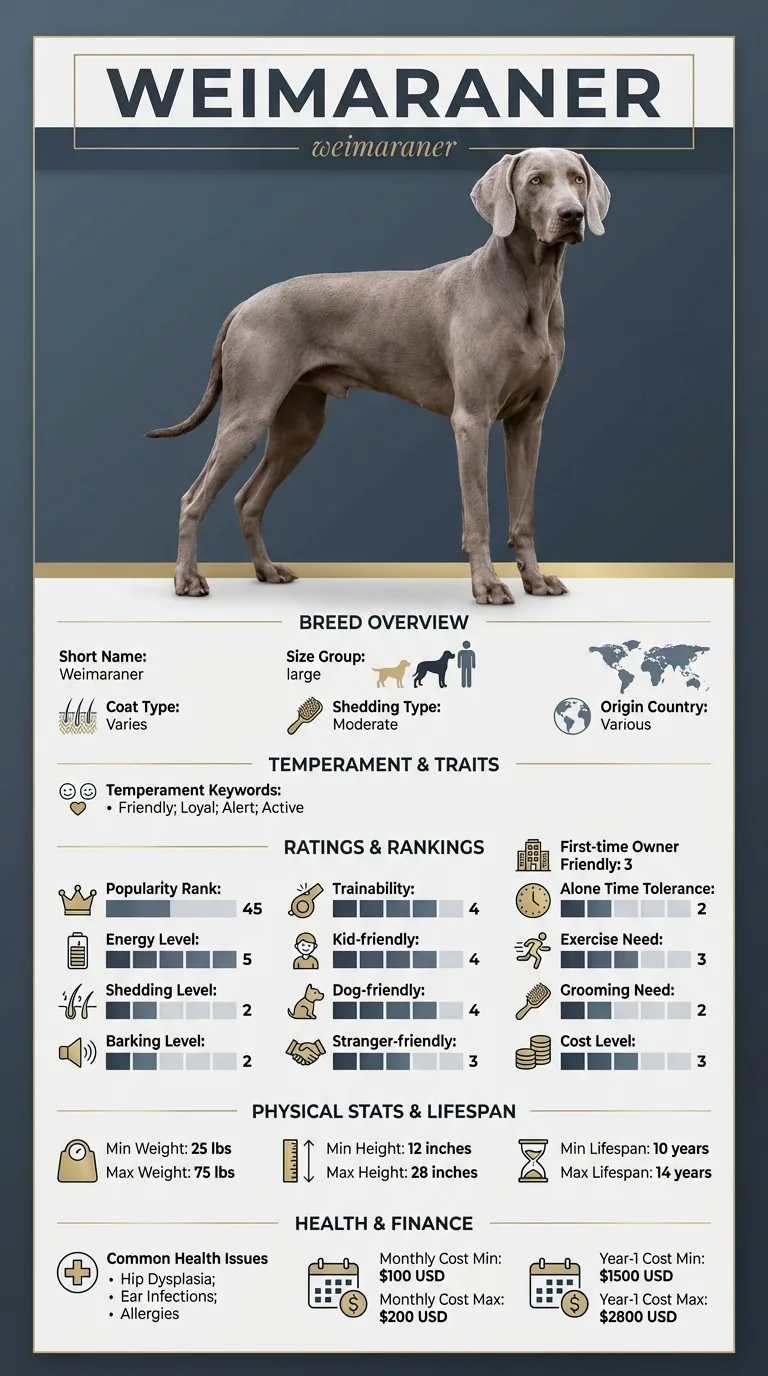
Owners who've read breathing-risk content written for flat-faced breeds and want to know whether any of it applies to their long-nosed Weimaraner are the audience for this page.
This guide is not medical advice. If your dog shows pain, sudden behavior change, or worsening symptoms, consult a licensed veterinarian.
Some links may be affiliate links. We may earn a commission at no extra cost to you. We only suggest products we believe are helpful for dog owners.
We research and check what we publish, but we do not warrant that any figure, date, price, or statement is accurate, complete, or current, and we accept no liability for any loss, cost, injury, or other harm arising from the use of this site. Use it as one reference among several. You remain responsible for your own decisions and for your dog's care - confirm anything that matters with a licensed veterinarian or another qualified professional before you act on it. Full disclaimer.
Brachycephalic Airway Syndrome is a well-documented structural breathing condition in extremely short-muzzled breeds like Bulldogs, French Bulldogs, and Pugs, and it isn't established as occurring in Weimaraners. A Weimaraner's proportionate, elongated muzzle doesn't produce the airway crowding that causes BOAS, so owners are better served focusing on the breed's actual documented risks, especially bloat.
BOAS is common enough within flat-faced breeds that some studies estimate a majority of Bulldogs show at least some clinical signs, but it has no established prevalence in Weimaraners because the anatomical cause doesn't exist in this breed. For a Weimaraner, breathing changes are far more likely to trace back to exertion, heat, or a genuine breed risk like bloat than to any BOAS-type airway malformation.
BOAS is driven by generations of breeding flat-faced dogs for an increasingly shortened skull, which crowds the soft palate, nasal passages, and throat tissue into a small space. Weimaraners were bred in the opposite direction, for a long, functional muzzle suited to tracking scent over distance, so this genetic driver simply isn't present in the breed's structure.
Because the anatomical cause of BOAS doesn't exist in Weimaraners, there are no environmental triggers that turn this specific condition on in the breed. The environmental factors actually worth managing in a Weimaraner are heat and overexertion, which can cause real but separate problems like heatstroke or contribute to bloat risk around mealtimes.
Contact a vet promptly if panting doesn't resolve with rest, if gums look pale or blue, or if you notice a swollen abdomen or repeated unproductive retching. These point toward heatstroke or bloat, the genuine emergencies relevant to this breed, rather than a BOAS-type airway issue.
A condition that's genuinely serious in other breeds can create unnecessary worry when misapplied to a Weimaraner. Watch for these specific mistakes.
See all Weimaraner health problems, which breeds are prone to brachycephalic airway syndrome boas, or the full Weimaraner breed guide for temperament, exercise needs and ownership costs.
There's no timeline to track for BOAS in this breed because it isn't a condition Weimaraners develop. The more useful timeline is lifelong: staying alert to bloat risk factors and heat management for as long as you own the dog.
Success here means recognizing that a Weimaraner's loud panting or breathlessness after a hard run is normal athletic behavior, and redirecting real vigilance toward the breed's documented risks like bloat, hip dysplasia, and von Willebrand disease. Owners who make this shift spend less energy worrying about an irrelevant condition and more on the health issues that actually affect this breed.
BOAS results from breeding for an extremely shortened skull, which compresses the soft tissue of the nose, throat, and soft palate into too little space. The Weimaraner is proportioned closer to a natural, wolf-like muzzle length rather than a compressed one. There's no structural reason for the airway crowding that defines BOAS to occur in this breed.
Veterinary literature on BOAS consistently names English Bulldogs, French Bulldogs, Pugs, and Boston Terriers as the breeds where elongated soft palates, stenotic nares, and everted laryngeal saccules are documented problems. Weimaraners don't appear on these lists, and there's no evidence of a comparable airway malformation in the breed. A Weimaraner's nostrils, throat, and palate develop with normal proportions for a working, scent-driven dog.
This doesn't mean Weimaraners never pant hard or sound loud when excited; an energetic, athletic breed working at full speed will breathe heavily as a completely normal response. The distinction is that this panting resolves quickly with rest and isn't paired with the audible obstruction, exercise intolerance, or collapse seen in true BOAS cases.

Even without BOAS, Weimaraners are a high-drive breed that can push past safe limits during hot-weather exercise, so heat exhaustion and heatstroke are genuine risks worth managing directly. Watch for excessive drooling, uncoordinated movement, bright red gums, or panting that won't settle even after rest, and treat any of these as reasons to cool the dog and call a vet.
A more breed-relevant concern after strenuous exercise or a large meal is bloat (gastric dilatation-volvulus), a true emergency in deep-chested breeds like the Weimaraner that can look distressing in ways owners sometimes mistake for a breathing problem. Signs include a visibly swollen abdomen, unproductive retching, and restlessness, and this needs immediate emergency care rather than home management.
The practical takeaway mirrors other breed-mismatch topics: redirect real concern about breathing or collapse in a Weimaraner toward the conditions actually documented in the breed, especially bloat, rather than a flat-faced airway syndrome that doesn't apply here.

After moving to Asheville, North Carolina, Priya started taking her two-year-old Weimaraner, Sable, on long trail runs and noticed her breathing hard and loudly for several minutes afterward. A neighbor's French Bulldog had just been diagnosed with BOAS, and Priya worried Sable might have something similar. Her vet examined Sable's throat and palate, found completely normal anatomy for the breed, and explained that BOAS doesn't occur in dogs with a muzzle length like Sable's. The visit shifted instead toward practical guidance: hydration during trail runs, watching for bloat symptoms after Sable's meals, and recognizing that her loud recovery panting was simply how a fit, hardworking Weimaraner cools down.
Key takeaway: Loud panting after exercise in a Weimaraner is normal athletic recovery, not a sign of the flat-faced airway condition that affects breeds like French Bulldogs; real vigilance for this breed belongs on bloat and its other documented health risks.
No. BOAS is a structural airway condition tied to the extremely shortened skulls of breeds like Bulldogs, French Bulldogs, and Pugs, and it isn't recognized as occurring in the long-muzzled Weimaraner.
Weimaraners are a high-energy working breed, and loud panting after exertion is a normal cooling response rather than a sign of airway obstruction. If panting doesn't settle within a reasonable rest period or is paired with collapse or blue-tinged gums, that warrants an urgent vet visit regardless of breed.
English Bulldogs, French Bulldogs, Pugs, and Boston Terriers are the breeds most consistently documented with BOAS due to their extremely shortened, flattened skulls. The Weimaraner's proportionate, elongated muzzle keeps it outside that group entirely.
Occasional snoring can happen in any dog, including Weimaraners, usually from sleeping position or mild nasal congestion. Persistent, loud snoring paired with daytime breathing effort is unusual for this breed and is worth a vet check, though it isn't a sign of BOAS in this breed.
The condition most likely to present with breathing distress in a Weimaraner is bloat (GDV), where a distended, gas-filled stomach restricts normal chest expansion. This is unrelated to airway anatomy and requires immediate emergency surgery, unlike BOAS, which is managed surgically on the airway itself in other breeds.
Yes, in a protective way. The breed was developed for endurance scent work in the field, which favored a long, open airway and muzzle rather than the compressed structure that causes BOAS in flat-faced breeds.
Focus on the conditions genuinely documented in the breed: bloat (GDV), hip dysplasia, hypertrophic osteodystrophy, von Willebrand disease, and separation anxiety. These are where a Weimaraner owner's vigilance and vet conversations are actually useful.
No, BOAS is documented in flat-faced breeds like Bulldogs and Pugs, not in the long-muzzled Weimaraner.
It's almost always normal exertional panting in an athletic breed, not airway obstruction.
Heat exhaustion and heatstroke are real risks during intense exercise, so schedule hard activity for cooler hours.
BOAS corrective surgery has no relevance to this breed since the underlying flat-faced anatomy doesn't occur here.
Training doesn't change airway anatomy, but teaching a solid settle cue helps a high-drive Weimaraner cool down after exertion.
A one-page prep sheet for this condition: the signs, the questions to ask, what to get priced. Unlocks here.
You get: Vet visit prep sheet
No spam. One-click unsubscribe. See our privacy policy.
Preview page 1 before you decide.