Behavior
Lower-shedding coat?
The Weimaraner, rated low (2/5) shedding versus the Saint Bernard's high (4/5).

Quick answer
Lower-shedding coat?
The Weimaraner, rated low (2/5) shedding versus the Saint Bernard's high (4/5).
Saint Bernard or Weimaraner? On paper they differ most on exercise need, and on the scales Saint Bernard is the heavier at 120–180 lbs. Here is how the two compare on everything that shapes an ordinary week.
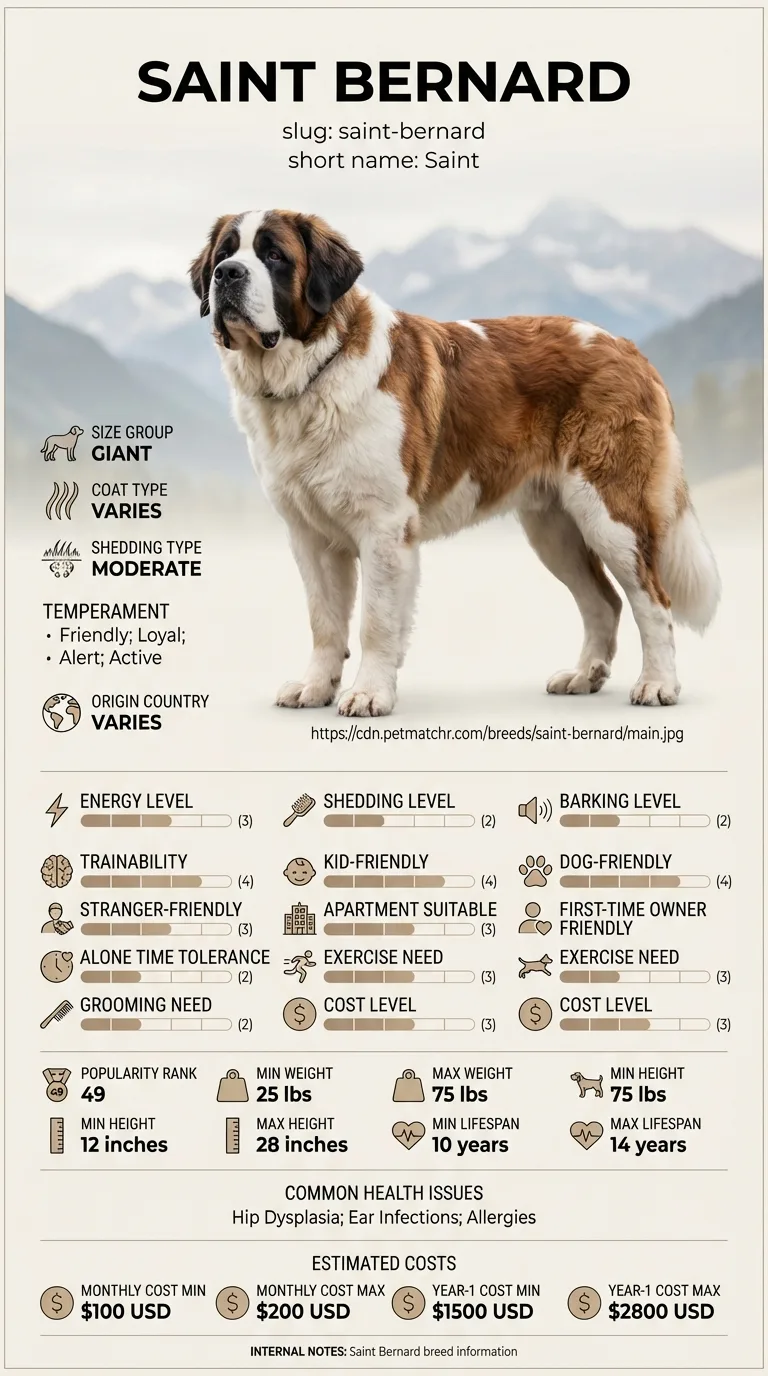
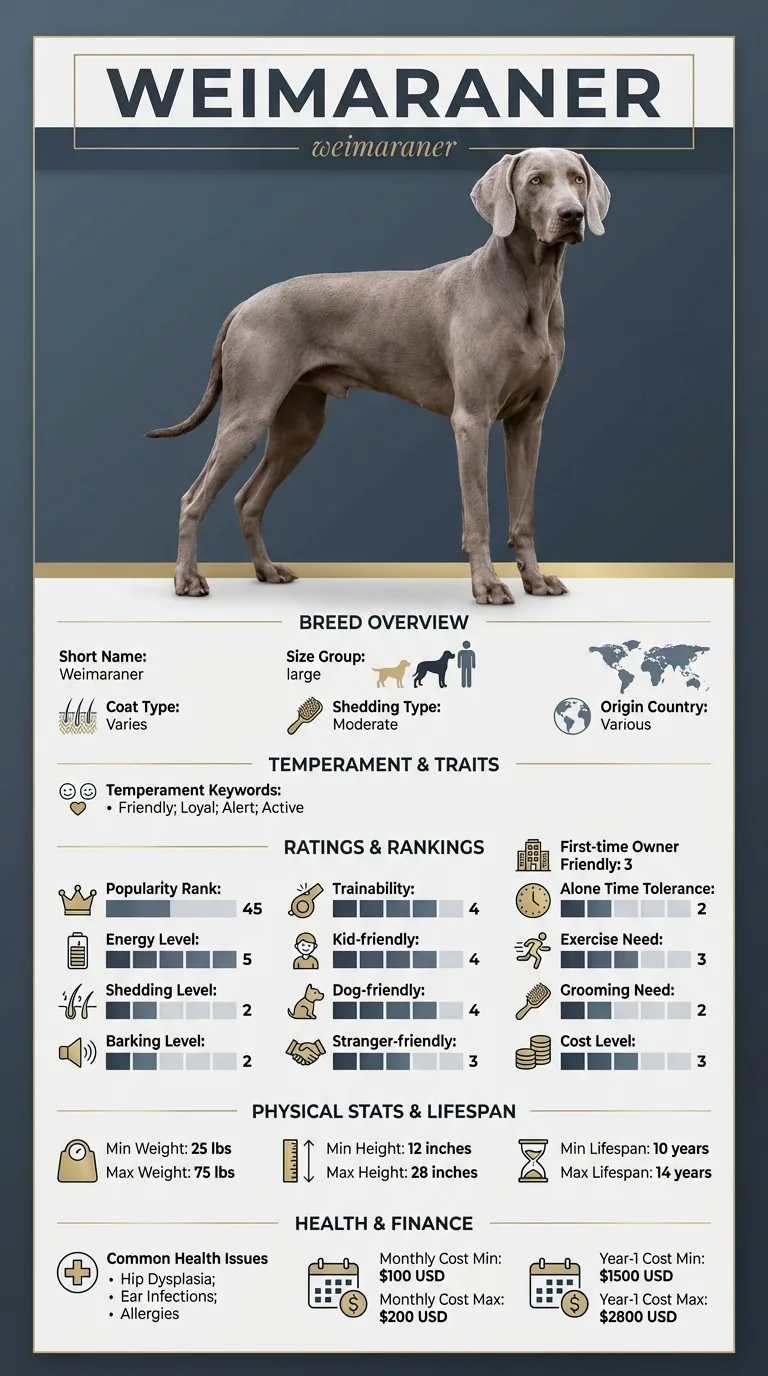
This is for someone already down to Saint Bernard and Weimaraner and deciding between them. For this pair the decision usually turns on exercise need and energy level, so those are covered first and in most detail. Both rate 1/5 for flats, so housing does not settle this one. It is written for the decision rather than the breed history.
Between Saint Bernard and Weimaraner, exercise need is what separates them, and Saint Bernard is the lower-effort dog of the two to keep.
Choose Saint Bernard if this is your first dog, your walking routine is modest and the dog will be alone during the working day.
Choose Weimaraner if you do not want a standing grooming appointment, shedding is a problem in your house and you want a dog that picks up training quickly.
| Feature | saint bernard | weimaraner | Winner |
|---|---|---|---|
| Size class | giant | large | Equal |
| Weight | 120–180 lbs | 55–90 lbs | Equal |
| Height | 26–30 in | 23–27 in | Equal |
| Lifespan | 8–10 years | 10–13 years | weimaraner |
| Exercise need | Low (2/5) | Very high (5/5) | saint bernard |
| Grooming need | Moderate (3/5) | Very low (1/5) | weimaraner |
| Shedding | High (4/5) | Low (2/5) | weimaraner |
| Energy level | Low (2/5) | Very high (5/5) | Equal |
| Barking | Low (2/5) | Moderate (3/5) | saint bernard |
| Apartment suitability | Very low (1/5) | Very low (1/5) | Equal |
| Good for first-time owners | Moderate (3/5) | Low (2/5) | saint bernard |
| Tolerates being alone | Moderate (3/5) | Very low (1/5) | saint bernard |
| Trainability | Moderate (3/5) | High (4/5) | weimaraner |
| Good with kids | Very high (5/5) | High (4/5) | saint bernard |
| Good with other dogs | High (4/5) | Moderate (3/5) | saint bernard |
| Friendly to strangers | High (4/5) | Moderate (3/5) | saint bernard |
| Cost level | Very high (5/5) | Moderate (3/5) | weimaraner |
| Coat | Short or long double coat | Short and sleek | Equal |
| Origin | Various | Various | Equal |
| Typical monthly cost | $150–$310 | $110–$240 | Equal |
| Typical first-year cost | $2,200–$4,200 | $1,700–$3,200 | Equal |
The Weimaraner's 55–90 lb, 23–27 inch frame is substantial in its own right, but the Saint Bernard's 120–180 lbs and 26–30 inches still outweighs it by roughly double at the high end. Both are large dogs that need real space, though the Weimaraner's build is athletic and lean — the breed is nicknamed the 'Gray Ghost' for its sleek, silver-gray coat and rangy build — while the Saint Bernard carries dense, heavy mass. A household choosing between them should note that the Weimaraner, while smaller on paper, is still too big to treat as a small-space dog.
The Saint Bernard's low (2/5) exercise need sits at the opposite end of the scale from the Weimaraner's very high (5/5), a rating that matches its history as an all-day hunting companion. The Weimaraner's "Energetic" and "Headstrong" temperament tags describe a dog that needs both physical exertion and mental engagement or it will find its own outlets, often destructive ones. This is one of the largest exercise-need gaps in this comparison set — a household that can offer an hour or more of vigorous daily activity suits the Weimaraner, while a lower-activity household suits the Saint Bernard far better.
The Weimaraner's short, sleek coat needs very low (1/5) grooming and sheds only low (2/5), a stark contrast to the Saint Bernard's moderate (3/5) grooming need and high (4/5) shedding. A quick weekly wipe-down covers most of the Weimaraner's coat care, while the Saint Bernard requires more regular brushing plus drool cleanup. For owners prioritizing minimal coat maintenance, the Weimaraner is the clearly easier breed, though its thin coat also means less natural insulation in cold weather compared to the Saint Bernard's coat, built for snow.
Both breeds rate very low (1/5) for apartment suitability, so neither is a realistic small-space dog despite the size difference between them. Barking rates low (2/5) for the Saint Bernard against moderate (3/5) for the Weimaraner. Alone-time tolerance is where the real gap sits: moderate (3/5) for the Saint Bernard versus very low (1/5) for the Weimaraner, a breed well known for separation anxiety — which appears directly on its own health/behavior list — making long unsupervised stretches genuinely risky for the dog's wellbeing, not just an inconvenience.
Trainability rates high (4/5) for the Weimaraner against moderate (3/5) for the Saint Bernard, but the Weimaraner's "Headstrong" temperament tag is a real caveat — this is a smart, capable breed that also tests boundaries, and its low (2/5) first-time-owner rating (versus the Saint Bernard's moderate 3/5) reflects how much consistent, confident handling it needs. A Weimaraner responds well to structured training but can take advantage of an inexperienced or inconsistent owner. The Saint Bernard's more moderate profile across both metrics makes it the gentler learning curve for someone new to dog ownership.
The Saint Bernard edges ahead with kids — very high (5/5) versus the Weimaraner's high (4/5) — and with other dogs, high (4/5) versus moderate (3/5). Strangers rate moderate (3/5) for both breeds. The Weimaraner's intensity and strong prey drive, consistent with its hunting background, mean supervision matters more around small children and smaller pets than the raw numbers alone suggest. Families wanting the more consistently laid-back household dog will likely lean toward the Saint Bernard, while those wanting an athletic, devoted companion for an active family may prefer the Weimaraner.
The Weimaraner's 10–13 year lifespan runs ahead of the Saint Bernard's 8–10 years, and both breeds share Bloat (GDV) and Hip Dysplasia risk as deep-chested large dogs. The Weimaraner's list adds Hypertrophic Osteodystrophy, Von Willebrand Disease (a blood-clotting disorder worth knowing before any surgery), and Separation Anxiety, while the Saint Bernard's list adds Elbow Dysplasia, Dilated Cardiomyopathy, and Entropion. Given that both breeds share bloat risk, owners of either should learn the warning signs and consider slow-feed bowls or a preventive gastropexy discussion with their vet.
Cost level rates very high (5/5) for the Saint Bernard against moderate (3/5) for the Weimaraner, with monthly costs of $150–310 versus $110–240 and first-year costs of $2,200–4,200 versus $1,700–3,200 — a narrower gap than some other pairings, since the Weimaraner is still a large, food-hungry dog in its own right. Its very-low (1/5) grooming need helps offset that food cost. Saint Bernard owners should expect the largest single cost driver to remain sheer food volume, given the breed's weight advantage over the Weimaraner even at the low end of both ranges.
Saint Bernard weighs 120–180 lbs and lives 8–10 years; Weimaraner weighs 55–90 lbs and lives 10–13 years. The two diverge most on exercise need, energy level and grooming need and 3 other rated axes. Almost every rated axis separates them at least slightly. In the table, a "winner" means easier for an ordinary household — not better. Size, coat and origin are recorded without a verdict. Because both breeds are scored the same way, the gaps are reliable even where the absolute numbers are rough.

The Weimaraner, rated very high (5/5) against the Saint Bernard's low (2/5) — this breed was built for all-day fieldwork.
The Weimaraner, with very low (1/5) grooming need and low (2/5) shedding, versus the Saint Bernard's moderate (3/5) grooming and high (4/5) shedding.
No — it rates very low (1/5) for alone tolerance and is specifically prone to separation anxiety, which appears on its own health list.
The Saint Bernard, rated very high (5/5) with kids versus the Weimaraner's high (4/5), though both are solid choices.
Yes — Bloat (GDV) appears on both health lists, a real concern for these deep-chested large breeds.
The Weimaraner, tagged 'Headstrong' in temperament, despite rating higher than the Saint Bernard on raw trainability (4/5 versus 3/5).
The Weimaraner, at $110–240 versus the Saint Bernard's $150–310, though the gap is narrower than with smaller comparison breeds.
The Weimaraner, rated low (2/5) shedding versus the Saint Bernard's high (4/5).
The Weimaraner — it's rated very low (1/5) for alone tolerance and separation anxiety appears on its own health list.
The Saint Bernard, rated high (4/5) versus the Weimaraner's moderate (3/5).
The Weimaraner, at 10–13 years versus the Saint Bernard's 8–10.
Secure checkout on Stripe. We never see your card.
7-day money-back guarantee. Instant access.
Health information here is general and is not veterinary advice. If your dog shows pain, sudden behaviour change, or worsening symptoms, consult a licensed veterinarian.
Some links on this site are affiliate links. We may earn a commission at no extra cost to you, and we only suggest products we believe are helpful for dog owners.
We research and check what we publish, but we do not warrant that any figure, date, price, or statement is accurate, complete, or current, and we accept no liability for any loss, cost, injury, or other harm arising from the use of this site. Use it as one reference among several. You remain responsible for your own decisions and for your dog's care - confirm anything that matters with a licensed veterinarian or another qualified professional before you act on it. Full disclaimer.
Match your lifestyle to the right dog.
Take quizNot sure which breed is right for you? Take our 2-minute quiz to find out.
Take the quiz