Health
Is hip dysplasia a recognized concern in Weimaraners specifically?
Yes, it's a documented health issue for the breed and is tracked through national hip screening databases.

Quick answer
Is hip dysplasia a recognized concern in Weimaraners specifically?
Yes, it's a documented health issue for the breed and is tracked through national hip screening databases.
Hip screening data doesn't tell you your future dog will be fine — it tells you the odds, and the odds are worth understanding before you buy.
This matters most to prospective buyers evaluating breeders and litters, and to owners of young Weimaraners deciding whether to screen hips before breeding or heavy athletic use.
This guide is not medical advice. If your dog shows pain, sudden behavior change, or worsening symptoms, consult a licensed veterinarian.
Some links may be affiliate links. We may earn a commission at no extra cost to you. We only suggest products we believe are helpful for dog owners.
We research and check what we publish, but we do not warrant that any figure, date, price, or statement is accurate, complete, or current, and we accept no liability for any loss, cost, injury, or other harm arising from the use of this site. Use it as one reference among several. You remain responsible for your own decisions and for your dog's care - confirm anything that matters with a licensed veterinarian or another qualified professional before you act on it. Full disclaimer.
Hip dysplasia prevalence in Weimaraners is tracked through national screening databases precisely because it's a recognized concern for large, active breeds. For prospective buyers, understanding what a hip score actually means — and doesn't guarantee — is more useful than treating any single number as a final answer.
Hip dysplasia is common enough among large breeds, including Weimaraners, that it's one of the primary reasons national hip screening programs exist at all. Exact prevalence varies by breeding population and screening practices, which is why looking at a specific breeder's track record matters more than a single breed-wide statistic.
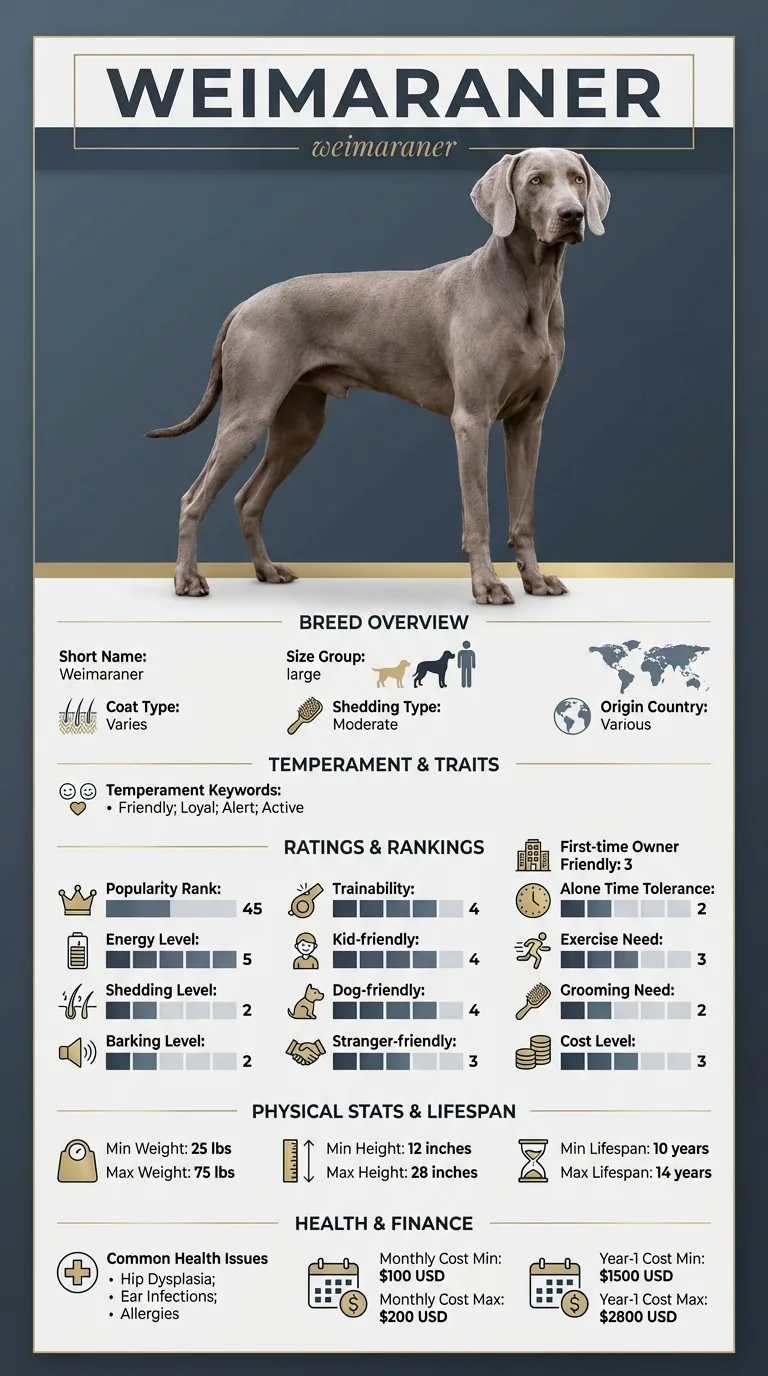
As a large breed in the 55-to-90-pound range, Weimaraners fall squarely into the size category where hip dysplasia is most commonly documented and screened for, since larger joints under sustained load are more likely to reveal underlying structural laxity over a lifetime.
Beyond genetics, growth rate and nutrition during the rapid puppy growth phase influence how a genetically predisposed joint actually develops, which is why responsible breeders often provide feeding guidance alongside health screening information.
Bring up hip screening at your puppy's early wellness visits, especially if you're considering breeding, agility, or other high-impact activities later. If you notice bunny-hopping, reluctance to jump, or a limp at any age, schedule an exam rather than waiting to see if it resolves.
See all Weimaraner health problems, which breeds are prone to hip dysplasia prevalence, or the full Weimaraner breed guide for temperament, exercise needs and ownership costs.
Screening results for a specific dog are typically available within days of X-rays being taken. Understanding what those results mean for a litter or a breeding decision is more of an ongoing education process than a single data point.
Success looks like making a genuinely informed decision — buying from a breeder who screens and shares results honestly, and understanding that even a good score shifts the odds rather than eliminating risk.
Hip dysplasia is recognized widely enough across large breeds, Weimaraners included, that national screening databases exist specifically to track it. Screening organizations grade hip X-rays on a scale from excellent to severely dysplastic, and breed clubs use aggregate results to track how a breed is trending over time. A breeder advertising 'hips OFA good' or 'PennHIP screened' is giving you real, verifiable information — but it's information about that specific dog's joints, not a guarantee about the puppies.
Hip dysplasia is inherited in a complex way, influenced by multiple genes plus environmental factors like growth rate and puppy nutrition. That means two OFA-good parents can still, occasionally, produce a puppy that develops dysplasia, and two moderately scored parents can produce puppies with good hips. Screening shifts the odds meaningfully in your favor, it just doesn't eliminate risk entirely — which is worth understanding rather than treating a good score as an absolute guarantee.
A breeder who screens and shares results openly is doing meaningfully more than one who doesn't, but a few specific questions help you understand what that screening actually covers.

Before bringing home her Weimaraner puppy, Helga had two breeders to choose between, both advertising 'healthy, well-bred dogs.' Only one, when asked directly, produced actual OFA certificates for both parents along with hip results for two older littermates from a previous breeding. The other breeder said hips were 'never really an issue in our lines' but had no documentation to show. Helga chose the first breeder. Her puppy, Odin, was later PennHIP screened himself at five months as part of a plan to eventually compete in field trials, coming back with solid results. Helga couldn't know for certain Odin would avoid hip problems entirely, but she'd stacked the odds meaningfully in his favor with information she could actually verify.
Key takeaway: A hip score is a probability tool, not a guarantee — the real value is in choosing breeders who screen honestly and share what they find, verifiable documents rather than reassurance.
It's recognized as a documented health concern for the breed, common enough that national hip screening databases track it specifically in Weimaraners alongside other large breeds, though individual risk varies by lineage.
No. It meaningfully improves the odds because hip dysplasia has a strong hereditary component, but the inheritance pattern is complex, and environmental factors during puppyhood also play a role, so no score is an absolute guarantee.
OFA typically evaluates a static X-ray of the hip joint, usually at two years or older, and assigns a grade. PennHIP measures joint laxity specifically and can be done earlier, which is why some breeders use both.
It's a meaningful red flag if a breeder can't or won't share hip screening documentation, especially for a breed where hip dysplasia is a recognized concern. It doesn't guarantee a problem, but it removes information you'd otherwise have to make a more informed decision.
Yes — PennHIP can be performed as early as 16 weeks in some cases, giving earlier information than waiting for a standard OFA evaluation at maturity, which can be useful if you're considering breeding or heavy athletic activities.
Prevalence can vary by breeding program and selection practices rather than by line type alone. The most reliable signal is a specific breeder's actual screening practices and results, not general assumptions about line type.
No, plenty of unscreened dogs never develop symptomatic hip dysplasia. It simply means you have less information to estimate the odds, which is a different thing from a guaranteed outcome either way.
Yes, it's a documented health issue for the breed and is tracked through national hip screening databases.
No, it improves the odds but doesn't eliminate risk, since inheritance is complex and environment also plays a role.
Ask to see actual screening documentation for both parents, not just a verbal assurance, and ask about the wider family line if available.
PennHIP can sometimes be done as early as 16 weeks, while standard OFA evaluation is typically done at two years or older.
Yes, it's a meaningful red flag for a breed where hip dysplasia is a recognized concern, and worth factoring into your decision.
A one-page prep sheet for this condition: the signs, the questions to ask, what to get priced. Unlocks here.
You get: Vet visit prep sheet
No spam. One-click unsubscribe. See our privacy policy.
Preview page 1 before you decide.