Health
Is ARVC a real risk for Weimaraners?
No, it's documented in Boxers and Doberman Pinschers, not in Weimaraners.

Quick answer
Is ARVC a real risk for Weimaraners?
No, it's documented in Boxers and Doberman Pinschers, not in Weimaraners.
ARVC sounds like exactly the hidden heart risk a sporting-breed owner should worry about, but the research trail leads to two specific breeds, and the Weimaraner isn't one of them.
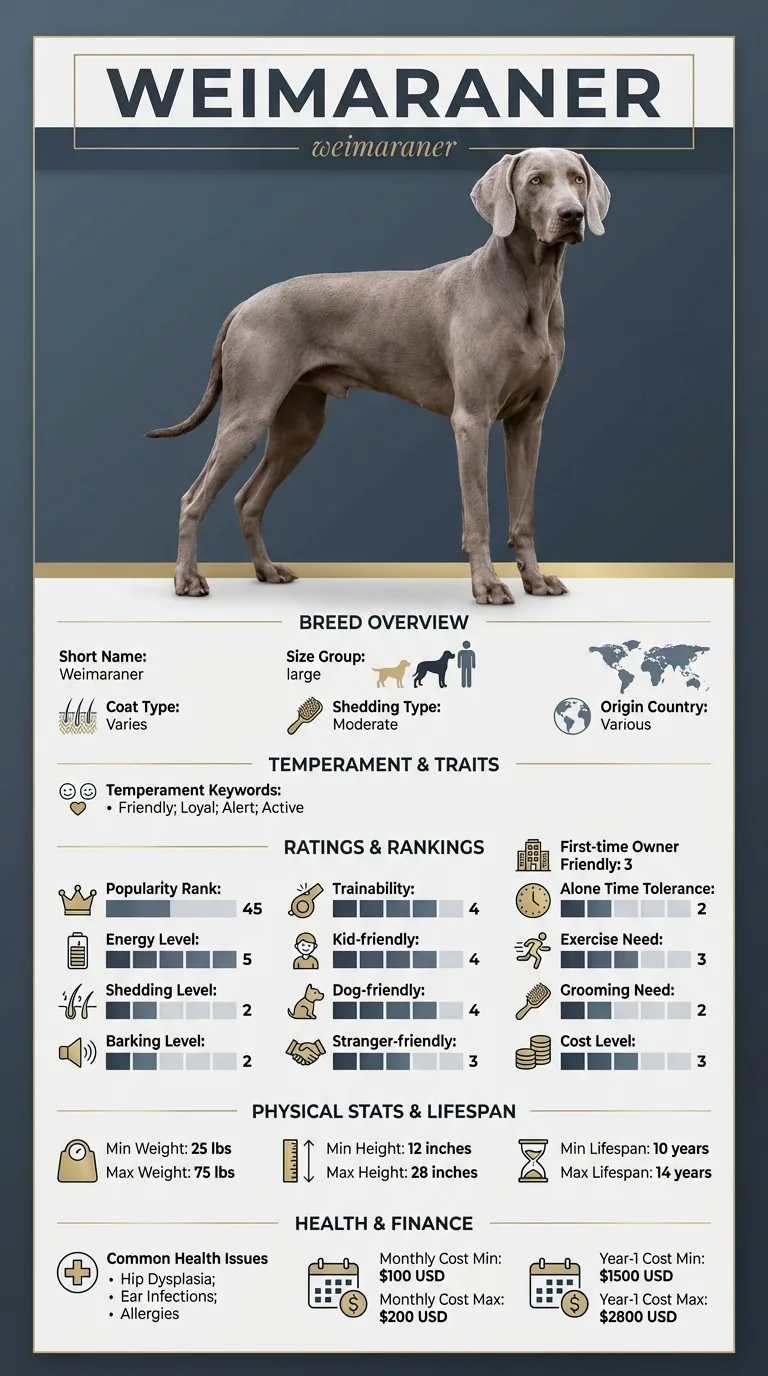
This page is for Weimaraner owners who've come across ARVC while reading general canine heart disease content and want a straight answer on whether it's relevant to their dog.
This guide is not medical advice. If your dog shows pain, sudden behavior change, or worsening symptoms, consult a licensed veterinarian.
Some links may be affiliate links. We may earn a commission at no extra cost to you. We only suggest products we believe are helpful for dog owners.
We research and check what we publish, but we do not warrant that any figure, date, price, or statement is accurate, complete, or current, and we accept no liability for any loss, cost, injury, or other harm arising from the use of this site. Use it as one reference among several. You remain responsible for your own decisions and for your dog's care - confirm anything that matters with a licensed veterinarian or another qualified professional before you act on it. Full disclaimer.
Arrhythmogenic right ventricular cardiomyopathy is a serious inherited heart rhythm disorder well documented in Boxers and Doberman Pinschers, not established in Weimaraners. Owners concerned about a Weimaraner's collapse, distress, or exercise intolerance should look first to the breed's actual documented risks, including bloat, hip dysplasia, and separation anxiety.
ARVC is considered one of the more common inherited heart diseases within Boxer and Doberman Pinscher populations specifically, with dedicated screening protocols built around those breeds. It isn't recognized as occurring in Weimaraners, making it essentially a non-issue for this breed compared to genuinely prevalent Weimaraner risks like bloat and hip dysplasia.
The mutations behind ARVC have been mapped specifically to Boxer and Doberman Pinscher genetics through targeted cardiology research on those breeds. The Weimaraner's genetic background as a sporting breed carries no identified link to either mutation, and its own well-documented risks are structural and immune in nature, not primarily electrical heart conditions.
Because ARVC isn't established in Weimaraners, there are no meaningful environmental triggers to track for it in this breed. Environmental factors worth tracking instead are the ones tied to its real risks: fast eating and post-meal exercise for bloat, and rapid growth or over-exercise as a puppy for hip and bone development issues.
See a vet promptly for any collapse, fainting, pale gums, a visibly distended abdomen, or persistent exercise intolerance in a Weimaraner; these deserve a same-day or emergency evaluation regardless of the underlying cause. Your vet's workup will reasonably focus on bloat, orthopedic pain, and general cardiac function rather than ARVC specifically.
ARVC's dramatic symptoms, fainting, sudden collapse, sudden death, can make owners of any breed anxious. Here's where that anxiety tends to lead Weimaraner owners astray.
See all Weimaraner health problems, which breeds are prone to arrhythmogenic right ventricular cardiomyopathy arvc, or the full Weimaraner breed guide for temperament, exercise needs and ownership costs.
There's no meaningful ARVC timeline to track in a Weimaraner since the condition isn't documented in the breed. If your dog is instead being monitored for bloat risk or hip dysplasia, expect those to be ongoing, breed-typical management concerns across its life rather than a single diagnostic milestone.
Success here looks like redirecting concern, and any veterinary budget, toward the Weimaraner's actual documented risks: recognizing bloat symptoms quickly, managing hip and joint health, and addressing separation anxiety, rather than pursuing a cardiac pathway built for a different breed. An owner who understands this distinction makes calmer, better-informed decisions when something actually looks wrong.
ARVC has been mapped to specific genetic mutations in Boxers and, separately, in Doberman Pinschers, through decades of breed-focused cardiology research. Both are lineages where the disease is common enough that cardiologists screen for it routinely, using Holter monitoring and, increasingly, genetic tests built around each breed's known mutation.
The Weimaraner is a sporting breed with a different genetic background and no identified connection to either mutation. Its documented health concerns, bloat, hip dysplasia, hypertrophic osteodystrophy, von Willebrand disease, and separation anxiety, reflect its own distinct genetic and structural profile, not a shared cardiac vulnerability with Boxers or Dobermans.

When a Weimaraner collapses, struggles to breathe, or seems suddenly distressed, bloat (GDV) is typically the emergency a vet will consider first; it's a genuine, well-documented risk in deep-chested breeds and can escalate within hours. Hip dysplasia can also cause a dog to overexert itself and then seem weak or reluctant to move, especially after a long hike.
Separation anxiety, one of this breed's most consistently reported behavioral issues, can produce heavy panting, drooling, and frantic pacing that looks alarming but isn't cardiac in origin. None of these conditions are ARVC, but each is a real, documented reason a Weimaraner owner might reasonably worry about their dog's distress.

After reading a viral post about sudden cardiac death in dogs, Marisol in Tucson spent a week worried that her three-year-old Weimaraner, Duke, might have ARVC, especially after he seemed winded on an unusually hot afternoon hike. Her vet explained that documented ARVC cases trace specifically to Boxer and Doberman Pinscher bloodlines, and that Duke's panting fit heat and exertion rather than a rhythm disorder. The appointment shifted instead to a conversation about bloat prevention and keeping an eye on his hips as he aged, the two risks actually relevant to his breed. Marisol left with a feeding and exercise plan tailored to Weimaraners instead of a cardiac test built for a different dog entirely.
Key takeaway: A frightening condition documented in other breeds isn't a reasonable worry for a Weimaraner; channeling that same vigilance toward bloat awareness and joint health protects Duke far more effectively.
Arrhythmogenic right ventricular cardiomyopathy is an inherited heart disease that replaces right ventricle muscle with fatty or fibrous tissue, causing dangerous arrhythmias. It's well characterized in Boxers, where it's often called Boxer cardiomyopathy, and in Doberman Pinschers, which carry a separate genetic form.
No. The genetic mutations linked to ARVC have been identified specifically in Boxers and Doberman Pinschers, and there's no established research connecting the disease to Weimaraners.
It's understandable to worry, but in this breed a collapse after exertion is far more often tied to hip dysplasia, heat exhaustion, or bloat than to a cardiac disease that isn't documented in Weimaraners. Get your dog seen urgently so a vet can rule out those more likely causes first.
Those tests are built around the specific mutations found in Boxers and Dobermans, so they aren't validated for Weimaraners and likely won't tell you anything meaningful. A standard veterinary cardiac exam is a more useful first step if you have concerns.
There's no ARVC-specific symptom list to track in this breed since it isn't a documented risk here. General warning signs like fainting or persistent exercise intolerance still deserve a vet visit, but in a Weimaraner they're more likely tied to bloat-related distress or joint pain.
The breed's well-established risks are bloat (GDV), hip dysplasia, hypertrophic osteodystrophy, von Willebrand disease, and separation anxiety. None of these is a heart rhythm disorder like ARVC.
Yes, this breed is prone to separation anxiety, and an anxious episode can cause heavy panting, drooling, and pacing that looks distressing. That pattern reflects a behavioral response, not the cardiac disease process seen in ARVC.
No, it's documented in Boxers and Doberman Pinschers, not in Weimaraners.
Get emergency veterinary care immediately, since bloat and joint pain are far more likely causes in this breed than a rare cardiac disease.
No, those panels are built for Boxer and Doberman mutations and aren't validated for Weimaraners.
Yes, its panting and pacing can look alarming but come from a behavioral cause rather than a cardiac one.
Budget and watch for the breed's real documented risks: bloat, hip dysplasia, hypertrophic osteodystrophy, and von Willebrand disease.
A one-page prep sheet for this condition: the signs, the questions to ask, what to get priced. Unlocks here.
You get: Vet visit prep sheet
No spam. One-click unsubscribe. See our privacy policy.
See a sample page before you decide.
Early access list
The free prep sheet covers the same-day warning signs, a symptom log and the questions to ask. We are considering a fuller kit that adds a cost worksheet for the usual tests and treatments (US price ranges with their sources) and a plain-English guide to ways of covering the bill. It is not built yet; this list tells us whether it is worth building.
One email, no spam, unsubscribe anytime. Information only, not veterinary advice.