Health
What is the first thing to rule out in a Sheltie losing stamina?
Thyroid function. Hypothyroidism is documented in the breed, causes exactly this, and is a cheap blood test away.

Quick answer
What is the first thing to rule out in a Sheltie losing stamina?
Thyroid function. Hypothyroidism is documented in the breed, causes exactly this, and is a cheap blood test away.
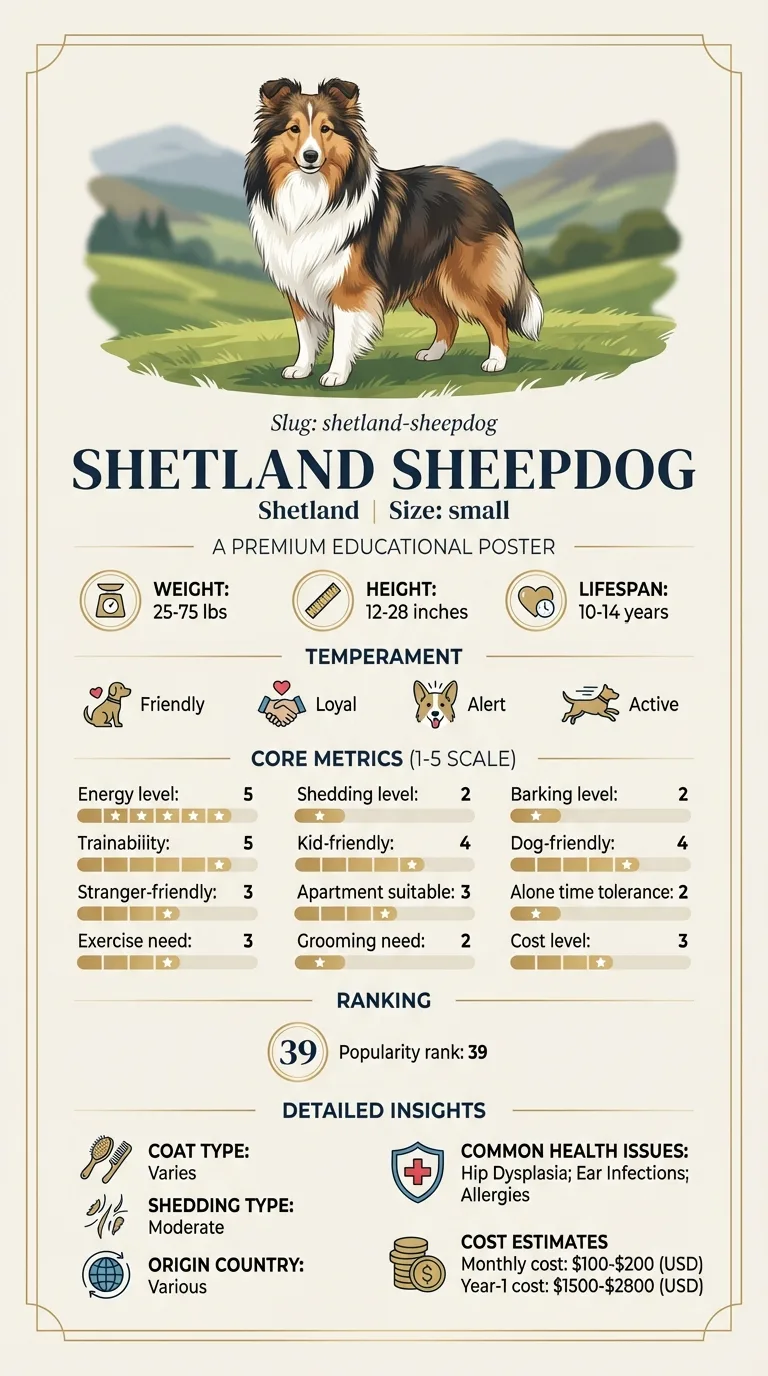
This is a breed rated four out of five for both energy and exercise need. A Sheltie who stops asking for her walk is not being sensible. She is telling you something has changed.
Owners whose middle-aged Sheltie has quietly halved her own walk. People whose dog is fine in cool weather and hopeless in summer. Anyone who has been told their dog is just getting older and does not find that convincing.
This guide is not medical advice. If your dog shows pain, sudden behavior change, or worsening symptoms, consult a licensed veterinarian.
Some links may be affiliate links. We may earn a commission at no extra cost to you. We only suggest products we believe are helpful for dog owners.
We research and check what we publish, but we do not warrant that any figure, date, price, or statement is accurate, complete, or current, and we accept no liability for any loss, cost, injury, or other harm arising from the use of this site. Use it as one reference among several. You remain responsible for your own decisions and for your dog's care - confirm anything that matters with a licensed veterinarian or another qualified professional before you act on it. Full disclaimer.
Exercise intolerance is a reduction in the amount of activity a dog can comfortably sustain, and in a working breed it is one of the earliest signs that something is wrong. It rarely arrives dramatically. It presents as a dog who turns for home sooner, who lies down on a walk she used to lead, or who takes longer to stop panting afterwards. Because it is gradual and easy to attribute to age, it is under-reported, and the underlying causes are frequently treatable.
Common enough that any Sheltie owner should expect to encounter it at some point during a 12 to 14 year life. What matters is whether it reflects a treatable condition or genuine ageing. Given that hypothyroidism is documented for this breed and produces precisely this picture, exercise intolerance in a Shetland Sheepdog carries a meaningfully higher chance of having a specific, correctable cause than the same symptom in many other breeds.
Two documented breed conditions feed directly into this symptom. Hypothyroidism reduces metabolic rate, stamina and heat production, and it is one of the five conditions recorded for the Shetland Sheepdog. Patellar luxation produces hind limb pain that reduces activity without necessarily producing a visible limp. Beyond the documented list, the coat is a genuine mechanical factor: long, dense, double, with heavy seasonal shedding, it obstructs the skin-level heat loss a working dog depends on in summer. The breed's high baseline energy of four out of five is what makes any decline noticeable in the first place.
Heat and humidity account for most seasonal variation, and hard surfaces radiating stored warmth make midday summer walks disproportionately demanding for a low-standing dog. Weight is a continuous factor and one that is entirely concealed by coat, so it is usually discovered on scales rather than by eye. Exercise pattern matters as well: a dog who does very little on weekdays loses condition, and the resulting reduction in stamina looks like disease when it is deconditioning. Slippery indoor flooring reduces confidence in a sore dog and compounds inactivity.
Go urgently for exercise intolerance accompanied by collapse, fainting, blue or grey gums, laboured breathing at rest, or coughing at night, since these point at the heart or lungs and are time sensitive. Seek a prompt appointment for a noticeable decline in stamina developing over weeks rather than years, for reduced activity alongside weight gain, or for a dog who has become reluctant to jump or climb stairs. Ask specifically for thyroid bloodwork given the breed's documented predisposition, and ask for a trial of pain relief if joint pain is plausible, since a clear improvement on medication is itself informative.
See all Shetland Sheepdog health problems, which breeds are prone to exercise intolerance, or the full Shetland Sheepdog breed guide for temperament, exercise needs and ownership costs.
Thyroid treatment typically produces visible improvement in energy over four to twelve weeks. Coat-related summer intolerance resolves within a week or two of proper undercoat removal. Cardiac and joint causes are managed rather than cured, with improvement over weeks and ongoing adjustment.
A dog who once again asks for her walk, keeps up on a familiar route and recovers her normal breathing within a few minutes afterwards. For an older dog success may be a stable, comfortable level of activity rather than a return to what she managed at four, and knowing which of those you are aiming at is part of the plan.
The timing and conditions around reduced stamina narrow the cause considerably before any test is run. Track these before your appointment.
Hypothyroidism is one of the five conditions on the Shetland Sheepdog's documented health profile, and reduced exercise tolerance is one of its central features. The thyroid gland sets the metabolic rate of essentially every tissue, and when output falls the whole dog slows down: less energy, less heat production, reduced stamina, a tendency to gain weight and a coat that dulls and thins.
What makes it so easy to miss in this breed is that its most visible signs are hidden. Weight gain disappears under a long, dense double coat, and coat quality changes are attributed to seasonal shedding. Reduced energy in a dog past seven is read as ageing. Owners routinely arrive at a diagnosis having described the dog as slowing down for two years.
The test is a blood sample, it is not expensive, and it is treatable with a daily tablet. Given that it is documented for the breed and that it produces exactly this symptom, thyroid function belongs early in any Sheltie exercise intolerance workup rather than as an afterthought once the expensive tests are done.
The second cause specific to this breed is the coat itself, which is a mechanical rather than a medical problem. A dog whose loosened undercoat has not been raked out is wearing insulation she cannot remove, and in summer she will lose stamina long before her cardiovascular system is the limiting factor. That version of exercise intolerance resolves with two thorough grooming sessions and costs nothing, which is a good reason to rule it in or out before assuming disease.

Kirsty had led her family's morning walk for six years. Somewhere around her eighth birthday she began hanging back on the return leg, and by nine she was stopping to lie down halfway. Her owner Neil described her to friends as an old lady who had earned a rest. What prompted the appointment was unrelated: a recurring ear infection. The vet weighed her, found she had gained four pounds nobody could see under her coat, and ran a thyroid panel alongside the ear swab. It came back clearly abnormal. Six weeks after starting treatment Kirsty was pulling on the lead again. Neil's summary was that he had spent two years watching a treatable condition and calling it age, and that the only reason it was ever found was that her ears got infected.
Key takeaway: In this breed, a dog quietly reducing her own exercise deserves a thyroid test before she gets an explanation about ageing.
The breed rates four out of five for exercise need and energy, so a fit adult typically wants an hour or more of varied activity daily and asks for more. A dog consistently satisfied with far less than her own previous norm is worth investigating.
Some reduction across a 12 to 14 year life is expected. A noticeable change over months rather than years is not, and ageing is a diagnosis of exclusion in a breed with a documented thyroid predisposition. Get the bloodwork before accepting the explanation.
Resting breathing rate while your dog is asleep. Count for thirty seconds and double it. A consistent rise above your dog's own baseline points at the heart or lungs and gives days of warning before symptoms.
Often not. A seasonal pattern strongly suggests heat dissipation, and in this breed the usual culprit is a packed undercoat. Rake it out thoroughly, shift walks to cool parts of the day, and see whether the pattern resolves before pursuing anything else.
Frequently. A dog with sore knees or a sore back does less without appearing lame, especially in a stoic working breed. Stiffness that eases after the first ten minutes is the classic clue, and a trial of pain relief is itself diagnostic.
Usually yes, but at a level your dog can manage comfortably, and ask your vet. Stopping entirely causes muscle loss that makes the underlying problem worse, so the aim is adjustment rather than rest.
Thyroid function. Hypothyroidism is documented in the breed, causes exactly this, and is a cheap blood test away.
The dense double coat blocks heat loss through the skin. A packed, unbrushed undercoat is often the whole explanation.
Joint pain is worst at the start and eases with movement. Heart trouble gets worse the longer exercise continues.
Resting breathing rate during sleep, body weight monthly, and the point on a familiar walk where your dog first wants to turn back.
An examination with bloodwork is a modest one-off expense relative to the breed's eighty to a hundred and fifty dollar monthly running cost.
A one-page prep sheet for this condition: the signs, the questions to ask, what to get priced. Unlocks here.
You get: Vet visit prep sheet
No spam. One-click unsubscribe. See our privacy policy.
See a sample page before you decide.
Early access list
The free prep sheet covers the same-day warning signs, a symptom log and the questions to ask. We are considering a fuller kit that adds a cost worksheet for the usual tests and treatments (US price ranges with their sources) and a plain-English guide to ways of covering the bill. It is not built yet; this list tells us whether it is worth building.
One email, no spam, unsubscribe anytime. Information only, not veterinary advice.