Health
Why do Shelties get plaque between the teeth?
A refined, narrow jaw carrying forty two teeth creates tight contacts where food debris and plaque accumulate and are hard to dislodge.

Quick answer
Why do Shelties get plaque between the teeth?
A refined, narrow jaw carrying forty two teeth creates tight contacts where food debris and plaque accumulate and are hard to dislodge.
Dental disease is the most common diagnosis in adult dogs and the most preventable. It is also the single most likely reason your Shetland Sheepdog will ever be anesthetised, which is where the breed becomes relevant.
Owners who have just been quoted for a dental and want to know whether it is necessary. People whose Sheltie will not tolerate a toothbrush. Anyone whose dog has bad breath and who assumes that is simply what dogs smell like.
This guide is not medical advice. If your dog shows pain, sudden behavior change, or worsening symptoms, consult a licensed veterinarian.
Some links may be affiliate links. We may earn a commission at no extra cost to you. We only suggest products we believe are helpful for dog owners.
We research and check what we publish, but we do not warrant that any figure, date, price, or statement is accurate, complete, or current, and we accept no liability for any loss, cost, injury, or other harm arising from the use of this site. Use it as one reference among several. You remain responsible for your own decisions and for your dog's care - confirm anything that matters with a licensed veterinarian or another qualified professional before you act on it. Full disclaimer.
Periodontal disease begins as a film of bacteria on the tooth surface, hardens into tartar, and progresses beneath the gum line where it destroys the ligament and bone anchoring each tooth. The visible brown deposit on a crown is the least important part; the damage happens where you cannot see it. It is painful, it is progressive, and it is almost entirely preventable with home care that most owners never start because nobody showed them how.
Dental disease is the single most commonly diagnosed condition in adult dogs across all breeds, with a large majority showing some degree of it by three years old. It is not listed among the Shetland Sheepdog's five documented conditions, because it is not an inherited breed predisposition. It is instead a near-universal consequence of canine anatomy and owner habits, made slightly worse here by jaw width.
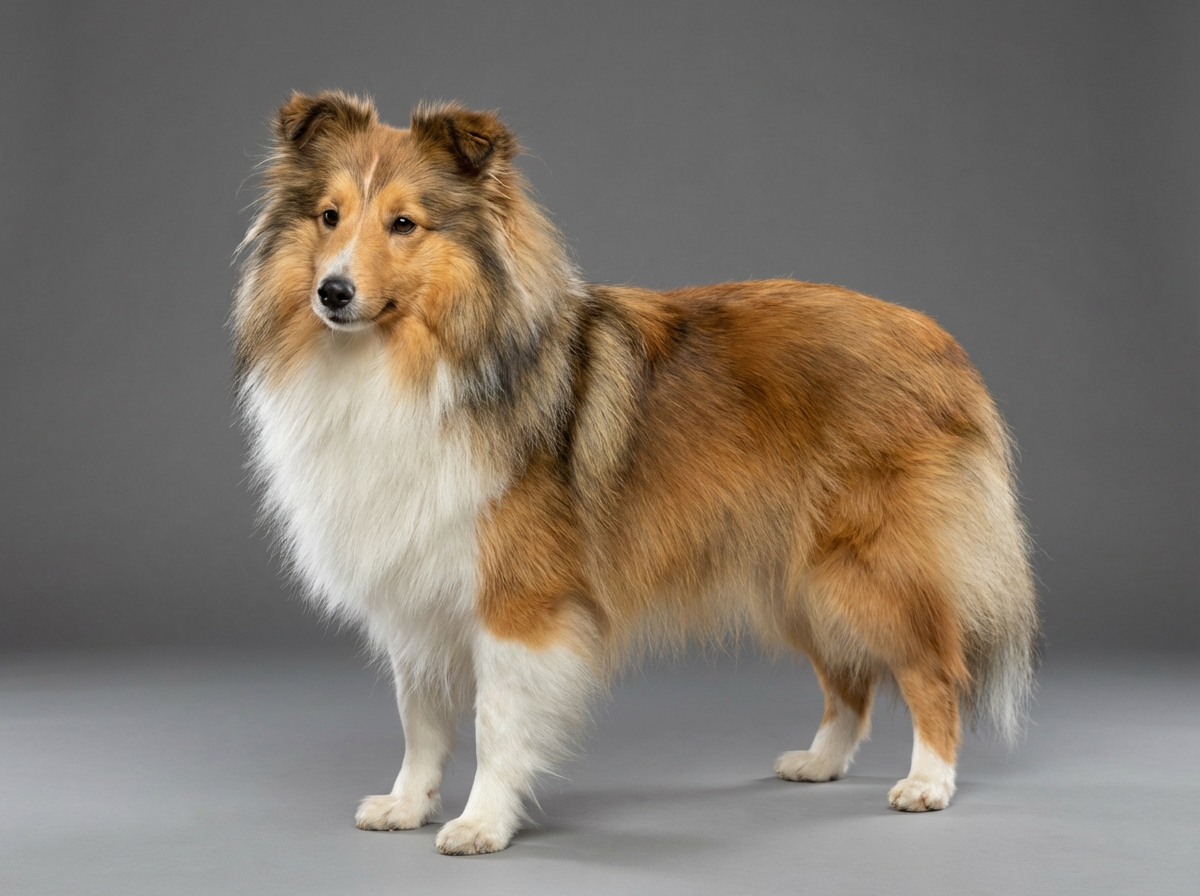
The Shetland Sheepdog's long, tapered wedge of a head is elegant and functional and gives a comparatively narrow jaw. Forty two adult teeth in that jaw sit with tight interproximal contacts, particularly among the incisors and premolars, and those contacts trap debris that brushing reaches poorly and chewing does not dislodge. The breed's documented MDR1 drug sensitivity does not cause dental disease but shapes how it is treated, since every proper dental requires general anesthesia. Longevity of 12 to 14 years also means more decades of accumulation than a shorter-lived breed accrues.
Diet and habit account for most of the variation between individual dogs. Soft, sticky foods and frequent treats leave more residue than dry, abrasive diets. An absence of brushing is the dominant factor by a wide margin. Very hard chew items work the other way, fracturing teeth outright: stones, bones, antlers and hard nylon toys are all common causes of a broken carnassial. Access to a garden with pebbles is a surprisingly frequent source of dental fractures in dogs who like to carry things.
Book promptly for a fractured tooth, particularly one with a pink or dark spot in the centre indicating an exposed pulp, since those are painful and become infected. Seek same-day help for facial swelling, especially a firm swelling below one eye, which suggests an abscessed upper tooth root, and for a dog who has stopped eating, is drooling blood, or is pawing at her mouth. Book a routine assessment for persistent bad breath, visible tartar, red or receding gums, chewing on one side, or an adult dog who has never had her mouth examined. Ask for dental radiographs to be included in any dental procedure, since a great deal of disease is invisible without them.
See all Shetland Sheepdog health problems, which breeds are prone to dental issues, or the full Shetland Sheepdog breed guide for temperament, exercise needs and ownership costs.
Building brushing tolerance takes four to six weeks of short daily sessions. Gum inflammation improves within two to four weeks of consistent brushing. A dental procedure resolves existing disease in a day, but plaque reforms within days, so the home routine is what determines when the next one is needed.
Pink gums, neutral breath, a dog who chews comfortably on both sides, and dentals scheduled as planned maintenance rather than as emergencies with multiple extractions. The realistic goal is slowing accumulation, not a mouth that never needs professional attention.
Nothing else comes close to daily brushing for preventing dental disease. The reason most owners fail is that they start by opening the dog's mouth. Build it in stages instead, a few days on each step.
A proper dental cannot be done on a conscious dog. Cleaning below the gum line, probing every tooth for pocketing and taking dental radiographs all require full general anesthesia, and anything advertised as anesthesia-free dental cleaning is cosmetic scaling of the visible crown that leaves the disease under the gum untouched.
That means most Shetland Sheepdogs will be anesthetised at least once, and often several times across a 12 to 14 year life, for dentistry. The breed carries a documented MDR1 drug sensitivity, an inherited variation in how certain drug molecules are handled, and dental appointments are where it most often becomes relevant simply because they are the most common reason for a Sheltie to be sedated.
The action is straightforward. Get the DNA test done well before a dental is booked, not the week of the procedure. Give the written result to your practice. Photograph it for your phone so it is available at an emergency clinic if a tooth is ever broken out of hours. A cheek swab and a two week wait removes an unknown from every anesthetic your dog will ever have.
One more reason not to defer dentistry: the longer disease is left, the longer the procedure and the more teeth come out. A short dental on a mouth in reasonable condition is a much smaller anesthetic than a two hour extraction session on a mouth that has been neglected for five years. The dogs who need the longest anesthetics are the ones whose owners waited.

Peebles was six and had never had a dental. Her owner Ronan brushed her coat religiously, since a Sheltie coat demands it, and had simply never thought about her teeth. She ate normally and seemed entirely well. What prompted the appointment was a smell he had started noticing when she yawned. Under anesthesia, dental radiographs showed significant bone loss around three teeth and an abscessed root that had been entirely invisible from the front of the mouth. Four teeth came out. The procedure ran to two hours. Her MDR1 test, done three weeks earlier at the practice's suggestion, came back with one faulty copy and shaped the anesthetic protocol. Ronan now brushes her teeth while she waits for her dinner, which took about five weeks to establish and now takes forty seconds.
Key takeaway: A dog eating happily can have an abscessed tooth. Smell and look monthly, because appetite tells you almost nothing about a mouth.
It depends entirely on the mouth rather than on a schedule. Some dogs with good home care go years between procedures; others need one every eighteen months. Ask your vet to grade the mouth at each annual visit so you are working from an assessment rather than a guess.
They help and they do not replace it. Chews work mechanically on the crown surfaces they touch, which is not where periodontal disease does its damage. Look for products with independent veterinary dental accreditation and count their calories in the daily ration.
No. Healthy dog breath is fairly neutral. A strong or foul smell usually means bacterial activity in an inflamed mouth, and it is one of the more reliable signals that a mouth needs examining rather than tolerating.
Dogs eat through remarkable amounts of dental pain. Appetite is a poor indicator. Better clues are chewing on one side, dropping food, turning away from hard treats she used to like, and pawing at the face.
Yes. A retained deciduous tooth sitting alongside its adult replacement creates a tight trap for debris and can push the adult tooth out of alignment. They are usually removed, often at the same time as neutering.
Chronic oral infection maintains a persistent inflammatory load and is associated with effects elsewhere in the body. Whether or not you find that argument compelling, a painful mouth is reason enough on its own to treat it.
A refined, narrow jaw carrying forty two teeth creates tight contacts where food debris and plaque accumulate and are hard to dislodge.
No. It polishes the visible crown and leaves the disease below the gum line untreated, while giving a false impression of a healthy mouth.
Because a dental requires general anesthesia and is the most common reason a Sheltie is anesthetised. The genotype should be known first.
Daily is the target and several times a week is genuinely useful. Outer surfaces only, built up gradually over several weeks.
Several hundred dollars with anesthesia and radiographs, rising sharply with extractions, against a normal monthly budget of eighty to a hundred and fifty dollars.
A one-page prep sheet for this condition: the signs, the questions to ask, what to get priced. Unlocks here.
You get: Vet visit prep sheet
No spam. One-click unsubscribe. See our privacy policy.
Preview page 1 before you decide.