Living
Bigger dog: Golden Retriever or Shetland Sheepdog?
The Golden Retriever, by a wide margin — 55-75 lbs versus 15-25 lbs.

Quick answer
Bigger dog: Golden Retriever or Shetland Sheepdog?
The Golden Retriever, by a wide margin — 55-75 lbs versus 15-25 lbs.
Golden Retriever or Shetland Sheepdog? On paper they differ most on barking, and on the scales Golden Retriever is the heavier at 55–75 lbs. Here is how the two compare on everything that shapes an ordinary week.
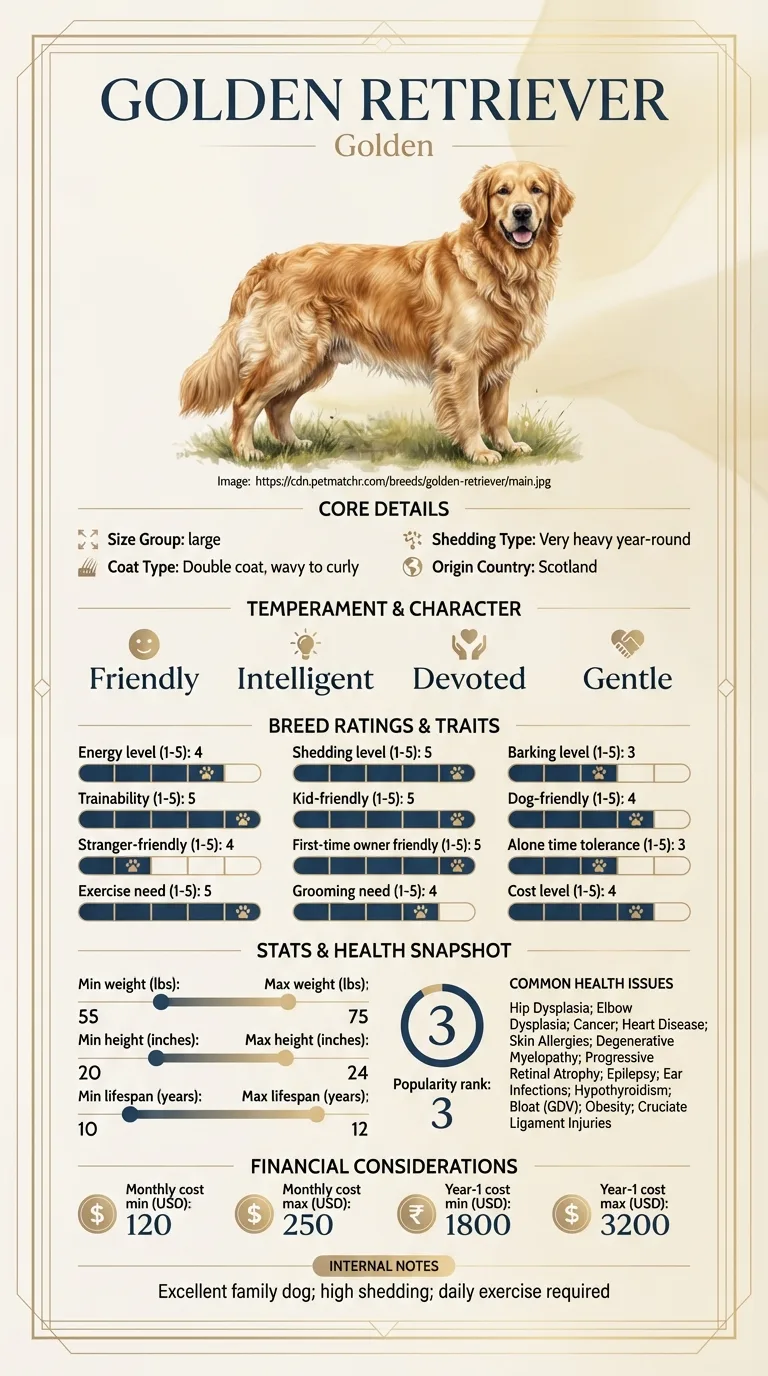
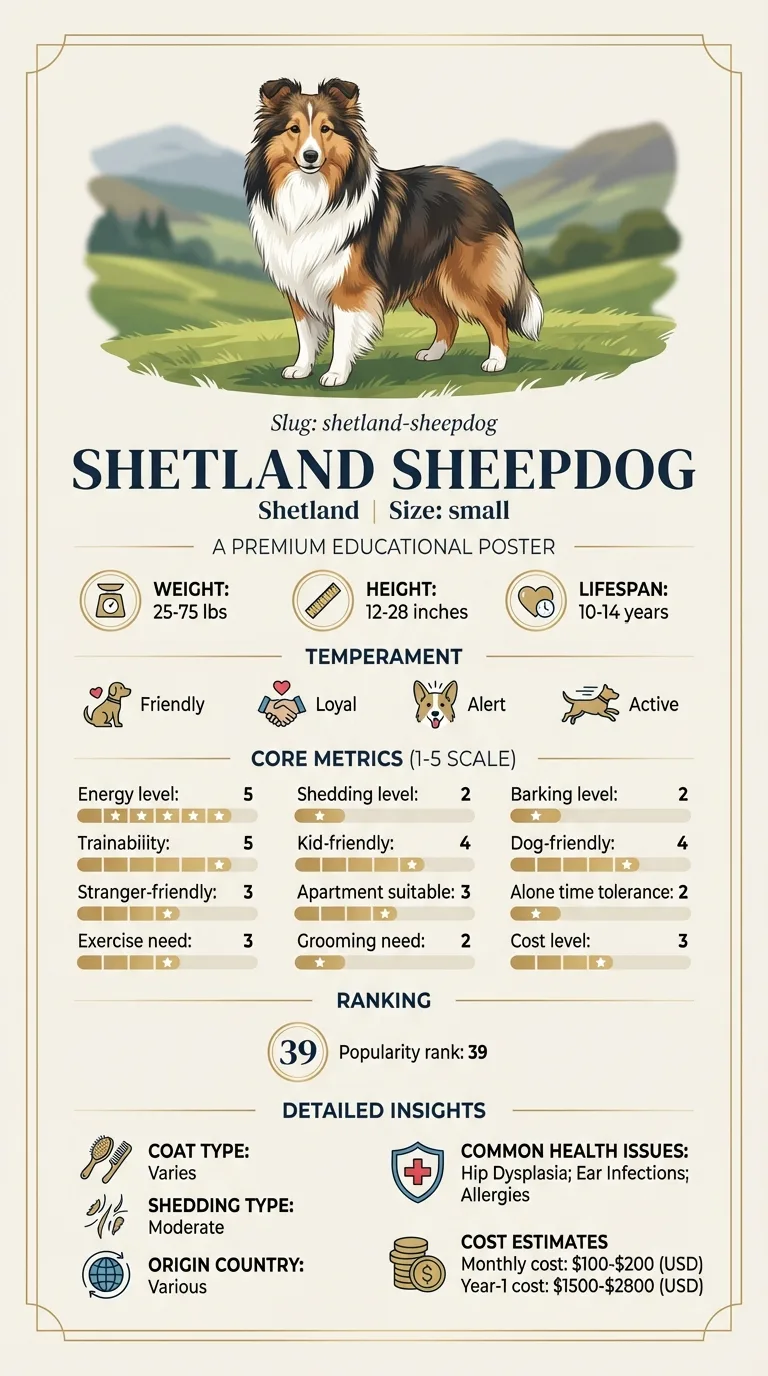
This is for someone already down to Golden Retriever and Shetland Sheepdog and deciding between them. For this pair the decision usually turns on barking and friendly to strangers, so those are covered first and in most detail. Anyone choosing from a flat has a clear answer here: Shetland Sheepdog rates 3/5 against 2/5. Breed history is left out; what follows is what you will actually live with.
Between Golden Retriever and Shetland Sheepdog, barking is what separates them; neither is the lower-effort dog overall.
Choose Golden Retriever if this is your first dog, the dog will be alone during the working day and there are young children at home.
Choose Shetland Sheepdog if you are in a flat or a smaller home, shedding is a problem in your house and your walking routine is modest.
| Feature | golden retriever | shetland sheepdog | Winner |
|---|---|---|---|
| Size class | large | small | Equal |
| Weight | 55–75 lbs | 15–25 lbs | Equal |
| Height | 20–24 in | 13–16 in | Equal |
| Lifespan | 10–12 years | 12–14 years | shetland sheepdog |
| Exercise need | Very high (5/5) | High (4/5) | shetland sheepdog |
| Grooming need | High (4/5) | High (4/5) | Equal |
| Shedding | Very high (5/5) | High (4/5) | shetland sheepdog |
| Energy level | High (4/5) | High (4/5) | Equal |
| Barking | Moderate (3/5) | Very high (5/5) | golden retriever |
| Apartment suitability | Low (2/5) | Moderate (3/5) | shetland sheepdog |
| Good for first-time owners | Very high (5/5) | High (4/5) | golden retriever |
| Tolerates being alone | Moderate (3/5) | Low (2/5) | golden retriever |
| Trainability | Very high (5/5) | Very high (5/5) | Equal |
| Good with kids | Very high (5/5) | High (4/5) | golden retriever |
| Good with other dogs | High (4/5) | High (4/5) | Equal |
| Friendly to strangers | High (4/5) | Low (2/5) | golden retriever |
| Cost level | High (4/5) | Moderate (3/5) | shetland sheepdog |
| Coat | Double coat, wavy to curly | Long, dense double coat | Equal |
| Origin | Scotland | Various | Equal |
| Typical monthly cost | $120–$250 | $80–$150 | Equal |
| Typical first-year cost | $1,800–$3,200 | $1,100–$2,300 | Equal |
A Golden Retriever tips the scale at 55 to 75 pounds and stands 20 to 24 inches at the shoulder, while a Shetland Sheepdog is built on an entirely different scale — 15 to 25 pounds and just 13 to 16 inches. That's roughly a three-to-one weight gap, closer to comparing a medium suitcase to a carry-on. The Golden's frame demands more floor space to stretch out and more strength behind the leash during walks, while the compact Sheltie can curl up on a lap or under a desk without anyone noticing. Anyone choosing between them first has to decide how much dog, literally, their home and car can comfortably absorb.
Both breeds land at 4/5 on general energy level, but their exercise ratings diverge — the Golden Retriever is rated very high (5/5) for exercise need against the Sheltie's still-considerable high (4/5). In practice this means the Golden wants a serious daily outlet: swimming, fetch, long runs, or retrieving work, since an under-exercised Golden gets destructive and restless. The Sheltie's herding instincts show up as agility, flyball, or brisk structured walks rather than sheer mileage — it burns energy mentally as much as physically. Families who already run, hike, or do dog sports will keep either breed satisfied; a sedentary household will struggle with both.
Grooming need is identical on paper — both breeds score 4/5 — but the coats behind that number are different animals. The Golden's wavy-to-curly double coat sheds at a very high 5/5 rate, meaning near-constant fur on floors and clothing plus seasonal blowouts twice a year. The Sheltie's long, dense double coat sheds high (4/5), still heavy but a notch below the Golden's output. Both need brushing several times a week to prevent mats and manage loose undercoat, and neither is a fit for someone who can't tolerate hair on furniture. Owners with allergies or a low tolerance for vacuuming should look elsewhere entirely.
Apartment suitability favors the Sheltie, rated moderate (3/5) against the Golden's low (2/5) — but that edge comes with a catch: Shelties are rated very high (5/5) for barking, the loudest rating on this comparison, driven by their vocal, sensitive herding temperament. A Golden barks only moderately (3/5) but needs more square footage and daily exercise to stay calm indoors. On being left alone, the Golden tolerates it moderately (3/5) while the Sheltie rates lower at 2/5, reflecting its devoted, people-oriented nature. Neither breed is an ideal solo-all-day apartment dog; the choice comes down to whether thin walls or limited space is the bigger constraint.
Both breeds are rated very high (5/5) for trainability, making either a strong match for a first-time owner willing to put in consistent work — though the Golden actually edges ahead on the first-time-owner scale itself (5/5 versus the Sheltie's 4/5). The Golden's friendly, intelligent, gentle temperament tends to produce a biddable, food-motivated learner. The Sheltie brings bright, sensitive intelligence that responds beautifully to positive methods but can shut down under harsh correction, since sensitivity is a defining trait. Both do well with reward-based training and early socialization; the main adjustment for Sheltie owners is managing a dog that notices and reacts to everything around it.
With kids, the Golden rates very high (5/5) against the Sheltie's still-solid high (4/5), and the gap widens with strangers — Golden high (4/5), Sheltie low (2/5). That reflects real temperament differences: the Golden is described as friendly and devoted, greeting most visitors warmly, while the Sheltie is more reserved and vocal around unfamiliar faces, often announcing arrivals loudly before warming up. Both score high (4/5) for getting along with other dogs, so multi-dog households face no real tradeoff there. Families expecting frequent guests or a rowdier household of young kids will likely find the Golden's easygoing nature the smoother fit.
The Sheltie's 12-14 year lifespan outpaces the Golden's 10-12 years, and the health lists explain part of why. The Golden carries a long roster of concerns — hip and elbow dysplasia, cancer, heart disease, skin allergies, degenerative myelopathy, progressive retinal atrophy, epilepsy, ear infections, hypothyroidism, bloat, obesity, and cruciate ligament injuries — thirteen conditions in total, with cancer being a particularly significant risk factor for the breed. The Sheltie's list is shorter and more specialized: collie eye anomaly, MDR1 drug sensitivity (a dangerous reaction to certain medications), dermatomyositis, hypothyroidism, and patellar luxation. Prospective Sheltie owners should specifically ask breeders about MDR1 testing before certain drugs are ever prescribed.
Cost level splits high (4/5) for the Golden against moderate (3/5) for the Sheltie, and the ranges bear that out: the Golden runs $120-$250 monthly and $1,800-$3,200 in year one, while the Sheltie runs $80-$150 monthly and $1,100-$2,300 in year one. Much of that gap traces back to sheer size — more food, larger-dose medications, and bigger boarding and grooming bills for the Golden. Both breeds carry real veterinary costs given their respective health lists, so budgeting for pet insurance or a dedicated savings fund makes sense either way. Over a decade of ownership, the Sheltie is meaningfully the cheaper companion to keep.
Golden Retriever weighs 55–75 lbs and lives 10–12 years; Shetland Sheepdog weighs 15–25 lbs and lives 12–14 years. The two diverge most on barking and friendly to strangers. They are level on good with other dogs, energy level and grooming need, so those cannot decide it. The comparison marks an easier option only where one exists. Facts like weight and country of origin are not scored. Both dogs are rated from the same dataset, which is what makes the numbers comparable with each other even though any individual dog sits somewhere inside its breed's range.

The Sheltie sheds slightly less — rated high (4/5) versus the Golden's very high (5/5) — though both are heavy, double-coated shedders that need regular brushing. Neither is a good match for a strictly hair-free home.
Possibly — Shelties are rated very high (5/5) for barking, the top rating in this comparison, largely due to their alert, vocal herding instincts. The Golden barks only moderately (3/5), so noise-sensitive households or close-quarter neighbors may prefer the Golden.
The Golden Retriever edges it, rated very high (5/5) for first-time owners against the Sheltie's high (4/5). Both are highly trainable (5/5), but the Golden's more outgoing, less sensitive temperament forgives beginner mistakes more easily.
The Golden does carry a longer list of breed-associated conditions — thirteen versus the Sheltie's five — including cancer, bloat, and hip dysplasia, and its 10-12 year lifespan is shorter than the Sheltie's 12-14 years. Size and genetics both play a role.
Not comfortably. The Golden tolerates alone time moderately (3/5) and the Sheltie rates lower at 2/5, since both are devoted, people-focused breeds. Long solo hours in either case risk anxiety or destructive behavior without a plan like a midday walker.
The Sheltie, by a wide margin — $1,100-$2,300 in year one versus $1,800-$3,200 for the Golden, reflecting the Golden's higher food, medication, and grooming costs at nearly triple the body weight.
Yes, though slightly less so on paper — Shelties rate high (4/5) with kids against the Golden's very high (5/5). The Sheltie's herding instinct can mean occasional nipping at heels during rough play, worth managing with younger children.
The Golden Retriever, by a wide margin — 55-75 lbs versus 15-25 lbs.
The Shetland Sheepdog, rated very high (5/5) versus the Golden's moderate (3/5).
The Shetland Sheepdog, at 12-14 years versus the Golden's 10-12 years.
The Golden Retriever, rated high (4/5) against the Sheltie's low (2/5).
Secure checkout on Stripe. We never see your card.
7-day money-back guarantee. Instant access.

Health information here is general and is not veterinary advice. If your dog shows pain, sudden behaviour change, or worsening symptoms, consult a licensed veterinarian.
Some links on this site are affiliate links. We may earn a commission at no extra cost to you, and we only suggest products we believe are helpful for dog owners.
We research and check what we publish, but we do not warrant that any figure, date, price, or statement is accurate, complete, or current, and we accept no liability for any loss, cost, injury, or other harm arising from the use of this site. Use it as one reference among several. You remain responsible for your own decisions and for your dog's care - confirm anything that matters with a licensed veterinarian or another qualified professional before you act on it. Full disclaimer.
Match your lifestyle to the right dog.
Take quizNot sure which breed is right for you? Take our 2-minute quiz to find out.
Take the quiz