Living
Beagle or Shetland Sheepdog?
Pick the Beagle if you want a dog that warms up to strangers quickly. Pick the Sheltie if you want a highly trainable dog and don't mind more barking and grooming.

Quick answer
Beagle or Shetland Sheepdog?
Pick the Beagle if you want a dog that warms up to strangers quickly. Pick the Sheltie if you want a highly trainable dog and don't mind more barking and grooming.
Beagle or Shetland Sheepdog? On paper they differ most on grooming need, and on the scales Beagle is the heavier at 20–30 lbs. Here is how the two compare on everything that shapes an ordinary week.
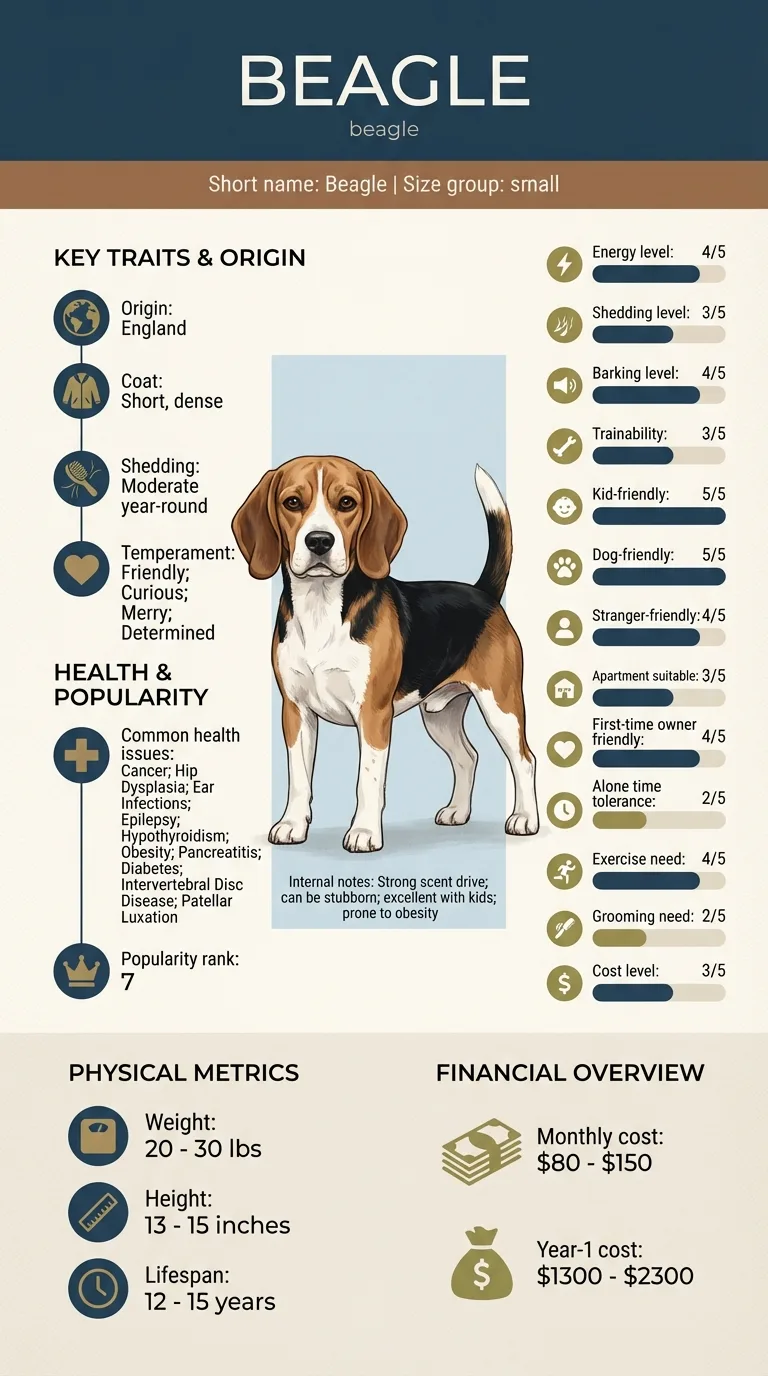
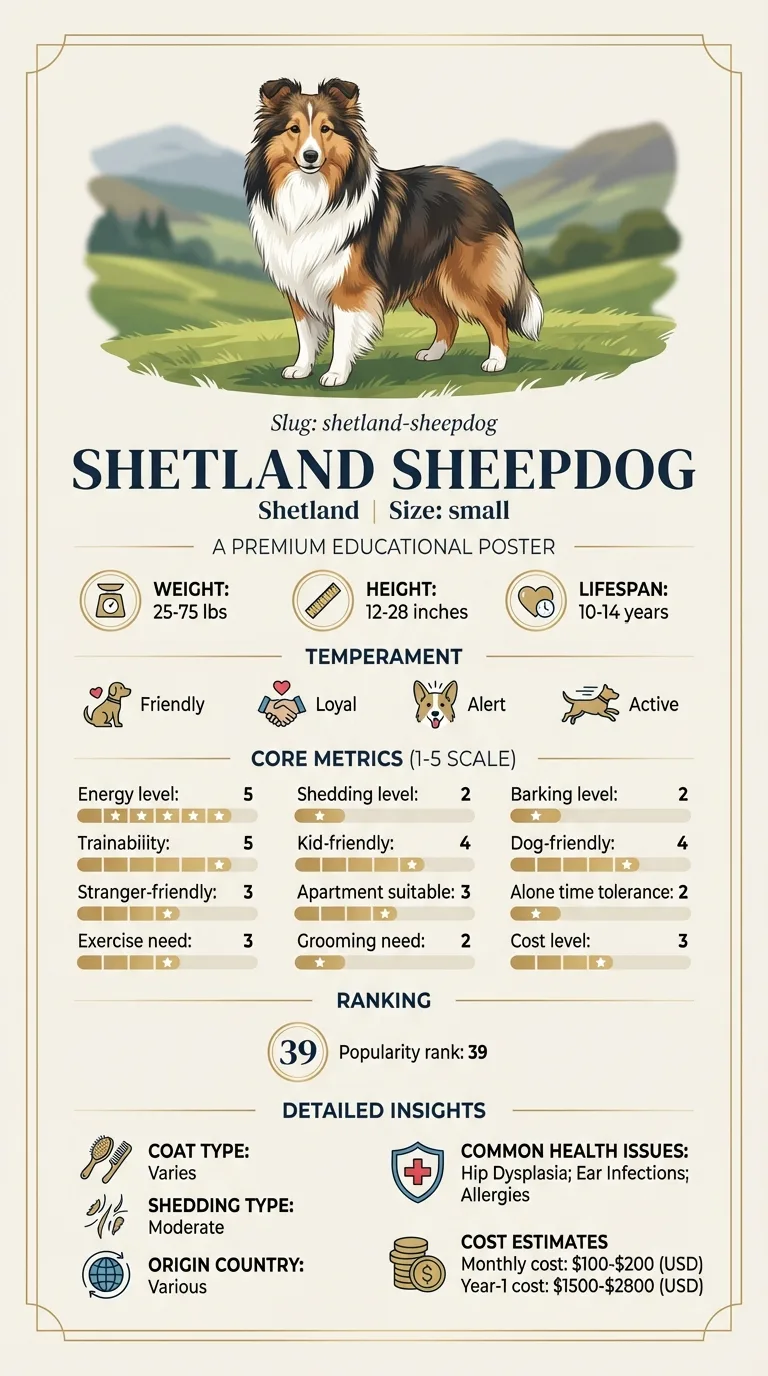
This is for someone already down to Beagle and Shetland Sheepdog and deciding between them. For this pair the decision usually turns on grooming need and trainability, so those are covered first and in most detail. Both rate 3/5 for flats, so housing does not settle this one. Breed history is left out; what follows is what you will actually live with.
Between Beagle and Shetland Sheepdog, grooming need is what separates them, and Beagle is the lower-effort dog of the two to keep.
Choose Beagle if you do not want a standing grooming appointment, shedding is a problem in your house and there are young children at home.
Choose Shetland Sheepdog if you want a dog that picks up training quickly, a smaller dog suits your car, your home or your back and you want a dog that is more watchful with visitors.
| Feature | beagle | shetland sheepdog | Winner |
|---|---|---|---|
| Size class | small | small | Equal |
| Weight | 20–30 lbs | 15–25 lbs | Equal |
| Height | 13–15 in | 13–16 in | Equal |
| Lifespan | 12–15 years | 12–14 years | beagle |
| Exercise need | High (4/5) | High (4/5) | Equal |
| Grooming need | Low (2/5) | High (4/5) | beagle |
| Shedding | Moderate (3/5) | High (4/5) | beagle |
| Energy level | High (4/5) | High (4/5) | Equal |
| Barking | High (4/5) | Very high (5/5) | beagle |
| Apartment suitability | Moderate (3/5) | Moderate (3/5) | Equal |
| Good for first-time owners | High (4/5) | High (4/5) | Equal |
| Tolerates being alone | Low (2/5) | Low (2/5) | Equal |
| Trainability | Moderate (3/5) | Very high (5/5) | shetland sheepdog |
| Good with kids | Very high (5/5) | High (4/5) | beagle |
| Good with other dogs | Very high (5/5) | High (4/5) | beagle |
| Friendly to strangers | High (4/5) | Low (2/5) | beagle |
| Cost level | Moderate (3/5) | Moderate (3/5) | Equal |
| Coat | Short, dense | Long, dense double coat | Equal |
| Origin | England | Various | Equal |
| Typical monthly cost | $80–$150 | $80–$150 | Equal |
| Typical first-year cost | $1,300–$2,300 | $1,100–$2,300 | Equal |
These two are close in size - the Beagle at 20-30 lbs and 13-15 inches, the Shetland Sheepdog slightly lighter at 15-25 lbs with an almost identical height range of 13-16 inches. If size alone were the question, this would be a near-toss-up; the real differences show up elsewhere. Either dog fits comfortably in a mid-size car crate or standard bed, unlike some of the larger breeds compared elsewhere on this site.
Exercise need and energy level both tie at high (4/5), so neither breed is the lower-effort option. Both want a real daily outlet - the Beagle through scent-driven wandering, the Sheltie through herding-bred activity and mental engagement. Herding breeds like the Sheltie often do best with structured activities such as agility or fetch rather than unstructured free time alone in a yard.
The Sheltie's long double coat needs real upkeep - high (4/5) grooming against the Beagle's low (2/5) - and sheds more too, high (4/5) versus moderate (3/5). Regular brushing is non-negotiable with a Sheltie if you want to avoid matting. A slicker brush two to three times a week keeps its coat manageable and cuts down on loose hair around the house.
Both tie at moderate (3/5) for apartment suitability, but the Sheltie barks more - very high (5/5), the top rating on this page, against the Beagle's already-high (4/5). If you're worried about noise complaints, the Sheltie is the riskier pick despite similar space needs. Sound-dampening measures or dedicated bark training are worth considering if noise complaints are a real risk in your building.
The Sheltie rates very high (5/5) on trainability against the Beagle's moderate (3/5), and both tie at high (4/5) for first-time-owner suitability. A Sheltie's herding instincts and sensitivity make it responsive to training, but that same sensitivity means it needs a gentler hand than a food-driven Beagle. A Sheltie also tends to bond closely with one person, so consistency in who handles training sessions helps it learn faster.
The Beagle pulls ahead with strangers - high (4/5) against the Sheltie's low (2/5), a big gap that reflects the Sheltie's more reserved, watchful nature. Both do well with kids (Beagle very high 5/5, Sheltie high 4/5) and other dogs (Beagle very high 5/5, Sheltie high 4/5), so the stranger-friendliness gap is really the one factor worth weighing carefully here.
Shared risks include hypothyroidism and patellar luxation. The Sheltie's own list features breed-specific concerns - collie eye anomaly, MDR1 drug sensitivity, dermatomyositis - that don't appear for the Beagle. MDR1 sensitivity is worth flagging to your vet before any medication is prescribed, since certain common drugs can cause serious reactions in affected dogs. The Beagle edges out on lifespan, 12-15 years against the Sheltie's 12-14.
Both breeds tie at moderate (3/5) cost and identical $80-150 monthly ranges. First-year costs are close too - $1,300-2,300 for the Beagle versus $1,100-2,300 for the Sheltie - making this one of the more budget-neutral comparisons on this site. Neither breed requires specialty food or frequent professional grooming, keeping ongoing costs fairly predictable for a new owner either way, month after month.
Beagle weighs 20–30 lbs and lives 12–15 years; Shetland Sheepdog weighs 15–25 lbs and lives 12–14 years. The two diverge most on grooming need, trainability and friendly to strangers. They are level on tolerates being alone, apartment suitability and cost level, so those cannot decide it. The comparison marks an easier option only where one exists. Facts like weight and country of origin are not scored. Both dogs are rated from the same dataset, which is what makes the numbers comparable with each other even though any individual dog sits somewhere inside its breed's range.

Close - the Beagle runs 20-30 lbs and 13-15 inches, the Sheltie 15-25 lbs and 13-16 inches. Height ranges nearly overlap entirely.
The Sheltie, rated high (4/5) against the Beagle's moderate (3/5), and it needs more grooming too - high (4/5) versus low (2/5) - thanks to its long double coat.
The Sheltie, rated very high (5/5) - the top barking score on this page - against the Beagle's high (4/5). Both are vocal breeds, but the Sheltie edges out even the Beagle.
The Beagle, clearly - high (4/5) against the Sheltie's low (2/5). Shelties are bred to be watchful and can be reserved with people they don't know.
Essentially none - both run $80-150 monthly, and first-year costs land within about $200 of each other.
Hypothyroidism and patellar luxation appear on both lists. The Sheltie also carries breed-specific risks like collie eye anomaly and MDR1 drug sensitivity that the Beagle's list doesn't include.
Pick the Beagle if you want a dog that warms up to strangers quickly. Pick the Sheltie if you want a highly trainable dog and don't mind more barking and grooming.
Nearly identical - both run $80-150 monthly, one of the closest cost matches on this site.
Tied at high (4/5) for both - neither breed is a low-exercise option.
Close - 12-15 years for the Beagle against 12-14 for the Sheltie.
Secure checkout on Stripe. We never see your card.
7-day money-back guarantee. Instant access.
Health information here is general and is not veterinary advice. If your dog shows pain, sudden behaviour change, or worsening symptoms, consult a licensed veterinarian.
Some links on this site are affiliate links. We may earn a commission at no extra cost to you, and we only suggest products we believe are helpful for dog owners.
We research and check what we publish, but we do not warrant that any figure, date, price, or statement is accurate, complete, or current, and we accept no liability for any loss, cost, injury, or other harm arising from the use of this site. Use it as one reference among several. You remain responsible for your own decisions and for your dog's care - confirm anything that matters with a licensed veterinarian or another qualified professional before you act on it. Full disclaimer.
Match your lifestyle to the right dog.
Take quizNot sure which breed is right for you? Take our 2-minute quiz to find out.
Take the quiz