Health
Are Saint Bernards at higher risk during pregnancy?
Yes, data shows a substantially elevated complication rate compared to the general dog population.

Quick answer
Are Saint Bernards at higher risk during pregnancy?
Yes, data shows a substantially elevated complication rate compared to the general dog population.
Data has shown Saint Bernards facing a substantially higher rate of pregnancy-related complications than the general dog population, which makes this a category any breeder needs to plan around rather than hope to avoid.
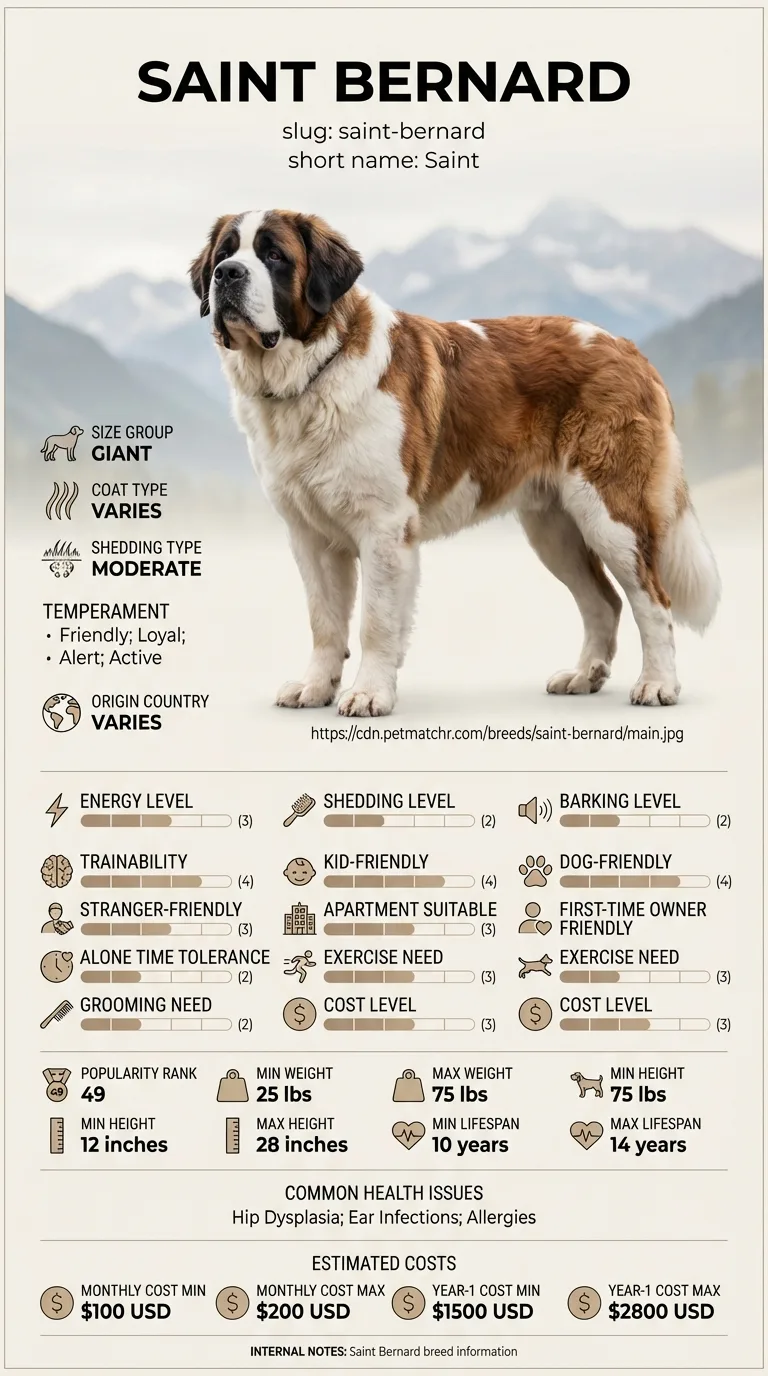
This is directly relevant to breeders and anyone considering breeding their Saint Bernard, since the risks here require planning well before whelping day, not just responding once labor starts.
This guide is not medical advice. If your dog shows pain, sudden behavior change, or worsening symptoms, consult a licensed veterinarian.
Some links may be affiliate links. We may earn a commission at no extra cost to you. We only suggest products we believe are helpful for dog owners.
We research and check what we publish, but we do not warrant that any figure, date, price, or statement is accurate, complete, or current, and we accept no liability for any loss, cost, injury, or other harm arising from the use of this site. Use it as one reference among several. You remain responsible for your own decisions and for your dog's care - confirm anything that matters with a licensed veterinarian or another qualified professional before you act on it. Full disclaimer.
Check this first
Strong, active straining for more than thirty minutes without producing a puppy, more than two to four hours between puppies with continued straining, green or dark discharge before the first puppy arrives, or visible distress, weakness, or collapse in the dam are all signs of a whelping emergency requiring immediate veterinary intervention, often including an emergency cesarean section.
Normal labor, by contrast, involves regular contractions producing puppies at reasonably spaced intervals, with the dam alert and attentive to each newborn. This doesn't require intervention beyond monitoring, though having a vet's contact information ready throughout is still wise.
Given the documented elevated complication rate in this breed, many experienced Saint Bernard breeders plan for the possibility of a cesarean section in advance rather than treating it as an unlikely worst case, arranging in advance which emergency clinic they'd go to and confirming that clinic can perform the procedure on short notice.
If any of these apply, call your vet or an emergency clinic now. The rest of this page is for the cases that are not an emergency.
Pregnancy and whelping complications in Saint Bernards stem largely from the mismatch between puppy size and the dam's birth canal, variability in litter size, and the overall physical demands giant-breed size places on a pregnant and laboring body. Documented data shows this breed facing a substantially elevated complication rate compared to the general dog population, making advance planning, not reactive crisis management, the standard approach among experienced breeders.
Pregnancy complications, including a meaningfully elevated need for cesarean delivery, are well documented as more frequent in Saint Bernards than in the general dog population, making this one of the more consistently cited breed-specific risk categories for anyone considering breeding.
The Saint Bernard's giant size means puppies are proportionally large relative to the dam's birth canal in a way that increases the odds of difficult, prolonged, or obstructed labor compared to smaller breeds, and this same size factor adds general cardiovascular and orthopedic strain to the dam throughout pregnancy.
Inadequate prenatal monitoring, lack of advance planning for potential cesarean delivery, and insufficient nutritional support for a large litter's demands are the main environmental factors that turn a baseline elevated breed risk into an actual crisis during whelping.
Talk to your vet well before breeding about health screening and whelping planning specific to this breed's documented risks. Strong straining for over thirty minutes without a puppy, long gaps between puppies with continued straining, unusual discharge, or visible distress in the dam are emergencies requiring immediate veterinary care.
Breeding decisions and whelping preparation both carry real weight in this breed, and a few choices measurably increase risk.
See all Saint Bernard health problems, which breeds are prone to pregnancy complications, or the full Saint Bernard breed guide for temperament, exercise needs and ownership costs.
Pregnancy in dogs generally lasts about 63 days, and whelping itself can take anywhere from several hours to over a day depending on litter size and how labor progresses, with giant breeds sometimes needing closer monitoring throughout given the documented complication rate.
Success means a planned, well-monitored pregnancy and whelping with veterinary support readily available, resulting in a healthy dam and puppies, rather than assuming natural delivery will proceed without complications given this breed's documented risk profile.
Before breeding her Saint Bernard, Freya, Denise researched the breed's documented pregnancy complication rates and decided to plan accordingly rather than assume a smooth natural delivery. She scheduled a prenatal ultrasound two weeks before the due date, which showed a large litter of nine puppies, and confirmed in advance with her vet's clinic that emergency cesarean support would be available. When Freya's labor stalled after the third puppy with continued strong straining and no progress, Denise called her vet immediately rather than waiting, and Freya was brought in for an emergency cesarean that safely delivered the remaining six puppies.
Key takeaway: Having already confirmed emergency cesarean availability and litter size in advance meant Denise didn't lose critical time figuring out logistics during an actual crisis, which very likely made the difference for Freya and her puppies.
Puppy head and body size relative to the birth canal, variable litter sizes, and the general physical demands of a giant-breed pregnancy all contribute to a documented elevated risk of complications like difficult labor requiring a cesarean section.
A pre-breeding health screening for both parents, prenatal imaging to estimate litter size, and arranging veterinary support or an emergency plan in advance are all standard recommendations for reducing risk in this breed.
They occur more frequently than in many smaller breeds, given the documented difficulty some giant-breed dams have delivering puppies naturally, making it wise to plan for this possibility rather than assume natural delivery will go smoothly.
Complications can include pregnancy toxemia, difficulty maintaining adequate nutrition for a large litter, and general physical strain on the dam's joints and cardiovascular system carrying significant additional weight.
Given the documented elevated complication rate, many experienced breeders arrange for veterinary availability, whether on-site or on call, rather than planning to manage a difficult labor entirely without professional support.
Hip and elbow evaluations, cardiac screening, and general health clearance for both the dam and sire are commonly recommended, given the breed's documented risk across multiple health categories that can affect pregnancy safety.
An emergency cesarean section and any related neonatal care represent a significant cost, making financial planning, alongside a savings buffer or insurance consideration, an important part of responsible breeding preparation.
Yes, data shows a substantially elevated complication rate compared to the general dog population.
Puppy size relative to the birth canal and general physical strain both contribute to elevated risk.
Yes, many experienced breeders plan for this possibility given the breed's documented complication rate.
Strong straining for over thirty minutes without a puppy, or long gaps between puppies, are signs to call a vet.
Yes, an emergency cesarean section represents a significant cost worth planning for financially.
A one-page prep sheet for this condition: the signs, the questions to ask, what to get priced. Unlocks here.
You get: Vet visit prep sheet
No spam. One-click unsubscribe. See our privacy policy.
Preview page 1 before you decide.