DogBreedCompass
← Back to breed profileEvery breed’s cost in Washington DC

Saint Bernard Cost in Washington, DC

See Saint Bernard price across all cities →

Quick answer

Saint Bernard cost in Washington, DC

Roughly $188–$388 monthly and $2,750–$5,250 for year one, well above average — with the local quirk that federal parkland and District rules can both apply to a single walk, which makes a fixed six-foot lead the sensible default.

A Saint Bernard in Washington, DC costs roughly $188 to $388 a month, with year one landing near $2,750 to $5,250 — well above the national average, in line with one of the country's more expensive metros. The genuinely local peculiarity is jurisdictional. An enormous share of this city's green space is federal land, and federal land has its own rules about dogs.

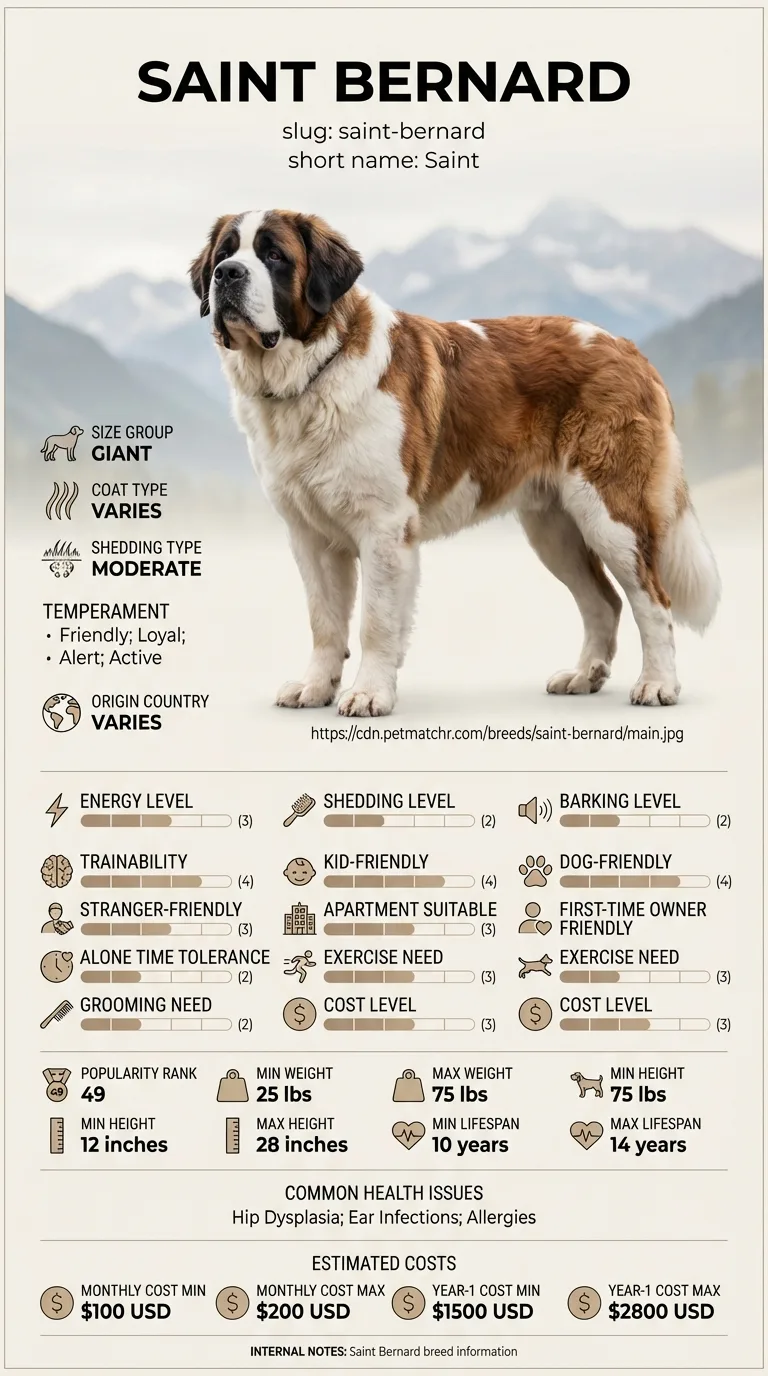
Saint Bernard Cost in Washington, DC infographic

Why costs vary

The documented risks are the usual list — Hip Dysplasia, Elbow Dysplasia, Dilated Cardiomyopathy, Entropion and Bloat — each more expensive in a giant because dosing, materials and anesthetic time scale with 120 to 180 pounds. The leash question is not a medical cost, but it is the one where an owner of this breed can create an expensive problem in a single unlucky second.

Cost summary

Washington prices well above the national line with a nine-month prevention season, and its distinctive local requirement is equipment and training rather than additional spending.

Estimate · source: estimation · confidence: medium · updated 2026-09-06 · not a quote

First year
$2750 - $5250
Ongoing monthly
$188 - $388

First-year expenses

ItemCost range
One-time setup (giant crate, bed, fixed six-foot lead, first exam, spay/neuter)
The lead is the cheapest item in this line and the one that satisfies both rulebooks on the same walk.
$650 - $1120

Monthly expenses

ItemCost range
Food
A giant's volume against expensive metro retail, making this the largest recurring line by a clear margin.
$90 - $161
Prevention (nine-month season)
A moderately long window for the Mid-Atlantic, with each dose in the top weight bracket available.
$35 - $63

Is pet insurance worth it?

Veterinary insurance covers the medical risks; liability arising from an incident involving a large dog is a question for a home or renter's policy instead.

When insurance makes sense

Buy medical cover early if an operation at this metro's pricing would strain the household, and separately confirm how your home policy treats a dog this size.

When you might skip it

A household with a deep reserve can self-fund the medical side, but should still check the liability side rather than assume it.

Ways to save without cutting essentials

The savings here are in equipment and training, because you will not negotiate District service pricing downward.

  • Use a fixed lead of six feet or less as the default, which satisfies federal parkland rules everywhere in the city.
  • Retire retractable leads entirely, which give no useful control on a dog of this weight.
  • Book group training while the puppy is still physically manageable rather than after it is not.
  • Buy prevention against the region's nine-month season instead of a default twelve.
  • Skip daycare where possible, since a 2-out-of-5 exercise requirement rarely justifies giant-breed daycare rates.

Washington Cost Factors: One Walk, Two Rulebooks

The practical upshot is equipment. A fixed lead of six feet or less satisfies the federal requirement and works everywhere else in the District, which is a good reason to make it the default rather than something you swap in at a park boundary. Retractable leads are a poor fit for this dog regardless of the rules: they offer almost no control at the moment control is needed, and the difference between a mildly interested 30-pound dog and a mildly interested 150-pound one is not a difference of degree.

The second requirement is manners, which at this weight is a legal matter as much as a social one. This breed's trainability is documented at 3 out of 5 — genuinely responsive to consistency rather than automatic — and the skills that count in a city this crowded are walking without pulling, settling on cue, and disengaging from distractions. Those are teachable, and they are far easier to teach at forty pounds than at a hundred and forty.

The good news is that the underlying temperament fits. Documented as gentle, patient and watchful, rated 4 out of 5 with strangers and 4 out of 5 with other dogs, this is not a breed that wants trouble on a crowded path.

The Cost of a City Without Yards

A large share of households here live in apartments or rowhouses without private outdoor space, which is why walking and daycare appear in so many local dog budgets. This breed carries the lowest apartment-suitability rating on the scale, a rating about floor area rather than behaviour, and no amount of Washington salary changes what 150 pounds of dog needs from a floor plan.

The compensation is that the walking requirement itself is small: energy and exercise requirement are both documented at 2 out of 5, so the daily outing is short. A yardless household with this breed needs reliability rather than volume, which is a considerably cheaper problem than the one a working breed would present in the same apartment.

On the ordinary lines, expect above-average pricing throughout, a nine-month parasite-prevention season, food as the largest recurring cost, and boarding charged by run size in a market where space is expensive.

Saint Bernard Cost in Washington, DC - The Cost of a City Without Yards

The Lead That Was Too Long by Four Feet

A Washington owner walking their Saint Bernard on a retractable lead in a federal park was stopped by a ranger and told, politely, that the rule is six feet and the reason is the crowd. The dog had done nothing wrong. What stuck with the owner was the second half of the conversation: at fourteen feet of slack, a hundred and fifty pounds of friendly dog reaching a picnic blanket is not something a person stops. They switched leads that afternoon.

Key takeaway: In a city where one walk crosses two rulebooks, a fixed short lead is both the legal answer and the practical one. It is also the cheapest thing in the entire budget.

Frequently asked questions

How much is a Saint Bernard per month in Washington, DC?

Roughly $188 to $388, well above the national average, reflecting one of the country's more expensive metros.

What is the first-year total?

About $2,750 to $5,250, once the initial exam, sterilisation and giant-sized equipment are added to the recurring costs.

Why do leash rules get a whole section?

Because much of the District's green space is federal parkland with its own regulations requiring a leash no longer than six feet, alongside the District's own rules. One walk can cross both.

Are retractable leads a problem?

For this breed, yes, independently of the regulations. They give almost no control at the moment it is needed, and a 150-pound dog is not a scaled-up small one.

What training actually matters here?

Walking without pulling, settling on cue, and disengaging from distractions. All are teachable, and all are far easier taught at forty pounds than at a hundred and forty.

How much emergency reserve should I hold?

Around $1,550, sized against the District's above-average pricing and the drug and material volumes a giant patient requires.

Quick answers

View more answers
Costs

Saint Bernard cost in Washington, DC

Roughly $188–$388 monthly and $2,750–$5,250 for year one, well above average — with the local quirk that federal parkland and District rules can both apply to a single walk, which makes a fixed six-foot lead the sensible default.

Related DogBreedCompass guides

Important reminder

This guide is not medical advice. If your dog shows pain, sudden behavior change, or worsening symptoms, consult a licensed veterinarian.

Some links may be affiliate links. We may earn a commission at no extra cost to you. We only suggest products we believe are helpful for dog owners.

Get the 12-month budget for this breed in your city

One sheet with every line item, the emergency fund and when insurance pays off - unlocks on this page.

You get: 12-month budget sheet

No spam. One-click unsubscribe. See our privacy policy.

Preview page 1 before you decide.

Related guides