Living
Which is bigger?
The Saint Bernard, up to 180 lbs versus the Standard Schnauzer's 50 lbs.

Quick answer
Which is bigger?
The Saint Bernard, up to 180 lbs versus the Standard Schnauzer's 50 lbs.
Saint Bernard or Schnauzer (Standard)? On paper they differ most on apartment suitability, and on the scales Saint Bernard is the heavier at 120–180 lbs. Here is how the two compare on everything that shapes an ordinary week.
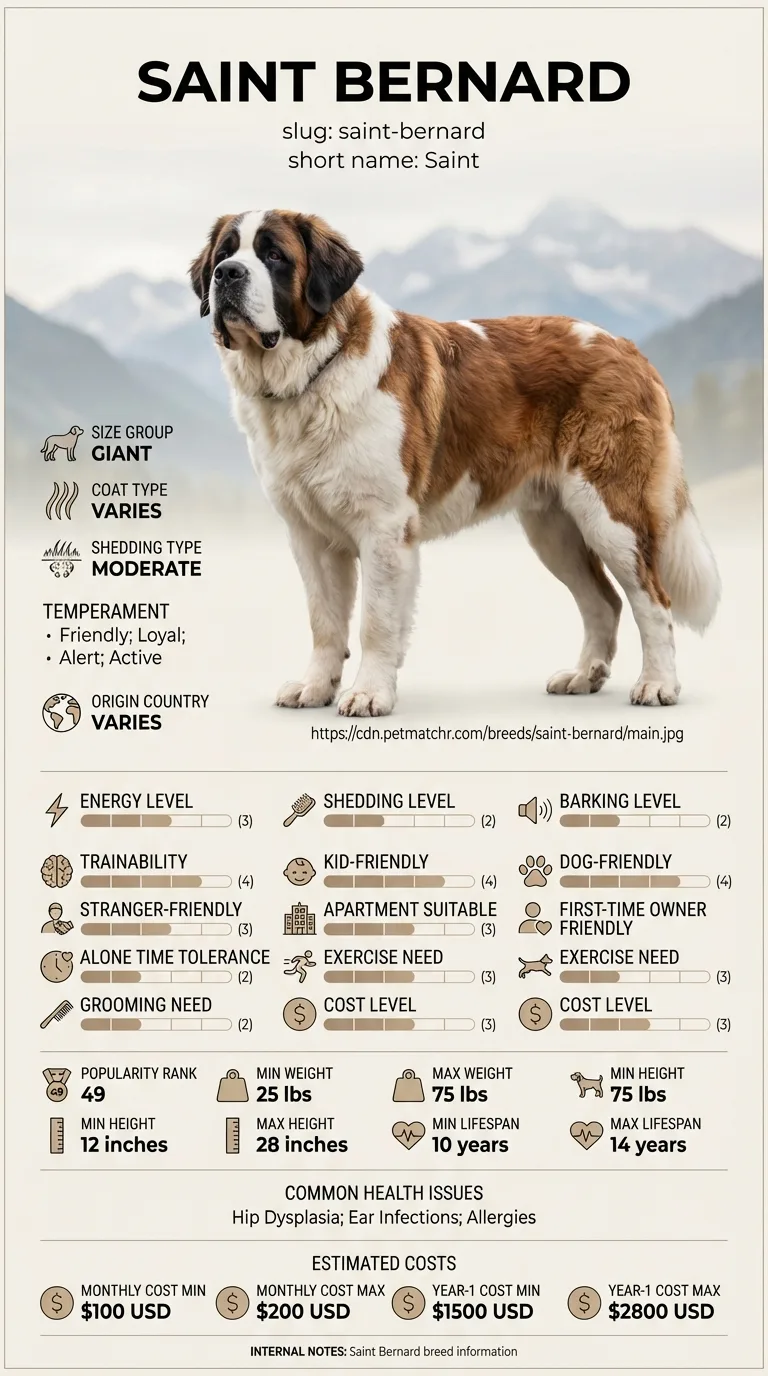
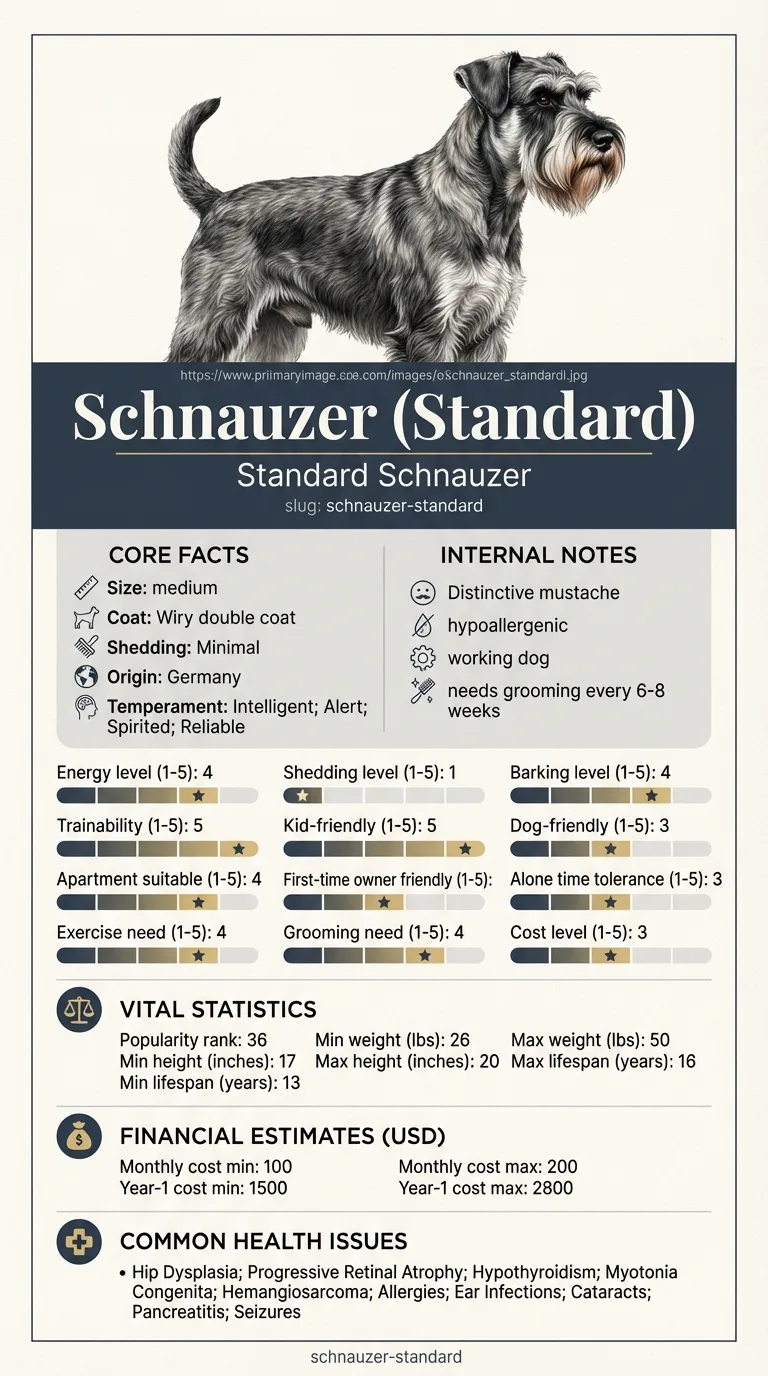
This is for someone already down to Saint Bernard and Schnauzer (Standard) and deciding between them. For this pair the decision usually turns on apartment suitability and shedding, so those are covered first and in most detail. Anyone choosing from a flat has a clear answer here: Schnauzer (Standard) rates 4/5 against 1/5. Breed history is left out; what follows is what you will actually live with.
Between Saint Bernard and Schnauzer (Standard), apartment suitability is what separates them; neither is the lower-effort dog overall.
Choose Saint Bernard if you do not want a standing grooming appointment, your walking routine is modest and you already have another dog.
Choose Schnauzer (Standard) if you are in a flat or a smaller home, shedding is a problem in your house and you want a dog that picks up training quickly.
| Feature | saint bernard | schnauzer standard | Winner |
|---|---|---|---|
| Size class | giant | medium | Equal |
| Weight | 120–180 lbs | 26–50 lbs | Equal |
| Height | 26–30 in | 17–20 in | Equal |
| Lifespan | 8–10 years | 13–16 years | schnauzer standard |
| Exercise need | Low (2/5) | High (4/5) | saint bernard |
| Grooming need | Moderate (3/5) | High (4/5) | saint bernard |
| Shedding | High (4/5) | Very low (1/5) | schnauzer standard |
| Energy level | Low (2/5) | High (4/5) | Equal |
| Barking | Low (2/5) | High (4/5) | saint bernard |
| Apartment suitability | Very low (1/5) | High (4/5) | schnauzer standard |
| Good for first-time owners | Moderate (3/5) | Moderate (3/5) | Equal |
| Tolerates being alone | Moderate (3/5) | Moderate (3/5) | Equal |
| Trainability | Moderate (3/5) | Very high (5/5) | schnauzer standard |
| Good with kids | Very high (5/5) | Very high (5/5) | Equal |
| Good with other dogs | High (4/5) | Moderate (3/5) | saint bernard |
| Friendly to strangers | High (4/5) | Moderate (3/5) | saint bernard |
| Cost level | Very high (5/5) | Moderate (3/5) | schnauzer standard |
| Coat | Short or long double coat | Wiry double coat | Equal |
| Origin | Various | Germany | Equal |
| Typical monthly cost | $150–$310 | $100–$200 | Equal |
| Typical first-year cost | $2,200–$4,200 | $1,500–$2,800 | Equal |
This is the widest size gap in the batch — the Saint Bernard's giant 120–180 lb, 26–30 in frame against the Standard Schnauzer's medium 26–50 lbs and 17–20 in, meaning the Schnauzer's upper weight roughly matches the Saint Bernard's lower weight bound alone. Anyone cross-shopping these two is really choosing between a giant breed built for cold-weather rescue work and a compact, wiry-coated working terrier-type — about as different a physical proposition as this comparison format allows. A Saint Bernard's sheer bulk also means basic tasks like lifting it into a car or onto a vet's table require real physical effort, unlike the compact Schnauzer.
The Standard Schnauzer is the far more active breed on paper, High (4/5) exercise need and energy level against Low (2/5) for the Saint Bernard on both measures. That's a full two-point gap, and it flips the usual large-breed-equals-more-exercise assumption on its head — the giant Saint Bernard is content with modest activity, while the mid-sized Schnauzer needs serious daily engagement to stay content. A short daily stroll genuinely satisfies the Saint Bernard, while the Schnauzer's high energy level calls for a real investment of time most days of the week.
The Saint Bernard needs somewhat less coat maintenance, Moderate (3/5) grooming against High (4/5) for the Standard Schnauzer's wiry double coat, which typically needs hand-stripping or clipping. Shedding flips hard the other way — High (4/5) for the Saint Bernard versus a remarkable Very low (1/5) for the Schnauzer, whose wiry coat holds onto loose hair rather than shedding it out. Households wanting minimal fur on the floor should lean firmly toward the Schnauzer despite its higher grooming-appointment needs. Saint Bernards with the long-coat variation need more frequent brushing than the short-coat type, another variable worth asking a breeder about directly.
The Standard Schnauzer is dramatically better suited to small spaces, High (4/5) apartment suitability against a rock-bottom Very low (1/5) for the Saint Bernard, whose sheer size is the limiting factor rather than temperament. Barking favors the calmer Saint Bernard, Low (2/5) against High (4/5) for the Schnauzer, so the trade-off is space against noise: a quiet giant that needs room, or a vocal compact dog that fits almost anywhere. A Schnauzer's barking can often be redirected with training focused on its alert-driven triggers, giving apartment dwellers a realistic path to a quieter household.
The Standard Schnauzer is notably more trainable, Very high (5/5) against Moderate (3/5) for the Saint Bernard, though both tie at Moderate (3/5) for first-time-owner suitability. Temperament tells two very different stories: the Saint Bernard is Gentle, Patient, Friendly, and Watchful, a naturally biddable-by-disposition profile even with its middling trainability score, while the Schnauzer is Intelligent, Alert, Spirited, and Reliable, a sharper, more independently switched-on personality that channels well into structured training. The Saint Bernard's Watchful temperament word suggests it still pays attention to its surroundings even without the Schnauzer's sharper trainability score.
The Saint Bernard pulls ahead on sociability — High (4/5) with other dogs against Moderate (3/5) for the Schnauzer, and High (4/5) friendliness to strangers against Moderate (3/5) — while the two tie at Very high (5/5) with kids, both breeds' top possible score on that measure. For households prioritizing an easygoing dog around a stream of visitors and other pets, the Saint Bernard's Gentle, Friendly temperament backs up its higher sociability numbers. Both breeds tying for the top score with kids is a strong signal for families, provided introductions are supervised as with any large or high-energy dog.
The Standard Schnauzer lives considerably longer, 13–16 years against a shorter 8–10 years for the Saint Bernard — nearly double at the low end. The Saint Bernard's health list is comparatively short at five conditions — Hip Dysplasia, Elbow Dysplasia, Dilated Cardiomyopathy, Entropion, and Bloat (GDV) — while the Schnauzer's runs to ten, including Hemangiosarcoma, Myotonia Congenita, Pancreatitis, and Seizures alongside shared Hip Dysplasia risk. A shorter list doesn't offset the Saint Bernard's notably shorter average lifespan as a giant breed. Entropion on the Saint Bernard's list, an eyelid condition, is usually correctable with minor surgery if caught early during routine checkups.
The Saint Bernard is the pricier of the two by a clear margin, Very high (5/5) cost level against Moderate (3/5) for the Standard Schnauzer, with monthly costs of $150–$310 versus $100–$200 and first-year costs of $2,200–$4,200 against $1,500–$2,800. The Saint Bernard's sheer size drives food, medication dosing, and equipment costs well above the Schnauzer's more modest requirements. Its Very high cost level, the top rating in this comparison, reflects just how much a giant breed's size drives up nearly every ownership expense.
Saint Bernard weighs 120–180 lbs and lives 8–10 years; Schnauzer (Standard) weighs 26–50 lbs and lives 13–16 years. The two diverge most on apartment suitability, shedding and exercise need and 4 other rated axes. They are level on tolerates being alone, good for first-time owners and good with kids, so those cannot decide it. The comparison marks an easier option only where one exists. Facts like weight and country of origin are not scored. Both dogs are rated from the same dataset, which is what makes the numbers comparable with each other even though any individual dog sits somewhere inside its breed's range.

The Standard Schnauzer, rated High (4/5) against Low (2/5) for the Saint Bernard — a reversal of the usual assumption that bigger dogs need more activity.
The Standard Schnauzer by a wide margin, High (4/5) versus Very low (1/5) for the Saint Bernard, whose size alone makes small spaces impractical.
The Saint Bernard, High (4/5) against a remarkable Very low (1/5) for the Standard Schnauzer.
The Standard Schnauzer, 13–16 years against 8–10 for the Saint Bernard.
The Saint Bernard, Low (2/5) barking versus High (4/5) for the Standard Schnauzer.
The Saint Bernard, rated High (4/5) on both measures against Moderate (3/5) for the Schnauzer.
The Standard Schnauzer, at $100–$200 monthly against $150–$310 for the Saint Bernard, whose Very high (5/5) cost level is the highest rating in this comparison.
The Saint Bernard, up to 180 lbs versus the Standard Schnauzer's 50 lbs.
The Standard Schnauzer, High (4/5) versus Low (2/5) for the Saint Bernard.
The Standard Schnauzer, 13–16 years versus 8–10 for the Saint Bernard.
The Standard Schnauzer, High (4/5) apartment suitability versus Very low (1/5) for the Saint Bernard.
Secure checkout on Stripe. We never see your card.
7-day money-back guarantee. Instant access.
Health information here is general and is not veterinary advice. If your dog shows pain, sudden behaviour change, or worsening symptoms, consult a licensed veterinarian.
Some links on this site are affiliate links. We may earn a commission at no extra cost to you, and we only suggest products we believe are helpful for dog owners.
We research and check what we publish, but we do not warrant that any figure, date, price, or statement is accurate, complete, or current, and we accept no liability for any loss, cost, injury, or other harm arising from the use of this site. Use it as one reference among several. You remain responsible for your own decisions and for your dog's care - confirm anything that matters with a licensed veterinarian or another qualified professional before you act on it. Full disclaimer.
Match your lifestyle to the right dog.
Take quizNot sure which breed is right for you? Take our 2-minute quiz to find out.
Take the quiz