Living
Havanese or Saint Bernard -- which fits your life?
Choose the Havanese for apartment life and a lower budget; choose the Saint Bernard only if you have real space and a much larger cost allowance.

Quick answer
Havanese or Saint Bernard -- which fits your life?
Choose the Havanese for apartment life and a lower budget; choose the Saint Bernard only if you have real space and a much larger cost allowance.
Havanese or Saint Bernard? On paper they differ most on apartment suitability, and on the scales Saint Bernard is the heavier at 120–180 lbs. Here is how the two compare on everything that shapes an ordinary week.
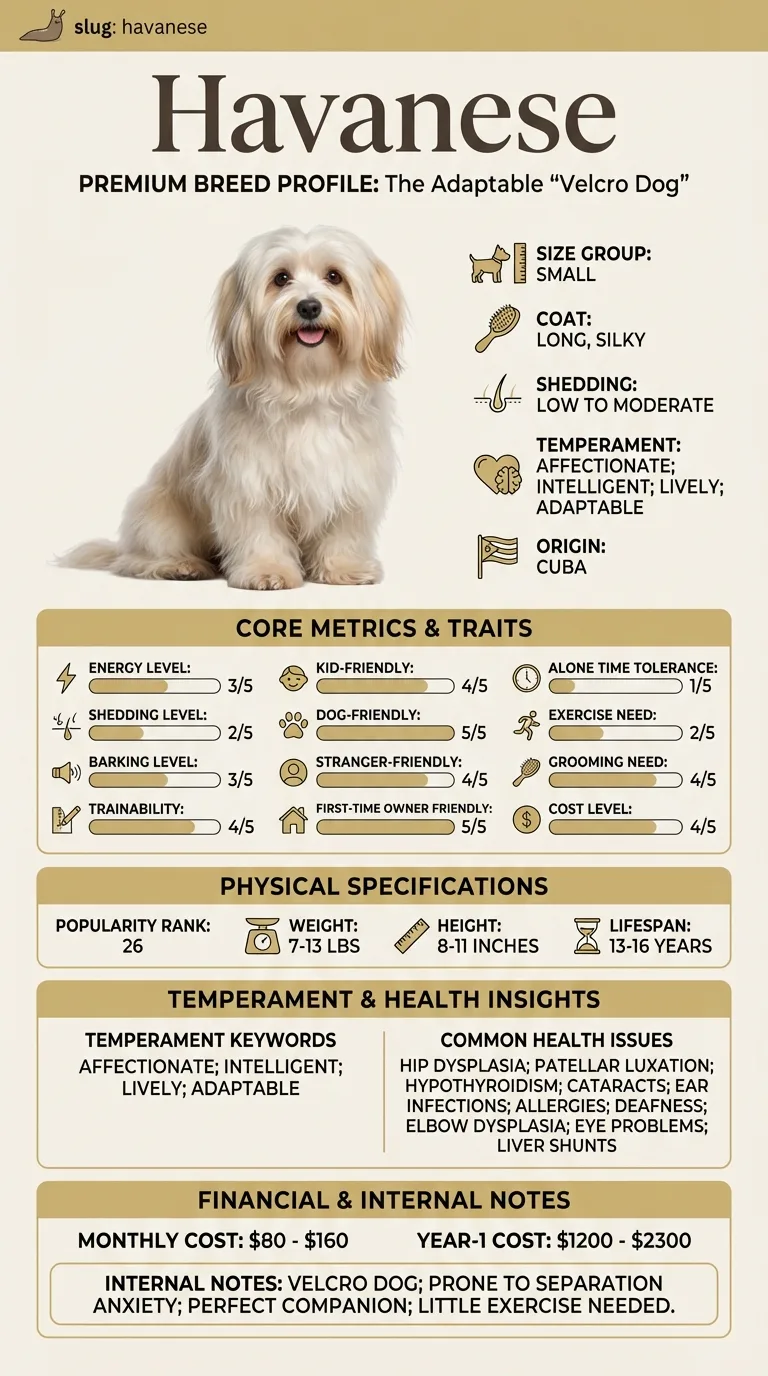
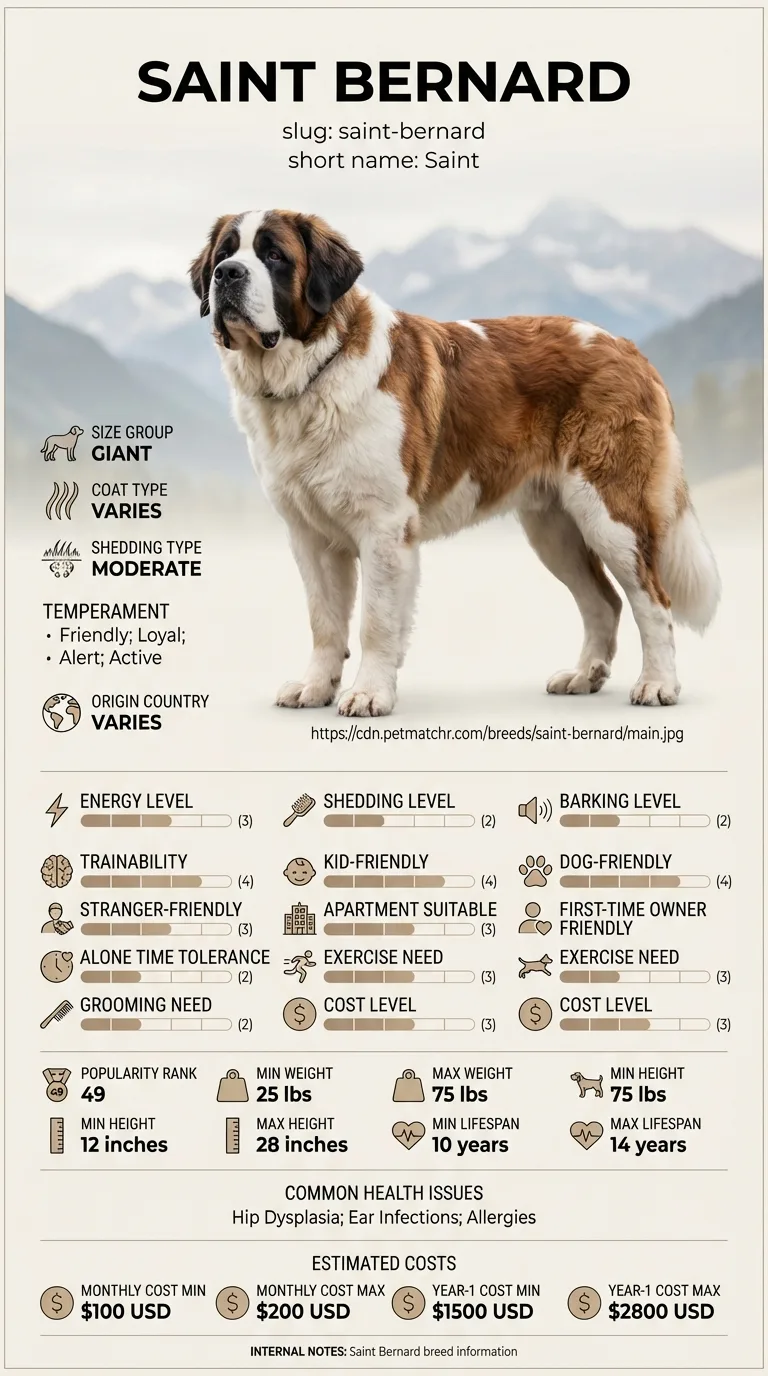
This is for someone already down to Havanese and Saint Bernard and deciding between them. For this pair the decision usually turns on apartment suitability and shedding, so those are covered first and in most detail. Anyone choosing from a flat has a clear answer here: Havanese rates 5/5 against 1/5. Breed history is left out; what follows is what you will actually live with.
Between Havanese and Saint Bernard, apartment suitability is what separates them, and Havanese is the lower-effort dog of the two to keep.
Choose Havanese if you are in a flat or a smaller home, this is your first dog and shedding is a problem in your house.
Choose Saint Bernard if you do not want a standing grooming appointment, the dog will be alone during the working day and there are young children at home.
| Feature | havanese | saint bernard | Winner |
|---|---|---|---|
| Size class | small | giant | Equal |
| Weight | 7–13 lbs | 120–180 lbs | Equal |
| Height | 8–11 in | 26–30 in | Equal |
| Lifespan | 13–16 years | 8–10 years | havanese |
| Exercise need | Low (2/5) | Low (2/5) | Equal |
| Grooming need | High (4/5) | Moderate (3/5) | saint bernard |
| Shedding | Low (2/5) | High (4/5) | havanese |
| Energy level | Moderate (3/5) | Low (2/5) | Equal |
| Barking | Moderate (3/5) | Low (2/5) | saint bernard |
| Apartment suitability | Very high (5/5) | Very low (1/5) | havanese |
| Good for first-time owners | Very high (5/5) | Moderate (3/5) | havanese |
| Tolerates being alone | Very low (1/5) | Moderate (3/5) | saint bernard |
| Trainability | High (4/5) | Moderate (3/5) | havanese |
| Good with kids | High (4/5) | Very high (5/5) | saint bernard |
| Good with other dogs | Very high (5/5) | High (4/5) | havanese |
| Friendly to strangers | High (4/5) | High (4/5) | Equal |
| Cost level | High (4/5) | Very high (5/5) | havanese |
| Coat | Long, silky | Short or long double coat | Equal |
| Origin | Cuba | Various | Equal |
| Typical monthly cost | $80–$160 | $150–$310 | Equal |
| Typical first-year cost | $1,200–$2,300 | $2,200–$4,200 | Equal |
This is a small dog next to a giant one -- Havanese at 7-13 lbs, Saint Bernard at 120-180 lbs, with height more than double, 8-11 inches versus 26-30. A Saint Bernard this size needs floor space and doorway clearance a Havanese never will, and even a "Gentle" giant reputation doesn't change the physical logistics of housing a dog that can outweigh most adult owners. Furniture, car transport, and vet-office scales are all sized differently for this breed.
Both rate a low 2/5 for exercise need, genuinely surprising for a dog the Saint Bernard's size, but the breed is known for being calm and "Patient" rather than athletic. Energy level itself is rated low for the Saint Bernard (2/5) against moderate for the Havanese (3/5), so despite the size gap, the bigger dog is actually the more laid-back one on paper. Don't mistake that calmness for zero needs, though -- a dog this large still benefits from regular gentle movement to protect its joints.
The Havanese needs more grooming effort (4/5) than the Saint Bernard (3/5), but the Saint Bernard sheds far more, 4/5 versus 2/5, a lot of hair from a large-bodied double coat, just less brushing-intensive than the Havanese's longer, finer coat. Given the coat can run short or long depending on the individual dog, actual grooming time varies more within the Saint Bernard breed than these averaged ratings fully capture.
The gap here is stark: Havanese 5/5 for apartment suitability, Saint Bernard just 1/5, the lowest score in this comparison. Barking favors the Saint Bernard though, 2/5 vs 3/5, a quiet, if enormous, housemate, just not one a small unit can reasonably accommodate. Even a calm, low-barking giant breed still needs enough square footage to move around, lie down, and turn without constantly bumping into walls or furniture.
Havanese trains a step higher (4/5 vs 3/5) and is rated far more suitable for first-time owners, 5/5 vs 3/5. A Saint Bernard's size alone raises the stakes of training -- leash manners and impulse control matter more when the dog outweighs most adults, even one as "Patient" and even-tempered as this breed tends to be. A poorly leash-trained Saint Bernard is a much bigger physical problem than a poorly leash-trained Havanese.
Saint Bernards score even better with kids than Havanese, 5/5 vs 4/5, matching their gentle-giant reputation and "Friendly" temperament tag, and Havanese edges ahead with other dogs, 5/5 vs 4/5. Both are rated equally friendly to strangers (4/5). Saint Bernards also tolerate being alone somewhat better, 3/5 vs the Havanese's 1/5 -- worth noting for a household where someone is regularly out of the house for a full workday.
The lifespan gap is severe -- 13-16 years for the Havanese against just 8-10 for the Saint Bernard, typical of giant breeds generally. The Saint Bernard's five-condition health list includes dilated cardiomyopathy and bloat alongside hip and elbow dysplasia, heart and joint issues that scale with body size. Owners of giant breeds are often advised to watch specifically for bloat symptoms, since it can become an emergency within hours.
The Saint Bernard is rated the highest cost tier on this site, 5/5, against the Havanese's 4/5, and the dollar figures back it up: $150-310 monthly versus $80-160, and $2,200-4,200 in the first year versus $1,200-2,300. Feeding and treating a 150-plus-pound dog isn't cheap, and large-breed veterinary procedures, medications, and equipment -- crates, beds, car harnesses -- all scale up in price along with the dog itself.
Havanese weighs 7–13 lbs and lives 13–16 years; Saint Bernard weighs 120–180 lbs and lives 8–10 years. The two diverge most on apartment suitability, shedding and good for first-time owners and 1 other rated axes. They are level on exercise need and friendly to strangers, so those cannot decide it. The comparison marks an easier option only where one exists. Facts like weight and country of origin are not scored. Both dogs are rated from the same dataset, which is what makes the numbers comparable with each other even though any individual dog sits somewhere inside its breed's range.

Enormously -- 120-180 lbs versus 7-13 lbs, and more than double the height. A Saint Bernard is one of the largest breeds this site compares against the Havanese.
No -- rated 2/5, the same low score as the Havanese. It's a calm breed despite its size, though its bulk still needs room to move around comfortably.
Not really -- rated 1/5, the lowest apartment score in this comparison, against the Havanese's 5/5. Size is the limiting factor here, not noise; barking is actually rated lower for the Saint Bernard.
The Saint Bernard, rated 5/5 against the Havanese's 4/5, consistent with its longstanding gentle-giant reputation.
Significantly -- $150-310 a month versus $80-160 for the Havanese, and $2,200-4,200 in the first year versus $1,200-2,300.
At 8-10 years against the Havanese's 13-16, it follows the general large and giant-breed pattern, and its health list, including dilated cardiomyopathy and bloat, reflects the strain a very large body places on the heart and digestive system.
The Saint Bernard, rated 3/5 versus the Havanese's 1/5 -- still not ideal for long stretches, but noticeably better than the Havanese's very low tolerance.
Choose the Havanese for apartment life and a lower budget; choose the Saint Bernard only if you have real space and a much larger cost allowance.
$80-160 for the Havanese versus $150-310 for the Saint Bernard, the highest cost tier in this comparison.
Both are low, 2/5 -- the Saint Bernard's size doesn't translate to high exercise demands.
Havanese 13-16 years, Saint Bernard 8-10 years -- a difference of up to eight years.
Secure checkout on Stripe. We never see your card.
7-day money-back guarantee. Instant access.

Health information here is general and is not veterinary advice. If your dog shows pain, sudden behaviour change, or worsening symptoms, consult a licensed veterinarian.
Some links on this site are affiliate links. We may earn a commission at no extra cost to you, and we only suggest products we believe are helpful for dog owners.
We research and check what we publish, but we do not warrant that any figure, date, price, or statement is accurate, complete, or current, and we accept no liability for any loss, cost, injury, or other harm arising from the use of this site. Use it as one reference among several. You remain responsible for your own decisions and for your dog's care - confirm anything that matters with a licensed veterinarian or another qualified professional before you act on it. Full disclaimer.
Match your lifestyle to the right dog.
Take quizNot sure which breed is right for you? Take our 2-minute quiz to find out.
Take the quiz