Health
What's the key warning sign for these spinal conditions?
A wobbly or uncoordinated gait, especially in the hind legs, rather than simple stiffness or slowness.

Quick answer
What's the key warning sign for these spinal conditions?
A wobbly or uncoordinated gait, especially in the hind legs, rather than simple stiffness or slowness.
A wobbly hind end, reluctance to lower the head to eat, or a dragging back paw is not the same picture as ordinary stiffness. These are signs pointing toward the spinal column itself, not just tired muscles, and giant breeds are the size class where vets watch for them most closely.
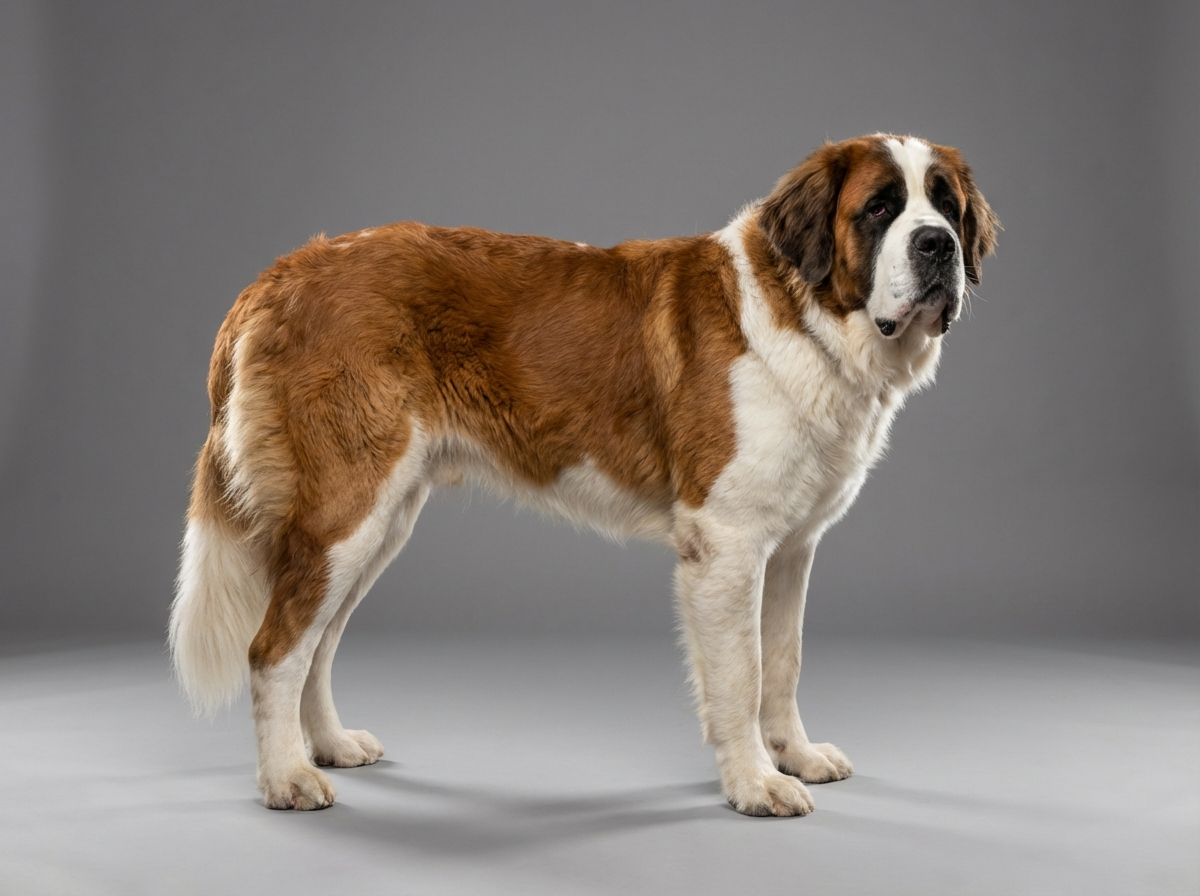
Owners already managing their Saint Bernard's general joint and back-strain risk who now notice a genuinely different pattern — weakness, dragging, or an odd wobble — and are not sure whether it is the same issue getting worse or something new.
This guide is not medical advice. If your dog shows pain, sudden behavior change, or worsening symptoms, consult a licensed veterinarian.
Some links may be affiliate links. We may earn a commission at no extra cost to you. We only suggest products we believe are helpful for dog owners.
We research and check what we publish, but we do not warrant that any figure, date, price, or statement is accurate, complete, or current, and we accept no liability for any loss, cost, injury, or other harm arising from the use of this site. Use it as one reference among several. You remain responsible for your own decisions and for your dog's care - confirm anything that matters with a licensed veterinarian or another qualified professional before you act on it. Full disclaimer.
Back and spine issues, distinct from ordinary muscular strain, refer to conditions affecting the spinal column itself — most notably cervical vertebral instability and lumbosacral stenosis — where the spinal cord or nerve roots are compressed. These are best documented in other giant breeds but remain a relevant concern given the mechanical stress a very large body places on the spine.
These specific spinal conditions are considered uncommon in Saint Bernards compared to breeds like Great Danes and Dobermans, where they are better documented, but any giant breed can develop them given the shared size-related mechanical stress on the spine.
The mechanical demand of a very large body moving through daily life puts real stress on the spine's structural elements — vertebrae, discs, and the canal that houses the spinal cord and nerve roots. While the strongest documented cases are in other giant breeds, Saint Bernards share the same size-related biomechanics that make these conditions plausible.
Repeated high-impact activity, rapid unmanaged growth in puppyhood, and simply the passage of time carrying a heavy frame all contribute to gradual mechanical wear on the spinal column and surrounding structures.
See a vet promptly for any new wobbliness, dragging of a paw, reluctance to lower the head, or lowered tail carriage. Treat as a true emergency any sudden hind-end weakness, inability to stand, or apparent paralysis, since rapid spinal cord compression can worsen quickly without treatment.
See all Saint Bernard health problems, which breeds are prone to backspine issues, or the full Saint Bernard breed guide for temperament, exercise needs and ownership costs.
Diagnosis typically takes one to two specialist visits including advanced imaging. Recovery or management timelines vary widely by condition and severity, ranging from weeks of restricted activity to a longer surgical recovery.
Success is an accurate diagnosis reached quickly, appropriate treatment started before significant nerve damage occurs, and a dog that regains as much normal function as its specific condition and severity allow.
Cervical vertebral instability involves the neck vertebrae compressing the spinal cord, most often producing a wobbly, uncoordinated gait, especially in the hind legs, sometimes with the head held low. It is best documented in Great Danes and Dobermans, but any giant breed's size and neck length can put comparable mechanical stress on the cervical spine, and it is worth being aware of even without being the most typical dog affected.
Lumbosacral stenosis is a narrowing of the canal where the lower spine meets the pelvis, more directly tied to a large body's weight passing through that joint for years. It tends to show up as reluctance to jump, a lowered tail carriage, or pain when the lower back is extended, and is more clearly linked to sheer size and age than cervical instability is.
Both are distinct from the everyday muscular back strain a large, growing dog experiences — they involve the spinal cord or nerve roots directly, which is why neurological signs like weakness, dragging or incoordination separate them from ordinary stiffness.
Ordinary strain responds to rest; these signs generally do not, and they warrant imaging rather than a wait-and-see approach.

Nell, a seven-year-old Saint Bernard, started swaying slightly when descending her family's porch steps, something they initially chalked up to arthritis given her age. Over a few weeks the wobble became more noticeable, and her back nails began showing unusual wear from mild dragging. A vet exam found neurological signs beyond typical arthritis, and an MRI at a referral center confirmed lumbosacral stenosis. Nell started on activity restriction and anti-inflammatory management, avoiding stairs and jumping. Over two months her gait stabilized, and she has remained stable on ongoing management without needing surgery.
Key takeaway: The worn nails on one back paw were the detail that separated Nell's condition from ordinary arthritis — a subtle, easy-to-miss sign that pointed her family toward the right diagnosis instead of another round of joint supplements.
No. General strain involves muscles and ligaments and responds to rest and management. Cervical instability and lumbosacral stenosis involve the spinal cord or nerve roots directly and typically need imaging and specialist input.
Usually with a neurological exam followed by advanced imaging such as an MRI or CT scan, since plain X-rays often cannot show soft tissue compression on the spinal cord clearly.
Not always — some mild cases are managed with activity restriction and anti-inflammatory treatment, while more severe or progressive cases may need surgical decompression. This is decided case by case with a veterinary neurologist.
They are best documented in Great Danes and Dobermans, but any giant breed's size puts comparable mechanical stress on the spine, so awareness is still worthwhile even without a strong breed-specific data set for Saint Bernards.
Degenerative myelopathy is a separate, typically painless, slowly progressive nerve condition usually seen in older dogs. Cervical instability and lumbosacral stenosis more often involve pain and can progress more variably.
Outcomes vary by severity and how early treatment starts. Catching mild signs early and starting appropriate management or surgery generally gives a better outlook than waiting until signs are advanced.
Vets often recommend strict rest and avoiding jumping, stairs and rough play until imaging clarifies the diagnosis, since further strain on an unstable spine can worsen compression.
A wobbly or uncoordinated gait, especially in the hind legs, rather than simple stiffness or slowness.
It involves the spinal cord or nerve roots directly, producing neurological signs like dragging or weakness, not just soreness.
An MRI or CT scan, since plain X-rays usually cannot show soft tissue compression on the spinal cord.
Sudden hind-end weakness or collapse is an emergency; gradually progressing signs still warrant a prompt, non-emergency vet visit.
Mild cases sometimes are, with activity restriction and medication, though more severe cases may need surgical decompression.
A one-page prep sheet for this condition: the signs, the questions to ask, what to get priced. Unlocks here.
You get: Vet visit prep sheet
No spam. One-click unsubscribe. See our privacy policy.
Preview page 1 before you decide.