Behavior
More energetic day to day?
The Shiba Inu, rated high (4/5) energy versus the Saint Bernard's low (2/5).

Quick answer
More energetic day to day?
The Shiba Inu, rated high (4/5) energy versus the Saint Bernard's low (2/5).
Saint Bernard or Shiba Inu? On paper they differ most on apartment suitability, and on the scales Saint Bernard is the heavier at 120–180 lbs. Here is how the two compare on everything that shapes an ordinary week.
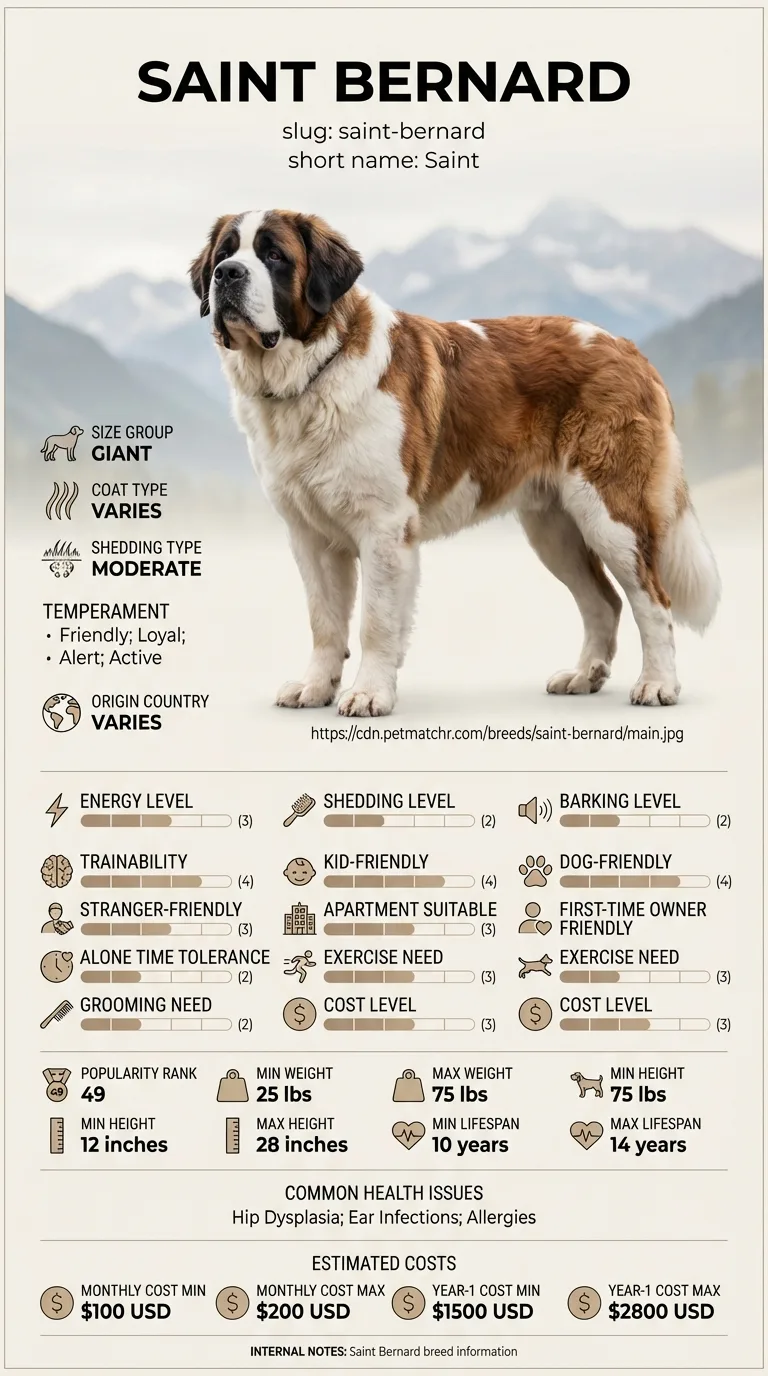
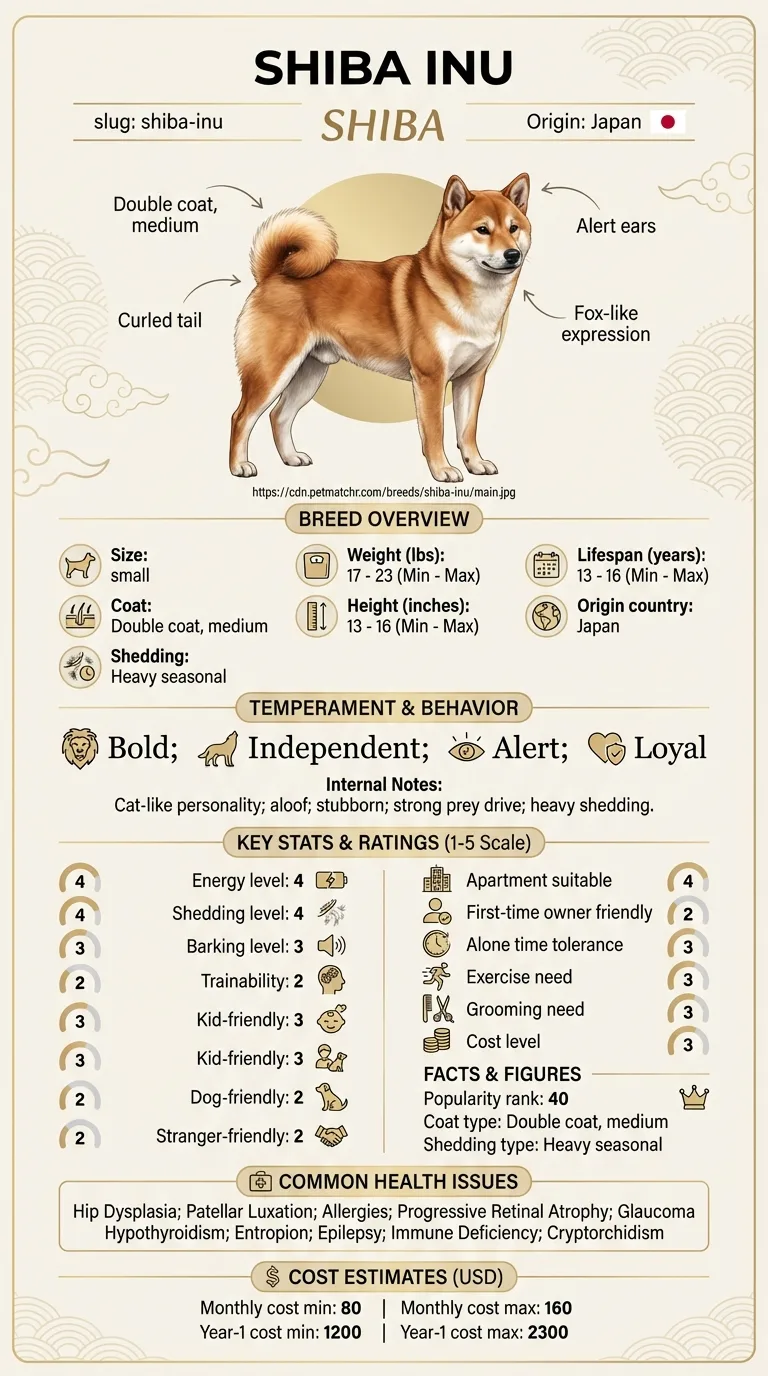
This is for someone already down to Saint Bernard and Shiba Inu and deciding between them. For this pair the decision usually turns on apartment suitability and energy level, so those are covered first and in most detail. Anyone choosing from a flat has a clear answer here: Shiba Inu rates 4/5 against 1/5. The focus throughout is on daily consequences rather than breed background.
Between Saint Bernard and Shiba Inu, apartment suitability is what separates them, and Shiba Inu is the lower-effort dog of the two to keep.
Choose Saint Bernard if this is your first dog, your walking routine is modest and there are young children at home.
Choose Shiba Inu if you are in a flat or a smaller home, a smaller dog suits your car, your home or your back and you want a dog that can keep up with an active routine.
| Feature | saint bernard | shiba inu | Winner |
|---|---|---|---|
| Size class | giant | small | Equal |
| Weight | 120–180 lbs | 17–23 lbs | Equal |
| Height | 26–30 in | 13–16 in | Equal |
| Lifespan | 8–10 years | 13–16 years | shiba inu |
| Exercise need | Low (2/5) | Moderate (3/5) | saint bernard |
| Grooming need | Moderate (3/5) | Moderate (3/5) | Equal |
| Shedding | High (4/5) | High (4/5) | Equal |
| Energy level | Low (2/5) | High (4/5) | Equal |
| Barking | Low (2/5) | Moderate (3/5) | saint bernard |
| Apartment suitability | Very low (1/5) | High (4/5) | shiba inu |
| Good for first-time owners | Moderate (3/5) | Low (2/5) | saint bernard |
| Tolerates being alone | Moderate (3/5) | Moderate (3/5) | Equal |
| Trainability | Moderate (3/5) | Low (2/5) | saint bernard |
| Good with kids | Very high (5/5) | Moderate (3/5) | saint bernard |
| Good with other dogs | High (4/5) | Low (2/5) | saint bernard |
| Friendly to strangers | High (4/5) | Low (2/5) | saint bernard |
| Cost level | Very high (5/5) | Moderate (3/5) | shiba inu |
| Coat | Short or long double coat | Double coat, medium | Equal |
| Origin | Various | Japan | Equal |
| Typical monthly cost | $150–$310 | $80–$160 | Equal |
| Typical first-year cost | $2,200–$4,200 | $1,200–$2,300 | Equal |
Weight alone separates these two by a factor of roughly seven: a 120–180 lb, 26–30 inch Saint Bernard versus a 17–23 lb, 13–16 inch Shiba Inu. The Shiba is barely bigger than a Saint Bernard puppy at a few months old, which matters for anyone picturing both dogs in the same household — a Saint Bernard can physically overwhelm a Shiba in play without meaning to. Furniture, car space, and even leash strength requirements scale very differently: a Shiba can be walked on a standard leash by almost anyone, while a Saint Bernard's pulling power calls for a sturdier harness and a handler who can hold their ground.
The Saint Bernard rates low (2/5) for both exercise need and energy level, while the Shiba Inu rates moderate (3/5) for exercise but high (4/5) for energy — a combination that reads as a small dog who is intensely alert and reactive in short bursts rather than one who needs marathon mileage. Shiba owners often describe sudden zoomies followed by long stretches of independent lounging, consistent with the breed's "Bold" and "Independent" temperament tags. The Saint Bernard's exercise needs are easily met with short walks, making this pairing a case where the giant breed is actually the lower-maintenance one physically, even though its size suggests otherwise.
Both breeds shed heavily (4/5), and both carry a moderate (3/5) grooming need, but the routines look different day to day. The Saint Bernard's short-or-long double coat needs regular brushing plus drool management, while the Shiba Inu's medium double coat blows its undercoat seasonally in dramatic clumps that call for daily brushing during those weeks. Neither breed is a hypoallergenic option. Shiba owners should budget for a deshedding tool and more frequent vacuuming during spring and fall coat blows, while Saint Bernard owners deal with a steadier, year-round shed alongside slobber on top of the fur itself.
The Shiba Inu is rated high (4/5) for apartment suitability against the Saint Bernard's very low (1/5), making the Shiba the far more realistic choice for compact living. Barking favors the Saint Bernard at low (2/5) versus the Shiba's moderate (3/5) — Shibas are known for the distinctive "Shiba scream," a vocalization that can surprise neighbors even at a moderate frequency rating. Both breeds tolerate alone time moderately (3/5), so neither is an ideal fit for owners gone 10+ hours a day, though the Shiba's independent streak may make solo hours feel more natural to the dog than to a people-oriented Saint Bernard.
This is a rare case where the giant breed out-trains the small one: the Saint Bernard rates moderate (3/5) for trainability against the Shiba Inu's low (2/5), and the gap shows up in the first-time-owner scores too — moderate (3/5) for the Saint Bernard versus low (2/5) for the Shiba. Shiba Inus are famously independent and often described as cat-like in their willingness to ignore commands they see no point in following, a trait tied directly to their "Independent" temperament tag. First-time owners drawn to the Shiba's compact size should know that recall training, in particular, requires patience and a securely fenced yard rather than trust off-leash.
With kids, the Saint Bernard rates very high (5/5) against the Shiba's moderate (3/5), and the pattern repeats with other dogs — high (4/5) for the Saint Bernard versus low (2/5) for the Shiba, a breed with a reputation for same-sex aggression and a strong prey drive toward smaller animals. Strangers see the same split: high (4/5) friendliness for the Saint Bernard versus low (2/5) for the Shiba. Households with young children, other pets, or a lot of visitor traffic will generally find the Saint Bernard's temperament profile the easier fit, despite its intimidating size.
The Shiba Inu's 13–16 year lifespan nearly doubles the Saint Bernard's 8–10 years, though the Shiba's health list is the longer one here: Hip Dysplasia, Patellar Luxation, Allergies, Progressive Retinal Atrophy, Glaucoma, Hypothyroidism, Entropion, Epilepsy, Immune Deficiency, and Cryptorchidism. The Saint Bernard's shorter list — Hip Dysplasia, Elbow Dysplasia, Dilated Cardiomyopathy, Entropion, and Bloat (GDV) — includes fewer conditions but tends toward more acute, giant-breed-specific emergencies like bloat. Both breeds share Hip Dysplasia and Entropion risk, so joint and eyelid screening are worth asking about regardless of which breed a household chooses.
Cost level rates very high (5/5) for the Saint Bernard versus moderate (3/5) for the Shiba Inu, and the dollar ranges track closely: $150–310 monthly and $2,200–4,200 first-year for the Saint Bernard against $80–160 monthly and $1,200–2,300 first-year for the Shiba. Food volume is the clearest driver of the gap, though giant-breed veterinary visits, larger medication doses, and bigger equipment all add up. The Shiba's shorter health-issue list per visit doesn't necessarily mean cheaper vet bills, given how many distinct conditions appear on its list, but its food and gear costs alone put it well under the Saint Bernard's overall spend.
Saint Bernard weighs 120–180 lbs and lives 8–10 years; Shiba Inu weighs 17–23 lbs and lives 13–16 years. The two diverge most on apartment suitability, energy level and good with kids and 3 other rated axes. They are level on tolerates being alone, grooming need and shedding, so those cannot decide it. The table below marks a winner only where one breed is genuinely easier for a typical owner; size and origin are facts rather than merits and stay level. Ratings come from one source applied to both breeds, so they are meaningful against each other rather than as absolute scores.

The Saint Bernard, rated low (2/5) for barking versus the Shiba Inu's moderate (3/5); Shibas are known for a sharp, high-pitched vocalization sometimes called the 'Shiba scream.'
The Shiba Inu, tagged 'Independent' and 'Bold' in temperament and rated low (2/5) for trainability — it will often make its own decisions rather than defer to a handler.
Not especially — it's rated low (2/5) for compatibility with other dogs, notably lower than the Saint Bernard's high (4/5).
The Shiba Inu, at 13–16 years, nearly double the Saint Bernard's 8–10 year average lifespan.
The Shiba Inu by a wide margin — rated high (4/5) for apartment suitability against the Saint Bernard's very low (1/5).
Roughly double — $150–310 a month versus the Shiba's $80–160, and $2,200–4,200 versus $1,200–2,300 in the first year.
Neither scores high, but the Saint Bernard's moderate (3/5) rating edges out the Shiba's low (2/5), largely due to the Shiba's independent, harder-to-train nature.
The Shiba Inu, rated high (4/5) energy versus the Saint Bernard's low (2/5).
The Saint Bernard, rated high (4/5) with other dogs versus the Shiba's low (2/5).
The Shiba Inu, at $1,200–2,300 versus the Saint Bernard's $2,200–4,200.
The Shiba Inu, 13–16 years to the Saint Bernard's 8–10.
Secure checkout on Stripe. We never see your card.
7-day money-back guarantee. Instant access.
Health information here is general and is not veterinary advice. If your dog shows pain, sudden behaviour change, or worsening symptoms, consult a licensed veterinarian.
Some links on this site are affiliate links. We may earn a commission at no extra cost to you, and we only suggest products we believe are helpful for dog owners.
We research and check what we publish, but we do not warrant that any figure, date, price, or statement is accurate, complete, or current, and we accept no liability for any loss, cost, injury, or other harm arising from the use of this site. Use it as one reference among several. You remain responsible for your own decisions and for your dog's care - confirm anything that matters with a licensed veterinarian or another qualified professional before you act on it. Full disclaimer.
Match your lifestyle to the right dog.
Take quizNot sure which breed is right for you? Take our 2-minute quiz to find out.
Take the quiz