Health
What's the hallmark sign of DM?
Slow, painless weakening and incoordination in the hind limbs, without pain when the area is examined.

Quick answer
What's the hallmark sign of DM?
Slow, painless weakening and incoordination in the hind limbs, without pain when the area is examined.
A dog that is stumbling but shows absolutely no sign of pain when the same limb is examined is telling you something specific. DM does not hurt the way arthritis or a slipped disc typically does, and that painless quality is one of its most defining, and most unsettling, features.
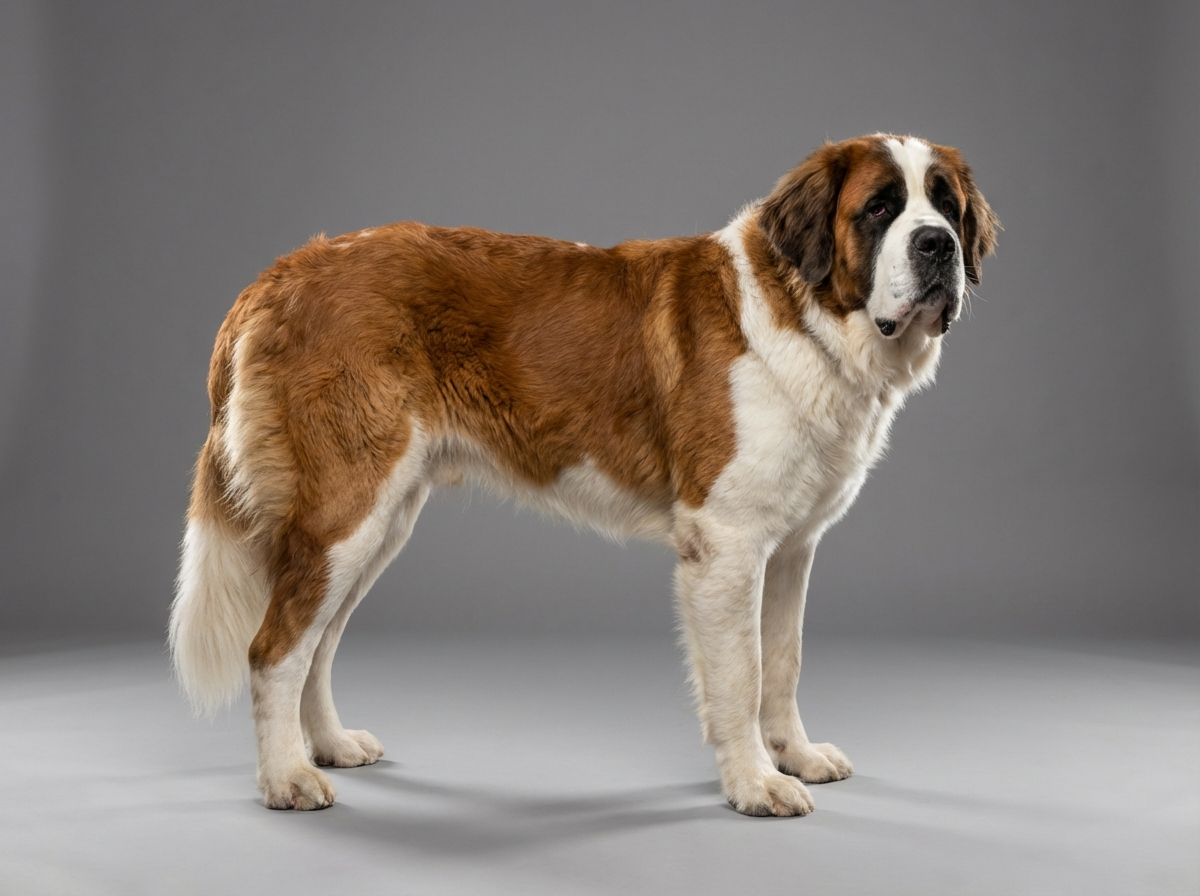
Owners of an older Saint Bernard noticing gradually worsening hind-leg coordination who are trying to understand why their dog does not seem to be in pain despite an obviously weakening gait.
This guide is not medical advice. If your dog shows pain, sudden behavior change, or worsening symptoms, consult a licensed veterinarian.
Some links may be affiliate links. We may earn a commission at no extra cost to you. We only suggest products we believe are helpful for dog owners.
We research and check what we publish, but we do not warrant that any figure, date, price, or statement is accurate, complete, or current, and we accept no liability for any loss, cost, injury, or other harm arising from the use of this site. Use it as one reference among several. You remain responsible for your own decisions and for your dog's care - confirm anything that matters with a licensed veterinarian or another qualified professional before you act on it. Full disclaimer.
Degenerative myelopathy is a progressive, typically painless disease of the spinal cord that gradually weakens the hind limbs in older dogs. Its hallmark painless progression helps distinguish it from more common, treatable causes of hind-limb weakness like arthritis or a compressive disc problem, though there is currently no cure.
Degenerative myelopathy is a recognized condition in older large-breed dogs generally, though it is not among the most frequently cited health issues specifically documented for Saint Bernards, and any hind-limb weakness should first be evaluated for more common, treatable causes.
DM is associated with a specific genetic mutation found across a range of breeds, though it is not established as a strongly elevated risk specifically for Saint Bernards compared to more commonly affected breeds. It remains a possibility worth ruling in or out in any older dog with progressive hind-limb weakness.
There is no well-established environmental trigger for DM, since it is understood as primarily a genetic, age-related degenerative condition rather than one driven by external factors.
See a vet for any new, progressive hind-limb weakness, dragging or incoordination in an older dog, to rule out more common and treatable causes first. There is no sudden emergency specific to DM's typical slow course, but any abrupt change in condition warrants prompt evaluation to rule out a separate, acute problem.
See all Saint Bernard health problems, which breeds are prone to degenerative myelopathy dm, or the full Saint Bernard breed guide for temperament, exercise needs and ownership costs.
DM typically progresses over six months to a couple of years, moving from mild hind-limb weakness toward more significant mobility loss, though the exact pace varies meaningfully between individual dogs.
Success is not reversal, since there is no cure, but rather maintaining the best possible mobility, comfort and quality of life for as long as possible through supportive equipment and rehabilitation, with an honest understanding that the underlying decline will continue.
Degenerative myelopathy involves progressive degeneration of the nerve fibers within the spinal cord itself, rather than compression from a herniated disc or inflammation from arthritis, both of which typically cause pain alongside weakness. DM's hallmark is a slow, usually symmetrical decline in hind-limb coordination and strength — dragging toes, scuffed nails, swaying when standing still — that progresses over months without the dog showing signs of discomfort when the affected area is examined.
This painless quality is genuinely important diagnostically, since a dog showing pain alongside hind-limb weakness more likely has a compressive spinal issue like the cervical instability or lumbosacral stenosis covered elsewhere, or arthritis, both of which are managed very differently than DM. A vet, and often a veterinary neurologist, uses a combination of neurological exam findings and imaging to rule out these more common, treatable causes before confirming a DM diagnosis, which currently has no cure and a genetic test available for some at-risk breeds.
None of these interventions cure DM, but together they can meaningfully extend a good quality of life for a dog that, notably, is not in pain throughout most of the disease's course.

If you think your Saint has degenerative myelopathy (dm), the plan is three steps: write down what you have seen and when it started, book a veterinary appointment rather than waiting for the next flare, and take video of the behaviour or symptom before you go — the thing you are worried about rarely happens in the consulting room. Screening in the parents covers hip dysplasia, elbow dysplasia, dilated cardiomyopathy.
What the vet visit should produce is a diagnosis and a written plan, not just reassurance: what is being ruled out, what the monitoring interval is, and which signs mean you come back sooner. Ask what the treatment costs across a year rather than per visit, because that is the number that decides whether you are managing this condition or reacting to it.
Between appointments, keep a short log — dates, what you saw, what changed. It is the single most useful thing an owner brings to a follow-up, and for degenerative myelopathy (dm) it is often what separates a clear pattern from a guess.
Boomer, a ten-year-old Saint Bernard, began dragging his back toes slightly on walks, something his family initially assumed was simple old-age stiffness. When their vet examined him and found no pain response anywhere along his back or hips despite the obvious weakness, further workup was recommended to rule out other causes. Imaging ruled out a compressive disc problem, and Boomer's pattern — slow, symmetrical, entirely painless hind-limb decline — was consistent with degenerative myelopathy. His family started a structured rehabilitation program and added a supportive harness for walks. Over the following year his hind-limb function continued to decline gradually, and the family transitioned to a mobility cart, which let Boomer continue joining family walks well after his legs alone could no longer carry him.
Key takeaway: The absence of pain, which initially seemed reassuring, turned out to be the exact detail pointing toward Boomer's actual diagnosis — a reminder that painless does not mean nothing is wrong.
Generally no — DM is characterized by a painless progressive weakness, which is one of the key features that helps distinguish it from more painful conditions like arthritis or a herniated disc.
Those conditions typically involve pain from nerve compression and can sometimes be treated surgically. DM is a slow, painless nerve degeneration with no surgical treatment and no cure, generally progressing over many months.
No, there is currently no cure for DM. Management focuses on maintaining mobility and quality of life for as long as possible through rehabilitation and supportive equipment.
Diagnosis typically involves ruling out other, more common and treatable causes of hind-limb weakness through neurological exam and imaging, since there is no single definitive test to confirm DM in a living dog.
A genetic test for a relevant mutation exists and is used in some at-risk breeds, though its predictive value varies and should be discussed with your vet in the context of your specific dog.
Progression varies but often unfolds over six months to a couple of years, moving from mild hind-limb weakness to more significant mobility loss.
Many veterinary rehabilitation professionals believe structured physical therapy can help slow functional decline and maintain muscle strength longer, making it a widely recommended supportive measure.
The early signs are set out in the sections above, and they are the reason to book a veterinary appointment rather than wait. Degenerative Myelopathy (DM) in Saints is diagnosed by a vet, not from a symptom list, and the sooner it is on record the more options remain open.
Slow, painless weakening and incoordination in the hind limbs, without pain when the area is examined.
No — there is currently no cure, and management focuses on maintaining mobility and quality of life.
Arthritis typically causes pain; DM is characterized by its painless progression, which helps distinguish the two.
Many veterinary rehabilitation professionals believe structured physical therapy can help slow functional decline.
Often yes, since DM does not affect the front limbs or alertness, allowing many affected dogs to stay mobile and engaged with a cart.
A one-page prep sheet for this condition: the signs, the questions to ask, what to get priced. Unlocks here.
You get: Vet visit prep sheet
No spam. One-click unsubscribe. See our privacy policy.
Preview page 1 before you decide.