Living
Which is smaller?
The Pug, at 14-18 lbs versus the Golden's 55-75 lbs.

Quick answer
Which is smaller?
The Pug, at 14-18 lbs versus the Golden's 55-75 lbs.
Golden Retriever or Pug? On paper they differ most on exercise need, and on the scales Golden Retriever is the heavier at 55–75 lbs. Here is how the two compare on everything that shapes an ordinary week.
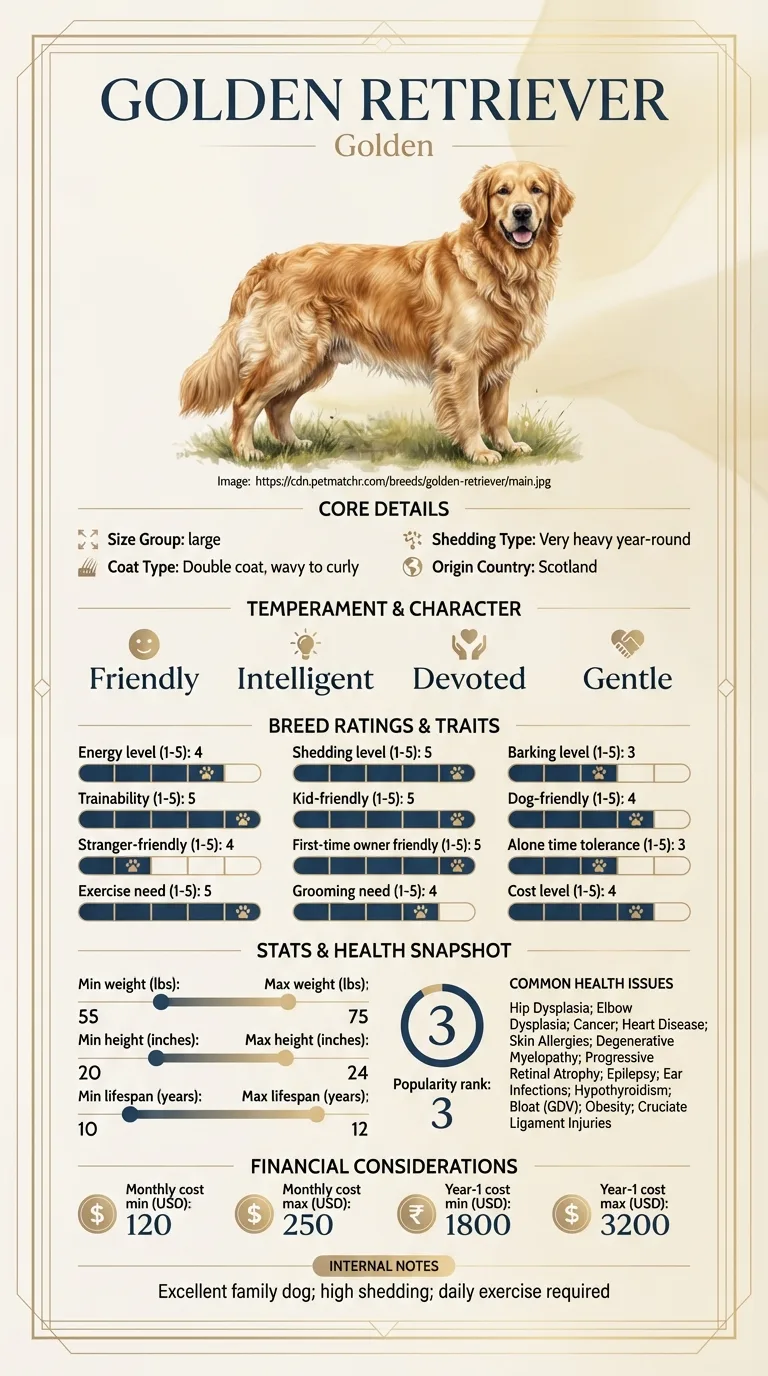
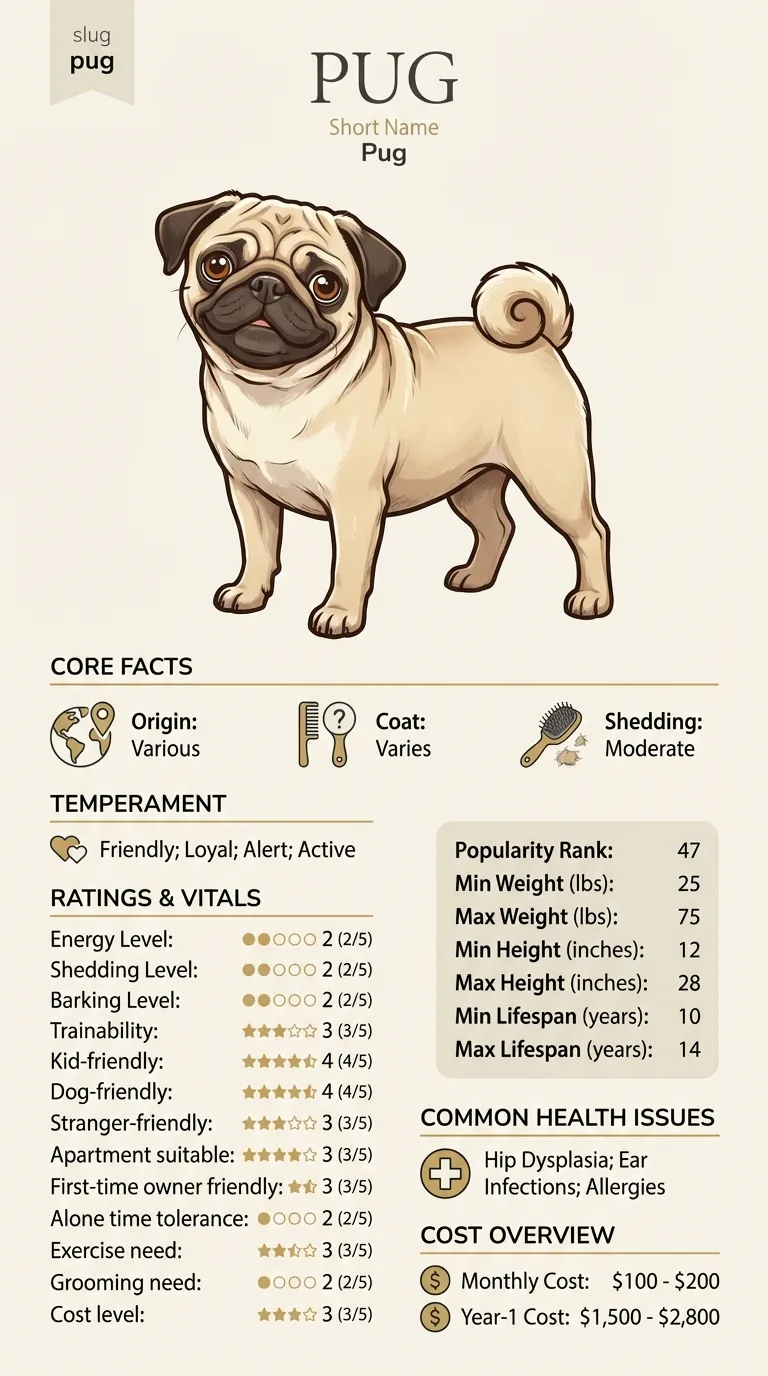
This is for someone already down to Golden Retriever and Pug and deciding between them. For this pair the decision usually turns on exercise need and apartment suitability, so those are covered first and in most detail. Anyone choosing from a flat has a clear answer here: Pug rates 5/5 against 2/5. There is no origin story here — only what changes about your week.
Between Golden Retriever and Pug, exercise need is what separates them, and Pug is the lower-effort dog of the two to keep.
Choose Golden Retriever if the dog will be alone during the working day, you want a dog that picks up training quickly and you want a dog that can keep up with an active routine.
Choose Pug if you are in a flat or a smaller home, you do not want a standing grooming appointment and shedding is a problem in your house.
| Feature | golden retriever | pug | Winner |
|---|---|---|---|
| Size class | large | small | Equal |
| Weight | 55–75 lbs | 14–18 lbs | Equal |
| Height | 20–24 in | 10–13 in | Equal |
| Lifespan | 10–12 years | 13–15 years | pug |
| Exercise need | Very high (5/5) | Low (2/5) | pug |
| Grooming need | High (4/5) | Low (2/5) | pug |
| Shedding | Very high (5/5) | High (4/5) | pug |
| Energy level | High (4/5) | Low (2/5) | Equal |
| Barking | Moderate (3/5) | Low (2/5) | pug |
| Apartment suitability | Low (2/5) | Very high (5/5) | pug |
| Good for first-time owners | Very high (5/5) | Very high (5/5) | Equal |
| Tolerates being alone | Moderate (3/5) | Low (2/5) | golden retriever |
| Trainability | Very high (5/5) | Moderate (3/5) | golden retriever |
| Good with kids | Very high (5/5) | Very high (5/5) | Equal |
| Good with other dogs | High (4/5) | High (4/5) | Equal |
| Friendly to strangers | High (4/5) | Very high (5/5) | pug |
| Cost level | High (4/5) | Moderate (3/5) | pug |
| Coat | Double coat, wavy to curly | Short, smooth double coat | Equal |
| Origin | Scotland | Various | Equal |
| Typical monthly cost | $120–$250 | $80–$150 | Equal |
| Typical first-year cost | $1,800–$3,200 | $1,100–$2,300 | Equal |
Few pairings on this site feature a bigger physical gap relative to shared popularity: the Golden Retriever at 55-75 lbs and 20-24 inches towers over the Pug's compact 14-18 lbs and 10-13 inch frame. The Pug's short, smooth double coat and famously wrinkled, brachycephalic face give it a completely different silhouette and health profile from the Golden's longer-muzzled, athletic build. Despite the size gap, the Pug's dense double coat actually sheds at a High (4/5) rate, only one point below the Golden's Very High (5/5) — a surprise to people who assume a short coat automatically means less hair around the house.
Exercise need separates these two sharply, Very High (5/5) for the Golden against Low (2/5) for the Pug — a direct consequence of the Pug's brachycephalic airway, which limits how much sustained exertion or heat exposure it can safely handle. Energy level is listed as a tie in the data despite the Golden's High (4/5) rating against the Pug's Low (2/5) score, reflecting how differently the two breeds express activity: the Golden wants a real job to do, while the Pug is content with short bursts of play followed by long naps, especially in warm weather.
Grooming need favors the Pug clearly, Low (2/5) against the Golden's High (4/5) — there's no long fur to brush out or mat to manage. Shedding tells a different story, though: the Pug still rates High (4/5), only one step below the Golden's Very High (5/5), because its short double coat sheds constantly year-round despite requiring minimal brushing effort. Pug owners often describe this exact combination — an easy coat to maintain but a surprising amount of loose hair on dark clothing — as one of the breed's most underestimated traits going in.
The Pug rates Very High (5/5) on apartment suitability against the Golden's Low (2/5), and its Low (2/5) barking tendency, versus the Golden's Moderate (3/5), makes it an even better fit for shared walls. That said, alone-time tolerance favors the Golden, Moderate (3/5) against the Pug's Low (2/5) — Pugs are famously people-oriented and prone to separation anxiety, with Affectionate among its core listed temperament traits. A Pug suits compact, quiet living arrangements well, provided its owner isn't gone for long stretches during the day.
Both breeds rate Very High (5/5) for first-time-owner suitability, making this an easier choice for a novice than most large-versus-small pairings on the site. Trainability still favors the Golden, Very High (5/5) against the Pug's Moderate (3/5) — Pugs are intelligent but famously stubborn and food-motivated in ways that can slow structured obedience work, with Mischievous appearing directly among its listed traits. A first-time owner willing to use extra patience and treat-based motivation will find the Pug perfectly manageable; one hoping for competition-level obedience should lean toward the Golden.
Both breeds rate Very High (5/5) on good-with-kids and High (4/5) on good-with-other-dogs, so family life works well with either. The Pug actually edges ahead on friendliness to strangers, Very High (5/5) against the Golden's High (4/5) — Charming and Even-tempered are two of its defining traits, and Pugs are famously unbothered by new people in a way that even the sociable Golden doesn't quite match. This is one of the few categories across the whole comparison where the smaller breed genuinely outperforms the Golden rather than simply keeping pace.
The Pug's 13-15 year lifespan beats the Golden's 10-12 years, but its five-condition health list carries serious weight for its size: Brachycephalic Airway Syndrome (BOAS), Pug Dog Encephalitis, Corneal Ulcers, and Hemivertebrae are all structural or breed-specific concerns tied directly to its flat face and compact spine, on top of shared Obesity risk with the Golden. BOAS in particular means Pug owners need to watch heat and exertion closely, a very different health-management style from the Golden's broader thirteen-condition list of issues like Cancer and Hip Dysplasia. Neither breed's list is easy, just differently shaped.
The Pug runs more affordable overall, Moderate (3/5) cost against the Golden's High (4/5), with a $80-$150 monthly range and $1,100-$2,300 first-year cost versus the Golden's $120-$250 and $1,800-$3,200. Lower food volume and minimal grooming needs keep routine costs down, but prospective Pug owners should budget for the possibility of BOAS-related veterinary care, which can include surgical correction in more severe cases — a cost category the Golden's health list simply doesn't carry in the same concentrated way, even with its own longer list of conditions.
Golden Retriever weighs 55–75 lbs and lives 10–12 years; Pug weighs 14–18 lbs and lives 13–15 years. The two diverge most on exercise need, apartment suitability and grooming need and 2 other rated axes. They are level on good with other dogs, good for first-time owners and good with kids, so those cannot decide it. Where the table declares a winner it means less work for the owner, nothing more; descriptive rows are left as ties on purpose. The value here is in the differences between the two columns; treat any single score as approximate.

Yes, clearly — the Pug rates Very High (5/5) apartment suitability and Low (2/5) barking, against the Golden's Low (2/5) apartment score and Moderate (3/5) barking.
Yes — they rate High (4/5) on shedding, only one point below the Golden Retriever's Very High (5/5), because their double coat sheds constantly year-round.
The Golden Retriever, by a wide margin — it rates Very High (5/5) exercise need against the Pug's Low (2/5), since the Pug's brachycephalic airway limits its heat and exertion tolerance.
Somewhat — Pugs rate Moderate (3/5) trainability against the Golden's Very High (5/5), owing to a food-motivated but occasionally stubborn, mischievous streak.
Brachycephalic Airway Syndrome (BOAS), Pug Dog Encephalitis, Corneal Ulcers, and Hemivertebrae are all documented, largely tied to the breed's flat face and compact spine.
The Pug, rated Very High (5/5) against the Golden's High (4/5) — a rare category where the smaller breed edges out the Golden.
The Pug, averaging 13-15 years against the Golden's 10-12 years.
The Pug, at 14-18 lbs versus the Golden's 55-75 lbs.
The Pug, rated Low (2/5) versus the Golden's Very High (5/5).
The Pug, rated Moderate (3/5) cost versus the Golden's High (4/5).
The Pug, rated Very High (5/5) versus the Golden's High (4/5).
See every pug comparison.
Secure checkout on Stripe. We never see your card.
7-day money-back guarantee. Instant access.

Health information here is general and is not veterinary advice. If your dog shows pain, sudden behaviour change, or worsening symptoms, consult a licensed veterinarian.
Some links on this site are affiliate links. We may earn a commission at no extra cost to you, and we only suggest products we believe are helpful for dog owners.
We research and check what we publish, but we do not warrant that any figure, date, price, or statement is accurate, complete, or current, and we accept no liability for any loss, cost, injury, or other harm arising from the use of this site. Use it as one reference among several. You remain responsible for your own decisions and for your dog's care - confirm anything that matters with a licensed veterinarian or another qualified professional before you act on it. Full disclaimer.
Match your lifestyle to the right dog.
Take quizNot sure which breed is right for you? Take our 2-minute quiz to find out.
Take the quiz