Health
What does wobbler syndrome actually affect?
The neck vertebrae and the spinal cord passing through them, causing a wobbly, unsteady gait especially in the back legs.

Quick answer
What does wobbler syndrome actually affect?
The neck vertebrae and the spinal cord passing through them, causing a wobbly, unsteady gait especially in the back legs.
A dog can look perfectly steady standing still and reveal a genuinely unstable neck the moment it tries to walk a straight line.
Owners of middle-aged and senior large-breed dogs noticing an unsteady, wobbly walk, particularly one more pronounced in the back legs.
This guide is not medical advice. If your dog shows pain, sudden behavior change, or worsening symptoms, consult a licensed veterinarian.
Some links may be affiliate links. We may earn a commission at no extra cost to you. We only suggest products we believe are helpful for dog owners.
We research and check what we publish, but we do not warrant that any figure, date, price, or statement is accurate, complete, or current, and we accept no liability for any loss, cost, injury, or other harm arising from the use of this site. Use it as one reference among several. You remain responsible for your own decisions and for your dog's care - confirm anything that matters with a licensed veterinarian or another qualified professional before you act on it. Full disclaimer.
Wobbler syndrome is a condition where malformed or unstable neck vertebrae compress the spinal cord, producing a characteristic wobbly gait most pronounced in the back legs. It's best documented in a few other large and giant breeds rather than this one specifically, but this breed's size category places it within the general population where the condition can occur, and cost across diagnosis and treatment ranges widely.
Wobbler syndrome isn't specifically documented as common in this breed, unlike a few other large and giant breeds where it's more closely associated, but it occurs across large dogs broadly often enough that an unsteady, wobbly gait in a large-breed dog warrants proper spinal imaging rather than an assumption of simple arthritis.
This breed's own documented health record doesn't single out wobbler syndrome, but its large adult size places it generally within the population of large and giant breeds where cervical vertebral instability is recognized to occur, following the same structural mechanism seen across those breeds.
There's no major environmental trigger for the underlying vertebral malformation itself, though a harness rather than a neck collar reduces added pressure on an already vulnerable cervical spine, and weight management reduces overall spinal load.
Talk to your vet promptly about any wobbly, unsteady gait, particularly one more pronounced in the back legs. Seek urgent care for sudden worsening, an inability to stand, or loss of bladder or bowel control.
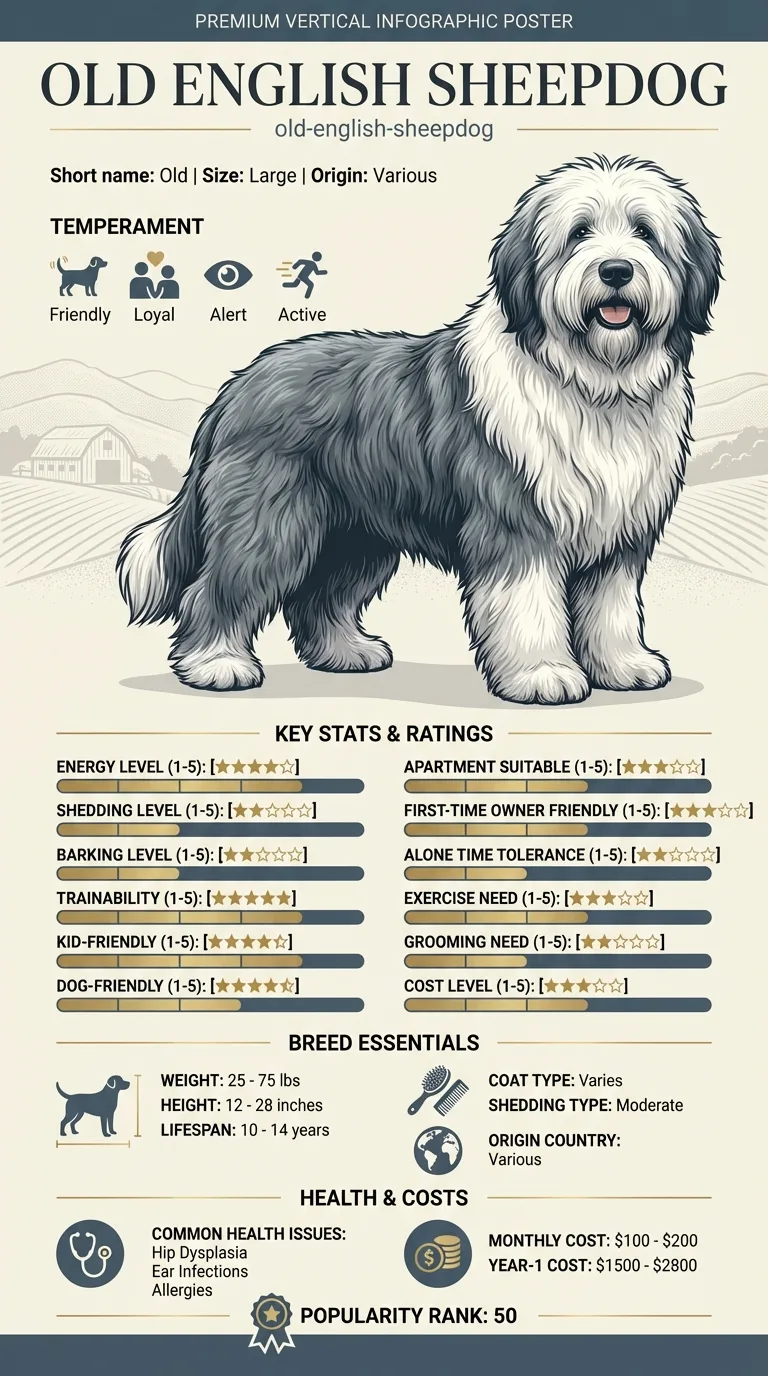
See all OLD English Sheepdog health problems, which breeds are prone to wobbler syndrome, or the full OLD English Sheepdog breed guide for temperament, exercise needs and ownership costs.
Symptoms often develop and progress gradually over months before prompting a vet visit. Diagnosis via MRI typically happens within a few weeks of an initial exam, with treatment, conservative or surgical, generally spanning weeks to a few months for full recovery or stabilization.
Success looks like halted or slowed progression and improved gait stability, whether achieved through conservative management or surgical decompression, with the specific outcome depending heavily on how early the condition was caught and treated.
Wobbler syndrome develops when one or more of the neck vertebrae are malformed or when the ligaments and joints stabilizing the cervical spine become abnormally lax, allowing excess movement between vertebrae that pinches or compresses the spinal cord passing through the center of the spine. Because the spinal cord carries signals to the entire body below the neck, this compression produces a wide gait, weakness, and coordination problems that typically affect the back legs more noticeably than the front, sometimes progressing to include the front legs as compression worsens. Symptoms often develop gradually, starting with subtle stumbling or scuffed toenails and progressing over months, though some cases worsen more acutely if a specific movement causes sudden additional compression.
MRI is the standard imaging tool to confirm wobbler syndrome and precisely locate which vertebrae are involved, since X-rays alone can suggest but not definitively confirm the spinal cord compression itself. Treatment ranges considerably by severity: milder cases are sometimes managed with strict activity restriction, a harness instead of a neck collar to avoid added neck pressure, and anti-inflammatory medication, while more significant compression often requires surgical decompression to relieve pressure on the spinal cord. Total cost across diagnosis and treatment for this condition commonly runs anywhere from around five hundred dollars for a milder, conservatively managed case to seven thousand dollars or more when MRI imaging and surgical decompression are both needed, a wide range that makes early diagnosis and an honest conversation about treatment options particularly important for planning.

Gunner, a seven-year-old Old English Sheepdog in Kansas City, developed a subtly wider, wobblier gait in his back legs over about two months, something his owner Doug initially attributed to arthritis given his age. When Gunner also started scuffing his back toenails on walks, Doug brought him in, and an MRI confirmed wobbler syndrome with moderate spinal cord compression at two vertebral levels. Given the degree of compression, Doug's vet recommended surgical decompression rather than conservative management alone. The total cost, including MRI and surgery, came in near six thousand dollars. Gunner's recovery took about ten weeks of restricted activity and rehabilitation, after which his gait had improved substantially, though a slight wobble remained detectable on close observation.
Key takeaway: What looked like ordinary aging turned out to be a genuine spinal instability, and getting an MRI rather than assuming arthritis gave Gunner's family an accurate severity picture and a real treatment decision to make.
It's a condition where malformed or unstable neck vertebrae compress the spinal cord, producing a characteristically unsteady, wobbly gait, usually more pronounced in the back legs.
It isn't specifically documented as common in this breed, being better recognized in a few other large and giant breeds, but its size category places it within the general population where wobbler syndrome occurs, making it worth ruling out for any large dog with an unsteady gait.
A wide, wobbly stance and stumbling, particularly in the back legs, sometimes with scuffed toenails from dragging the paws slightly, generally developing and worsening gradually over months.
MRI is the standard confirmatory imaging tool, precisely showing which vertebrae are involved and how much the spinal cord is being compressed, since X-rays alone can suggest but not definitively confirm the diagnosis.
No, milder cases are sometimes managed with strict activity restriction, a harness instead of a collar, and anti-inflammatory medication, while more significant spinal cord compression often benefits from surgical decompression.
The range is wide, roughly five hundred dollars for a milder, conservatively managed case up to seven thousand dollars or more when MRI imaging and surgery are both needed.
Many dogs improve meaningfully with appropriate treatment, whether conservative or surgical, though the degree of recovery depends on how much spinal cord compression had occurred and for how long before treatment began.
The neck vertebrae and the spinal cord passing through them, causing a wobbly, unsteady gait especially in the back legs.
MRI imaging is the standard tool to precisely locate and confirm spinal cord compression.
No, milder cases can be managed with activity restriction and medication, while more significant compression often needs surgical decompression.
Roughly five hundred dollars for conservative management up to seven thousand dollars or more for MRI plus surgery.
Many improve meaningfully, though outcomes depend on how much compression occurred before treatment began.
A one-page prep sheet for this condition: the signs, the questions to ask, what to get priced. Unlocks here.
You get: Vet visit prep sheet
No spam. One-click unsubscribe. See our privacy policy.
Preview page 1 before you decide.