Health
Does this breed have narrowed nostrils like a Bulldog?
No, it has a normal muzzle and nostril structure; stenotic nares is specific to brachycephalic breeds.

Quick answer
Does this breed have narrowed nostrils like a Bulldog?
No, it has a normal muzzle and nostril structure; stenotic nares is specific to brachycephalic breeds.
One dog's nostrils are pinched by cartilage that never developed properly; this breed's nostrils are just buried under hair that needs a trim.
Owners who've read about stenotic nares while researching breathing concerns and want to understand why it doesn't apply here, and anyone whose dog's untrimmed facial coat may be genuinely restricting airflow at the nose.
This guide is not medical advice. If your dog shows pain, sudden behavior change, or worsening symptoms, consult a licensed veterinarian.
Some links may be affiliate links. We may earn a commission at no extra cost to you. We only suggest products we believe are helpful for dog owners.
We research and check what we publish, but we do not warrant that any figure, date, price, or statement is accurate, complete, or current, and we accept no liability for any loss, cost, injury, or other harm arising from the use of this site. Use it as one reference among several. You remain responsible for your own decisions and for your dog's care - confirm anything that matters with a licensed veterinarian or another qualified professional before you act on it. Full disclaimer.
Stenotic nares is a structural nostril-narrowing condition specific to brachycephalic breeds with shortened muzzles, and it does not apply to this breed, which has a normal, unshortened muzzle. What owners sometimes encounter instead is a coat-related airflow obstruction, overgrown facial hair pressing against the nostrils, an entirely manageable grooming issue rather than a structural defect.
True stenotic nares does not occur in this breed, since it lacks the shortened muzzle structure required for the condition. Coat-related nasal obstruction from overgrown facial hair, while not a formal diagnosis, is a common and easily corrected everyday grooming issue for owners who let the face coat grow untrimmed.
This breed's documented muzzle structure is normal and unshortened, meaning it lacks the cartilage compression that causes true stenotic nares in brachycephalic breeds. Its actual documented respiratory concern, Primary Ciliary Dyskinesia, is a completely different, ciliary-function-based condition.
Infrequent grooming allows facial hair to grow long enough to press against or cover the nostrils, and matting compounds the effect by adding bulk and reducing the coat's ability to move freely away from the nose during breathing.
Talk to your vet if labored or noisy breathing continues after the facial coat has been properly trimmed, since this would point toward a genuine medical cause rather than a coat obstruction and deserves a proper exam.
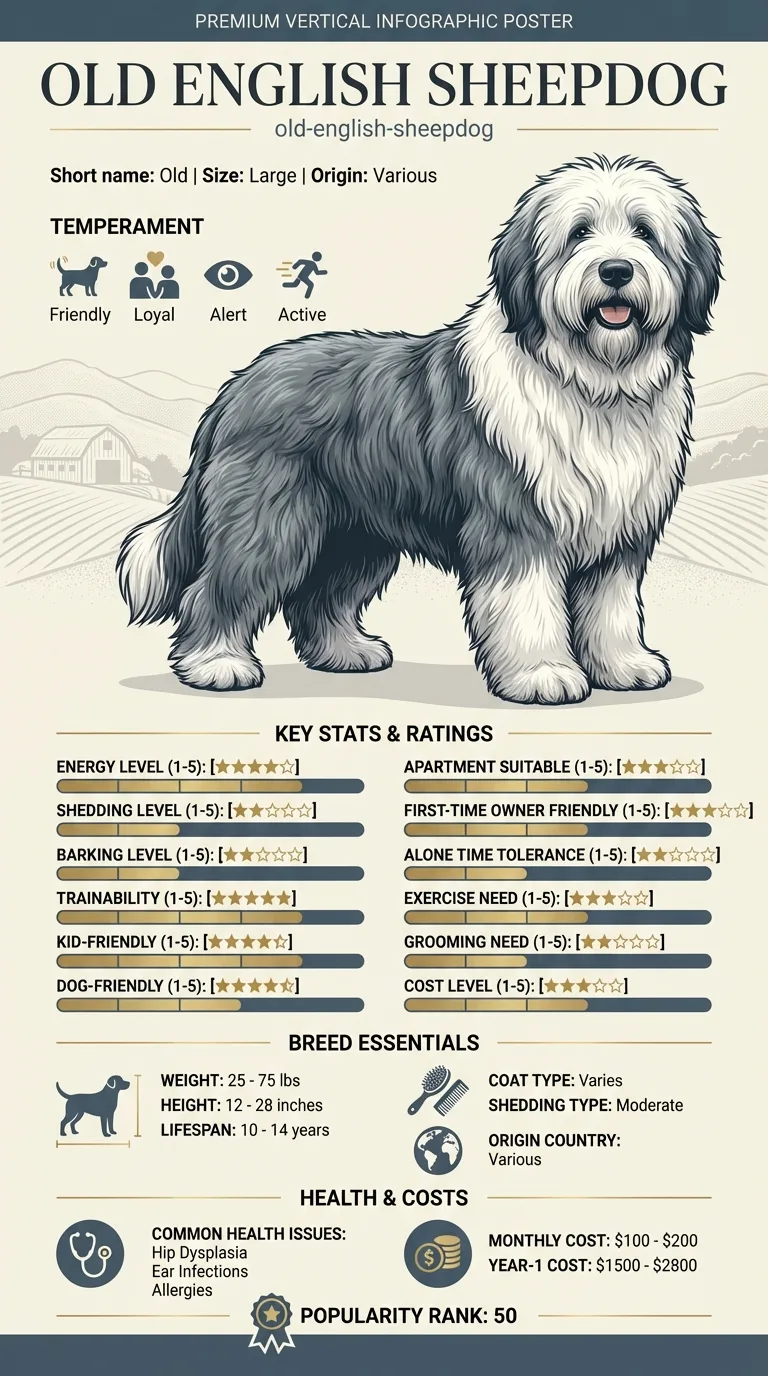
See all OLD English Sheepdog health problems, which breeds are prone to small nostrils stenotic nares, or the full OLD English Sheepdog breed guide for temperament, exercise needs and ownership costs.
Coat-related nasal obstruction resolves immediately once the offending hair is trimmed, unlike a structural condition that would require ongoing management. This makes regular grooming a simple, permanent solution rather than a temporary fix.
Success looks like a consistently trimmed muzzle area that never restricts airflow in the first place, achieved through routine grooming rather than reactive trims only after breathing effort becomes noticeable.
Stenotic nares develops because a shortened, compressed muzzle structure leaves too little cartilage to hold the nostril openings wide, physically pinching the airway at its very entrance. It's one part of a broader pattern of airway crowding seen in brachycephalic breeds, alongside an elongated soft palate and narrowed windpipe, collectively causing the labored breathing associated with those breeds. None of that structural crowding applies to this breed, whose muzzle is normal length with adequately sized nostril cartilage. A vet examining this breed's nose would not expect to find the pinched, slit-like nostril openings that define true stenotic nares, because the underlying skeletal and cartilage structure simply isn't shortened the way it is in a brachycephalic breed.
This breed's genuinely relevant nose-and-airflow issue is entirely different: long facial hair, left untrimmed, can physically press against and partially cover the nostrils, particularly if the coat is matted or hasn't been groomed recently. This isn't a structural, permanent condition the way stenotic nares is, it's a manageable, temporary obstruction that resolves immediately once the offending hair is trimmed back or tied away from the face. A dog struggling to breathe comfortably through a face full of overgrown hair can look, from a distance, like it's having the same kind of trouble a brachycephalic dog has, but the fix here is a grooming appointment, not a surgical airway correction.

Poppy, a three-year-old Old English Sheepdog in Denver, started making a slightly noisy snuffling sound during walks that worried her owner Ben enough to look up breathing conditions online, where stenotic nares kept coming up as a possibility. At her vet visit, her muzzle structure looked completely normal on exam, but her facial coat, several weeks overdue for a trim, was noticeably long enough to be pressing against her nostrils. Ben trimmed the area himself that same day, and the snuffling sound was gone within the hour. Poppy's vet confirmed there was no underlying structural issue and that keeping the muzzle area on a regular trim schedule going forward would prevent it from recurring.
Key takeaway: A worrying-sounding symptom and a scary internet search led Ben toward a diagnosis that simply doesn't apply to this breed, and the actual fix was as simple as a trim Poppy was already overdue for.
No, this is a structural condition specific to brachycephalic breeds with shortened muzzles, and this breed has a normal, unshortened muzzle with adequately sized nostril cartilage.
Yes, but for a completely different reason: overgrown facial hair can physically press against or cover the nostrils if left untrimmed, a manageable grooming issue rather than a structural airway defect.
Trim the hair away from the nose and muzzle; if breathing noticeably eases, it was coat-related. If labored breathing continues after a proper trim, that warrants a veterinary exam rather than assuming grooming will resolve it.
No, since this breed doesn't have the structural airway crowding that sometimes requires surgical correction in brachycephalic breeds. Its own documented respiratory concern is Primary Ciliary Dyskinesia, an unrelated ciliary function condition.
Yes, keeping the muzzle and nose area trimmed or tied back is a simple, preventable way to ensure unobstructed airflow, regardless of whether any breathing concern is present.
No, heavy panting in this breed is far more likely related to its dense double coat and limited heat tolerance than to any nostril structure issue, since stenotic nares isn't a condition this breed's anatomy produces.
Primary Ciliary Dyskinesia, a genetic condition affecting how the airway clears mucus and debris, is specifically documented in this breed, an entirely different mechanism from the structural airway narrowing seen in brachycephalic breeds.
No, it has a normal muzzle and nostril structure; stenotic nares is specific to brachycephalic breeds.
Overgrown facial hair pressing against or covering the nostrils, a manageable grooming issue rather than a structural defect.
Trim or tie back the hair around the nose and muzzle; breathing typically eases immediately.
No, since it doesn't have the structural airway narrowing that sometimes requires surgical correction in brachycephalic breeds.
Primary Ciliary Dyskinesia, an unrelated genetic condition affecting airway mucus clearance rather than nostril structure.
A one-page prep sheet for this condition: the signs, the questions to ask, what to get priced. Unlocks here.
You get: Vet visit prep sheet
No spam. One-click unsubscribe. See our privacy policy.
Preview page 1 before you decide.