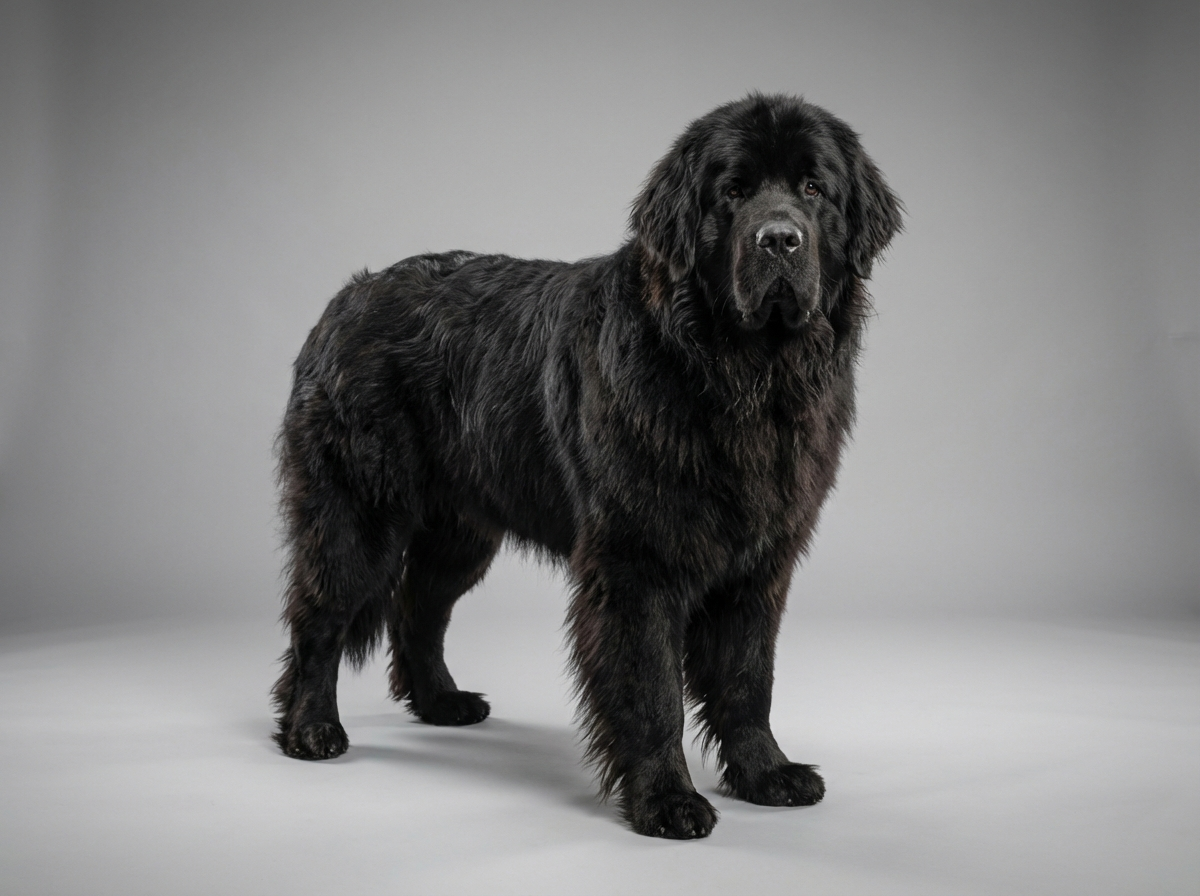
Health
What is the single most important sign of bloat?
Repeated retching that brings nothing up. In a giant breed that is a stronger and earlier signal than a visibly swollen abdomen, which appears late under a deep chest and heavy coat.

Quick answer
What is the single most important sign of bloat?
Repeated retching that brings nothing up. In a giant breed that is a stronger and earlier signal than a visibly swollen abdomen, which appears late under a deep chest and heavy coat.
Bloat is on the short list of conditions Newfoundlands are known for, and it is the only one on that list that can kill a healthy dog between dinner and midnight.
This is for the owner standing in a kitchen at eleven at night watching a big dog behave oddly and trying to decide whether it is worth the emergency fee. It is written to make that decision easier.
This guide is not medical advice. If your dog shows pain, sudden behavior change, or worsening symptoms, consult a licensed veterinarian.
Some links may be affiliate links. We may earn a commission at no extra cost to you. We only suggest products we believe are helpful for dog owners.
We research and check what we publish, but we do not warrant that any figure, date, price, or statement is accurate, complete, or current, and we accept no liability for any loss, cost, injury, or other harm arising from the use of this site. Use it as one reference among several. You remain responsible for your own decisions and for your dog's care - confirm anything that matters with a licensed veterinarian or another qualified professional before you act on it. Full disclaimer.
GDV is a surgical emergency in which a gas-filled stomach rotates, cutting off its own blood supply and obstructing the return of blood to the heart. It is one of the conditions Newfoundland owners are specifically warned about. Survival depends almost entirely on how fast the dog reaches a hospital, which makes recognition an owner skill rather than a veterinary one. The financial dimension is real and worth planning for before the night it happens.
Bloat appears on the short list of health issues associated with the Newfoundland, alongside hip dysplasia, subaortic stenosis, dilated cardiomyopathy and cystinuria. It is a well-documented problem of deep-chested large and giant breeds generally. Most individual Newfoundlands will never experience it, but the consequences of a single episode are severe enough that every owner of the breed should be able to recognise it without looking anything up.
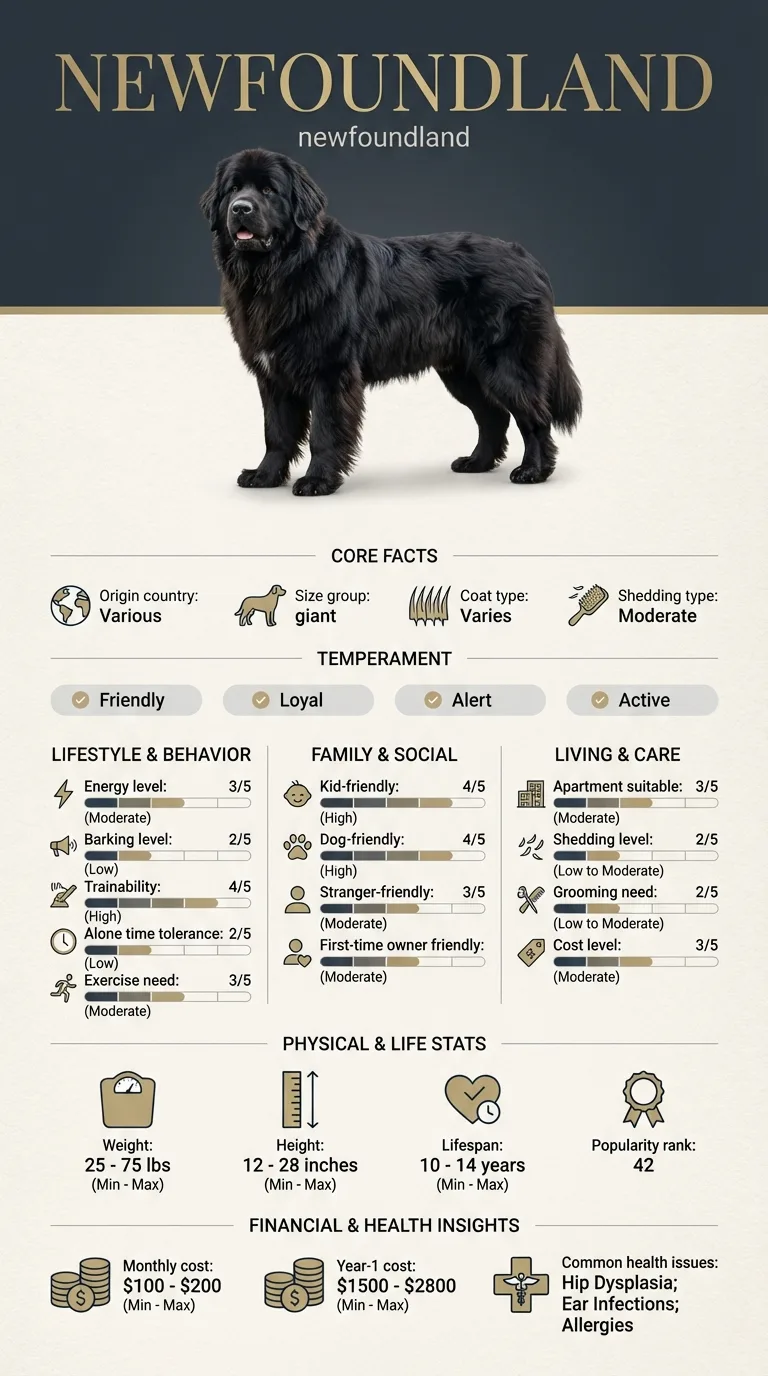
Conformation is the primary driver. Giant deep-chested dogs have a stomach suspended in a tall, narrow abdominal cavity with room to rotate, and at 100 to 150 pounds and 26 to 28 inches tall the Newfoundland fits that description precisely. The dense water-resistant double coat and heavy body then delay visual recognition of distension, so the breed loses time at the front end of the emergency. The Newfoundland's calm and patient temperament works against it here too, because a stoic dog in serious pain may simply stand quietly rather than making the fuss that would send an owner to the car.
The commonly cited environmental contributors are all about how food and water meet activity: one large daily meal instead of divided portions, rapid eating, a large drink taken down at once after swimming or exertion, and vigorous play immediately after eating. Household stressors such as boarding, travel or a change in routine appear repeatedly in case histories. The single most important environmental factor of all, though, is distance and access: how far the nearest twenty-four hour surgical facility is, and whether the household has a plan for getting there at three in the morning.
This is one of the few conditions where the advice is not to phone first and think it over. Drive to an emergency veterinary hospital immediately if your Newfoundland is retching repeatedly without bringing anything up, has a tight or drum-like abdomen, cannot settle and keeps standing and lying down, is drooling heavily and looking at its own flank, has pale or grey gums, is breathing rapidly, or collapses. Call the hospital from the road so they are ready. Do not give food, water or any medication on the way, and do not wait to see whether the dog improves. If you are unsure whether what you are seeing counts, go anyway; the cost of an unnecessary examination is trivial next to the cost of a two-hour delay.
See all Newfoundland health problems, which breeds are prone to bloat gastric dilatation volvulusgdv, or the full Newfoundland breed guide for temperament, exercise needs and ownership costs.
Everything about this condition is compressed. Signs to serious deterioration can be a matter of a few hours. A dog taken in early, stabilised and operated on quickly may be home within two to four days, with two weeks of restricted activity and wound care. A dog who arrives late, or who needs part of the stomach or the spleen removed, faces a longer hospital stay, a higher cost and a poorer outlook. Rhythm disturbances often appear in the twenty-four to seventy-two hours after surgery and are monitored for.
Success is not a dog who is guaranteed never to bloat. It is a household where every adult can recognise unproductive retching, where the emergency hospital is a known address rather than a search result, where the money question was settled in advance, and where the elapsed time between the first odd behaviour and walking through the hospital door is measured in minutes. That elapsed time is the variable owners actually control.
The textbook description mentions a distended abdomen, and that is the sign owners of this breed can least rely on. A Newfoundland has a deep chest, a heavy water-resistant double coat and 100 to 150 pounds of body over the abdomen. By the time the belly looks visibly swollen from across the room, a great deal of time has already gone.
The sign that comes earlier and is far more specific is unproductive retching. The dog makes the full motion of vomiting, repeatedly, and produces nothing at all, or a small amount of white froth. That is the sound of a stomach trying to empty through a closed exit. A dog doing this is not a dog with an upset stomach; a dog with an upset stomach eventually brings something up.
Alongside it comes restlessness that does not resolve. A breed described as calm, patient and low in energy does not normally pace a room at night, get up, lie down, get up again, and refuse to settle. Many owners describe the dog looking round at its own flank, or standing with the elbows out and the neck extended. Drooling increases and becomes thick and ropey.
The abdomen check is done with hands, not eyes. With your dog standing, place a flat palm just behind the last rib on each side and press gently. A normal Newfoundland abdomen has give. A bloated one feels tight and drum-like, and the dog will usually object.

Emergency GDV surgery commonly falls in the range of roughly 1,500 to 7,500 US dollars depending on the hospital, the hour, the severity and what has to be removed. Owners who have not thought about this before the night in question lose time deciding, and time is the whole game. Work these out now.
If you think your Newfoundland has bloat (gastric dilatation-volvulus/gdv), the plan is three steps: write down what you have seen and when it started, book a veterinary appointment rather than waiting for the next flare, and take video of the behaviour or symptom before you go — the thing you are worried about rarely happens in the consulting room. Screening in the parents covers hip dysplasia, subaortic stenosis, dilated cardiomyopathy.
What the vet visit should produce is a diagnosis and a written plan, not just reassurance: what is being ruled out, what the monitoring interval is, and which signs mean you come back sooner. Ask what the treatment costs across a year rather than per visit, because that is the number that decides whether you are managing this condition or reacting to it.
Between appointments, keep a short log — dates, what you saw, what changed. It is the single most useful thing an owner brings to a follow-up, and for bloat (gastric dilatation-volvulus/gdv) it is often what separates a clear pattern from a guess.
Kepler was six and had eaten his evening meal at half past six as usual. At quarter past ten his owner Dana noticed him get up from his bed, walk to the hall, turn around and come back. He did it again a minute later. She had read about bloat when she bought him, and the thing she remembered was the retching. He had not retched. But he would not settle, and when she put her hand behind his last rib the belly felt like a football, which was nothing like the soft give she was used to from years of scratching his side. She rang the emergency hospital from the driveway, which was twenty-two minutes away, and her husband helped her get him into the back of the car. He retched twice on the journey and produced nothing. Radiographs at the hospital confirmed a twisted stomach. He was in surgery within forty minutes of arriving, the stomach was untwisted and found to be viable, a gastropexy was performed, and he came home on the Saturday. The bill was near the upper end of what Dana had budgeted for when she insured him as a puppy. The part she repeats to other owners is that the classic sign came second. What told her was a hand on the belly and a dog who would not lie down.
Key takeaway: In this breed you will feel bloat before you see it. Learn your dog's normal abdomen, take unsettled pacing at night seriously, and have the hospital's address in your phone before you need it.
Hours, not days. The stomach twists, its blood supply is cut off, and the pressure prevents blood returning to the heart. Dogs can go from apparently normal to shock within a few hours. There is no version of this where waiting until the morning surgery is the right call.
No. There is nothing an owner can safely do, and every home remedy circulating online costs time you do not have. Do not attempt to make the dog vomit, do not give anything by mouth, and do not try to pass a tube. Get in the car and go.
That is a good outcome and a reasonable price. Emergency clinicians would far rather assess ten dogs with a stomach upset than see one dog with a twisted stomach two hours late. Nobody will think you overreacted, and the examination and any imaging are a small fraction of the surgical cost.
The word bloat is used loosely for both simple gas distension and the twisted version. Simple distension is serious; the twist is life-threatening. You cannot distinguish them at home, and the practical consequence is identical: a dog with a tight abdomen and unproductive retching needs a vet immediately regardless of which one it turns out to be.
It is commonly associated with a large meal or a lot of water followed by activity, but it is not confined to that. Cases occur overnight hours after the last meal, and cases occur in dogs on well-managed feeding routines. Do not use the timing of the last meal to talk yourself out of an emergency visit.
Yes, substantially. A dense double coat over a deep-chested body means abdominal distension is late to become visible, so this breed's owners have to rely on behaviour and on hands. That is a strong argument for learning what your own dog's relaxed abdomen feels like while they are healthy.
Repeated retching that brings nothing up. In a giant breed that is a stronger and earlier signal than a visibly swollen abdomen, which appears late under a deep chest and heavy coat.
With the dog standing, press a flat palm just behind the last rib on each side. Learn what normal feels like now, so that a tight, drum-like belly registers immediately later.
Commonly around 1,500 to 7,500 US dollars, depending on the hospital, the hour and whether damaged stomach or spleen has to be removed. Preventive gastropexy during a planned surgery costs far less.
No. There is no safe waiting period. If the abdomen is tight, the dog is retching without producing, or the restlessness will not settle, drive to an emergency hospital now.
Feeding practices are widely discussed and worth agreeing with your vet, but no routine eliminates the risk. Recognition and speed remain the things that decide outcomes.
A one-page prep sheet for this condition: the signs, the questions to ask, what to get priced. Unlocks here.
You get: Vet visit prep sheet
No spam. One-click unsubscribe. See our privacy policy.
Preview page 1 before you decide.