DogBreedCompass
← Back to breed profile

Newfoundland Separation Anxiety: The Cost of Being This Devoted

Quick answer

Why is this breed prone to this despite being so calm?

Devotion and independence are different traits. This breed's intense attachment combined with only moderate alone-time tolerance creates real risk regardless of its placid general temperament.

A breed rated only moderate for tolerating time alone, built to be this attached to its people, is not a breed where separation problems should surprise anyone.

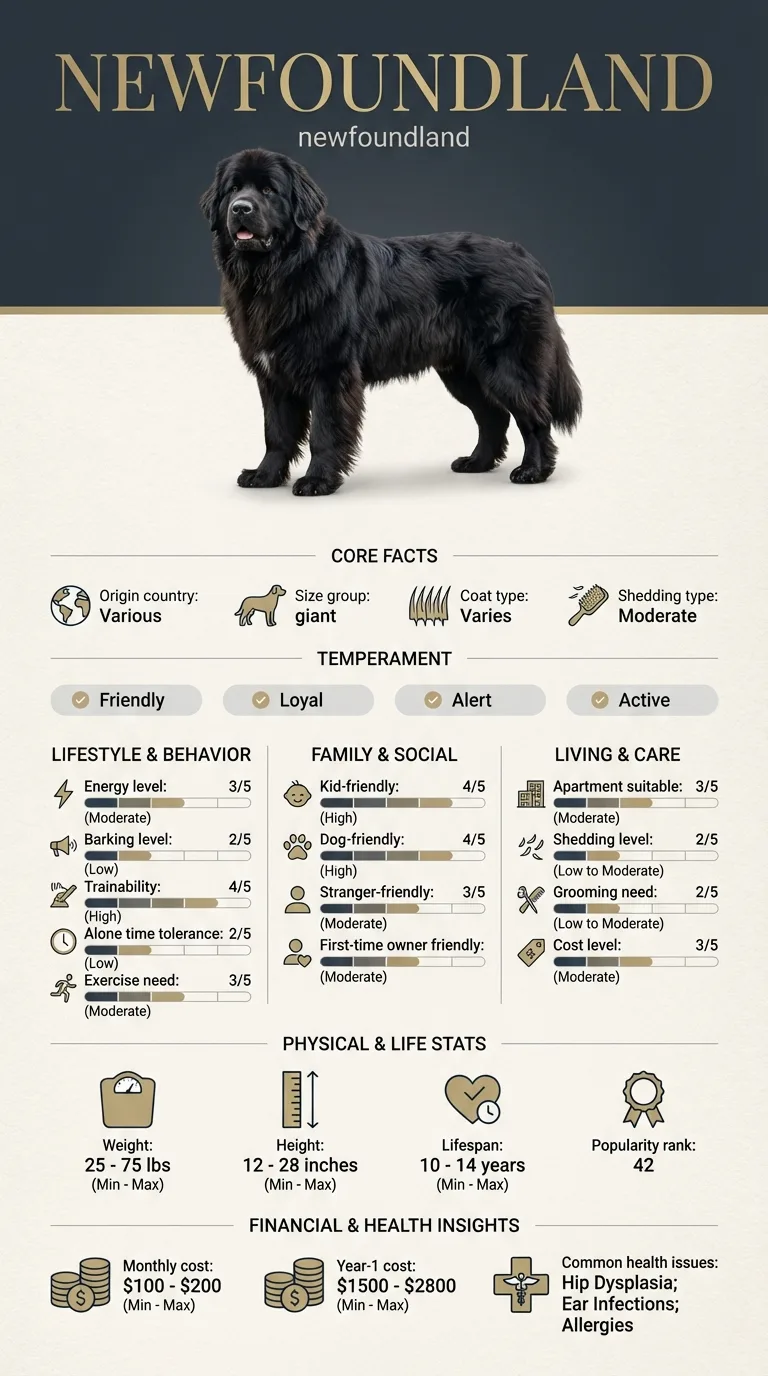
Newfoundland Separation Anxiety: The Cost of Being This Devoted infographic

For owners whose Newfoundland shows distress when left alone, whether through destruction, vocalising, house soiling or physical signs of anxiety, and for anyone bringing home a puppy who wants to build independence before it becomes a problem rather than after.

Important reminder

This guide is not medical advice. If your dog shows pain, sudden behavior change, or worsening symptoms, consult a licensed veterinarian.

Some links may be affiliate links. We may earn a commission at no extra cost to you. We only suggest products we believe are helpful for dog owners.

What this problem looks like

Separation-related distress in a Newfoundland stems from a genuine mismatch between this breed's documented devotion to its people and its only moderate rated tolerance for being left alone. It often presents more quietly than the classic anxious-dog picture, as persistent unsettledness, excessive drooling or door fixation rather than obvious frenzy, and the breed's giant size raises the practical stakes of any destructive or escape-driven behaviour that does occur.

Common triggers

  • Being left alone for periods beyond the dog's currently built tolerance
  • A sudden jump from rarely being left alone to a full workday absence
  • Dramatic, emotionally charged departure or arrival routines that heighten the contrast between together and alone
  • Insufficient early practice with short, gradually increasing absences during puppyhood
  • A change in household routine, such as a member returning to in-person work after being home

Separation anxiety is not one of the five conditions most consistently documented for this breed's physical health, which are hip dysplasia, subaortic stenosis, dilated cardiomyopathy, cystinuria and bloat, but it is a well-recognised behavioural risk given the breed's rated devotion and moderate alone-time tolerance. It is one of the more common behavioural concerns reported by owners of this breed rather than a rare occurrence.

Why this happens

Breed factors

The Newfoundland's documented temperament traits, sweet, patient, devoted and calm, describe a dog built around close attachment to its household rather than independent self-sufficiency. An alone-time tolerance rated only moderate, rather than high, means this attachment does not automatically translate into comfort with solitude, and a meaningful number of individual dogs genuinely struggle when left. The breed's giant size changes the consequences rather than the underlying cause, since a large, strong dog in genuine distress can cause more significant property damage or self-injury than a small dog exhibiting the identical emotional state.

Environment factors

Household routine is the dominant environmental factor. A puppy raised with frequent, low-key short absences from an early age typically tolerates solitude far better than one who is rarely left alone until a sudden change in circumstances requires it. Emotionally charged departure and arrival rituals can heighten a dog's sense that leaving is a significant event. Changes in a household's daily pattern, such as a person who previously worked from home returning to an office, are a common trigger point for separation-related behaviour to first appear or worsen in an adult dog.

What you can try

At-home strategies

  • Practise short absences from early puppyhood, building duration gradually rather than jumping straight to long periods alone.
  • Keep departures and arrivals calm and low-key rather than emotionally charged events.
  • Establish a comfortable independent resting spot used during ordinary daily life, not only introduced at the moment of departure.
  • Offer a long-lasting food puzzle or chew at the start of an absence to ease the early minutes, which are often the hardest.
  • Use a camera to observe an actual departure and identify the real pattern of distress, rather than guessing based on assumptions.
  • Build a roster of trusted alternatives, such as a sitter or daycare, for absences longer than your dog can currently manage comfortably.

When to consider a trainer

A trainer or veterinary behaviourist experienced with separation-related distress is genuinely valuable here, both for designing a properly paced desensitisation plan and for helping distinguish separation anxiety from other causes of destructive or vocal behaviour when alone. Given this breed's high trainability, most respond well to a consistent, well-structured plan, though severe cases benefit from professional guidance rather than trial and error alone.

When to talk to your vet

Book an appointment if separation-related behaviour is severe, involves self-injury, has developed suddenly in a previously comfortable adult dog, or has not improved despite several weeks of consistent, gradual departure practice. A veterinary behaviourist can assess whether medication support alongside a structured training plan is appropriate for more severe cases, and a general veterinary check is also worthwhile to rule out physical discomfort contributing to a sudden behaviour change.

See all Newfoundland health problems, which breeds are prone to separation anxiety, or the full Newfoundland breed guide for temperament, exercise needs and ownership costs.

Realistic expectations

Mild cases addressed early with consistent gradual practice often show real improvement within a few weeks. More established or severe separation distress typically takes several months of structured desensitisation, sometimes alongside veterinary behavioural support, and progress is rarely perfectly linear. A puppy raised with early, gradual alone-time practice from the start often avoids developing significant separation distress at all, which is the most efficient path where it is available.

Success is a dog who settles within a reasonable time of being left, without destructive behaviour, excessive vocalising, or visible distress signs on camera, and who greets returns calmly rather than with frantic relief. It does not require a dog who is indifferent to departures, since some attentiveness to a beloved household leaving is normal; the goal is a manageable, comfortable level of adjustment rather than total emotional neutrality.

Why a Naturally Calm Breed Still Struggles With This

It is a common assumption that a calm, low-energy, easygoing breed would cope well with being left alone, and for many Newfoundlands that assumption holds. But calm temperament and independence are not the same trait, and this breed's alone-time tolerance sits in the moderate range rather than the high one, meaning a meaningful proportion of individual dogs genuinely struggle with extended solitude despite their otherwise placid nature.

The mechanism is attachment rather than excess energy. A dog whose entire temperament is built around devotion to its people can experience departure as a much larger event than the same absence would be for a more independent breed. This often shows up differently than the stereotypical anxious-breed picture: rather than frantic pacing, a distressed Newfoundland may simply refuse to settle, drool excessively beyond its normal baseline, or position itself against the door the entire time its family is gone, calm in demeanour but clearly not at ease.

Body size adds a practical dimension that smaller breeds do not carry in the same way. Destructive behaviour from a distressed 130-pound dog can mean genuinely significant damage to doors, crates or furniture, and a panicking giant-breed dog attempting to escape a room or crate can injure itself in ways a smaller dog attempting the same behaviour usually would not. This raises the practical stakes of addressing the problem early rather than treating it as a phase to wait out.

Newfoundland Separation Anxiety - Why a Naturally Calm Breed Still Struggles

Building Independence Before It Is Needed

The most effective work happens before a real separation problem develops, particularly in a young dog, though an established pattern can still improve with a structured approach.

  • Practise very short absences from the very start, seconds at first, building gradually, rather than waiting until a full workday departure is the first real test.
  • Avoid dramatic greetings and goodbyes. Keeping arrivals and departures low-key helps prevent the contrast between together and alone from becoming the emotional event the dog fixates on.
  • Give your dog a consistent, comfortable independent resting spot used during normal daily life, not introduced for the first time only when you leave, so it is already associated with calm rather than absence.
  • Provide a long-lasting food puzzle or chew at the moment of departure so the very early minutes alone, often the hardest, are paired with something engaging rather than immediate awareness of the absence.
  • Use a camera to observe what actually happens during a real departure, since owners are often surprised by the specific pattern, whether it is early or delayed distress, constant door-watching, or a brief settle followed by a later spike.
  • Build a network of trusted alternatives, a sitter, a familiar neighbour, or doggy daycare, for situations requiring a longer absence than your dog can currently handle, rather than pushing past its current tolerance repeatedly.
  • Keep departures from being the only time enrichment or high-value chews appear, so their presence does not become an additional signal that reinforces anxiety about what is coming.

The Door That Told the Whole Story

Talia's Newfoundland, Otis, had never destroyed anything and never barked excessively, so when her family's routine shifted and she began working from an office three days a week, she was surprised when a camera she set up showed him standing pressed against the front door for the entire four-hour absence, occasionally drooling more heavily than his normal baseline, never once lying down. No furniture was damaged and no neighbours had complained, which was exactly why the problem had gone unnoticed for weeks. It was the camera footage that revealed genuine, sustained distress hiding behind a dog whose calm temperament meant he simply endured it quietly rather than acting out. Talia began with absences of only a few minutes, building slowly over several weeks, paired with a frozen food toy at departure and a deliberately unremarkable goodbye routine. By the two-month mark, camera footage showed Otis settling onto his bed within the first ten minutes rather than holding vigil at the door for hours.

Key takeaway: A calm breed can still be suffering quietly during an absence, with no destruction or barking to alert you. Camera footage is often the only way to see the real pattern in a dog built to endure discomfort without making a scene.

Frequently asked questions

Is separation anxiety common in this breed?

It is a real and recognised risk given this breed's rated devotion and only moderate alone-time tolerance, though not every Newfoundland develops it. Owners should not assume a naturally calm temperament guarantees comfort with solitude, since attachment and independence are different traits.

What does separation distress look like in a calm breed like this?

Sometimes differently than the classic frantic pacing picture. It can appear as refusing to settle, excessive drooling beyond the dog's normal baseline, fixation on the door or exit point, or quiet but persistent unease rather than obvious frenzy, which makes it easier for owners to miss at first.

How much can a giant-breed dog actually damage when distressed?

Meaningfully more than a small dog attempting the same behaviour, both to property and potentially to itself. A panicking 130-pound dog trying to escape a crate or room can cause real injury, which is part of why addressing early signs matters more here than in a lower-risk breed.

Can a puppy be prevented from developing this?

Not with certainty, but building tolerance to short, gradually increasing absences from early puppyhood, alongside a calm departure and arrival routine, meaningfully reduces the risk compared with a puppy who is rarely left alone until a full workday is suddenly required.

Does a companion dog fix separation anxiety?

Not reliably. Separation distress is usually about attachment to specific people rather than being alone in general, so a second dog can help some individual dogs but does not resolve the issue in every case and should not be assumed to be a fix without addressing the underlying pattern directly.

When does this need professional help rather than home practice?

When distress is severe, involves self-injury, or has not improved despite consistent gradual departure practice over several weeks. A veterinary behaviourist or a qualified trainer experienced with separation-related distress can design a more structured desensitisation plan and discuss whether medication support is appropriate alongside training.

Is barking specifically tied to being left alone the same issue as general reactive barking?

No, and the two need different approaches. Barking confined to periods of being alone, especially alongside pacing, drooling or destruction, points toward separation-related distress. General barking at doorbells or passing traffic is a different, more straightforward training issue.

Quick answers

View more answers
Behavior

Why is this breed prone to this despite being so calm?

Devotion and independence are different traits. This breed's intense attachment combined with only moderate alone-time tolerance creates real risk regardless of its placid general temperament.

Behavior

What does it typically look like here?

Often quiet but persistent unease, refusing to settle, excessive drooling, or fixation on the door, rather than classic frantic pacing.

Training

What is the single most useful early habit?

Practising very short absences from early puppyhood, building gradually, rather than a sudden jump to a full workday alone.

Living

Does size make this more serious?

Yes. A distressed 130-pound dog can cause significant property damage or self-injury attempting to escape, raising the practical stakes of early intervention.

Training

When should I get professional help?

When distress is severe, involves self-injury, or has not improved after several weeks of consistent gradual departure practice at home.

Related DogBreedCompass guides

  • excessive barking in NewfoundlandsBarking specifically tied to being alone is a related but distinguishable pattern from general reactive barking.
  • the Newfoundland breed profileThis breed's overall temperament and devotion explain why attachment-driven distress is a genuine risk.
  • exercise intolerance in this breedReduced exercise and mental engagement can compound anxiety-related behaviour at home.
  • anesthesia and medication considerationsProfessional support and possible medication are worth understanding as part of a full behavioural plan.
  • the real cost of owning a NewfoundlandDaycare, sitters and boarding are a real recurring cost consideration for managing alone time.

Take the right questions to the vet first

Behaviour changes often start with pain. The prep sheet for this page covers what to rule out, and what to ask.

You get: Vet visit prep sheet

No spam. One-click unsubscribe. See our privacy policy.

Preview page 1 before you decide.

Related guides