Health
Why is weight so hard to judge in this breed?
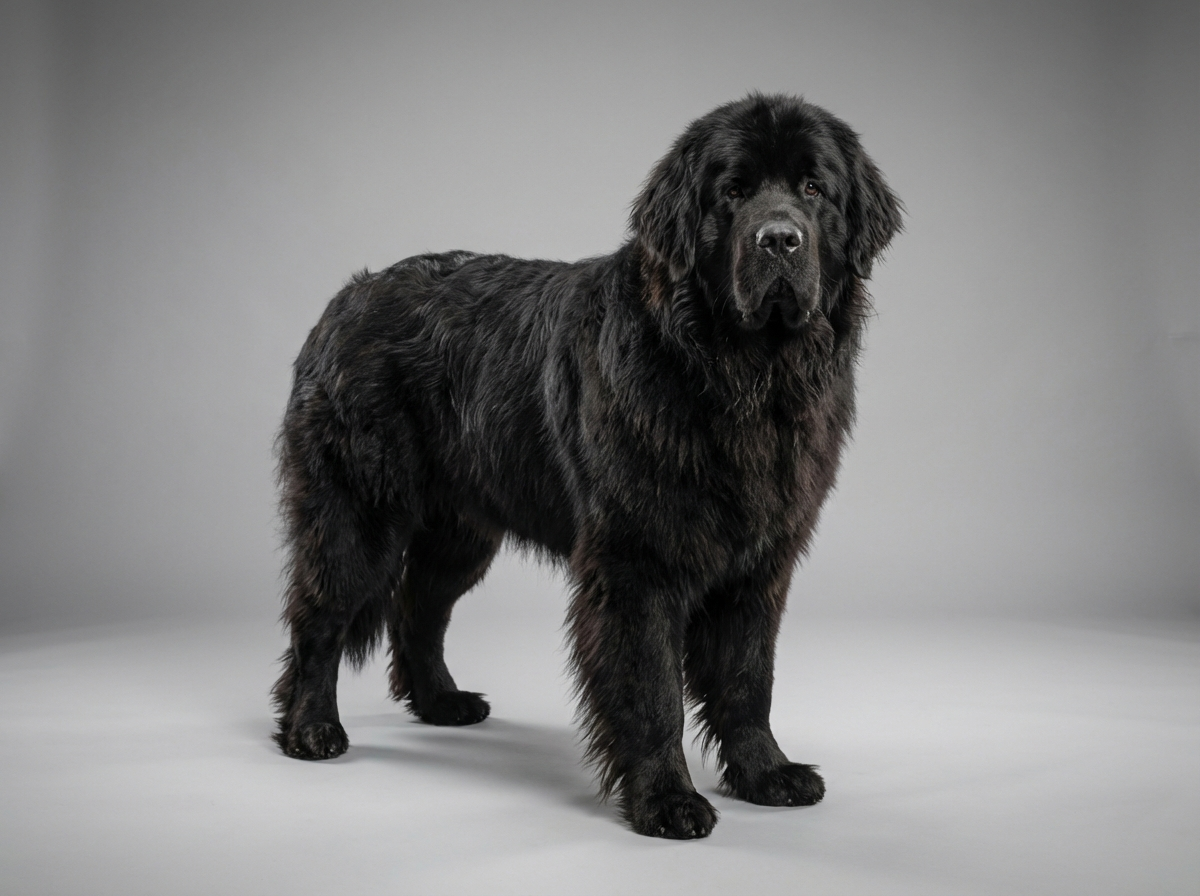
A heavy double coat hides body outline completely, and a dog that is supposed to be huge does not trigger the usual alarm.

Quick answer
Why is weight so hard to judge in this breed?
A heavy double coat hides body outline completely, and a dog that is supposed to be huge does not trigger the usual alarm.
Nobody looks at a Newfoundland and thinks that dog is too big. That is precisely the problem.
For owners who suspect their dog has gained weight but cannot tell through the coat, and for anyone managing a Newfoundland with joint or heart disease who has been told that weight loss is the priority.
This guide is not medical advice. If your dog shows pain, sudden behavior change, or worsening symptoms, consult a licensed veterinarian.
Some links may be affiliate links. We may earn a commission at no extra cost to you. We only suggest products we believe are helpful for dog owners.
We research and check what we publish, but we do not warrant that any figure, date, price, or statement is accurate, complete, or current, and we accept no liability for any loss, cost, injury, or other harm arising from the use of this site. Use it as one reference among several. You remain responsible for your own decisions and for your dog's care - confirm anything that matters with a licensed veterinarian or another qualified professional before you act on it. Full disclaimer.
Excess body weight in a Newfoundland is uniquely damaging because it lands on the systems this breed is documented to have trouble with: hips affected by dysplasia, a heart at risk of two documented conditions, and a cooling system already overwhelmed by a heavy double coat. It is also uniquely hard to detect, because the coat hides body outline and a giant breed is expected to look large.
Weight gain is one of the most common problems in this breed and one of the most under-recognised. A dog with an energy rating of 2 out of 5 and a moderate exercise need, living in a household that measures food by scoop, gains weight quietly, and the visual cues that prompt owners of other breeds to act simply do not fire here.
Several breed traits push in the same direction. An energy level rated 2 out of 5 means a Newfoundland burns relatively little without being asked to. An exercise need rated 3 out of 5 is moderate rather than high, so the exercise that does happen is not extensive. A heavy water-resistant double coat with heavy year-round shedding makes visual body condition assessment nearly impossible, removing the feedback loop that keeps owners of short-coated breeds honest. The breed's size expectation of 100 to 150 pounds gives every owner a plausible reason to believe their dog is simply at the larger end. And the documented hip dysplasia creates a vicious circle, since a sore dog moves less and a heavier dog is sorer.
Households drive this almost entirely. Free-feeding, scoop measuring and uncounted treats are the mechanical causes. Multiple family members feeding independently is the most common invisible failure, and it is remarkable how often a diet fails because nobody knew about the evening biscuit. Hot climates reduce activity for months at a time while food intake stays constant. Homes without a suitable scale, or without a means of weighing a very large dog, remove the measurement that would otherwise catch the drift early.
Book an appointment before starting any weight loss plan, to agree a target weight and a safe rate of loss, and to exclude medical causes of weight gain such as hormonal disease. Return promptly if weight continues to climb on a genuinely measured intake, if your dog becomes noticeably lethargic or heat-intolerant, or if a new reluctance to exercise appears. Seek urgent care for laboured breathing at rest, collapse, an inability to rise, or any sign of heat distress, since an overweight Newfoundland in warm weather is at real risk. Never crash-diet a giant-breed dog without veterinary supervision.
See all Newfoundland health problems, which breeds are prone to obesity, or the full Newfoundland breed guide for temperament, exercise needs and ownership costs.
Safe weight loss in a giant breed is slow and measured in months, not weeks. A dog carrying twenty excess pounds is typically looking at four to eight months of consistent management, and attempting to compress that risks losing muscle that failing joints need. Improvements in mobility often appear well before the target is reached, sometimes after the first ten pounds. Maintenance is permanent, and most households find the maintenance phase harder than the loss phase.
Success is ribs you can feel under light pressure, a stable monthly weight, a dog that rises more easily and walks further than it did, and a summer that passes without heat distress. It is not a thin dog, and a Newfoundland at a healthy weight is still an enormous animal. The truest measure is a household where everyone knows the daily total and the number on the scale has stopped moving upward.
Excess weight is bad for every dog. In a Newfoundland it lands directly on the two systems the breed is documented to have trouble with.
The first is the skeleton. Hip dysplasia is on this breed's health issue list, and the disease is fundamentally about force travelling through a joint that does not fit properly. Every additional pound increases that force at every step of every day. A dog carrying fifteen extra pounds is not slightly worse off, it is applying that extra load hundreds of thousands of times a year to a joint that is already wearing.
The second is the heart. Subaortic stenosis and dilated cardiomyopathy are both documented in the breed, and both reduce the heart's capacity to move blood. Fat is living tissue and it requires perfusion, so a heavier dog asks more of a pump that already has less to give.
There is a third cost that is specific to this breed's coat. Heat tolerance in a Newfoundland is already poor, and additional body fat is additional insulation on a dog that cannot shed heat efficiently. Overweight Newfoundlands are noticeably worse in warm weather, and heat emergencies in this breed are dangerous.
Weight is therefore not a cosmetic issue here. It is the multiplier sitting underneath the breed's three most serious vulnerabilities.

The single most common mistake in this breed is assessing weight by looking. The coat defeats that completely, and by the time a Newfoundland looks fat it is well beyond overweight.
Weight loss in this breed is achieved almost entirely through intake rather than exercise, and that is worth stating plainly. A Newfoundland has an energy level rated 2 out of 5 and an exercise need rated 3, and it cannot safely be exercised into weight loss in warm weather because heat tolerance is poor. Trying to burn off excess through activity risks a heat emergency and puts more load on the joints that are already the problem.
So the work happens at the bowl. Weigh food on a kitchen scale rather than scooping, because scoops vary and hands are generous. Count treats as part of the daily total rather than as extras, and switch high-calorie treats for pieces of the dog's own measured ration. Establish who in the household is feeding what, since multiple people each giving a little is the most common reason a diet fails invisibly.
Rate of loss matters. Slow is correct. A giant-breed dog losing weight too fast loses muscle along with fat, and muscle is what supports failing joints. Your veterinarian can give a weekly target appropriate to your dog's starting weight, and a plan built around that target is far more likely to hold than one built around impatience.
Exercise still belongs in the plan, but as a way of preserving muscle rather than as a calorie strategy. Level walking in cool conditions and swimming in cool water are the two best options for a heavy dog.
If you think your Newfoundland has obesity, the plan is three steps: write down what you have seen and when it started, book a veterinary appointment rather than waiting for the next flare, and take video of the behaviour or symptom before you go — the thing you are worried about rarely happens in the consulting room. Screening in the parents covers hip dysplasia, subaortic stenosis, dilated cardiomyopathy.
What the vet visit should produce is a diagnosis and a written plan, not just reassurance: what is being ruled out, what the monitoring interval is, and which signs mean you come back sooner. Ask what the treatment costs across a year rather than per visit, because that is the number that decides whether you are managing this condition or reacting to it.
Between appointments, keep a short log — dates, what you saw, what changed. It is the single most useful thing an owner brings to a follow-up, and for obesity it is often what separates a clear pattern from a guess.
Odin weighed 148 pounds at his annual check, up from 136 the year before, and his owners were genuinely baffled. They fed the same amount they always had, measured with the same scoop, twice a day. The veterinarian asked them to go home and write down, for one week, everything Odin ate and who gave it to him. The list that came back was longer than anyone expected. There were two dental chews a day, not one, because both adults were giving one. There was a slice of toast crust most mornings from a teenager. There was a handful of kibble whenever Odin sat politely by the cupboard, which turned out to be about six times a day. Nothing on the list was unreasonable on its own. Together they came to a meaningful share of his daily requirement. The family put a single sheet of paper on the fridge with the day's total portioned into a tub each morning. Anything anyone gave him came out of that tub. Nothing else changed, and no additional exercise was added because his hips would not have tolerated it. Odin reached 129 pounds over seven months and was noticeably easier on his feet by the third.
Key takeaway: In a multi-person household, the diet almost never fails at the meal. It fails in the gaps between meals, and the only reliable fix is one visible daily ration that every hand in the house has to draw from.
The breed range is roughly 100 to 150 pounds, but that is a population range and not a target for your individual dog. A dog whose correct weight is 115 pounds is overweight at 140 even though 140 is inside the breed range. Ask your veterinarian for a target specific to your dog's frame.
By feel rather than by sight. You should be able to feel the ribs under light pressure and detect a narrowing behind the ribcage. If you have to press firmly to find ribs, your dog is carrying too much.
Not safely in this breed. Heat tolerance is poor, joints are frequently already compromised, and heavy exercise in a giant dog carries real risk. Weight loss comes from measured intake, with exercise used to preserve muscle.
Slowly, and to a schedule your veterinarian sets. Rapid loss in a giant breed costs muscle, and muscle is what supports the joints you are trying to protect.
Discuss with your veterinarian whether a diet formulated for satiety would suit, split the daily ration into more meals, and use portions of the measured ration as treats. Also rule out medical causes of increased appetite rather than assuming it is greed.
In a breed with a nine to ten year lifespan and documented joint and cardiac disease, weight is one of the few levers that plausibly affects both comfort and duration. It will not add years on its own, but excess weight reliably shortens the comfortable ones.
It can be, and hormonal conditions such as an underactive thyroid are worth excluding if weight is climbing on genuinely unchanged food. Overfeeding remains the more common explanation in this breed, but the question is worth asking.
A heavy double coat hides body outline completely, and a dog that is supposed to be huge does not trigger the usual alarm.
Hands on the ribcage, plus a monthly weight written down. Never eyes alone.
The bowl. Measured food on a kitchen scale, with treats counted inside the daily total.
Dysplastic hips, a heart with documented predispositions, and heat tolerance that is already poor.
Usually. Less food, fewer orthopaedic interventions and lower drug volumes all reduce spending in a breed already at the top cost tier.
A one-page prep sheet for this condition: the signs, the questions to ask, what to get priced. Unlocks here.
You get: Vet visit prep sheet
No spam. One-click unsubscribe. See our privacy policy.
Preview page 1 before you decide.