Health
How are the two conditions connected?
Insulin-producing cells sit inside the tissue that pancreatic inflammation damages. Repeated or severe episodes can destroy them.

Quick answer
How are the two conditions connected?
Insulin-producing cells sit inside the tissue that pancreatic inflammation damages. Repeated or severe episodes can destroy them.
Inflammation that starts as a digestive problem can, over repeated episodes, take out the cells that control blood sugar. The two conditions are not separate bad luck.
For owners of Newfoundlands that have had more than one episode of pancreatic inflammation, and for anyone managing a senior dog in a breed where the senior years arrive at six or seven.
This guide is not medical advice. If your dog shows pain, sudden behavior change, or worsening symptoms, consult a licensed veterinarian.
Some links may be affiliate links. We may earn a commission at no extra cost to you. We only suggest products we believe are helpful for dog owners.
We research and check what we publish, but we do not warrant that any figure, date, price, or statement is accurate, complete, or current, and we accept no liability for any loss, cost, injury, or other harm arising from the use of this site. Use it as one reference among several. You remain responsible for your own decisions and for your dog's care - confirm anything that matters with a licensed veterinarian or another qualified professional before you act on it. Full disclaimer.
The pancreas produces both digestive enzymes and insulin from the same organ. Inflammation that damages the digestive tissue can also destroy the insulin-producing clusters embedded within it, and enough loss produces diabetes. The relationship is bidirectional, since poorly controlled diabetes increases the risk of further pancreatic problems. Both conditions cluster in the second half of life, which in a Newfoundland begins earlier than most owners expect.
Neither condition appears among the Newfoundland's documented health issues, which are hip dysplasia, subaortic stenosis, dilated cardiomyopathy, cystinuria and bloat. Both are common enough in dogs generally that a senior Newfoundland deserves monitoring, and a dog with a history of pancreatic inflammation deserves a lower threshold for glucose testing than one without.
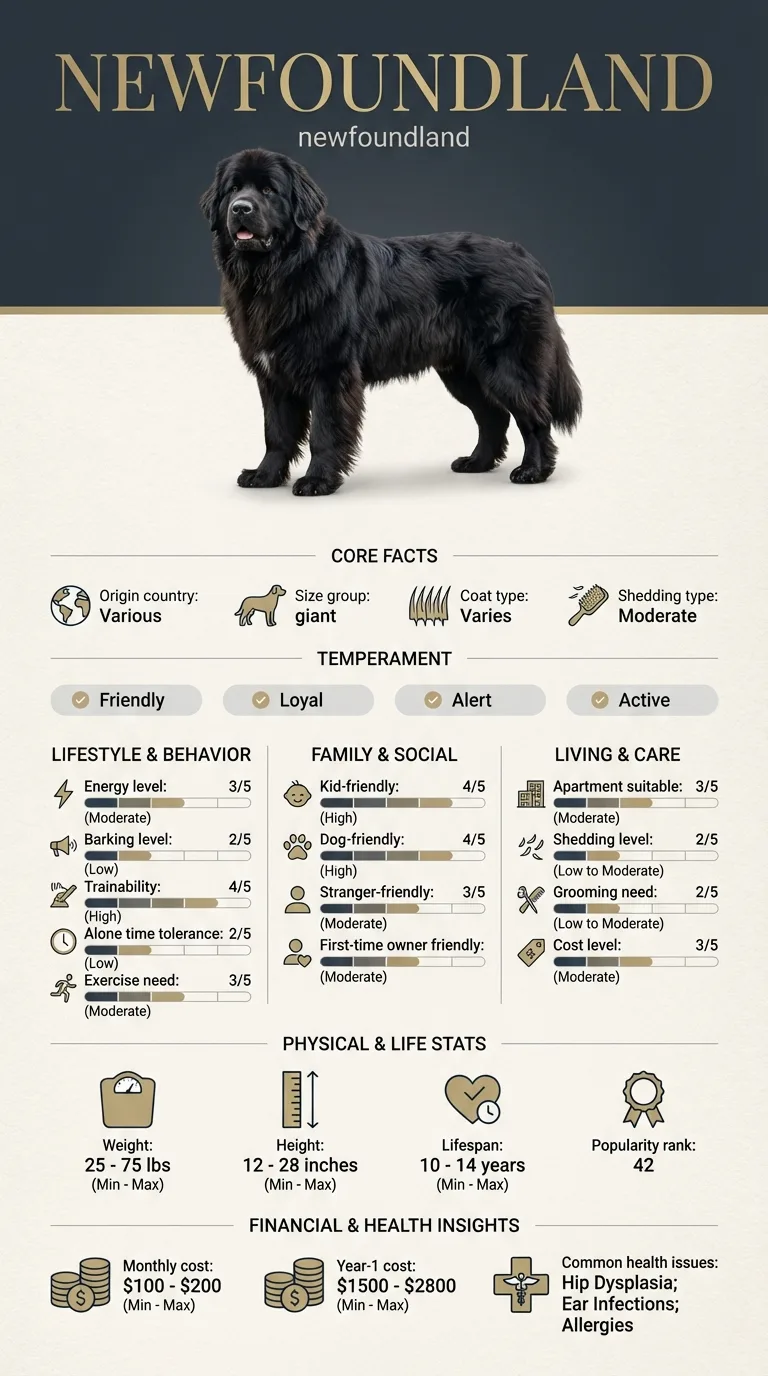
The Newfoundland does not carry a documented predisposition to either condition, and the breed's relevance is one of timeline and opportunity. A lifespan of nine to ten years compresses the senior period into an early calendar window, so endocrine disease of ageing arrives while owners still think of the dog as middle-aged. A rated energy level of 2 out of 5 combined with a heavy double coat that hides body condition makes excess weight easy to accumulate, and excess weight is associated with both conditions. A height of 26 to 28 inches gives the dog effortless access to counters and worktops, which is how the high-fat meals that precipitate pancreatic inflammation typically reach it.
Household routine is the dominant environmental factor once diabetes is established, because control depends on consistency. Homes with variable schedules, multiple people feeding, or a habit of adding food outside meals make stable management genuinely difficult. Kitchen access shapes the pancreatic side: unsecured bins, cleared or uncleared worktops, and visitors offering table food are the mechanisms behind most dietary indiscretion. Warm climates add a further layer, since a heavily coated dog with a chronic condition has less reserve for heat stress.
Seek emergency care for weakness, trembling, disorientation, collapse or seizures in a diabetic dog, since these can indicate blood sugar falling dangerously low. Go the same day for repeated vomiting, a hunched painful abdomen, unproductive retching, or profound lethargy, remembering that bloat is documented in this breed and is a surgical emergency. Book promptly for increased drinking and urination, weight loss despite good appetite, a change in appetite, or cloudiness developing in the eyes. Never adjust an insulin dose yourself, and never skip a meal in a dog receiving insulin without contacting your veterinarian first.
See all Newfoundland health problems, which breeds are prone to pancreatitis diabetes, or the full Newfoundland breed guide for temperament, exercise needs and ownership costs.
Stabilising a newly diagnosed diabetic dog typically takes several weeks of dose adjustment with repeated monitoring, and owners should expect more veterinary contact in the first month than at any point afterwards. Once stable, most dogs settle into a routine with rechecks every few months. Pancreatic episodes, if they recur, interrupt that stability and require re-stabilisation afterwards. This is lifelong management with no endpoint, and the household routine becomes permanent.
Success is a dog holding a steady weight, drinking a normal amount, comfortable and active at its own level, with blood glucose in the range the veterinarian is aiming for. It also looks like a household that has absorbed the routine to the point where it no longer feels like an effort. What it does not look like is a cure, and dogs with meaningful loss of insulin-producing tissue do not recover that function.
The bulk of the pancreas is exocrine tissue: cells that manufacture digestive enzymes and pipe them into the small intestine. When those enzymes activate prematurely inside the gland, the tissue digests itself, and that is pancreatitis.
Embedded within that tissue are the endocrine clusters, small islands of cells whose job is to sense blood glucose and release insulin. They make up only a small fraction of the organ by volume, and they sit inside the same territory that inflammation damages.
A single mild episode of inflammation usually does not destroy meaningful numbers of them. Repeated episodes, or a severe one, can. Insulin-producing cells that die are not replaced, and once enough of them are gone the body cannot move glucose out of the bloodstream and into cells where it is needed.
That is diabetes mellitus: sugar accumulating in the blood while the tissues that need it go without. The dog compensates by drinking heavily, urinating heavily, and eating more while losing weight, because the calories consumed cannot be used.
The relationship runs the other way too. A dog with poorly controlled diabetes is at increased risk of further pancreatic problems, which is why these two conditions tend to be discussed together rather than as separate items on a list.
The most common reason this connection is caught late is not medical. It is that owners of giant breeds are working from a small-dog calendar.

A Newfoundland managing both a history of pancreatic inflammation and established diabetes is on a diet with two constraints pulling in different directions, and this is why the plan must come from a veterinarian rather than from general advice.
Diabetic management wants consistency above all: the same food, in the same amount, at the same times, every day, so that insulin and glucose arrive on a predictable schedule. Pancreatic history wants fat restricted. Getting both right simultaneously usually means a prescription diet and a rigid routine, and it means that treats, table food and dietary improvisation stop being options entirely.
Insulin is administered by injection, and owners who have never done this are usually surprised by how manageable it becomes. What matters more than technique is timing, because doses must line up with meals.
Monitoring is the third element. Water intake, appetite, weight and, where a veterinarian directs it, blood glucose at home all form part of the picture. Written records matter more here than in almost any other condition, because dose adjustment decisions are made from trends.
The household commitment is real: twice-daily injections at fixed times, no exceptions, for the rest of the dog's life. It is worth being honest with yourself about this before starting, and worth knowing that a great many families find it becomes routine within a fortnight.

If you think your Newfoundland has pancreatitis & diabetes, the plan is three steps: write down what you have seen and when it started, book a veterinary appointment rather than waiting for the next flare, and take video of the behaviour or symptom before you go — the thing you are worried about rarely happens in the consulting room. Screening in the parents covers hip dysplasia, subaortic stenosis, dilated cardiomyopathy.
What the vet visit should produce is a diagnosis and a written plan, not just reassurance: what is being ruled out, what the monitoring interval is, and which signs mean you come back sooner. Ask what the treatment costs across a year rather than per visit, because that is the number that decides whether you are managing this condition or reacting to it.
Between appointments, keep a short log — dates, what you saw, what changed. It is the single most useful thing an owner brings to a follow-up, and for pancreatitis & diabetes it is often what separates a clear pattern from a guess.
Elsa had pancreatitis at six after a bin raid, and again at seven for no reason anyone identified. Both times she recovered well, and her owners were careful about fat afterwards. At eight they mentioned, almost in passing at a routine visit, that she was drinking more and had lost some weight, which they had been quietly pleased about because she had always been on the heavy side. She was eating as enthusiastically as ever. It was the combination that concerned the veterinarian. Losing weight while eating well is not what a dog on a controlled diet normally does, and Elsa's history of two pancreatic episodes made a glucose test an obvious next step. She was diabetic. The first six weeks were hard: three dose adjustments, several monitoring visits, and a household learning to inject twice daily at fixed hours. By the third month it had become as unremarkable as brushing teeth. Elsa is now ten, stable, and her owners keep a paper log on the kitchen windowsill that has never once been skipped.
Key takeaway: Weight loss in a dog that is eating well is not good news, even when the dog needed to lose weight. In a Newfoundland with a history of pancreatic inflammation, that combination is a reason to test rather than to celebrate.
No, and most dogs that have an episode of pancreatitis never become diabetic. The risk relates to how much of the insulin-producing tissue is destroyed, which is why repeated or severe episodes matter more than a single mild one.
Increased drinking and urination, an increased appetite, and weight loss despite eating well. That combination of eating more while losing weight is the most specific of the three and warrants an appointment.
Canine diabetes generally requires insulin, unlike some forms of the disease in other species. Diet and weight management support the treatment but do not replace it. This is a veterinary decision, not one to attempt independently.
Most dogs need insulin twice daily at consistent times aligned with meals. Your veterinarian will set the schedule and teach you the technique, and the routine becomes straightforward for most households within a couple of weeks.
Any dog with a chronic condition has less physiological reserve, and this breed already tolerates heat poorly because of its double coat and body mass. Heat management should be more conservative for a dog with diabetes, not less.
Blood sugar falling too low is the acute danger, producing weakness, trembling, disorientation, collapse or seizures. This requires immediate veterinary attention. Your veterinarian will explain exactly what to do if you observe it, and you should have that plan written down before you need it.
Yes. Well-managed diabetic dogs live comfortable, ordinary lives. What changes is the household routine, which becomes fixed rather than flexible, and the need for the family to be organised about timing.
Insulin-producing cells sit inside the tissue that pancreatic inflammation damages. Repeated or severe episodes can destroy them.
Weight loss despite a good or increased appetite. Drinking more is common but less specific.
Around six or seven, given a nine to ten year lifespan. Senior monitoring should start earlier than owners of small breeds expect.
Rigid timing. Twice-daily injections aligned with meals, at the same hours, every single day.
Not exactly. Diabetes wants consistency, pancreatic history wants fat restricted. That combination usually needs a prescription diet.
A one-page prep sheet for this condition: the signs, the questions to ask, what to get priced. Unlocks here.
You get: Vet visit prep sheet
No spam. One-click unsubscribe. See our privacy policy.
Preview page 1 before you decide.