Health
What does a breed prevalence percentage really measure?
The proportion of voluntarily submitted radiographs that fell into each grade. It is a statistic about submissions, not about every dog in the breed.

Quick answer
What does a breed prevalence percentage really measure?
The proportion of voluntarily submitted radiographs that fell into each grade. It is a statistic about submissions, not about every dog in the breed.
A breed percentage is a statement about which dogs got X-rayed and submitted, not a probability attached to your future puppy.
For prospective buyers comparing litters and trying to interpret a breeder's health paperwork, and for anyone who has read a frightening breed statistic online and wants to know what it actually rests on.
This guide is not medical advice. If your dog shows pain, sudden behavior change, or worsening symptoms, consult a licensed veterinarian.
Some links may be affiliate links. We may earn a commission at no extra cost to you. We only suggest products we believe are helpful for dog owners.
We research and check what we publish, but we do not warrant that any figure, date, price, or statement is accurate, complete, or current, and we accept no liability for any loss, cost, injury, or other harm arising from the use of this site. Use it as one reference among several. You remain responsible for your own decisions and for your dog's care - confirm anything that matters with a licensed veterinarian or another qualified professional before you act on it. Full disclaimer.
Hip dysplasia prevalence figures describe how often screened dogs in a breed were graded as dysplastic. Because screening is voluntary, methods differ between registries and countries, and results depend on the age at which dogs were imaged, these figures are useful for tracking trends and comparing lines but poor at predicting outcomes for one puppy. Understanding what the numbers rest on is what turns them into a buying tool.
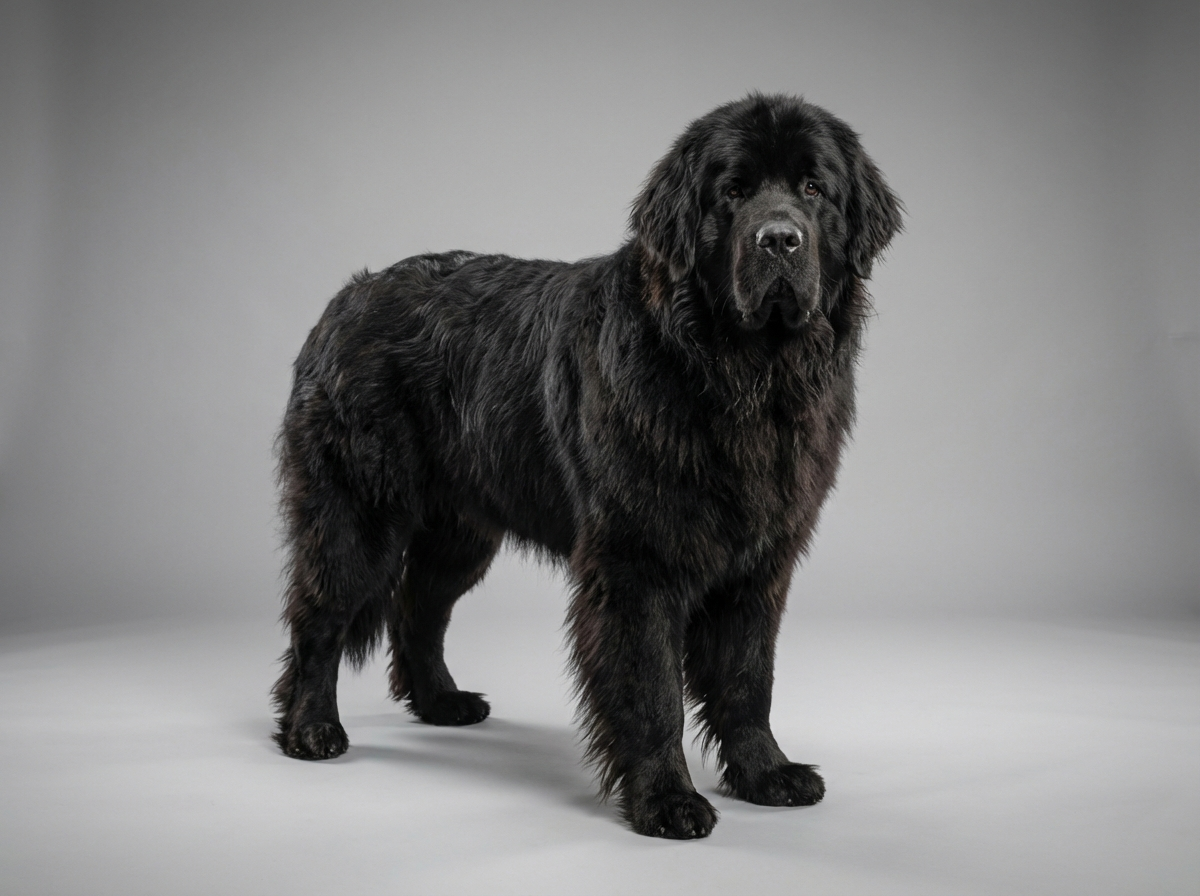
Hip dysplasia is documented as one of the Newfoundland's health concerns, and it is prevalent enough across the giant breeds generally that screening is standard practice among serious breeders. The precise percentage varies by registry and era, which is exactly the point this page is making.
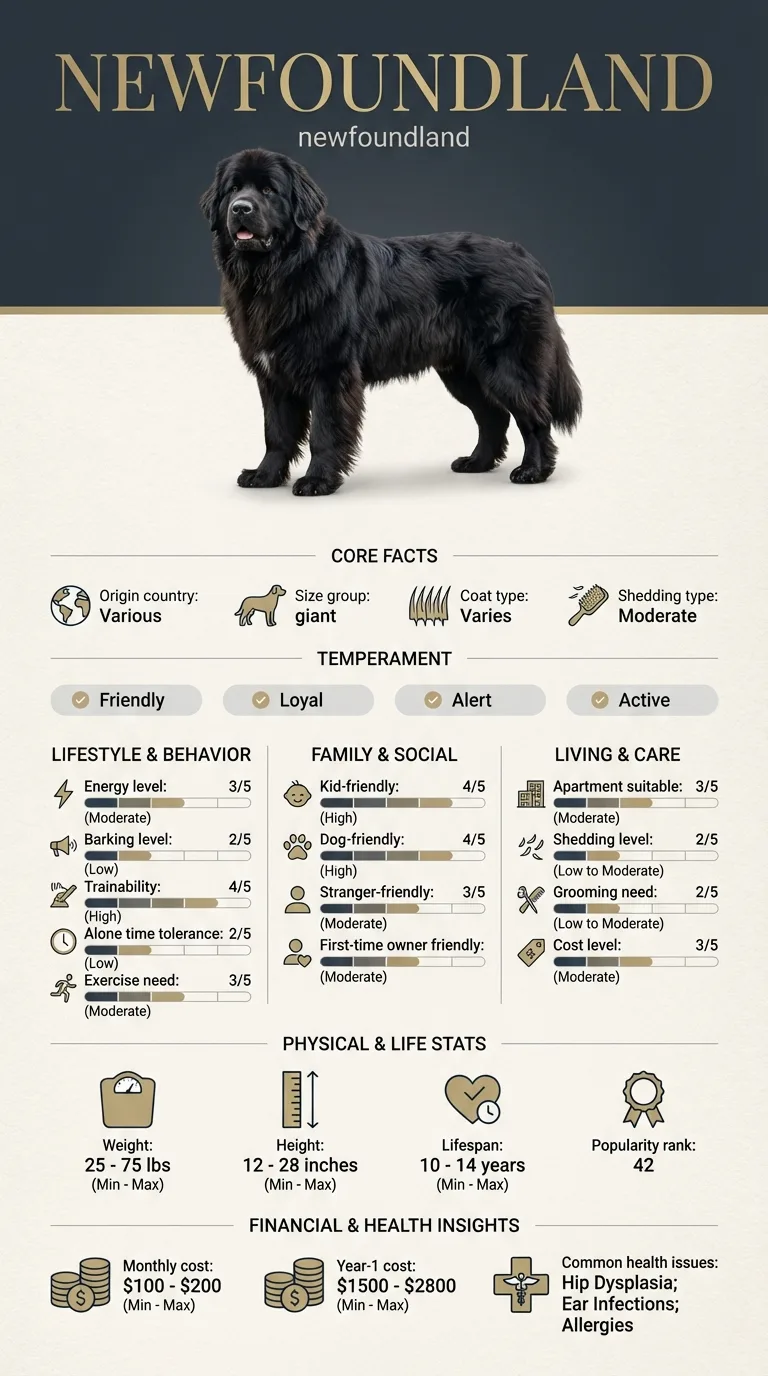
The Newfoundland appears in these statistics because the underlying condition is genuinely part of the breed, listed directly among its documented health issues. Giant breeds dominate hip dysplasia registries as a group for structural reasons: a 100 to 150 pound body places enormous load on the hip, and a skeleton that keeps growing well past a year spends longer in a formative state where laxity can develop. The breed's popularity rank of 42 also matters statistically, because a moderately popular breed produces enough screened dogs to generate meaningful figures while still being small enough that individual influential lines can shift the picture.
The environment shapes the data as much as the disease. Countries with an established, well-supported screening scheme produce fuller datasets than countries where screening is uncommon. Breeders working within a club culture that expects certificates submit more results, including mediocre ones. Cost also filters the data, since radiographs under sedation for a giant-breed dog are not cheap, and that expense quietly removes casual breeders and pet owners from the sample.
Talk to a veterinarian before you buy if you want help interpreting screening paperwork, and again when the puppy arrives to agree a growth and feeding plan. Book a clinical appointment if your young Newfoundland develops a limp, bunny-hops at a trot, struggles to rise, or seems reluctant to use its hind end, and do not dismiss these signs as clumsy puppy behaviour. Seek same-day care for sudden non-weight-bearing lameness, acute severe pain, or an abrupt inability to stand, since these suggest an injury or a neurological event rather than gradual developmental disease.
See all Newfoundland health problems, which breeds are prone to hip dysplasia prevalence, or the full Newfoundland breed guide for temperament, exercise needs and ownership costs.
Screening results for a breeding dog are typically finalised in early adulthood, and the effect of screening decisions on a breed is measured in generations rather than years. For a buyer, the practical timeline is shorter: paperwork can be reviewed in an afternoon, and the growth management that follows runs from collection day to roughly eighteen months of age. Whether the effort paid off may not be clear until the dog is middle-aged.
Success for a buyer is walking into a purchase with clear eyes: understanding what the certificates prove, what they do not, and which parts of the outcome are still in your hands. Success at the breed level, which is slower and less personal, is a screening culture consistent enough that the reported figures actually improve over decades rather than simply reflecting who chose to submit.
Most published hip dysplasia percentages for a breed come from screening registries. An owner or breeder has a dog radiographed under sedation at a set age, submits the films, and a panel or a measurement protocol assigns a result. The registry then reports how many submitted dogs fell into each category.
That process has a built-in distortion, and it works in both directions. Breeders who take health screening seriously submit more dogs, which raises the number of well-bred dogs in the sample. But a set of films that clearly shows a poor hip is less likely to be submitted at all, since there is no obligation to send in a disappointing result. The reported percentage is therefore a statistic about submitted films, not about the breed.
There is also more than one method. Some systems grade the appearance of the joint on a positioned radiograph and assign a category. Others measure joint laxity numerically, producing a distraction figure that can be compared across dogs and, importantly, can be measured much earlier in life. These methods do not produce interchangeable numbers, so a percentage quoted from one system cannot be compared directly with a percentage from another.
None of this makes screening useless. It makes screening a tool for comparing individual dogs and breeding lines, which is exactly what it was designed for, rather than a crystal ball for the breed as a whole.

A good breeder answers these without defensiveness and usually volunteers most of it. Reluctance to show paperwork is the most useful signal in the whole conversation.
Hip conformation is influenced by many genes rather than one, and it is also influenced by how a puppy grows. That combination means two screened parents with good results shift the odds meaningfully in the puppy's favour without eliminating the possibility of disease.
This is genuinely difficult for buyers, because it means health testing is worth insisting on while remaining an incomplete guarantee. The right conclusion is not that screening is theatre. Breeds where screening has been pursued consistently across generations show real improvement over decades, and lines where it has been ignored do not. The conclusion is that screening is a probability instrument.
It also means the buyer's own contribution starts the day the puppy comes home. Growth rate and body condition through the first eighteen months, the exercise a young giant-breed dog is asked to do, and the flooring it grows up on all affect how a hip develops. A puppy from screened parents raised heavy on slippery floors is not necessarily better off than a less pedigreed puppy raised lean and carefully.
The fair summary is this: the breeder controls the genetic starting point, and the owner controls a substantial part of what happens next.
A family researching Newfoundland puppies found the same breed-wide hip statistic quoted on two breeders' websites, presented in both cases as reassurance. They asked both breeders the same three questions: which scheme, what age, and may we see the certificates. The first breeder emailed scans within the hour: both parents screened under a named scheme at appropriate ages, plus results for three of the four grandparents and for two puppies from an earlier repeat of the same pairing. The second breeder said the dogs had been checked by a vet and were fine, and became noticeably less friendly when asked for documents. The family bought from the first breeder. Their dog is now four and has good hips, which proves nothing on its own, since one dog is not evidence. What the exercise did prove was that a percentage on a website is free to type, and a certificate is not.
Key takeaway: Quoted breed statistics cost a breeder nothing. Ask instead for the documents that cost something to obtain, and judge the answer by how readily they arrive.
Different registries use different grading methods, sample different populations, cover different decades, and depend on voluntary submission. Two honest sources can therefore report noticeably different percentages without either being wrong.
No. Population statistics do not transfer to individuals. What matters for your puppy is the screening record of its own parents and grandparents, and how the puppy is then raised.
Laxity-based measurement methods can be performed at a younger age than appearance-based grading, which is one reason breeders sometimes use them. Ask your veterinarian which approach is available and appropriate for your dog.
Not directly. Different national schemes use different scales and conventions. If you are comparing a dog screened abroad, ask which scheme produced the result and what the scale means.
It can be, particularly if you are considering breeding, if the dog is showing early signs, or if you want a baseline before problems begin. For a pet with no symptoms, discuss with your veterinarian whether the sedation and cost are justified.
The condition affects both sexes. What matters more than sex is the individual line, the dog's body weight, and its growth history, so treat any breed-wide figure as background rather than as a personal forecast.
Many responsible breeders offer a written health guarantee covering hips for a defined period. Read what it actually promises, since some guarantees offer a replacement puppy rather than help with treatment costs, and those are very different things for a family that already loves its dog.
The proportion of voluntarily submitted radiographs that fell into each grade. It is a statistic about submissions, not about every dog in the breed.
The actual screening certificates for both parents, with dates and the grading scheme named.
No. Hip conformation is influenced by many genes and by growth, so screening improves the odds rather than removing the risk.
Growth rate, body condition, exercise choices and household flooring during the first eighteen months. That contribution is substantial.
It generally does, because screening costs money and reduces how many dogs a breeder can use. In a breed already at the top cost tier, that premium usually buys real value.
A one-page prep sheet for this condition: the signs, the questions to ask, what to get priced. Unlocks here.
You get: Vet visit prep sheet
No spam. One-click unsubscribe. See our privacy policy.
Preview page 1 before you decide.