Health
What is the single most useful daily action?
Increase water intake, most reliably by adding water to food. Dilute urine keeps cystine dissolved.

Quick answer
What is the single most useful daily action?
Increase water intake, most reliably by adding water to food. Dilute urine keeps cystine dissolved.
This is not a stone problem caused by diet or bad luck. It is a specific inherited plumbing fault in the kidney tubules, and it lasts the dog's whole life.

For Newfoundland owners, especially of male dogs, who need to understand why their dog forms stones repeatedly, and for anyone who has been told their dog is straining to urinate and needs to know how urgent that is.
This guide is not medical advice. If your dog shows pain, sudden behavior change, or worsening symptoms, consult a licensed veterinarian.
Some links may be affiliate links. We may earn a commission at no extra cost to you. We only suggest products we believe are helpful for dog owners.
We research and check what we publish, but we do not warrant that any figure, date, price, or statement is accurate, complete, or current, and we accept no liability for any loss, cost, injury, or other harm arising from the use of this site. Use it as one reference among several. You remain responsible for your own decisions and for your dog's care - confirm anything that matters with a licensed veterinarian or another qualified professional before you act on it. Full disclaimer.
Check this first
Stones that form in the kidney or bladder can sit there causing irritation, blood in the urine and discomfort. That is unpleasant but not immediately dangerous. The catastrophic scenario happens when a stone moves and lodges in the urethra.
Anatomy decides who this happens to. A male dog's urethra is long and narrows as it passes through the penis, and it also has to pass alongside a bone. A stone that would travel harmlessly through a female's shorter, wider urethra can jam solidly in a male's. When it does, urine has nowhere to go.
What follows is not simply discomfort. Pressure backs up through the bladder to the kidneys, waste products that should be leaving the body accumulate in the blood, and the electrolyte disturbances that result can affect heart rhythm. A completely obstructed dog can become critically ill within a day and can die. In severe cases the bladder can rupture.
This is why straining to urinate in a male Newfoundland is treated as an emergency until proven otherwise. Owners frequently misread it as constipation, because a dog crouching repeatedly and producing nothing looks the same from a distance. If you cannot confirm that urine is actually being passed, assume it is not and go.
If any of these apply, call your vet or an emergency clinic now. The rest of this page is for the cases that are not an emergency.
Cystinuria is an inherited defect in the kidney's ability to reabsorb the amino acid cystine, which then accumulates in urine and precipitates into crystals and stones. Stones may sit quietly in the kidney or bladder, or they may move and obstruct the urethra. In male dogs, obstruction is a life-threatening emergency. Because the underlying transport defect never resolves, this is a condition managed continuously across a dog's life.
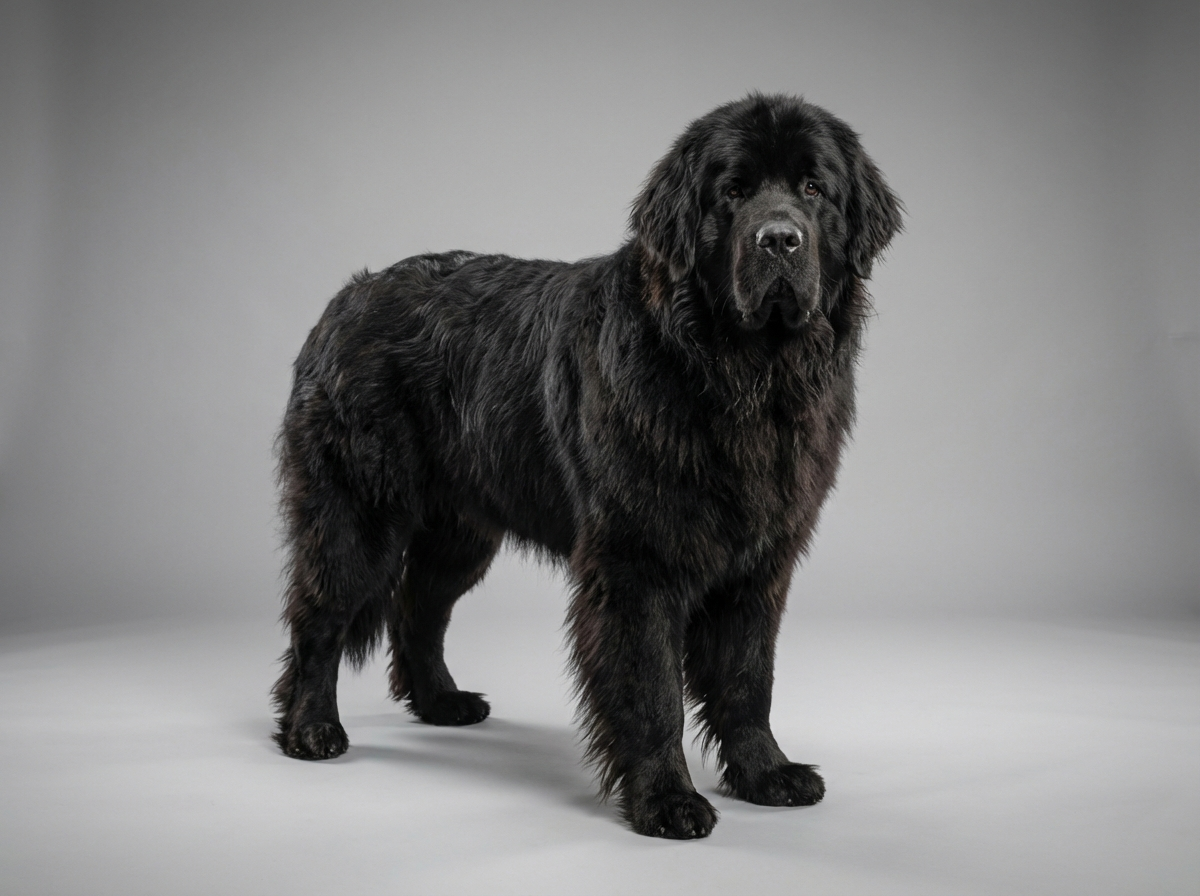
Cystinuria is one of the five conditions listed among the Newfoundland's documented health issues, which places it firmly among the problems owners of this breed should know about. Not every Newfoundland is affected, and severity varies, but the breed is genuinely recognised for this condition in veterinary urology.
This is one of the few Newfoundland problems that is purely genetic rather than a consequence of size. The transport defect is inherited and is documented in the breed, which is why responsible breeders screen for it and why it belongs in any serious discussion of Newfoundland health. Size does contribute at the margins, because a very large dog produces a large volume of urine and a correspondingly large total amount of cystine, and because surgical intervention on a 100 to 150 pound patient carries more cost and more anaesthetic consideration, particularly in a breed with documented cardiac predispositions. The breed's typical calm nature also means a dog with mild urinary discomfort may simply endure it quietly.
The environment does not cause cystinuria but it determines how often it produces stones. A dog fed exclusively dry food without added moisture produces more concentrated urine. Households where the dog is left for long stretches without a toilet break allow urine to sit and concentrate further. Limited access to fresh water, or water bowls that go stale in hot weather, reduce intake. Hot climates increase fluid losses through panting in a breed already burdened by a heavy double coat, concentrating urine further.
Go immediately, treating it as a surgical emergency, if your male dog is straining to urinate and producing little or nothing, is crying while trying, has a tense painful abdomen, is vomiting, or has become lethargic and unwilling to move. A complete urinary obstruction can be fatal within a day. Book a prompt appointment for blood in the urine, frequent small urinations, licking at the genital area, urinary accidents in a previously reliable dog, or straining that still produces a normal stream. Bring a urine sample if you can collect one easily, and do not restrict water in the hope of reducing accidents.
See all Newfoundland health problems, which breeds are prone to kidney stones, or the full Newfoundland breed guide for temperament, exercise needs and ownership costs.
Preventive changes to water and diet alter urine chemistry within days, but whether they are working is judged over months through repeat urine testing and imaging. Stones already present do not dissolve quickly, and some do not dissolve at all. Expect a monitoring schedule measured in months for the rest of the dog's life. Recurrence is common enough that a second episode should be planned for rather than treated as a failure of care.
Success is a dog that never obstructs. That is the outcome the entire management plan exists to produce. Beyond that, it looks like stable urine testing, no episodes of blood or straining, imaging that shows no new stone growth, and kidney function that remains normal into the dog's later years. It does not look like a cure, and any plan presented as one should be treated with suspicion.
The kidney filters an enormous volume of fluid and then reclaims what the body still needs before urine is produced. Among the substances routinely reclaimed is cystine, an amino acid. In cystinuria, the transport system responsible for pulling cystine back out of the filtrate does not work properly, so cystine that should have been recovered stays in the urine.
Cystine has one awkward property: it is poorly soluble. Once its concentration in urine exceeds what the fluid can hold, it comes out of solution as crystals, and crystals aggregate into stones. This is why the condition is a transport disorder that presents as a stone disease.
Solubility depends on two things the owner can influence. The first is how concentrated the urine is, because dilute urine holds more cystine in solution. The second is urine acidity, since cystine dissolves better in less acidic urine. Both of these are levers in management, and both are why veterinary plans for this condition focus so heavily on water and diet.
The defect is present from birth and does not go away. A dog that has had one stone removed still has the same kidneys it had the day before, which is why this is a lifelong management condition rather than a problem that gets fixed once.

None of these cure the transport defect. What they do is keep cystine dissolved rather than crystallised, which is the entire game.
Fergus was five, a male Newfoundland, and had been diagnosed with cystine stones eighteen months earlier. His family had managed him well, with added water in his food and a prescription diet, and had not had a problem since. On a Sunday afternoon he began squatting repeatedly in the garden, holding the position and producing nothing. His owner watched from the kitchen window and concluded he was constipated, which seemed reasonable, and decided to see how he was in the morning. An hour later Fergus was pacing and could not settle. His abdomen felt tight when his owner touched it, and that was what prompted the phone call. The emergency clinic told them to come immediately and explained on the phone why. Fergus had a stone lodged in his urethra. He was relieved of the obstruction that evening, spent two nights on fluids while his kidney values came back down, and made a full recovery. The veterinarian's parting comment was that another eight hours would have been a very different night, and that in a male dog with this diagnosis, the posture his owner had watched from the window is the one sign that never waits until morning.
Key takeaway: A crouching, straining Newfoundland producing nothing is a urinary emergency until you have actually seen urine hit the ground. In a male dog with cystinuria, that assumption saves lives.
Yes. It appears directly on the breed's documented health issue list alongside hip dysplasia, subaortic stenosis, dilated cardiomyopathy and bloat. It is one of the conditions the breed is genuinely known for, even though it gets far less attention than the others.
Often you would not until a problem occurs. Blood in the urine, frequent small urinations, straining, licking at the genital area, or urinating in unusual places are the common early signs. Some dogs are diagnosed on imaging done for another reason.
In a male dog, treat it as one. If your dog is posturing repeatedly and producing little or no urine, go to a veterinarian immediately. A complete obstruction is life-threatening within a day.
Diet is an important lever but rarely the whole answer. Water intake, urination frequency, urine acidity and monitoring all form part of the plan, and the specific dietary approach should be chosen by your veterinarian rather than bought off a shelf.
Some stones can be managed medically or removed by less invasive means, while others need surgical removal, particularly if they are obstructing. Because the defect persists, some dogs need more than one procedure across their lives.
They can carry and express the same transport defect and form stones. What differs is the consequence: a shorter, wider urethra means obstruction is far less likely, so females are less prone to the emergency scenario even when the underlying condition is present.
Genetic testing for cystinuria is available in some breeds, and its applicability varies by breed and variant. Discuss with your veterinarian which test is valid for a Newfoundland before spending money on a panel.
It can. Repeated obstruction and back-pressure damage kidney tissue, and recurrent infection adds to that. Preventing episodes is therefore also a way of protecting kidney function for the years ahead.
Increase water intake, most reliably by adding water to food. Dilute urine keeps cystine dissolved.
Their urethra is long and narrows, so a stone that would pass in a female can block it completely.
If you cannot confirm urine is actually being produced, assume a blockage and go immediately. The postures look almost identical.
No. It is a lifelong kidney transport fault, so management continues even after stones are removed.
More than average. Urine sitting in the bladder concentrates, so frequent opportunities genuinely reduce risk.
A one-page prep sheet for this condition: the signs, the questions to ask, what to get priced. Unlocks here.
You get: Vet visit prep sheet
No spam. One-click unsubscribe. See our privacy policy.
Preview page 1 before you decide.