Health
What is the main complication in giant-breed whelping?
Uterine inertia, where contractions fail to start or fade partway through a long delivery of a large litter. It leaves puppies inside a uterus that has stopped pushing.

Quick answer
What is the main complication in giant-breed whelping?
Uterine inertia, where contractions fail to start or fade partway through a long delivery of a large litter. It leaves puppies inside a uterus that has stopped pushing.
The most common serious complication is not dramatic. It is a bitch who has been straining for two hours with nothing to show for it.
People who have taken on a pregnant Mastiff, planned breeders preparing for a whelping, and owners who need to know when a labour has stopped being normal.
This guide is not medical advice. If your dog shows pain, sudden behavior change, or worsening symptoms, consult a licensed veterinarian.
Some links may be affiliate links. We may earn a commission at no extra cost to you. We only suggest products we believe are helpful for dog owners.
We research and check what we publish, but we do not warrant that any figure, date, price, or statement is accurate, complete, or current, and we accept no liability for any loss, cost, injury, or other harm arising from the use of this site. Use it as one reference among several. You remain responsible for your own decisions and for your dog's care - confirm anything that matters with a licensed veterinarian or another qualified professional before you act on it. Full disclaimer.
Whelping in a giant breed carries a higher complication rate than in medium-sized dogs. The dominant problem is uterine inertia, where a uterus distended by a large litter fatigues and stops contracting effectively partway through delivery. Obstruction by a large puppy, placental separation and a post-whelping collapse in blood calcium make up the other major risks, and each has a specific threshold at which waiting must stop.
Pregnancy complications are not among the health issues documented as characteristic of Mastiffs, but giant breeds as a group are widely recognised as higher-risk whelpers, and caesarean rates in large breeds exceed those in medium ones. Most Mastiff owners will never face this, since the great majority of dogs in this breed are neutered pets rather than breeding animals.
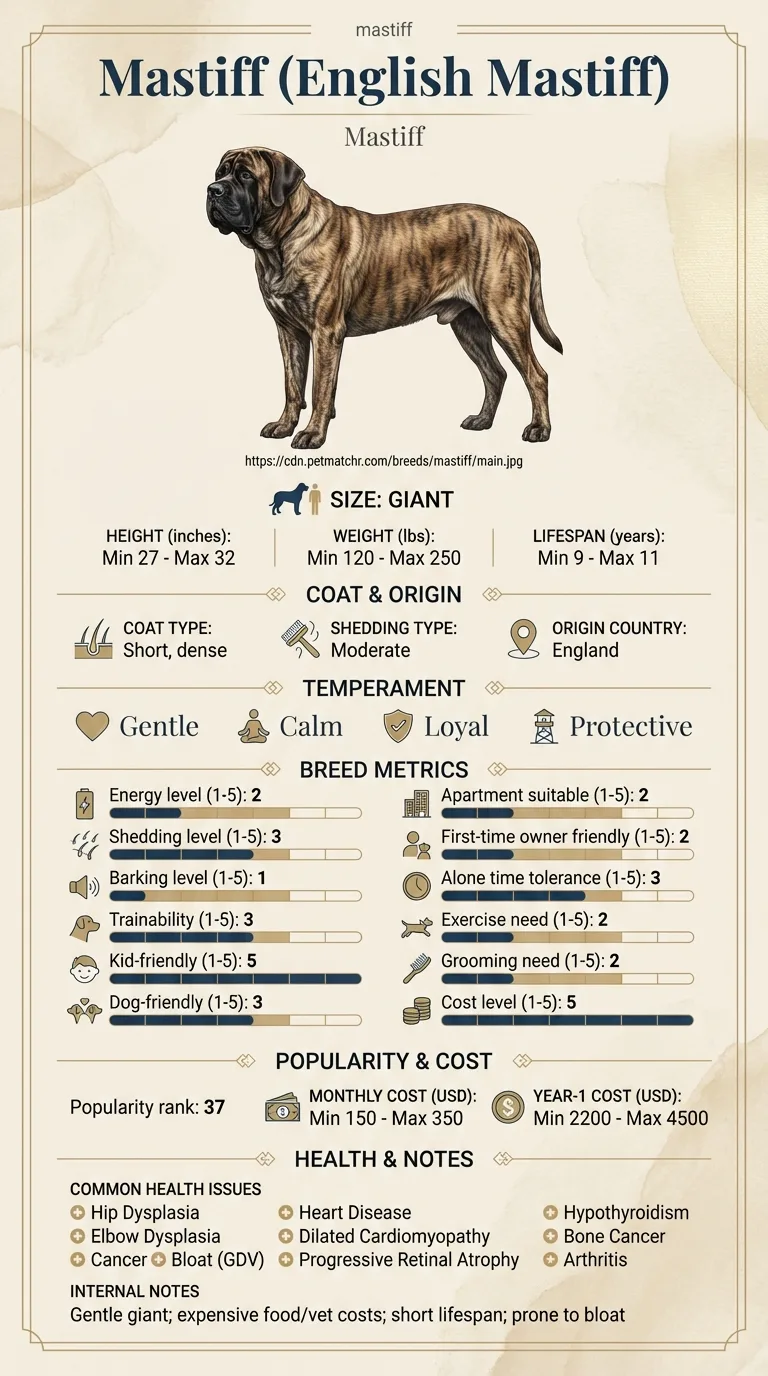
Scale is the underlying reason. A Mastiff bitch weighing 120 to 250 pounds carries a litter that is large in both number and individual size, and the uterine muscle has to sustain effective contraction across a delivery that may run many hours. Giant breeds are consistently over-represented in caesarean statistics for this reason. The breed's documented cardiac issues add a second layer, because an emergency caesarean means major abdominal surgery under anaesthetic in a dog whose heart status may be unknown. The nine-to-eleven-year lifespan also means a breeding bitch reaches middle age quickly.
Preparation dominates outcomes far more than anything biological that an owner can influence during the event itself. Whether a puppy count was done, whether the dam's temperature was being monitored, whether a clinic capable of handling a giant breed was identified in advance, and whether someone stays awake through the night all shape what happens. Nutrition through pregnancy matters, and so does the strong temptation to supplement calcium, which does harm rather than good when done without direction. A whelping area that is warm, clean, quiet and large enough for a dog of this size reduces stress on the dam considerably.
Go immediately for strong straining lasting more than twenty to thirty minutes without a puppy, more than two hours between puppies when the litter is not complete, green or black discharge before any puppy has been born, bright red bleeding, a foul-smelling discharge, or a dam who becomes weak, collapsed or feverish. Treat tremors, twitching, stiffness, extreme restlessness or heavy panting in the dam during lactation as an emergency, since a critical fall in blood calcium can progress to seizures. Never attempt to pull a stuck puppy. Have the dam and litter examined after whelping even when everything appeared to go well.
See all Mastiff health problems, which breeds are prone to pregnancy complications, or the full Mastiff breed guide for temperament, exercise needs and ownership costs.
Canine gestation runs roughly nine weeks. Active whelping in a giant breed with a large litter can extend across many hours, with normal rest intervals between puppies. Recovery from an uncomplicated whelping takes days, while recovery from a caesarean involves around two weeks of restricted activity in a dog simultaneously feeding a litter. The calcium risk window extends through peak lactation, generally the first several weeks after birth.
Success is a healthy dam and a live litter, with any intervention having happened early rather than after a long wait. It also includes preparation that turned out to be unnecessary, since the clinic identified in advance and the puppy count that confirmed the litter was complete are worth their cost even in a straightforward whelping. Owners should be honest that giant-breed whelping carries real risk to the dam, and that a decision to breed should follow health screening rather than precede it.
Uterine inertia is the central problem. The uterus is a muscle, and like any muscle it fatigues. A large litter distends it heavily, and a long labour delivering eight or ten substantial puppies asks it to keep contracting effectively for many hours. Primary inertia is where effective contractions never really begin; secondary inertia is where they begin, do their work, and then fail partway through. Both are more likely in giant breeds with big litters, and both end the same way if not addressed, with puppies still inside a uterus that has stopped pushing.
Puppy size relative to the birth canal is the second issue. A very large single puppy, or one presented awkwardly, can obstruct a delivery entirely. A litter of two in a dog this size is a particular concern, because puppies in a small litter grow larger than they would in a big one.
Calcium handling is the third. The demands of late pregnancy and lactation in a bitch feeding a large litter can outstrip her ability to mobilise calcium, producing restlessness, panting, tremors and eventually seizures. This is a genuine emergency and it typically appears in the weeks after whelping rather than during it. Supplementing calcium during pregnancy without veterinary direction can make this more likely rather than less, which is a common and damaging misconception.
Against all of this, a caesarean section on a giant breed is major abdominal surgery with anaesthetic considerations of its own, particularly in a breed where heart disease is documented.
In whelping, waiting to see is the main way things go wrong. These are the standard points at which veterinary help should be sought, and they are worth having on paper before the night begins.

If you think your Mastiff has pregnancy complications, the plan is three steps: write down what you have seen and when it started, book a veterinary appointment rather than waiting for the next flare, and take video of the behaviour or symptom before you go — the thing you are worried about rarely happens in the consulting room. Screening in the parents covers hip dysplasia, elbow dysplasia, cancer.
What the vet visit should produce is a diagnosis and a written plan, not just reassurance: what is being ruled out, what the monitoring interval is, and which signs mean you come back sooner. Ask what the treatment costs across a year rather than per visit, because that is the number that decides whether you are managing this condition or reacting to it.
Between appointments, keep a short log — dates, what you saw, what changed. It is the single most useful thing an owner brings to a follow-up, and for pregnancy complications it is often what separates a clear pattern from a guess.
Marisol had bred Mastiffs for eleven years and had the thresholds written on a card taped inside the whelping room door. Her bitch, Hedda, produced six puppies over five hours without difficulty. Then nothing. Hedda settled with the litter and seemed comfortable, and every instinct Marisol had said to let her rest. But the pre-whelping radiograph had counted nine, and the card on the door said two hours. At the two-hour mark she rang the practice. Hedda was in secondary inertia: her uterus had simply stopped contracting effectively. Three puppies were still inside. She had a caesarean that night and all three were delivered alive. Marisol says the radiograph was the single most valuable thing she did, because without a count she would have believed the litter was finished, and Hedda looked entirely content.
Key takeaway: A bitch in secondary inertia often looks calm and settled rather than distressed, which is exactly what makes it dangerous. A pre-whelping puppy count and a written time threshold turned a comfortable-looking pause into the point at which three puppies were saved.
Many giant-breed breeders arrange for the possibility rather than assuming one, which means identifying a clinic in advance, knowing their out-of-hours arrangement, and confirming they can handle a dog of this size. That preparation is sensible regardless. Whether an elective caesarean is appropriate for a particular bitch is a decision for a vet who knows the individual.
Not without veterinary direction. Supplementing calcium during pregnancy can interfere with the body's own regulation and is associated with a greater risk of the post-whelping calcium crisis, not less. Timing and formulation matter enormously here, and this is one of the areas where well-intentioned owner action most often causes harm.
Giant breeds commonly have large litters, and numbers well into the high single figures or beyond are not unusual. A pre-whelping radiograph or ultrasound to count puppies is genuinely useful, because knowing how many to expect is what tells you whether a labour has finished or stalled.
The main ones are retained placenta or a retained puppy, uterine infection, mastitis, and the calcium crisis associated with heavy lactation. A bitch feeding a large litter also has enormous nutritional demands. She should be checked after whelping rather than assumed to be fine because the puppies arrived.
It should. Hip dysplasia, elbow dysplasia, heart disease, dilated cardiomyopathy, cancer and progressive retinal atrophy are all documented in Mastiffs. Responsible breeding involves screening for what can be screened for, and cardiac status in particular is relevant because a caesarean may be needed under anaesthetic at short notice.
For any Mastiff not part of a considered breeding programme, this is a conversation worth having with your vet. Timing in giant breeds involves trade-offs relating to skeletal development, so it is not a simple yes or no, and the right answer depends on the individual dog and household rather than on a general rule.
Uterine inertia, where contractions fail to start or fade partway through a long delivery of a large litter. It leaves puppies inside a uterus that has stopped pushing.
After twenty to thirty minutes of strong straining with no puppy, after two hours between puppies with the litter unfinished, or at any green or black discharge before the first birth.
Not without veterinary direction. Supplementing during pregnancy can disrupt the body's own calcium regulation and is linked to greater risk of a post-whelping crisis.
Tremors, twitching, stiffness, extreme restlessness or panting in the dam. This can indicate a critical fall in blood calcium and needs immediate veterinary care.
Yes. A radiograph or ultrasound count tells you whether a labour has finished or stalled, which is otherwise very hard to judge.
A one-page prep sheet for this condition: the signs, the questions to ask, what to get priced. Unlocks here.
You get: Vet visit prep sheet
No spam. One-click unsubscribe. See our privacy policy.
Preview page 1 before you decide.