Costs
Mastiff cost in Des Moines
About $140–$305/month, $2,100–$4,000 for year one — below average for this breed, where real yard access provides genuine comfort even though this breed's exercise need stays low regardless.

See Mastiff price across all cities →
Quick answer
Mastiff cost in Des Moines
About $140–$305/month, $2,100–$4,000 for year one — below average for this breed, where real yard access provides genuine comfort even though this breed's exercise need stays low regardless.
A Mastiff (English Mastiff) in Des Moines costs about $140–$305 a month, with the first year around $2,100–$4,000 — below the national average for this breed, and Des Moines' real suburban yard-access norm suits this dog's genuine size far more than it suits its documented exercise need, which stays low regardless of how much space is available.
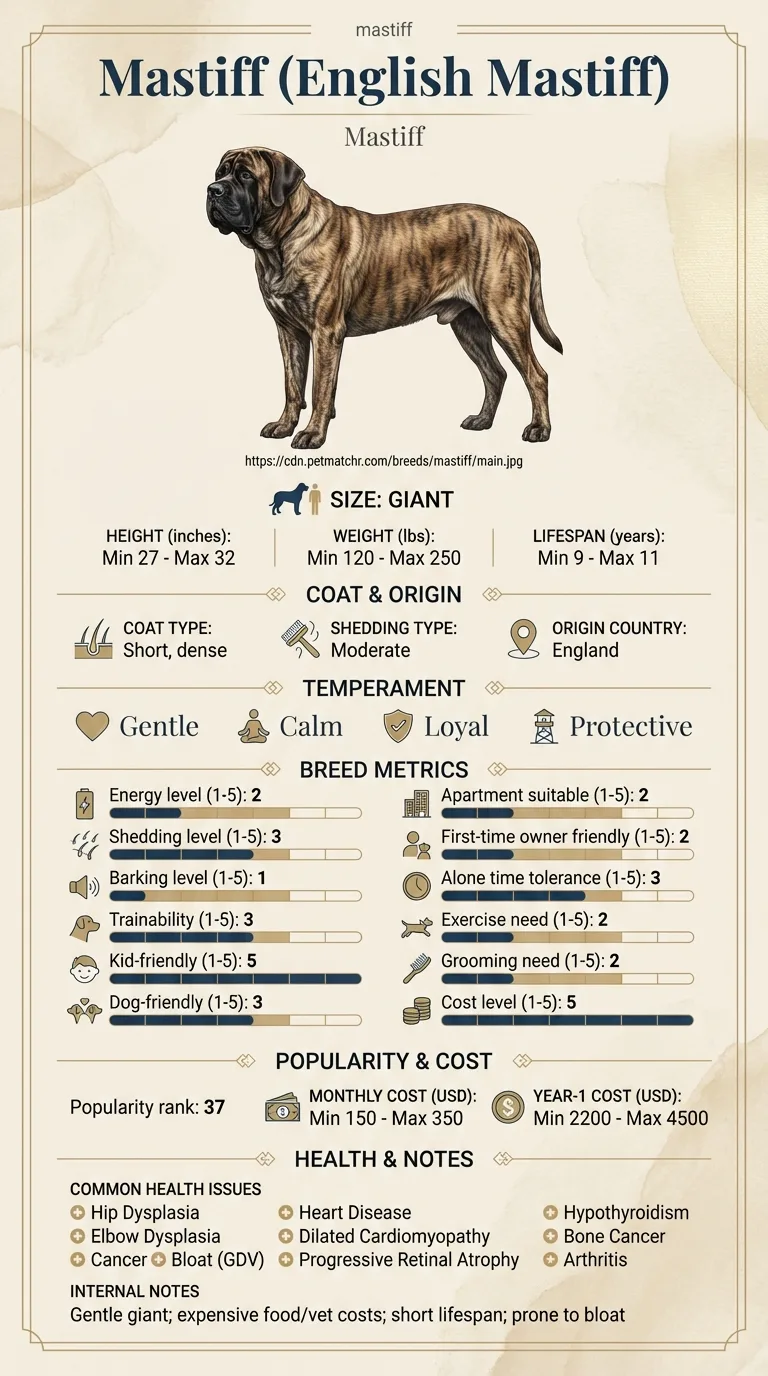
Bloat (GDV) is a genuine, well-documented emergency risk in this breed given its deep chest and giant size — no warning, immediate surgery needed. This breed's documented short lifespan, typically 9 to 11 years, also means health costs tend to arrive earlier and compound faster than in a longer-lived breed.
These figures reflect Iowa's below-national-average general pricing, with a note on the real, practical comfort value of typical yard access given this breed's genuine size.
Estimate · source: estimation · confidence: medium · updated 2026-10-06 · not a quote
| Item | Cost range |
|---|---|
One-time setup (large-breed crate, bed, initial vet visit, spay/neuter, gear) Covers the first exam, vaccinations, spay/neuter if needed, and giant-breed-sized gear — priced at Iowa's below-average rates. | $415 - $700 |
| Item | Cost range |
|---|---|
Food Genuinely among the highest food costs of any breed this site tracks, driven by this breed's documented 120-to-250-pound adult weight range; Iowa's below-average pricing helps somewhat. | $78 - $165 |
Each range starts from a national baseline for this breed's size class and is then adjusted for local cost of living and veterinary pricing. The baselines, and the source each one came from, are listed on our sources page (dataset 2026.09). Two inputs, the purchase price and the emergency reserve, have no published national figure we could verify, so we leave them to you rather than invent them.
These are planning estimates, not quotes. Your own numbers will move with the individual dog, your vet and your insurer. Build a budget with your own figures.
For a Mastiff in Des Moines, insurance is genuinely worth taking seriously given this breed's documented bloat risk, cancer risk and shorter lifespan, independent of the metro's favorable general cost of living.
This breed's real bloat and cancer statistics, combined with its shorter documented lifespan, make insurance a genuinely high-value purchase — buy while the dog is young, since costs and risk both climb faster here than in a longer-lived breed.
Skipping coverage is a reasonable call for an owner who's already set aside a substantial cash reserve sized specifically for this breed's real, larger-than-average emergency costs.
Des Moines' below-average costs help across the board, and typical yard access here is a genuine comfort bonus worth appreciating for this breed's size.
This breed's documented exercise need sits at the low end of the scale, so a yard here doesn't function the way it would for a breed that needs real room to run and play. What it does provide, given this dog's genuinely large size, is simple physical comfort: space to move between rooms and outdoor areas without feeling cramped, room to lie down fully stretched out, and an easy route outside without navigating narrow halls or stairs.
Des Moines' suburban housing pattern makes private yard access the norm rather than the exception, a real, practical fit for this breed's size-driven comfort needs even though its documented low exercise need means the yard isn't doing much active work.
That's on top of Iowa's genuinely below-average general cost of living, a real, straightforward advantage across food, routine vet care and grooming alike.

A Des Moines family worried their new Mastiff wouldn't get enough exercise from their modest backyard, having read general advice aimed at higher-energy breeds. The dog, true to its documented low-energy temperament, mostly used the space to stretch out fully in the shade rather than run around, genuinely content simply having room to move without feeling cramped indoors. The family came to appreciate the yard as a comfort feature rather than an exercise requirement.
Key takeaway: In Des Moines specifically, this breed's real yard-access comfort needs are about space and ease, not exercise, a genuine distinction worth understanding before assuming a yard means an active routine.
About $140–$305, below the national average for this breed, consistent with Iowa's generally lower cost of living.
Roughly $2,100–$4,000, including the initial vet exam, spay/neuter if needed, and gear on top of ongoing monthly costs.
Not for exercise specifically, but real yard access still provides genuine comfort given this breed's large size, room to move and stretch out without feeling cramped, which Des Moines' typical suburban housing pattern offers as the norm.
Genuinely, yes — Iowa's below-average general cost of living applies across food, routine vet care and grooming, among the more affordable markets this site tracks for this breed.
Especially worth pricing out given this breed's documented bloat risk, cancer risk and shorter lifespan, bought while the dog is young and before anything is on record.
Around $900 covers a typical significant vet visit in this market, reflecting both Des Moines' below-average pricing and this breed's genuinely larger dosing and procedure costs.
About $140–$305/month, $2,100–$4,000 for year one — below average for this breed, where real yard access provides genuine comfort even though this breed's exercise need stays low regardless.
This guide is not medical advice. If your dog shows pain, sudden behavior change, or worsening symptoms, consult a licensed veterinarian.
Some links may be affiliate links. We may earn a commission at no extra cost to you. We only suggest products we believe are helpful for dog owners.
We research and check what we publish, but we do not warrant that any figure, date, price, or statement is accurate, complete, or current, and we accept no liability for any loss, cost, injury, or other harm arising from the use of this site. Use it as one reference among several. You remain responsible for your own decisions and for your dog's care - confirm anything that matters with a licensed veterinarian or another qualified professional before you act on it. Full disclaimer.
One sheet with every line item, the emergency fund and when insurance pays off - unlocks on this page.
You get: 12-month budget sheet
No spam. One-click unsubscribe. See our privacy policy.
See a sample page before you decide.