Health
Which eye signs mean go now?
A squinting or closed eye, a cloudy blue haze with redness and pain, a pupil that has changed size or stopped responding, or sudden blindness. All need same-day care.

Quick answer
Which eye signs mean go now?
A squinting or closed eye, a cloudy blue haze with redness and pain, a pupil that has changed size or stopped responding, or sudden blindness. All need same-day care.
If your Mastiff is holding an eye shut, it is painful. Painful eyes do not wait until Monday.
Owners looking at a red, weepy, cloudy or half-closed eye right now and deciding whether it is an emergency, plus owners of an older Mastiff whose vision seems to be changing.
This guide is not medical advice. If your dog shows pain, sudden behavior change, or worsening symptoms, consult a licensed veterinarian.
Some links may be affiliate links. We may earn a commission at no extra cost to you. We only suggest products we believe are helpful for dog owners.
Eye disease in Mastiffs spans two quite different categories. Surface and pressure problems — corneal ulcers, eyelid conformation faults, raised intraocular pressure — are painful, move fast and are frequently emergencies. Internal degenerative disease, principally progressive retinal atrophy which is documented in this breed, is painless and slow but untreatable. Knowing which category you are looking at determines whether you drive to a clinic tonight or book an appointment.
Progressive retinal atrophy appears explicitly on the Mastiff's documented health issue list. Eyelid conformation problems are recognised across heavy-headed breeds with loose facial skin, and corneal injuries occur in any dog. Most Mastiffs will have at least one eye issue examined during a nine-to-eleven-year life, and the majority of those will be surface problems rather than blinding disease.
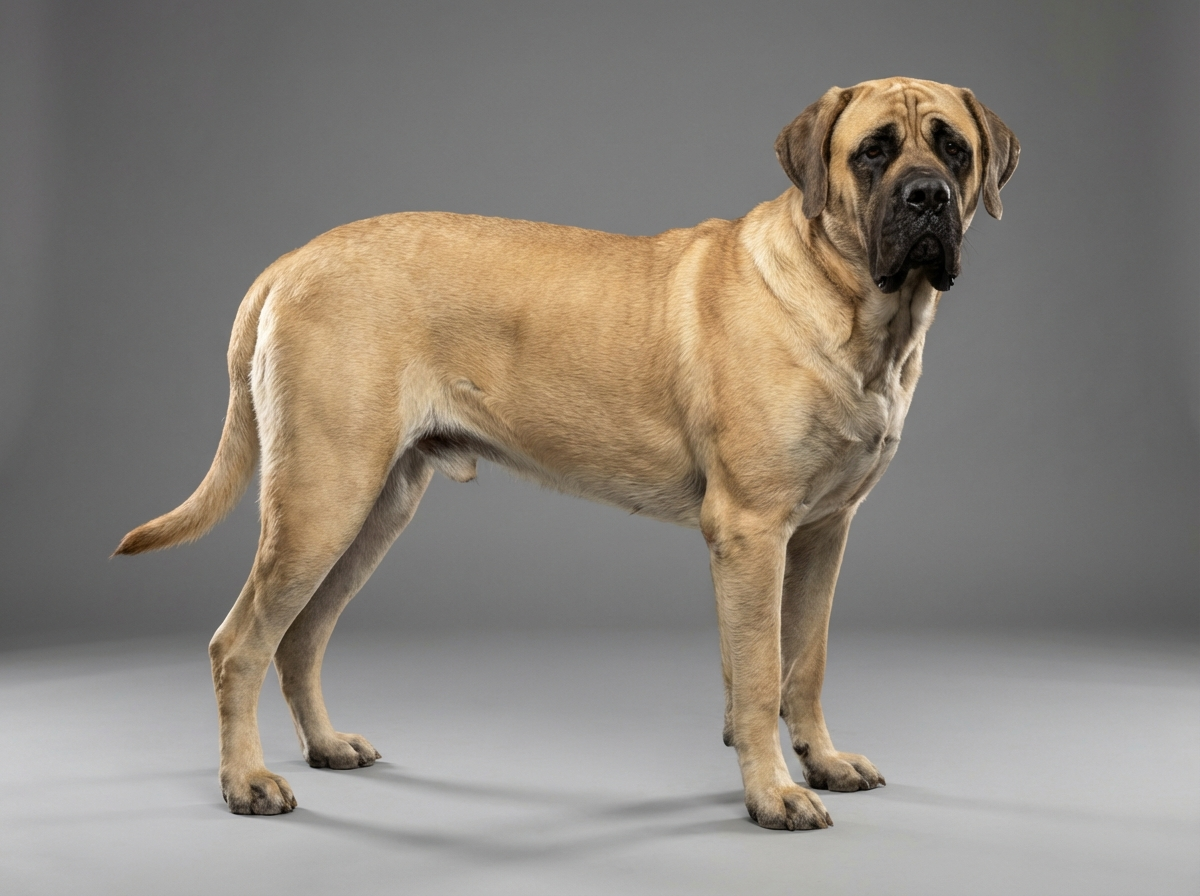
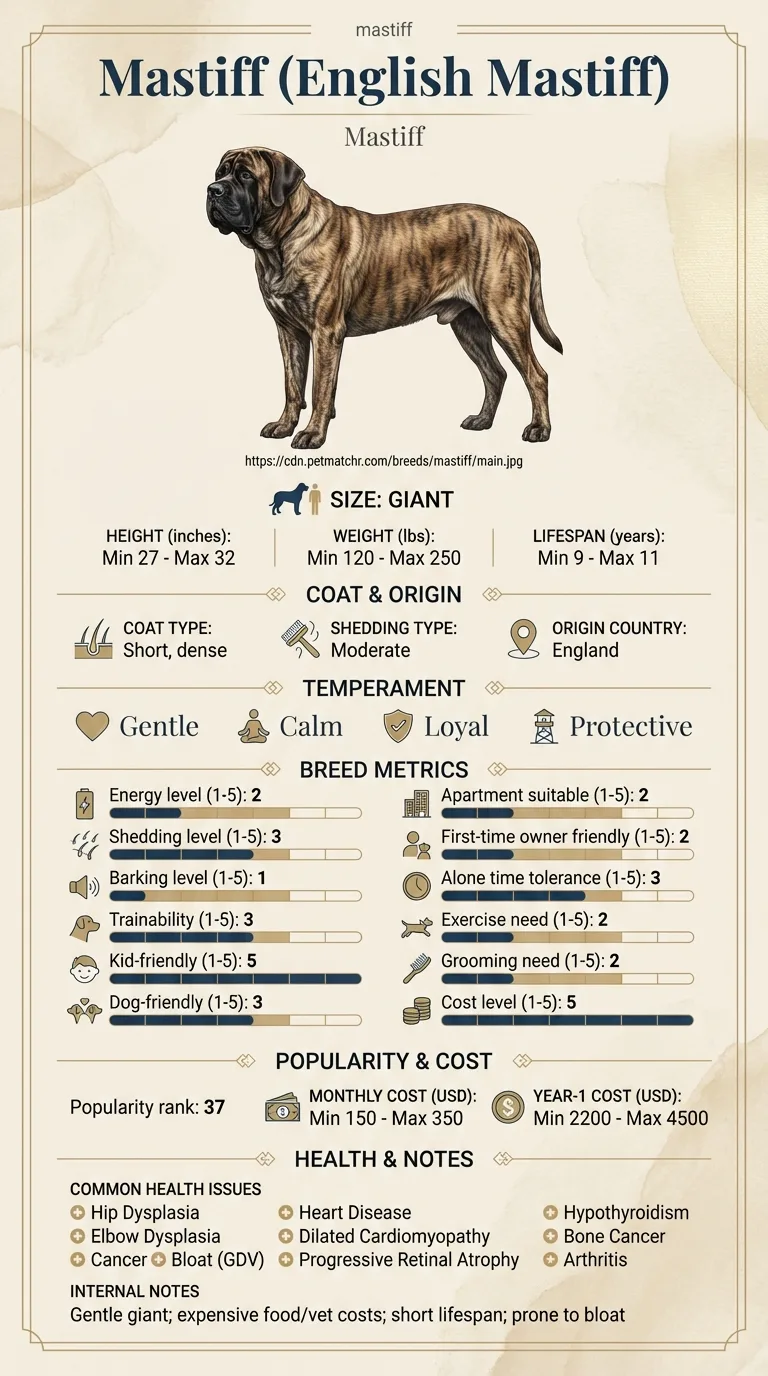
The Mastiff's head is the relevant feature. This is a heavy-boned breed with a broad skull and substantial loose facial skin, and breeds built this way are more prone to eyelids that do not sit flush against the eye, allowing lashes to rub the cornea or leaving the surface exposed. The head's size and the dog's height of 27 to 32 inches also mean the eyes travel at exactly the level of undergrowth and branches on a walk. Separately, progressive retinal atrophy is documented among the breed's health issues, which is an inherited problem unrelated to head shape.
Where a dog walks matters. Long grass, hedgerows and brambles at eye height account for a large share of corneal injuries. Dusty or windy conditions dry an exposed corneal surface. At home, a dog allowed to rub at an irritated eye against carpet or furniture converts a superficial problem into a deep one within hours, which is why a buster collar is one of the more useful things an owner can have in the cupboard. Delayed presentation is the other major factor, since almost every painful eye condition worsens with time untreated.
Go to a clinic the same day, including out of hours, for a squinting or closed eye, a red and painful eye, a cornea that has turned cloudy or blue, a visible ulcer or defect on the surface, a pupil that has changed size or stopped responding to light, blood in the eye, an eye that looks larger than the other, or sudden loss of vision. Do not wait overnight on any of these. Book within a day or two for persistent discharge, mild redness without pain, excess tearing, or gradual lens clouding in an older dog. Ask for referral to a veterinary ophthalmologist if a surface problem keeps recurring, since that pattern usually means an underlying eyelid fault.
See all Mastiff health problems, which breeds are prone to ocular disease, or the full Mastiff breed guide for temperament, exercise needs and ownership costs.
A simple corneal ulcer treated promptly usually heals within five to seven days with medication and a collar. Deeper or complicated ulcers take weeks and sometimes surgery. Eyelid correction surgery involves a recovery of around two weeks and is generally definitive. Progressive retinal atrophy runs over months to years and cannot be halted; the timeline is one of adaptation rather than treatment. Raised intraocular pressure is measured in hours, which is why it heads the triage list.
For surface problems, success is a comfortable eye with a clear cornea and no recurrence, which usually means any underlying eyelid fault was corrected rather than medicated repeatedly. For retinal degeneration, success looks entirely different: a dog who navigates the house confidently, is not startled or anxious, and continues to enjoy walks on familiar routes. Dogs adapt to gradual blindness far better than their owners expect, particularly a calm, steady breed like this one, and a blind Mastiff living well is a genuine success rather than a compromise.
Work through these in order. The first four are reasons to go now rather than to book an appointment.
Two things about the Mastiff are genuinely relevant, and it is worth separating them from claims that get attached to giant breeds generally.
The first is eyelid conformation. Mastiffs are a heavy-headed breed with substantial loose facial skin, and breeds built this way are more prone to eyelids that do not sit cleanly against the eye. An eyelid rolling inward turns eyelashes and haired skin against the cornea, producing constant irritation, tearing and eventually ulceration. An eyelid that droops outward leaves the surface poorly protected and prone to debris and drying. Both are structural and both are corrected surgically rather than managed with drops. Persistent tearing and recurrent conjunctivitis in a young Mastiff should prompt a proper look at eyelid position rather than repeated courses of medication.
The second is retinal disease. Progressive retinal atrophy appears explicitly among this breed's documented health issues. It is a gradual degeneration of the light-sensitive layer at the back of the eye, painless, affecting both eyes, and typically noticed first as difficulty in dim light. It cannot be treated, but it can be identified, and knowing it is the cause changes how you adapt the household.
Cataract also occurs in this breed. A cataract is a change in the lens itself and is a different thing from the mild bluish haze that most older dogs develop, which is a normal ageing change and affects vision far less.

Fenella's Mastiff, Osric, had a weepy left eye from the age of one. Over eighteen months he had four courses of drops from three different vets, each of which improved things for a fortnight before the discharge returned. The fifth time, Fenella asked to be referred. The ophthalmologist spent most of the consultation not on the eye surface but on the lid, and found the lower eyelid rolling inward along part of its length so a band of haired skin was in constant contact with the cornea. There was already a shallow area of scarring. The correction was a short surgery and two weeks in a buster collar. The discharge stopped and did not come back. What stayed with Fenella was the ophthalmologist's remark that the drops had all been reasonable treatments for the symptom, and that none of them could have fixed a lid that was the wrong shape.
Key takeaway: A surface eye problem that keeps returning after treatment is usually being caused by something structural. In a heavy-headed breed with loose facial skin, that something is very often the eyelid, and repeated courses of medication will keep working temporarily and failing permanently until the lid is looked at properly.
Do not wait if a clinic is available. Squinting means pain, and the causes range from a scratched cornea to raised pressure inside the eye. Corneal damage worsens quickly, particularly if the dog rubs at it, and a Mastiff's paw applied to its own face carries considerable force. Same-day assessment is the right call.
No. Some drops that are entirely safe for one condition can dramatically worsen another, particularly where a corneal ulcer or raised pressure is present. Using leftover medication before an examination also changes what the vet sees. If you need to do something while travelling, fit a buster collar to stop rubbing and go.
Look for hesitation in dim light first, since night vision is usually affected earliest in retinal degeneration. Then bumping into things in unfamiliar places, reluctance on stairs, startling when approached, and standing still in doorways. Dogs compensate remarkably well in familiar rooms, so vision loss is often much further advanced than owners realise.
No, and that is one of the few consolations. It is a painless degeneration that removes vision gradually, giving both dog and household time to adapt. Because it is documented in this breed, it should be on the list whenever an older Mastiff's night vision changes, and a specialist examination can confirm it.
It is a procedure to correct the position of an eyelid that rolls inward, removing a small amount of tissue so the lid sits properly. Where it is genuinely causing corneal irritation, it needs doing, because continued rubbing damages the cornea permanently. It is not cosmetic surgery; discuss the specifics with your vet or an ophthalmologist.
At every routine appointment as a minimum. If you are buying a puppy, ask whether the parents have had eye examinations by a specialist, since retinal disease is documented in the breed. For an adult with any history of eyelid or corneal problems, a specialist review is worth considering rather than relying on general practice alone.
A squinting or closed eye, a cloudy blue haze with redness and pain, a pupil that has changed size or stopped responding, or sudden blindness. All need same-day care.
No. Some drops badly worsen certain conditions, including corneal ulcers and raised pressure, and they change what the vet can see. Use a buster collar and go.
Loose facial skin can let eyelids roll inward or droop outward, so lashes rub the cornea or the surface is poorly protected. Both are corrected surgically, not with drops.
Difficulty in dim light. Night vision usually goes first, followed by bumping into objects in unfamiliar places and hesitation on stairs.
Not always. Most older dogs develop a normal bluish haze that affects vision little. A cataract is a different change in the lens and needs distinguishing by a vet.
A one-page prep sheet for this condition: the signs, the questions to ask, what to get priced. Unlocks here.
You get: Vet visit prep sheet
No spam. One-click unsubscribe. See our privacy policy.
Preview page 1 before you decide.