Health
How do I distinguish a seizure from a faint?
By the recovery. Seizures leave the dog confused and unsteady for minutes to hours; fainting is followed by normal behaviour within seconds.

Quick answer
How do I distinguish a seizure from a faint?
By the recovery. Seizures leave the dog confused and unsteady for minutes to hours; fainting is followed by normal behaviour within seconds.
Owners describe a dog that fell over. A neurologist wants to know whether it lost consciousness, and that one detail splits the diagnosis in half.
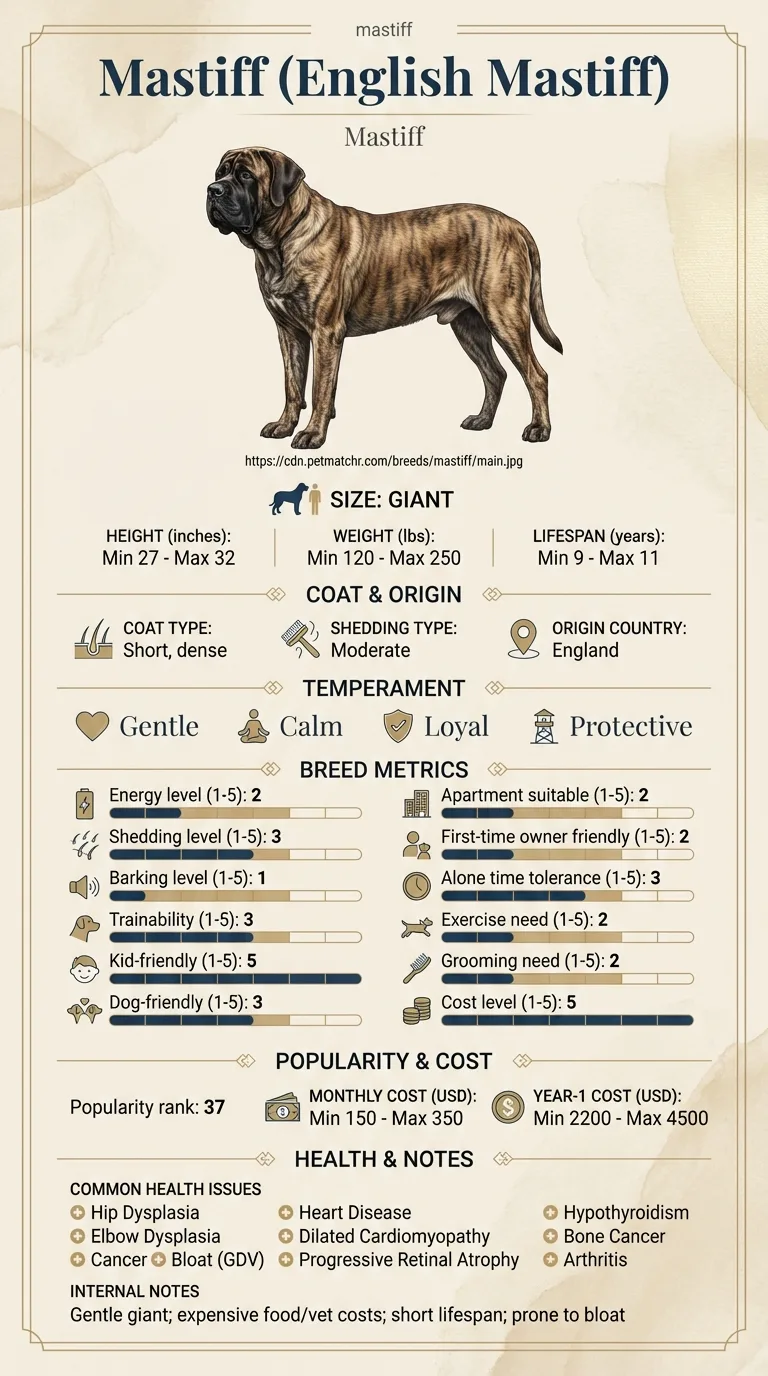
Owners of a Mastiff who has had an episode nobody can explain, or who has developed weakness, wobbliness or odd behaviour, and who need to describe it accurately enough to be useful.
This guide is not medical advice. If your dog shows pain, sudden behavior change, or worsening symptoms, consult a licensed veterinarian.
Some links may be affiliate links. We may earn a commission at no extra cost to you. We only suggest products we believe are helpful for dog owners.
We research and check what we publish, but we do not warrant that any figure, date, price, or statement is accurate, complete, or current, and we accept no liability for any loss, cost, injury, or other harm arising from the use of this site. Use it as one reference among several. You remain responsible for your own decisions and for your dog's care - confirm anything that matters with a licensed veterinarian or another qualified professional before you act on it. Full disclaimer.
Neurological disease covers any problem of the brain, spinal cord, nerves or muscle, and the first task is localisation rather than diagnosis. Owners typically present one of a handful of patterns — a seizure, a faint, a vestibular episode, gradual weakness or a behaviour change — and distinguishing between them shapes everything that follows. In giant breeds the spinal cord in the neck is a particularly common site.
Neurological signs are not among the conditions documented as characteristic of Mastiffs, but giant breeds are strongly associated with wobbler syndrome, and degenerative myelopathy affects older dogs of many large breeds. Cancer, which is documented in this breed, can also produce neurological signs when it affects the brain or spine.
Size shapes canine neurology more than most owners expect. Giant breeds are the population in which wobbler syndrome is concentrated, a condition arising from malformation or instability of the cervical vertebrae in a heavy dog whose neck supports a very large head. The Mastiff's proportions — 27 to 32 inches at the shoulder and 120 to 250 pounds — put it squarely in that group. Conversely the breed's normal limb proportions mean it lacks the chondrodystrophic trait behind small-breed disc disease. The nine-to-eleven-year lifespan also brings age-related neurological conditions forward into what feels like middle age.
Environment rarely causes neurological disease but frequently shapes how it presents and how well a dog copes. A very heavy dog with reduced coordination on polished floors falls repeatedly, which adds injury to the underlying problem. Walking on a neck collar rather than a harness loads the cervical spine directly in a breed where the neck is the vulnerable region. Excess weight worsens function in any dog with a spinal problem, and stairs or a high tailgate turn ordinary movement into a hazard once coordination is impaired.
Go to an emergency clinic immediately for a seizure lasting more than about five minutes, repeated seizures without recovery between them, a first seizure in a middle-aged or older Mastiff, sudden inability to stand, dragging limbs, loss of bladder or bowel control, sudden blindness, head pressing, or any collapse with laboured breathing. Book a prompt appointment for gradual gait change, scuffed hind nails, reluctance to lower the head, circling, or night-time pacing and disorientation. Mention any previous episode, however brief, and bring your video and log to the appointment.
See all Mastiff health problems, which breeds are prone to neurologic disease, or the full Mastiff breed guide for temperament, exercise needs and ownership costs.
Localisation by examination happens in a single consultation. Advanced imaging usually follows within two to six weeks depending on referral availability and on whether anaesthesia needs cardiac clearance first. Metabolic causes are often identified within days by bloodwork. Prognosis and timeline vary enormously by diagnosis: a vestibular episode may resolve substantially in a week, while degenerative myelopathy progresses over a year or more and wobbler syndrome is managed long term.
Success begins with an accurate localisation, because a treatable metabolic or compressive cause found early is a very different outcome from one missed while something else was investigated. For progressive spinal conditions, success is a dog who continues to walk, toilet independently and remain free of pain for as long as possible. Owners of a giant breed should also think honestly about what care they can physically provide, since a Mastiff who can no longer stand raises practical and quality-of-life questions best discussed with a veterinary team in advance rather than in crisis.
Getting these distinctions right in the history is genuinely valuable, because most episodes are over before anyone reaches a clinic.
The conditions that dominate canine neurology vary strikingly with body size, and a Mastiff sits in a distinct group.
Cervical spondylomyelopathy, usually called wobbler syndrome, is the archetypal giant-breed neurological disease. Instability or malformation in the neck vertebrae compresses the spinal cord, producing a wobbly, uncoordinated gait that is typically worse behind than in front, often with neck pain. It develops gradually and is one of the first things a neurologist considers in an unsteady Mastiff.
Degenerative myelopathy is the other major one: a progressive, notably painless loss of hind-limb coordination in older dogs, beginning with scuffed nails and a slight sway and advancing over many months.
Against those, the disc extrusions that dominate small-breed neurology are comparatively uncommon here, because Mastiffs lack the skeletal type that drives early disc calcification.
Brain disease is a different category. Seizures in a young adult often reflect a primary seizure disorder, while new-onset seizures in an older Mastiff raise more concern about a structural cause, and cancer is documented in this breed. Metabolic causes matter too, since liver and kidney disease can both produce neurological signs by allowing toxins to reach the brain.
All of which is why the neurologist's first act is a physical examination rather than an immediate scan.

If you think your Mastiff has neurologic disease, the plan is three steps: write down what you have seen and when it started, book a veterinary appointment rather than waiting for the next flare, and take video of the behaviour or symptom before you go — the thing you are worried about rarely happens in the consulting room. Screening in the parents covers hip dysplasia, elbow dysplasia, cancer.
What the vet visit should produce is a diagnosis and a written plan, not just reassurance: what is being ruled out, what the monitoring interval is, and which signs mean you come back sooner. Ask what the treatment costs across a year rather than per visit, because that is the number that decides whether you are managing this condition or reacting to it.
Between appointments, keep a short log — dates, what you saw, what changed. It is the single most useful thing an owner brings to a follow-up, and for neurologic disease it is often what separates a clear pattern from a guess.
Sorley's Mastiff, Nessa, had two frightening episodes six weeks apart. Both times she went down suddenly in the garden. Both times Sorley described her as having a fit. On the third occasion his daughter filmed it on her phone. Nessa dropped, was still for about eight seconds, then got straight up and walked off to drink from her bowl. There was no paddling, no drooling and no confused period afterwards. The neurologist watched twelve seconds of that video and redirected the whole investigation. This was not a seizure but a faint, and fainting in a seven-year-old Mastiff points at the circulation. A cardiology referral and a twenty-four hour rhythm monitor found runs of an abnormal heart rhythm, several of them at night. Nessa went onto cardiac medication rather than anti-seizure medication. The episodes stopped.
Key takeaway: The word owners reach for is usually seizure, and it is often wrong. Whether the dog was aware, and how quickly it returned to normal, decides whether the investigation heads toward the brain or the heart, and twelve seconds of phone footage answered it better than three consultations had.
Look at the recovery. After a seizure most dogs are disoriented, restless or unsteady for a period ranging from minutes to hours. After a faint the dog typically gets up and behaves entirely normally within seconds. Loss of bladder control and paddling limbs also favour a seizure, though neither is absolutely reliable.
A single brief seizure in a dog who then recovers normally should be seen promptly but is not usually an emergency. Go immediately for a seizure lasting more than about five minutes, for repeated seizures without full recovery in between, or for a first seizure in a middle-aged or older Mastiff, since a structural cause is more likely in that age group.
Pushing the head against a wall or furniture and holding it there is a recognised sign of forebrain disease and is frequently associated with toxins circulating from liver dysfunction. It is not a quirk and should never be ignored. Any dog head pressing needs veterinary assessment without delay.
Because pain separates several conditions. Wobbler syndrome and disc compression are often painful, while degenerative myelopathy characteristically is not. In a stoic breed like the Mastiff, pain can be subtle, so vets look for indirect signs: eating from a raised bowl by choice, reluctance to turn the head, or tension on spinal palpation.
Often, for spinal or brain disease, because these structures show poorly on plain radiographs. MRI requires general anaesthesia, which in a giant breed of middle age deserves its own conversation, particularly if cardiac status is unknown. Localising the problem by examination first reduces the amount of scanning needed.
Sometimes, and they are usually done early because the treatable metabolic causes are worth excluding cheaply before anaesthesia. Liver and kidney dysfunction, electrolyte disturbances and low blood sugar can all produce neurological signs. Ruling those in or out changes the plan considerably.
By the recovery. Seizures leave the dog confused and unsteady for minutes to hours; fainting is followed by normal behaviour within seconds.
Wobbler syndrome, a compression of the spinal cord in the neck producing a wobbly gait that is usually worse behind than in front, often with neck pain.
Yes. Pressing the head against a wall and holding it is a recognised sign of forebrain disease and needs veterinary assessment without delay.
If it lasts more than about five minutes, if seizures repeat without full recovery between them, or if it is a first seizure in a middle-aged or older dog.
Whether the dog was aware, how long it lasted, what the limbs did, and how long recovery took. Video is more useful than any description.
A one-page prep sheet for this condition: the signs, the questions to ask, what to get priced. Unlocks here.
You get: Vet visit prep sheet
No spam. One-click unsubscribe. See our privacy policy.
Preview page 1 before you decide.