Living
Which is the giant breed?
The Mastiff, spanning 120-250 lbs versus the Shar-Pei's 45-60 lbs.

Quick answer
Which is the giant breed?
The Mastiff, spanning 120-250 lbs versus the Shar-Pei's 45-60 lbs.
Chinese Shar-Pei or Mastiff (English Mastiff)? On paper they differ most on apartment suitability, and on the scales Mastiff (English Mastiff) is the heavier at 120–250 lbs. Here is how the two compare on everything that shapes an ordinary week.
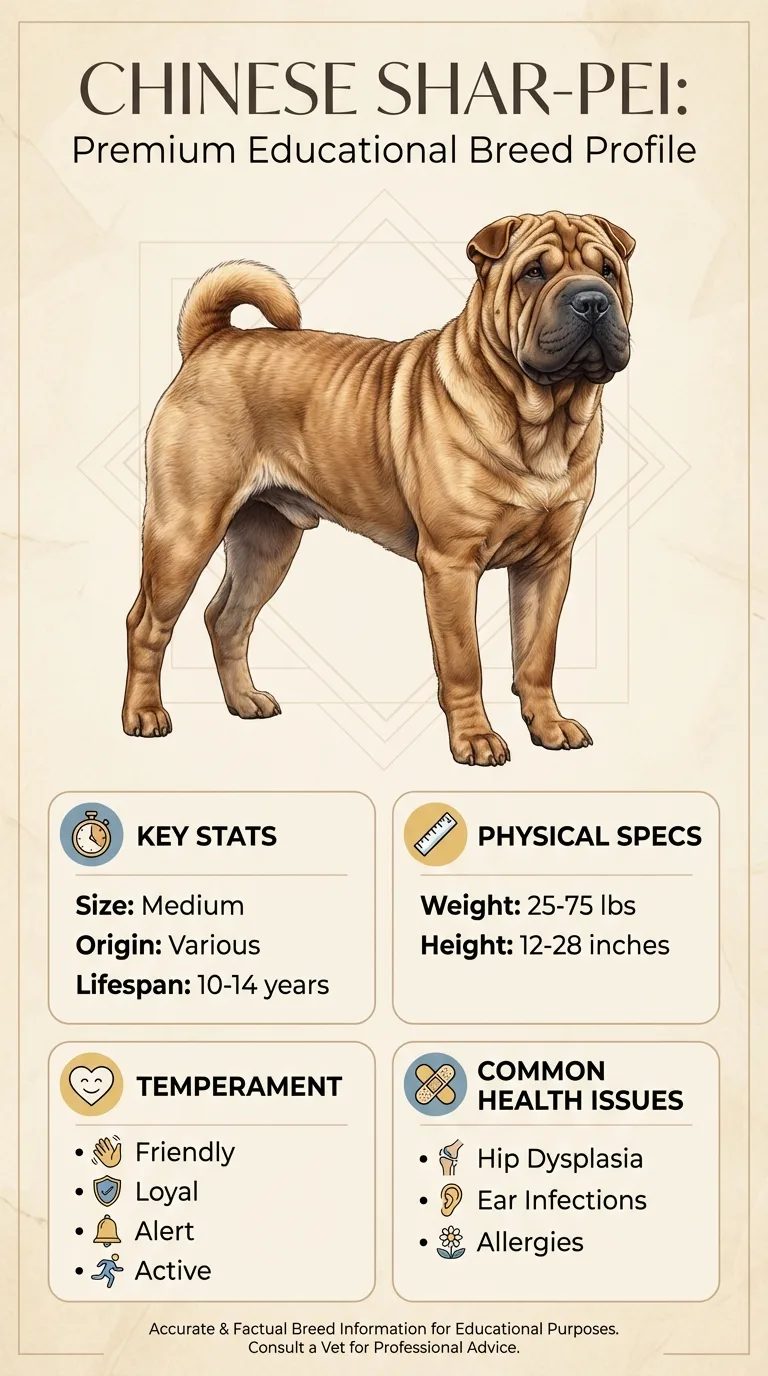
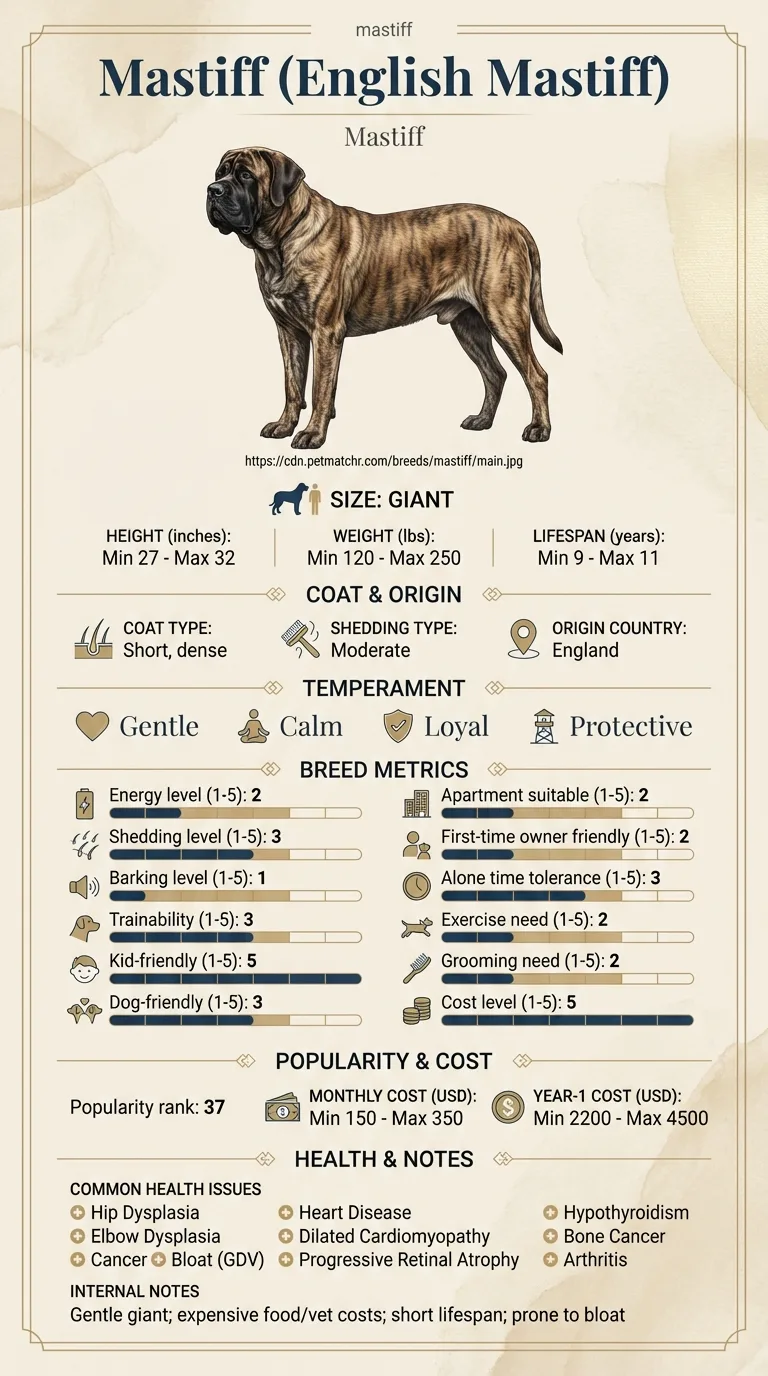
This is for someone already down to Chinese Shar-Pei and Mastiff (English Mastiff) and deciding between them. For this pair the decision usually turns on apartment suitability and good with kids, so those are covered first and in most detail. Anyone choosing from a flat has a clear answer here: Chinese Shar-Pei rates 4/5 against 2/5. Breed history is left out; what follows is what you will actually live with.
Between Chinese Shar-Pei and Mastiff (English Mastiff), apartment suitability is what separates them, and Chinese Shar-Pei is the lower-effort dog of the two to keep.
Choose Chinese Shar-Pei if you are in a flat or a smaller home, shedding is a problem in your house and a smaller dog suits your car, your home or your back.
Choose Mastiff (English Mastiff) if there are young children at home, you already have another dog and you want a dog that picks up training quickly.
| Feature | chinese shar pei | mastiff | Winner |
|---|---|---|---|
| Size class | medium | giant | Equal |
| Weight | 45–60 lbs | 120–250 lbs | Equal |
| Height | 18–20 in | 27–32 in | Equal |
| Lifespan | 8–12 years | 9–11 years | Equal |
| Exercise need | Low (2/5) | Low (2/5) | Equal |
| Grooming need | Low (2/5) | Low (2/5) | Equal |
| Shedding | Low (2/5) | Moderate (3/5) | chinese shar pei |
| Energy level | Low (2/5) | Low (2/5) | Equal |
| Barking | Low (2/5) | Very low (1/5) | mastiff |
| Apartment suitability | High (4/5) | Low (2/5) | chinese shar pei |
| Good for first-time owners | Low (2/5) | Low (2/5) | Equal |
| Tolerates being alone | Moderate (3/5) | Moderate (3/5) | Equal |
| Trainability | Low (2/5) | Moderate (3/5) | mastiff |
| Good with kids | Moderate (3/5) | Very high (5/5) | mastiff |
| Good with other dogs | Low (2/5) | Moderate (3/5) | mastiff |
| Friendly to strangers | Low (2/5) | Moderate (3/5) | mastiff |
| Cost level | High (4/5) | Very high (5/5) | chinese shar pei |
| Coat | Short and harsh | Short, dense | Equal |
| Origin | Various | England | Equal |
| Typical monthly cost | $100–$200 | $150–$350 | Equal |
| Typical first-year cost | $1,400–$2,900 | $2,200–$4,500 | Equal |
Set side by side, an English Mastiff can weigh four times as much as a Chinese Shar-Pei — 120 to 250 pounds against 45 to 60 — and stands a foot taller at 27 to 32 inches versus 18 to 20. The size classes alone tell the story: medium against giant. Where the Shar-Pei carries its bulk in dense, wrinkled folds over a compact frame, the Mastiff is simply massive, built with a huge head and heavy bone structure. Furniture, doorways, and car trunks all need to be sized for the bigger dog; a Mastiff that leans against a person can knock a small child over without meaning to.
These two are an unusually close match on activity — both rate Low, 2/5, for exercise need and Low, 2/5, for energy level. Neither breed asks for a jogging partner, and both are prone to long naps between short walks. The similarity is coincidental rather than a shared history: the Shar-Pei's low drive comes from its compact, guarding-dog build, while the Mastiff's comes from sheer mass making sustained activity impractical. Owners drawn to a low-key, couch-oriented dog will find either breed cooperative on this front, though the Mastiff's size means even a slow walk covers more ground per stride.
Grooming demands tie at Low, 2/5, for both breeds — neither has a coat that requires trims, styling, or elaborate brushing routines. Shedding is where they part ways: the Shar-Pei's short, harsh coat sheds at a Low 2/5 rate, while the Mastiff's short, dense coat sheds a step more, Moderate 3/5. In practical terms that means more fur on the floor and furniture with the Mastiff, simply because there's more dog generating it, even though per-inch the coats aren't wildly different. Neither breed suits an owner chasing a fur-free home, but the Shar-Pei comes closer.
Apartment living clearly favors the Shar-Pei, rated High, 4/5, versus the Mastiff's Low, 2/5 — a giant breed simply needs more floor space to turn around and sprawl. Ironically, the Mastiff is the quieter of the two: Very Low, 1/5, barking compared to the Shar-Pei's already-modest Low, 2/5. Both tolerate solitude equally well, Moderate 3/5. So a small-space owner gets a real tradeoff: pick the Shar-Pei for square footage and accept slightly more barking, or find room for a Mastiff and get near-silence in exchange for a dog that needs a much bigger footprint to live comfortably.
Neither breed is billed as ideal for a first-time owner — both rate Low, 2/5, on that measure — but the Mastiff edges ahead on trainability, Moderate 3/5 against the Shar-Pei's Low 2/5. Both share loyal, calm temperaments, though the Shar-Pei's profile adds independent and reserved while the Mastiff's adds gentle and protective. In practice, the Mastiff's protective streak paired with its sheer size makes early obedience and leash training non-negotiable — a giant dog that pulls is a genuine safety issue — while the Shar-Pei's stubbornness is more about patience than physical risk. Either dog rewards an owner who has trained a strong-willed breed before.
The Mastiff outperforms the Shar-Pei across every household-fit metric here: Very High, 5/5, with kids against Moderate 3/5, Moderate 3/5 with other dogs against Low 2/5, and Moderate 3/5 friendliness to strangers against Low 2/5. Despite its intimidating size, the Mastiff's gentle, protective nature makes it one of the more forgiving giant breeds around children, provided its bulk is supervised around toddlers. The Shar-Pei, true to its guard-dog ancestry, stays more reserved with unfamiliar people and other dogs, which suits a household that isn't constantly hosting guests or managing a multi-pet pack.
Lifespans sit close, 8 to 12 years for the Shar-Pei against 9 to 11 for the Mastiff, but the health pictures diverge sharply in scope. The Shar-Pei's five conditions center on its skin and folds — Skin Fold Dermatitis, Entropion, Familial Shar-Pei Fever — plus Hypothyroidism and Ear Infections. The Mastiff's list of ten is a giant-breed roster: Hip and Elbow Dysplasia, Bloat (GDV), Cancer, Bone Cancer, and cardiac issues including Heart Disease and Dilated Cardiomyopathy. Both share Hypothyroidism. Giant-breed owners should note Bloat is a genuine emergency risk that calls for slow feeding and monitored mealtimes, a concern the Shar-Pei simply doesn't carry.
The Mastiff is the more expensive dog to keep on every measure: a Very High, 5/5, overall cost rating against the Shar-Pei's already-steep High, 4/5. Monthly costs run $150 to $350 for the Mastiff versus $100 to $200 for the Shar-Pei, and first-year totals reach $2,200 to $4,500 for the Mastiff compared with $1,400 to $2,900. Food alone explains much of the gap — a 200-pound dog eats far more than a 55-pound one — and the Mastiff's giant-breed health risks like Bloat and cardiac disease add the potential for larger emergency vet bills down the line.
Chinese Shar-Pei weighs 45–60 lbs and lives 8–12 years; Mastiff (English Mastiff) weighs 120–250 lbs and lives 9–11 years. The two diverge most on apartment suitability and good with kids. They are level on tolerates being alone, energy level and exercise need, so those cannot decide it. The comparison marks an easier option only where one exists. Facts like weight and country of origin are not scored. Both dogs are rated from the same dataset, which is what makes the numbers comparable with each other even though any individual dog sits somewhere inside its breed's range.

The Mastiff, by a wide margin — 120 to 250 pounds against the Shar-Pei's 45 to 60 pounds, more than four times the weight at the upper end.
The Mastiff, rated Very High (5/5) with kids compared to the Shar-Pei's Moderate (3/5), though its size still calls for supervision around small children.
The data agrees — Mastiffs rate Low (2/5) for apartment suitability against the Shar-Pei's High (4/5), reflecting how much floor space a giant breed needs.
The Mastiff, at Very Low (1/5) barking, is notably quieter than the Shar-Pei's already-modest Low (2/5).
Expect roughly $2,200 to $4,500, compared with $1,400 to $2,900 for a Shar-Pei — driven largely by food volume and giant-breed vet costs.
Neither scores well — both rate Low (2/5) for first-time owner suitability, though the Mastiff is slightly more trainable at Moderate (3/5).
Bloat (GDV), a life-threatening emergency common in deep-chested giant breeds, which doesn't appear on the Shar-Pei's health list at all.
The Mastiff, spanning 120-250 lbs versus the Shar-Pei's 45-60 lbs.
The Mastiff, at Very Low (1/5) barking.
The Shar-Pei, with a High (4/5) cost rating versus the Mastiff's Very High (5/5).
The Mastiff, rated Very High (5/5) versus Moderate (3/5).
Secure checkout on Stripe. We never see your card.
7-day money-back guarantee. Instant access.
Health information here is general and is not veterinary advice. If your dog shows pain, sudden behaviour change, or worsening symptoms, consult a licensed veterinarian.
Some links on this site are affiliate links. We may earn a commission at no extra cost to you, and we only suggest products we believe are helpful for dog owners.
We research and check what we publish, but we do not warrant that any figure, date, price, or statement is accurate, complete, or current, and we accept no liability for any loss, cost, injury, or other harm arising from the use of this site. Use it as one reference among several. You remain responsible for your own decisions and for your dog's care - confirm anything that matters with a licensed veterinarian or another qualified professional before you act on it. Full disclaimer.
Match your lifestyle to the right dog.
Take quizNot sure which breed is right for you? Take our 2-minute quiz to find out.
Take the quiz