Health
Do Mastiffs have a genetic tendency to overeat?
A related gene variant is documented mainly in Labradors, but many Mastiff owners report similarly strong food-seeking behavior regardless of the exact cause.

Quick answer
Do Mastiffs have a genetic tendency to overeat?
A related gene variant is documented mainly in Labradors, but many Mastiff owners report similarly strong food-seeking behavior regardless of the exact cause.
A dog that always acts hungry isn't necessarily being manipulative - some dogs may be working against a genuinely stronger internal hunger signal.
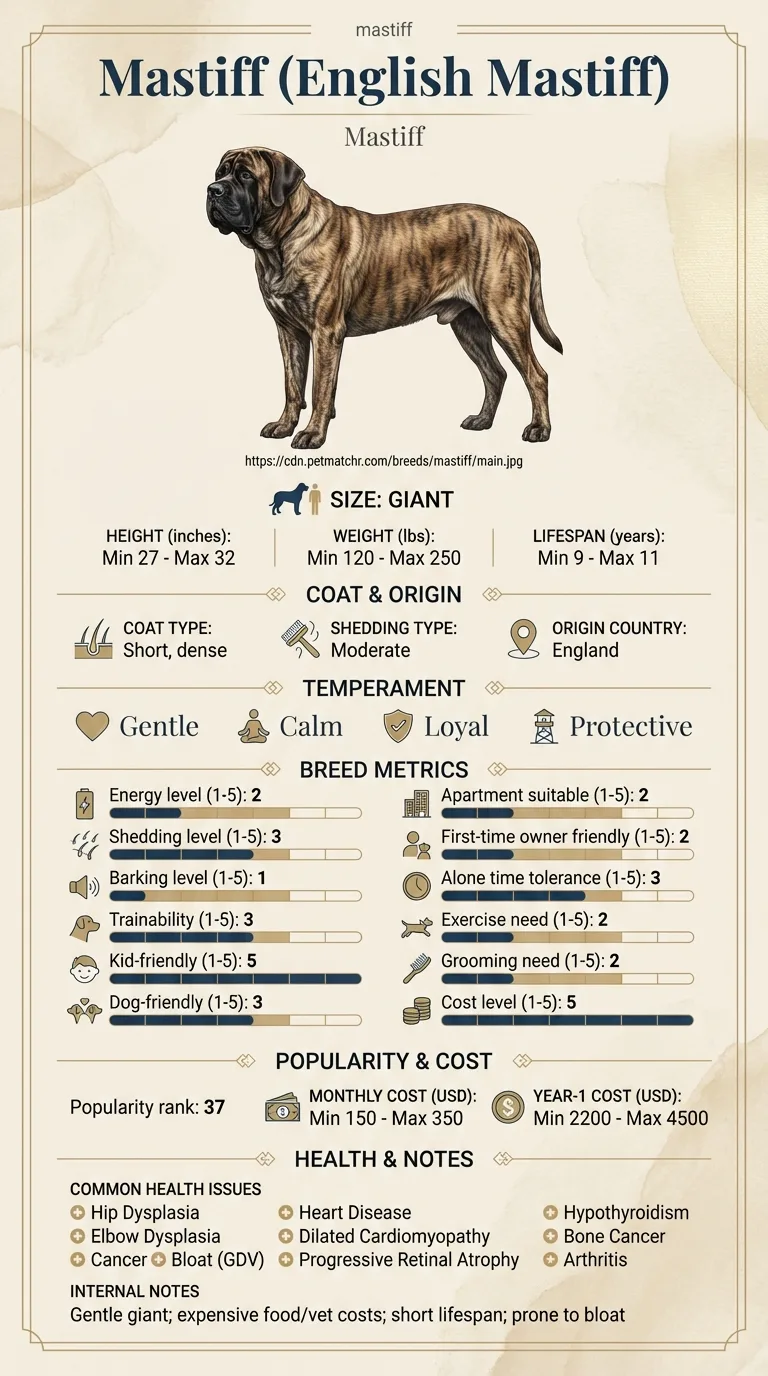
This affects owners whose Mastiff seems to beg, scavenge, or act distressed around food far more than seems proportionate to its actual caloric needs, and who are trying to manage weight without constant conflict at every meal.
This guide is not medical advice. If your dog shows pain, sudden behavior change, or worsening symptoms, consult a licensed veterinarian.
Some links may be affiliate links. We may earn a commission at no extra cost to you. We only suggest products we believe are helpful for dog owners.
We research and check what we publish, but we do not warrant that any figure, date, price, or statement is accurate, complete, or current, and we accept no liability for any loss, cost, injury, or other harm arising from the use of this site. Use it as one reference among several. You remain responsible for your own decisions and for your dog's care - confirm anything that matters with a licensed veterinarian or another qualified professional before you act on it. Full disclaimer.
Some dogs appear to carry a stronger genetic drive toward food-seeking behavior and a weaker internal sense of fullness, a pattern most clearly documented through a specific gene variant in Labrador Retrievers. Regardless of whether an identical mechanism is confirmed in Mastiffs, the practical concern for this breed is the same: a persistently food-motivated giant dog is at real risk of weight gain that compounds its existing joint and cardiac vulnerabilities.
Persistent, hard-to-satisfy hunger behavior is a common complaint among owners of large, food-driven breeds generally, and giant breeds with a documented tendency toward weight gain are no exception, even without a confirmed breed-specific genetic marker.
Regardless of the precise genetic mechanism, this breed's very large frame means even modest excess weight translates into substantial extra load on joints already at risk for hip and elbow dysplasia and arthritis, and added strain on a cardiovascular system already carrying documented heart disease risk. A strong food drive combined with that physical vulnerability makes weight management a higher-stakes issue here than in a smaller or less joint-vulnerable breed.
Households with inconsistent portion control, frequent treats, access to other pets' food, or a lower-activity routine due to the breed's naturally lower energy level all make it easier for a persistently hungry-acting dog to gradually gain weight without anyone noticing until it's become significant.
Talk to your vet if hunger behavior seems extreme, distressed, or paired with other symptoms, or if you're unsure whether current portions are appropriate for your dog's age, activity level, and body condition. A vet can also advise on whether genetic testing for known appetite variants is worth pursuing.
See all Mastiff health problems, which breeds are prone to genetic predisposition to obesity, or the full Mastiff breed guide for temperament, exercise needs and ownership costs.
Weight management in a giant breed is typically gradual - a safe, sustainable loss rate is measured in months, not weeks, to avoid stressing joints further during the process. Appetite drive itself doesn't disappear, but the behavior around it can be managed within a few weeks of consistent routine.
Success looks like a stable, healthy body condition maintained through structured feeding, not a dog that stops acting food-motivated altogether - for some dogs, that drive may simply be part of their baseline temperament.
The clearest documented finding here comes from work on a specific gene variant affecting appetite regulation, identified first and most robustly in Labrador Retrievers and a few related breeds, where affected dogs showed measurably stronger food-motivated behavior and higher obesity risk independent of how much they were actually fed. Similar appetite-regulation genetics are an active area of research across other breeds, including giant breeds, but a Mastiff-specific finding shouldn't be assumed just because the general biology is plausible.
What's not in question is the practical outcome for this breed regardless of the exact genetic mechanism: a large frame carrying extra weight puts significant additional load on joints already at risk for dysplasia and arthritis, and on a heart already carrying documented disease risk. The stakes of unmanaged weight gain are real here whether or not a specific gene is ever confirmed as the cause.
Managing a strong appetite drive in a giant breed takes a different approach than simply restricting food.

Diane's Mastiff Biscuit would finish a full meal and immediately act as though he hadn't eaten in days - pacing near the pantry, staring at the trash can, even nosing at Diane's own plate. She'd started quietly increasing his portions out of guilt, worried he was genuinely underfed despite following the feeding guide on the bag. A vet visit and a body condition check told a different story: Biscuit was already at a healthy weight, and increasing his food further would push him into the range that put real strain on his joints. Instead of more food, the vet suggested restructuring how he ate - three smaller meals instead of two, a slow-feed bowl, and a cup of plain green beans mixed in for volume. Biscuit still acts hungry between meals most days. Diane's stopped treating that as a problem to solve and started treating it as just part of who he is, managing his weight through structure rather than trying to make the hunger itself go away.
Key takeaway: A dog can be genuinely, persistently food-motivated and still be at a healthy weight - the fix is usually structure around eating, not simply feeding more to quiet the behavior.
A well-documented appetite-related gene variant has been identified mainly in Labrador Retrievers and some related breeds. Whether a specific variant exists in Mastiffs hasn't been established the same way, though similar appetite-drive behavior is reported by many owners regardless of the exact mechanism.
This can reflect a genuinely stronger internal hunger drive rather than manipulation or bad behavior. Some dogs' satiety signals appear to be less effective at telling the brain the stomach is full, leading to persistent food-seeking regardless of actual caloric need.
Yes, more so than for many breeds, because extra weight adds substantial load to joints already at documented risk for hip and elbow dysplasia and arthritis, and strains a cardiovascular system already carrying real heart disease risk.
Measure food by weight, use slow-feed bowls to extend mealtime, add vet-approved low-calorie bulk like plain vegetables, and count treats as part of the daily total rather than extras.
Reduce food only in consultation with your vet, since a persistently hungry dog on an already appropriate calorie intake needs a management strategy, not simple restriction, which risks nutritional gaps in a large-breed dog.
Some commercial genetic panels test for known appetite-related variants, though coverage and relevance can vary by breed. Discuss with your vet whether such testing would meaningfully change your dog's management plan before pursuing it.
A related gene variant is documented mainly in Labradors, but many Mastiff owners report similarly strong food-seeking behavior regardless of the exact cause.
Yes - extra weight significantly increases strain on joints and the heart, both already documented risk areas for this breed.
Slow-feed bowls, more frequent smaller meals, and vet-approved low-calorie bulk additions can extend satisfaction without adding excess calories.
Yes - treats should be counted as part of the total daily calorie allowance, not treated as separate from mealtime portions.
Not necessarily - it can reflect a genuinely stronger hunger drive rather than a trained or manipulative behavior.
A one-page prep sheet for this condition: the signs, the questions to ask, what to get priced. Unlocks here.
You get: Vet visit prep sheet
No spam. One-click unsubscribe. See our privacy policy.
Preview page 1 before you decide.