Costs
Mastiff cost in New York City
About $210–$440/month, $3,000–$5,500 for year one — among the highest this site tracks, with a real co-op board approval process worth preparing documentation for early.

See Mastiff price across all cities →
Quick answer
Mastiff cost in New York City
About $210–$440/month, $3,000–$5,500 for year one — among the highest this site tracks, with a real co-op board approval process worth preparing documentation for early.
A Mastiff (English Mastiff) in New York City costs about $210–$440 a month, with the first year around $3,000–$5,500 — among the highest this site tracks for this breed, in a market where co-op board approval for a dog this size often means a real, formal process: liability insurance proof, vet references and sometimes an in-person interview before move-in is even confirmed.
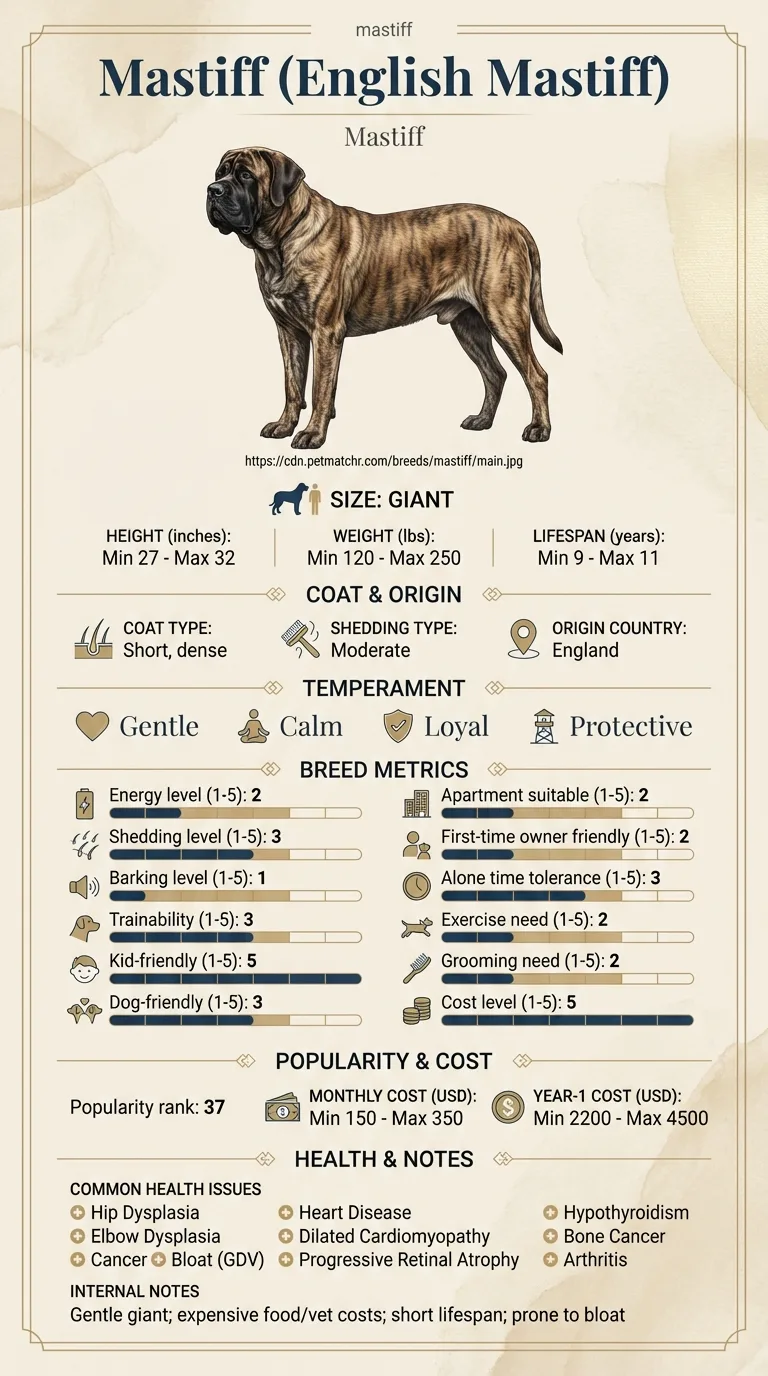
Bloat (GDV) is a genuine, well-documented emergency risk in this breed given its deep chest and giant size — no warning, immediate surgery needed. This breed's documented short lifespan, typically 9 to 11 years, also means health costs tend to arrive earlier and compound faster than in a longer-lived breed.
These figures reflect New York City's genuinely top-tier general pricing, with a real note on the co-op board documentation process this breed's size can trigger.
Estimate · source: estimation · confidence: medium · updated 2026-09-05 · not a quote
| Item | Cost range |
|---|---|
One-time setup (large-breed crate, bed, initial vet visit, spay/neuter, gear) Covers the first exam, vaccinations, spay/neuter if needed, and giant-breed-sized gear — priced at New York City's premium rates. | $535 - $910 |
| Item | Cost range |
|---|---|
Food Genuinely among the highest food costs of any breed this site tracks, driven by this breed's documented 120-to-250-pound adult weight range; New York City's premium pricing compounds it further. | $104 - $216 |
Each range starts from a national baseline for this breed's size class and is then adjusted for local cost of living and veterinary pricing. The baselines, and the source each one came from, are listed on our sources page (dataset 2026.09). Two inputs, the purchase price and the emergency reserve, have no published national figure we could verify, so we leave them to you rather than invent them.
These are planning estimates, not quotes. Your own numbers will move with the individual dog, your vet and your insurer. Build a budget with your own figures.
For a Mastiff in New York City, insurance is genuinely worth taking seriously on two fronts: pet health coverage given this breed's documented bloat and cancer risk, and liability coverage many co-op boards explicitly request.
This breed's real bloat and cancer statistics, combined with its shorter documented lifespan, make pet insurance a genuinely high-value purchase — buy while the dog is young, since costs and risk both climb faster here than in a longer-lived breed.
Skipping pet insurance is a reasonable call for an owner who's already set aside a substantial cash reserve sized specifically for this breed's real, larger-than-average emergency costs.
New York City's high costs call for real advance planning, especially around co-op board documentation.
New York City's co-op boards are genuinely known for thorough approval processes, and a dog this size can draw extra scrutiny well beyond a standard weight-limit line in the building's pet policy. Some boards ask for proof of liability insurance specific to dog ownership, written references from a veterinarian confirming good health and temperament, or an in-person meeting with the dog before finalizing approval.
That's a real, practical process worth researching and preparing documentation for well before a move date is set, since gathering vet references or securing a liability policy can genuinely take longer than expected under time pressure.
New York City's overall cost of living ranks among the highest this site tracks, showing up clearly in vet visit and boarding prices well above the national average, and apartment living without a yard makes professional dog-walking a routine, not occasional, expense here.

A New York City couple applying to a co-op building assumed their calm, well-trained Mastiff would breeze through approval, only to be asked for proof of liability insurance and a written reference from their veterinarian just days before their scheduled closing. Scrambling to gather both on short notice added real stress to an already tight timeline, a scramble they later realized could have been avoided by asking about the building's actual requirements up front.
Key takeaway: In New York City specifically, confirming a co-op board's real documentation requirements early is a genuinely worthwhile step given how often this breed's size draws extra scrutiny.
About $210–$440, among the highest this site tracks for this breed, reflecting New York City's genuinely premium general cost of living.
Roughly $3,000–$5,500, including the initial vet exam, spay/neuter if needed, and gear on top of ongoing monthly costs.
It varies by building, but real requirements can include proof of liability insurance, written veterinarian references, or an in-person interview with the dog, worth preparing for well before a move date.
Genuinely worth pricing out in advance — some boards request proof of coverage specifically, and having it ready avoids a real delay during a time-sensitive application.
Especially worth pricing out given this breed's documented bloat risk, cancer risk and shorter lifespan, bought while the dog is young and before anything is on record.
Around $1,325 covers a typical significant vet visit in this market, reflecting both New York City's high pricing and this breed's genuinely larger dosing and procedure costs.
About $210–$440/month, $3,000–$5,500 for year one — among the highest this site tracks, with a real co-op board approval process worth preparing documentation for early.
This guide is not medical advice. If your dog shows pain, sudden behavior change, or worsening symptoms, consult a licensed veterinarian.
Some links may be affiliate links. We may earn a commission at no extra cost to you. We only suggest products we believe are helpful for dog owners.
We research and check what we publish, but we do not warrant that any figure, date, price, or statement is accurate, complete, or current, and we accept no liability for any loss, cost, injury, or other harm arising from the use of this site. Use it as one reference among several. You remain responsible for your own decisions and for your dog's care - confirm anything that matters with a licensed veterinarian or another qualified professional before you act on it. Full disclaimer.
One sheet with every line item, the emergency fund and when insurance pays off - unlocks on this page.
You get: 12-month budget sheet
No spam. One-click unsubscribe. See our privacy policy.
Preview page 1 before you decide.