Health
How long is too long between puppies during labor?
More than two to four hours with the dam still actively laboring warrants an immediate call to the vet.

Quick answer
How long is too long between puppies during labor?
More than two to four hours with the dam still actively laboring warrants an immediate call to the vet.
A large litter that sounds like wonderful news at the ultrasound can turn into a genuine emergency during labor if even one puppy is malpositioned or oversized relative to the birth canal, which is exactly why a whelping plan needs a real emergency contingency, not just hope.
First-time breeders navigating a whelping for the first time without firsthand experience of what a true emergency looks like versus normal labor variation.
This guide is not medical advice. If your dog shows pain, sudden behavior change, or worsening symptoms, consult a licensed veterinarian.
Some links may be affiliate links. We may earn a commission at no extra cost to you. We only suggest products we believe are helpful for dog owners.
We research and check what we publish, but we do not warrant that any figure, date, price, or statement is accurate, complete, or current, and we accept no liability for any loss, cost, injury, or other harm arising from the use of this site. Use it as one reference among several. You remain responsible for your own decisions and for your dog's care - confirm anything that matters with a licensed veterinarian or another qualified professional before you act on it. Full disclaimer.
Check this first
Whelping has a lot of normal variation, but these specific signs cross the line into genuine emergencies.
If any of these apply, call your vet or an emergency clinic now. The rest of this page is for the cases that are not an emergency.
Pregnancy and whelping complications in Labrador Retrievers center mainly around dystocia risk from this breed's tendency toward larger litters, along with postpartum risks like eclampsia and mastitis. Recognizing the specific timing and symptom thresholds that separate normal labor variation from a true emergency is essential for any breeder managing a whelping, ideally planned in advance with a veterinary emergency contingency.
Dystocia and related complications occur at a meaningful enough rate in Labradors, given the breed's larger average litter size, that responsible breeding programs treat prenatal imaging and an emergency vet plan as standard preparation rather than optional extras.
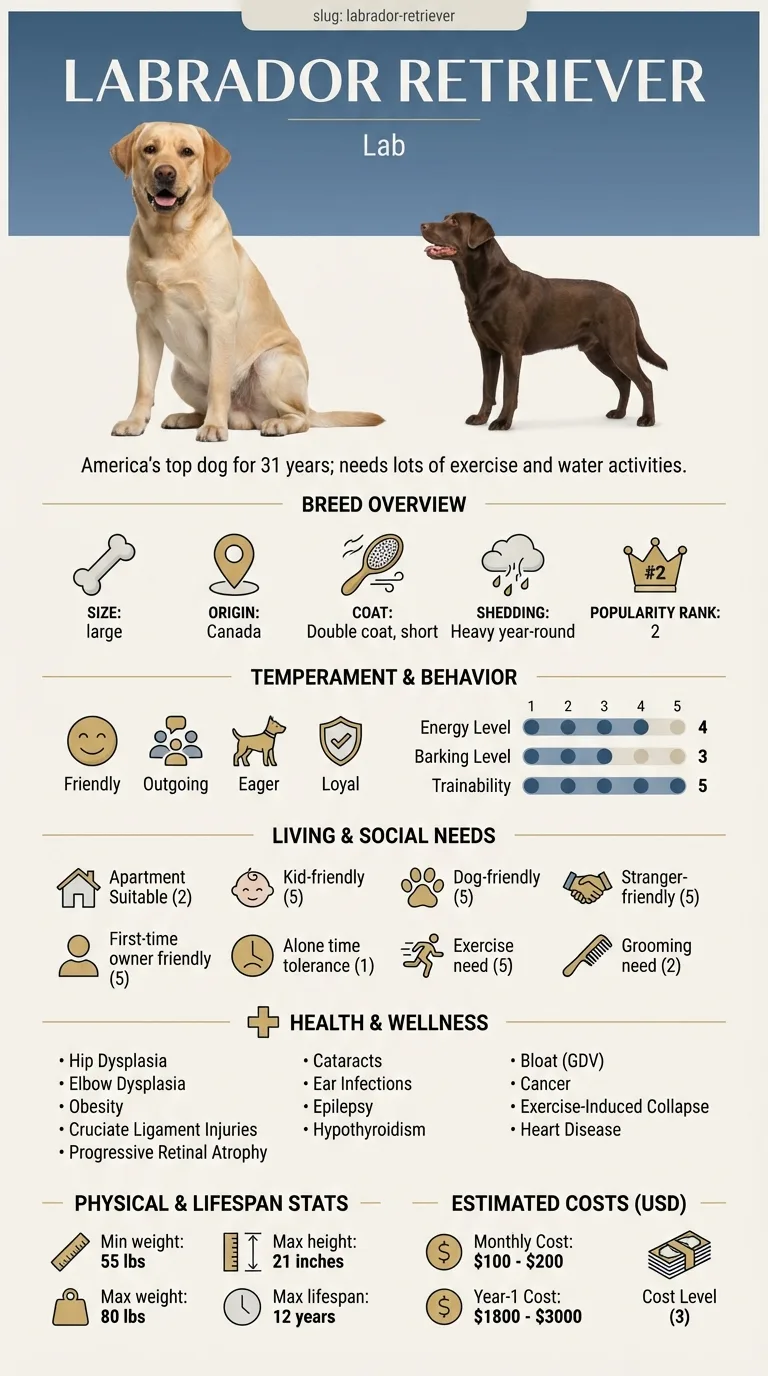
Labradors are a large breed known for relatively large litters, often six to ten puppies or more, which mechanically increases the odds of a malpositioned puppy or one too large relative to the birth canal compared to breeds with smaller typical litters. Their 55 to 80 pound frame also means whelping complications like eclampsia can develop with real intensity given how much calcium a large nursing litter demands from the dam.
An overweight dam going into pregnancy raises dystocia risk, and inadequate prenatal nutrition or monitoring can leave a dam more vulnerable to postpartum calcium depletion. Lack of a prenatal ultrasound or X-ray to estimate litter size removes an important planning tool that helps anticipate potential dystocia before labor begins.
Call your vet immediately for strong contractions lasting more than 30 minutes without a puppy delivered, a gap of more than two to four hours between puppies during active labor, green or dark discharge before any puppy is delivered, or postpartum tremors, restlessness, or a hot painful mammary gland — all of these warrant same-hour attention, not a wait-and-see approach.
See all Labrador Retriever health problems, which breeds are prone to pregnancy complications, or the full Labrador Retriever breed guide for temperament, exercise needs and ownership costs.
Normal labor typically progresses with puppies delivered every 30 minutes to two hours, completing within several hours to about 24 hours total for a larger litter. Any deviation from this pattern should prompt an immediate call rather than waiting to see if it resolves.
Success means a completed whelping with all puppies delivered safely, whether through natural labor or a timely emergency C-section when needed, followed by a healthy postpartum recovery with no eclampsia, mastitis, or infection — achieved through close monitoring and a clear emergency plan rather than assuming everything will proceed smoothly on its own.
Dystocia — difficulty giving birth — is the headline risk for this breed given its tendency toward larger litters, which can mean puppies competing for position in the birth canal or an oversized puppy relative to the dam's pelvis. Prolonged, unproductive straining, more than 30 minutes of strong contractions without a puppy delivered, or more than a two-to-four-hour gap between puppies with the dam still showing signs of labor, are the classic signals that intervention, potentially an emergency C-section, is needed rather than more waiting.
Eclampsia (also called milk fever) is a separate, later-stage risk, occurring in the weeks after whelping when the demand of nursing a large litter depletes the dam's calcium faster than it can be replenished, causing muscle tremors, restlessness, and in severe cases seizures — this is a true emergency requiring immediate veterinary treatment with IV calcium. Mastitis, an infection of the mammary glands, and retained placentas causing uterine infection (metritis) round out the other major postpartum risks worth monitoring for in the days and weeks after whelping.
Prenatal risk factors that increase the odds of these complications include a dam that's overweight going into pregnancy, a very large litter size confirmed on ultrasound or X-ray, and a dam whelping for the first time, which is part of why a planned prenatal vet visit with imaging to estimate litter size is standard practice for responsible breeders rather than an optional extra.

During her Lab Sadie's first whelping, breeder Renata had delivered five puppies over several hours with normal timing between each. When over three hours passed with Sadie still straining but no sixth puppy arriving, Renata called her vet immediately rather than assuming Sadie just needed more time. An ultrasound and exam confirmed a malpositioned puppy blocking the birth canal, and Sadie had an emergency C-section that delivered the remaining three puppies safely. All eight puppies and Sadie recovered fully, and Renata credits having a clear timing threshold in mind — rather than guessing based on how Sadie seemed to be doing — with catching the problem in time.
Key takeaway: Having a specific timing threshold decided in advance, rather than judging in the moment how urgent a labor delay feels, is what actually gets a breeder to call the vet soon enough to matter.
Their tendency toward larger litter sizes raises the odds of dystocia specifically, since more puppies competing for position or an oversized puppy relative to the birth canal are both more likely with a bigger litter, though many Labrador whelpings proceed without any complication.
Strong, productive contractions lasting more than 30 minutes without a puppy delivered, or more than a two-to-four-hour gap between puppies with ongoing labor signs, are the classic indicators that call for an immediate vet evaluation for possible emergency C-section.
Also called milk fever, it's a dangerous calcium deficiency that occurs in the weeks after whelping when nursing demand outpaces the dam's calcium reserves, causing tremors, restlessness, and potentially seizures — it's a true emergency requiring immediate IV calcium treatment.
Keeping the dam at a healthy weight before breeding, getting a prenatal ultrasound or X-ray to estimate litter size, and having an emergency vet plan in place before labor begins are the main preventive steps responsible breeders take.
It's an infection of the mammary glands, presenting as a hot, hard, or painful gland, sometimes with fever, that requires prompt veterinary treatment, usually antibiotics, to prevent it from worsening or affecting nursing puppies.
Emergency C-section surgery, given the urgency and often after-hours timing, commonly runs $1,500–$4,000 depending on complications and region.
Litter sizes commonly range from six to ten puppies, sometimes more, which is part of why prenatal imaging to estimate count and plan for potential dystocia risk is a standard part of responsible breeding preparation.
More than two to four hours with the dam still actively laboring warrants an immediate call to the vet.
Also called eclampsia, it's a dangerous postpartum calcium deficiency causing tremors and restlessness, requiring emergency IV calcium treatment.
Typically $1,500–$4,000 depending on complications and region.
Yes — a prenatal ultrasound or X-ray to estimate litter size helps plan for potential dystocia risk ahead of time.
It can indicate mastitis, an infection requiring prompt veterinary treatment, usually antibiotics.
A one-page prep sheet for this condition: the signs, the questions to ask, what to get priced. Unlocks here.
You get: Vet visit prep sheet
No spam. One-click unsubscribe. See our privacy policy.
Preview page 1 before you decide.