Health
Is MMVD as common in Labradors as in small breeds?
No — it's a documented possibility in Labradors but far less breed-defining than in small breeds like Cavalier King Charles Spaniels.

Quick answer
Is MMVD as common in Labradors as in small breeds?
No — it's a documented possibility in Labradors but far less breed-defining than in small breeds like Cavalier King Charles Spaniels.
It's easy to read online that MMVD is 'the most common heart disease in dogs' and assume that applies equally to every breed — for a Labrador specifically, the more accurate picture is a large breed whose valve disease risk profile looks meaningfully different from a small breed's.
Owners who've researched heart disease broadly and are trying to figure out how much of that general information actually applies to their specific large-breed dog.
This guide is not medical advice. If your dog shows pain, sudden behavior change, or worsening symptoms, consult a licensed veterinarian.
Some links may be affiliate links. We may earn a commission at no extra cost to you. We only suggest products we believe are helpful for dog owners.
We research and check what we publish, but we do not warrant that any figure, date, price, or statement is accurate, complete, or current, and we accept no liability for any loss, cost, injury, or other harm arising from the use of this site. Use it as one reference among several. You remain responsible for your own decisions and for your dog's care - confirm anything that matters with a licensed veterinarian or another qualified professional before you act on it. Full disclaimer.
Myxomatous mitral valve disease is a degenerative condition where the mitral valve's leaflets thicken and fail to close properly, allowing blood to leak backward and eventually causing heart enlargement. It's the most common acquired heart disease in dogs broadly, but it's disproportionately a small-breed condition, and in Labradors it sits alongside other plausible causes of age-related murmurs, including diet-associated cardiomyopathy, rather than being the dominant explanation by default.
MMVD does occur in senior Labradors, but it's meaningfully less common and less breed-defining here than in small breeds like Cavalier King Charles Spaniels, where it's one of the most predictable health outcomes of aging. In Labs, it's one of several plausible causes of an age-related cardiac finding rather than the presumed default.
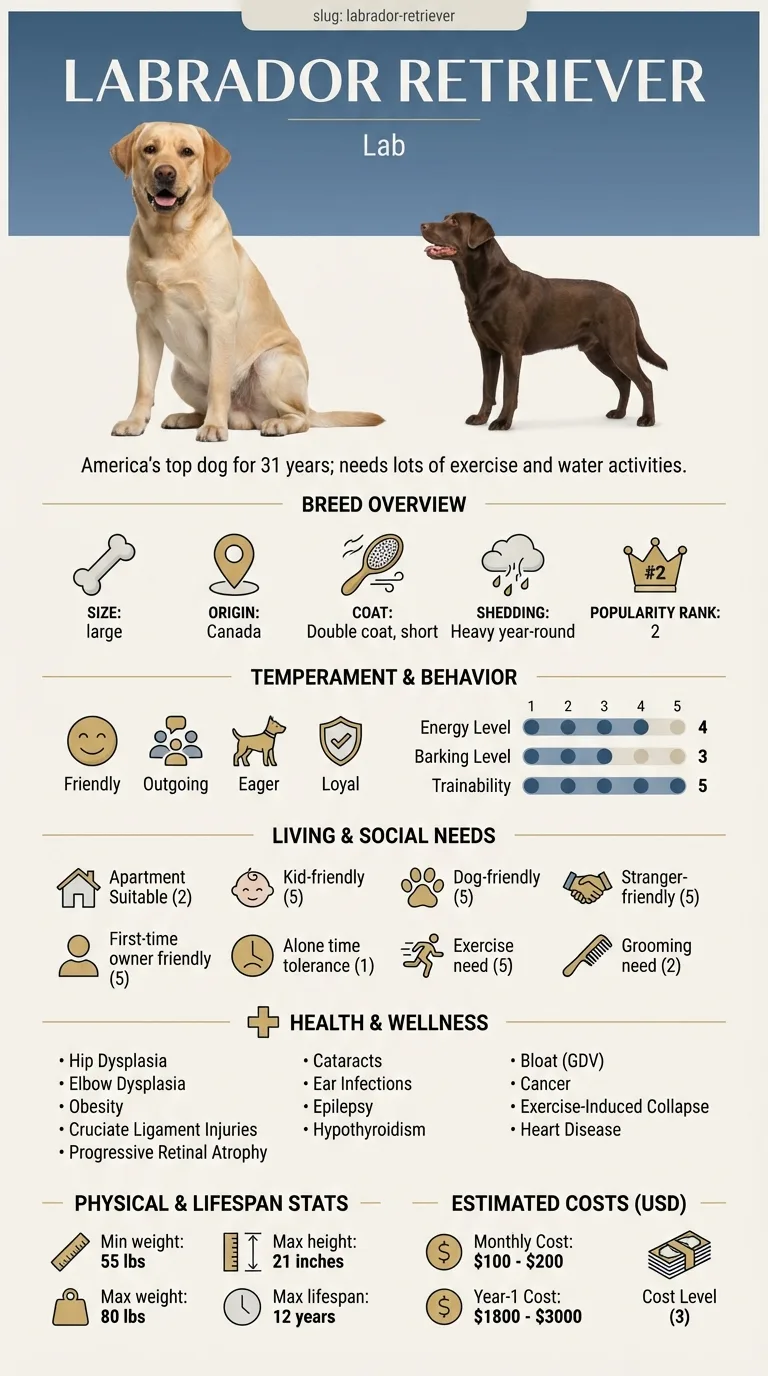
Labradors don't carry the pronounced genetic predisposition toward early-onset MMVD documented in certain small breeds, which is exactly why this condition looks different in this breed's overall cardiac risk picture. At 55 to 80 pounds with a 10 to 12 year lifespan, when MMVD does occur in a Lab it tends to follow the more general age-related degeneration pattern seen across large breeds broadly, rather than an early, near-universal onset.
Chronic obesity and reduced fitness can add cardiovascular strain that may accelerate symptoms once valve degeneration is present, though there's no strong environmental trigger for the underlying valve tissue changes themselves, which are primarily driven by age and, to a lesser degree in this breed, genetics.
Bring up a new murmur, reduced exercise tolerance, a cough (especially at rest or overnight), or labored breathing at a prompt vet visit — and seek emergency care immediately for fainting, collapse, or significant breathing distress, regardless of which underlying cardiac condition turns out to be the cause.
See all Labrador Retriever health problems, which breeds are prone to myxomatous mitral valve disease mmvd, or the full Labrador Retriever breed guide for temperament, exercise needs and ownership costs.
A newly found murmur typically leads to an echocardiogram within a few weeks to determine the actual cause and stage. Early-stage MMVD is often just monitored yearly; more advanced disease requiring medication is usually rechecked every three to six months to track progression.
Success means an accurately identified cause for any cardiac finding and, if MMVD is confirmed, stable management that keeps the dog comfortable for as long as possible — not a cure, since this remains a progressive condition once it develops, regardless of breed.
Myxomatous mitral valve disease is a degenerative thickening and deformation of the mitral valve's leaflets, which prevents the valve from closing completely and allows blood to leak backward with each heartbeat. Over time this leads to heart enlargement and, eventually, congestive heart failure in more advanced cases. This process is extremely well documented in small breeds, particularly Cavalier King Charles Spaniels, where it's so common and often so early-onset that it's considered close to breed-defining.
In large breeds like Labradors, mitral valve disease absolutely can occur, particularly in senior dogs, but it's one of several plausible causes of an age-related murmur rather than the dominant one — dilated cardiomyopathy, in particular, is a more breed-relevant concern for Labradors given documented diet-associated cases. This distinction matters because it shapes what your vet is actually listening and testing for: in a senior Lab with a new murmur, mitral valve degeneration is a reasonable possibility, but it's evaluated alongside other causes rather than assumed by default the way it more often is in a small breed.
The practical takeaway for a Labrador owner is to treat any new murmur as worth investigating on its own merits — grade, location, accompanying symptoms — rather than assuming either 'it's definitely just age-related valve wear' or importing a small-breed statistic wholesale onto a large dog.

Given the breed-specific nuance, here's what's genuinely worth prioritizing rather than applying general heart disease information uncritically.
After reading online that mitral valve disease is 'the most common heart disease in dogs,' Marissa assumed that's what was happening when her ten-year-old Lab, Bailey, was found to have a new murmur at his annual exam. Her vet explained that for a Labrador specifically, diet history and other structural causes needed to be considered too, and recommended a full echocardiogram rather than assuming the small-breed-typical diagnosis applied here. The echocardiogram found mild mitral valve degeneration alongside early, mild dilated cardiomyopathy, likely related to a grain-free diet Bailey had eaten for several years. Marissa switched his food immediately and started him on cardiac medication, with a recheck scheduled in four months to see how both conditions were tracking.
Key takeaway: General information about 'the most common heart disease in dogs' doesn't map evenly onto every breed — for a Labrador, a full workup matters more than assuming the small-breed-typical cause by default.
Not necessarily to the same degree it is in small breeds. It's one plausible cause of an age-related murmur in a Lab, but diet-associated dilated cardiomyopathy and congenital structural issues are also meaningfully relevant to this breed, making the overall picture more varied than in small dogs.
It's a degenerative thickening and deformation of the mitral valve leaflets that prevents the valve from closing completely, allowing blood to leak backward with each heartbeat and eventually leading to heart enlargement and, in advanced cases, congestive heart failure.
A murmur heard at a routine exam is often the first clue, followed by an echocardiogram to directly visualize the valve, measure the degree of leakage, and assess heart chamber size, which together determine the stage and treatment approach.
Treatment depends on stage — early-stage disease with no symptoms is often just monitored, while more advanced disease with heart enlargement or heart failure symptoms is managed with daily cardiac medications aimed at slowing progression and controlling fluid buildup.
The underlying valve degeneration process is similar, but small breeds, especially Cavalier King Charles Spaniels, tend to develop it earlier and more universally, while large breeds like Labradors see it less predictably and alongside other cardiac conditions more specific to their size class.
Ongoing cardiac medication for confirmed MMVD typically runs $50–$150 a month, with periodic recheck echocardiograms adding $300–$600 per visit to monitor progression.
Many dogs with early to moderate disease live comfortably for years with appropriate monitoring and, when needed, medication. Progression varies significantly between individual dogs, which is why regular rechecks matter more than a single diagnosis date.
No — it's a documented possibility in Labradors but far less breed-defining than in small breeds like Cavalier King Charles Spaniels.
An echocardiogram directly visualizes the valve and measures leakage severity and heart chamber size.
Typically $50–$150 a month depending on the specific drugs and dosage needed.
Diet-associated dilated cardiomyopathy and congenital structural defects are also relevant possibilities worth ruling out in this breed.
Yes, many dogs live comfortably for years with appropriate monitoring and medication as the disease progresses.
A one-page prep sheet for this condition: the signs, the questions to ask, what to get priced. Unlocks here.
You get: Vet visit prep sheet
No spam. One-click unsubscribe. See our privacy policy.
Preview page 1 before you decide.