Health
Which breeds get mitral valve disease most?
Small breeds, particularly cavaliers, dachshunds, poodles and small terriers, often from middle age. Large breeds more typically develop heart muscle disease instead.

Quick answer
Which breeds get mitral valve disease most?
Small breeds, particularly cavaliers, dachshunds, poodles and small terriers, often from middle age. Large breeds more typically develop heart muscle disease instead.
This is the most common acquired heart disease in dogs overall, and one of the least likely to be the explanation when a Bernese slows down.
Owners of an older Bernese with a murmur on the left side of the chest who have been given a staging letter and want to understand it, and owners trying to work out whether their dog's cough is cardiac.
This guide is not medical advice. If your dog shows pain, sudden behavior change, or worsening symptoms, consult a licensed veterinarian.
Some links may be affiliate links. We may earn a commission at no extra cost to you. We only suggest products we believe are helpful for dog owners.
We research and check what we publish, but we do not warrant that any figure, date, price, or statement is accurate, complete, or current, and we accept no liability for any loss, cost, injury, or other harm arising from the use of this site. Use it as one reference among several. You remain responsible for your own decisions and for your dog's care - confirm anything that matters with a licensed veterinarian or another qualified professional before you act on it. Full disclaimer.
Myxomatous mitral valve disease is the progressive degeneration of the valve between the left atrium and left ventricle. The thickened leaflets fail to seal, blood leaks backwards with each beat, and the left side of the heart enlarges to accommodate the extra volume. Eventually pressure backs up into the lungs, producing congestive heart failure. It is staged by imaging and managed with medication once enlargement is measurable.
Across all dogs this is the single most frequently diagnosed acquired heart disease, but that statistic is carried by small breeds. In a Bernese Mountain Dog it is an uncommon finding, and it is not among the breed's documented health issues. An older Berner with a left-sided murmur is more likely to be investigated for dilated heart muscle disease, and imaging is what settles the question.
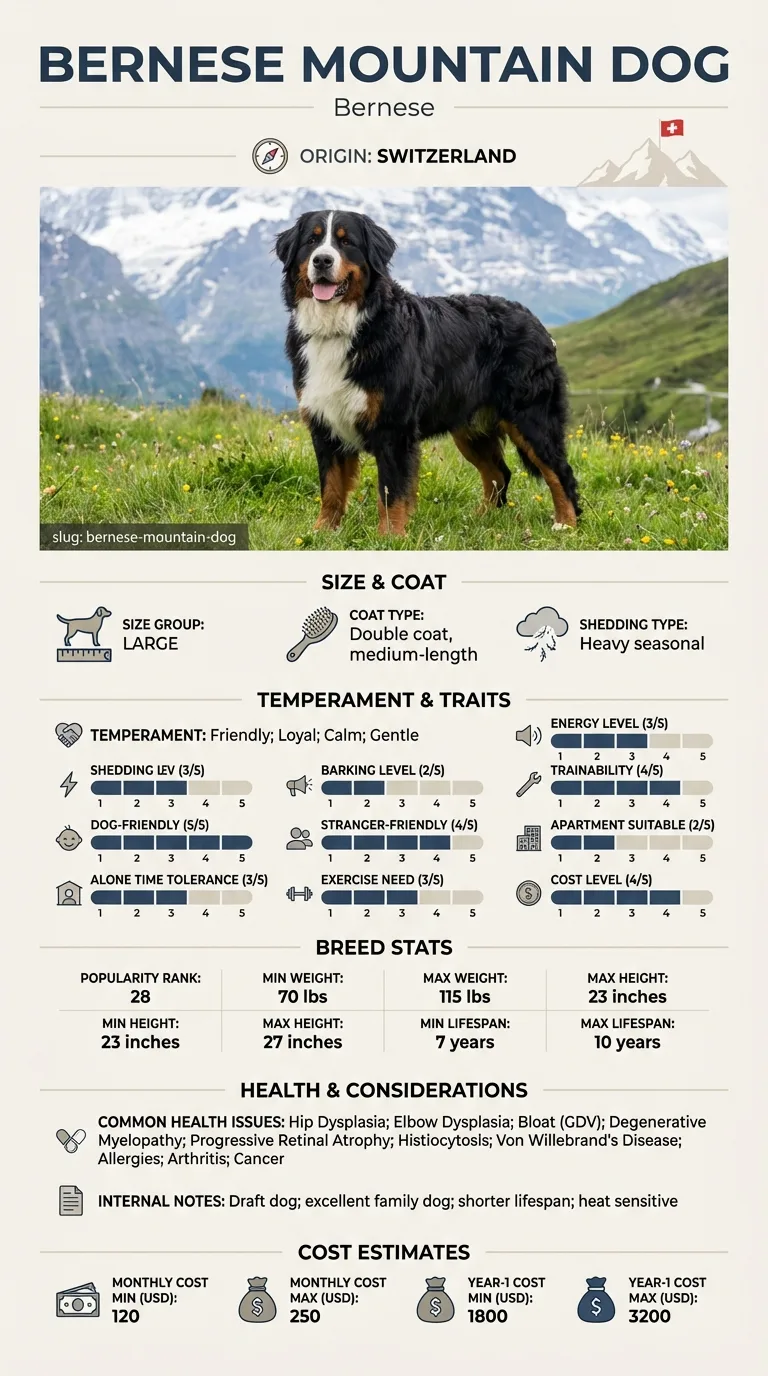
The honest framing here is that the Bernese lacks the predisposition rather than carries it. Valve degeneration clusters in small breeds through mechanisms that are not fully explained but are clearly size-linked. What the breed contributes is a modifying context: a heart pumping for a 70 to 115 pound body has less tolerance for volume overload, a deep chest heavily coated in fur makes murmurs harder to hear, and a seven to ten year lifespan means a slow disease may simply run out of time to matter.
Environment does not cause valve degeneration, but it determines when the compensating heart runs out of margin. Heat is the dominant factor in this breed, because a double coat built for the Swiss Alps forces the circulation to work harder on any warm day. Body weight is the next: a heavy dog requires more cardiac output for the same activity. Household sodium, chiefly from treats and shared human food, matters specifically once failure has developed and fluid balance becomes the thing being managed.
Go immediately if your Bernese is breathing rapidly or with visible effort while at rest, stands with elbows out and neck extended, has blue, grey or very pale gums, collapses, or coughs up pink froth. Those indicate fluid in the lungs and are a genuine emergency. Contact your practice within a day or two for a resting breath rate that has climbed over a week, a new night-time cough, a swollen abdomen, or a clear reduction in walking tolerance on cool days. Do not wait for a scheduled recheck if the breath count is rising.
Start here: Bernese Mountain Dog Most Common Genetic Disorders
See all Bernese Mountain DOG health problems, which breeds are prone to myxomatous mitral valve disease mmvd, or the full Bernese Mountain DOG breed guide for temperament, exercise needs and ownership costs.
This is a slow disease. Dogs commonly spend years in the murmur-without-enlargement stage, with rechecks every six to twelve months. Once medication starts at the enlargement stage, the goal is to delay failure, and that delay is measured in months to years rather than weeks. After an episode of congestive failure, stabilisation takes days in hospital and a period of dose adjustment at home, followed by ongoing management with regular monitoring.
Success is a long quiet stretch. That means a flat sleeping breath count month after month, a dog who eats well and enjoys short walks, medication given without gaps, and rechecks that show the same measurements rather than worsening ones. In a breed averaging seven to ten years, a dog diagnosed at eight who never reaches congestive failure has had a completely successful outcome even though the valve never improved.
Mitral valve degeneration accounts for the majority of acquired heart disease across the canine population, which is why it is described so widely. But that population figure is driven by small dogs. Cavaliers, dachshunds, poodles, terriers and similar breeds carry the condition heavily, often from middle age, and there are a great many of them.
Large breeds are a different story. When a big dog develops heart disease, the more typical pattern is dilation and weakening of the heart muscle itself rather than degeneration of a valve. That is why a Bernese Mountain Dog with a new murmur and reduced stamina is investigated for muscle disease first, with valve degeneration on the list but not at the top of it.
This matters practically for two reasons. First, an owner reading general mitral valve content will find advice, timelines and drug expectations calibrated to a fifteen pound dog, and those do not transfer cleanly to a ninety pound one. Second, the two diseases share early symptoms almost exactly, so distinguishing them requires imaging rather than reasoning.
Where valve degeneration does occur in a Bernese, it behaves the same way biologically but plays out against a shorter life. This breed averages seven to ten years, and mitral disease is typically a slow condition that takes years to progress from a murmur to symptoms. In a small dog that might mean eight years of disease. In a Berner, a valve murmur found at eight may never become the thing that matters.
Veterinary cardiologists use a lettered staging system, and knowing which stage your dog is in tells you exactly what should and should not be happening.

Heidi was nine when a left-sided murmur was noted at a routine visit. Her owners, who had lost a previous dog to heart failure, arrived at the cardiology referral expecting the worst. The echocardiogram showed a leaking mitral valve with no enlargement of the heart at all: stage B1. The cardiologist explained that no medication was indicated, that treating at this stage had not been shown to help, and that the useful thing was a weekly sleeping breath count and a recheck in twelve months. Heidi's owners kept the count on a kitchen calendar. It never moved out of the low twenties. At her recheck a year later the measurements were unchanged, and she was still walking twice a day on flat ground. She died at eleven of an unrelated cause, having never taken a single cardiac tablet.
Key takeaway: A murmur is not a countdown. Many dogs with mitral valve leakage never progress to the stage that requires treatment, and in a breed with a seven to ten year lifespan, a slow disease found late may never become the deciding factor.
No. It is the most common acquired heart disease in dogs as a whole, which is a different claim entirely. In this breed the documented health issues are led by cancer, hip and elbow dysplasia, bloat, degenerative myelopathy and arthritis. Valve degeneration is possible but is not a breed hallmark and is less typical in large dogs than muscle disease.
It is soft and moist rather than harsh, and it characteristically shows up at night or shortly after the dog lies down. It appears in the later stages, when the enlarged heart presses on the airway or fluid enters the lungs. A cough with a rising sleeping breath rate is the combination that needs prompt attention.
Current cardiology guidance reserves medication for dogs whose hearts have enlarged, which is stage B2. Treating a leaking valve before the heart has changed has not been shown to help. What B1 needs is a recheck interval and an owner watching the resting breath rate at home.
Count chest movements for thirty seconds while the dog is fully asleep, then double it. It is the single most useful home measurement in valve disease because a rising trend detects fluid accumulation before a cough or visible distress appears. Record it weekly in a notebook rather than trying to remember.
Once heart failure is present, controlling sodium intake matters, and treats and table scraps are usually the main hidden sources. Before that stage, the general advice is a good quality complete diet and a lean body condition. If your dog eats a grain-free or boutique food, raise it with your vet, since diet has been an area of active concern in canine heart disease.
Yes, in the earlier stages, with sensible limits. Short flat walks in cool weather ask far less of the heart than a hike. Because this breed is already heat sensitive, summer restriction is required regardless of the heart, and stacking cardiac limitation on top of that means the safe window narrows considerably in warm months.
Small breeds, particularly cavaliers, dachshunds, poodles and small terriers, often from middle age. Large breeds more typically develop heart muscle disease instead.
Measurable enlargement of the heart on imaging, known as stage B2, rather than the loudness of the murmur or how the dog appears at home.
A weekly sleeping breath count, written down. A rising trend detects fluid in the lungs earlier than any symptom you can see.
Usually slowly, over years. Many dogs spend a long period with a murmur and no enlargement, and some never reach the stage that requires treatment.
A one-page prep sheet for this condition: the signs, the questions to ask, what to get priced. Unlocks here.
You get: Vet visit prep sheet
No spam. One-click unsubscribe. See our privacy policy.
Preview page 1 before you decide.