Health
Is Perthes disease a Labrador-specific concern?
No — it's primarily documented in small and toy breeds and would be an uncommon finding in a large breed like a Labrador.

Quick answer
Is Perthes disease a Labrador-specific concern?
No — it's primarily documented in small and toy breeds and would be an uncommon finding in a large breed like a Labrador.
Where hip dysplasia is a joint that never fit together well, Legg-Calvé-Perthes is bone tissue actually dying from lost blood supply — a completely different mechanism that happens to produce some overlapping symptoms in a young dog's hip.
Owners of young Labs with unexplained hind-limb lameness who've been told hip dysplasia doesn't quite fit the picture, and owners simply researching every possibility after a vague early diagnosis.
This guide is not medical advice. If your dog shows pain, sudden behavior change, or worsening symptoms, consult a licensed veterinarian.
Some links may be affiliate links. We may earn a commission at no extra cost to you. We only suggest products we believe are helpful for dog owners.
We research and check what we publish, but we do not warrant that any figure, date, price, or statement is accurate, complete, or current, and we accept no liability for any loss, cost, injury, or other harm arising from the use of this site. Use it as one reference among several. You remain responsible for your own decisions and for your dog's care - confirm anything that matters with a licensed veterinarian or another qualified professional before you act on it. Full disclaimer.
Legg-Calvé-Perthes disease is a condition where blood supply loss causes the femoral head to die and deform, typically appearing in young dogs between four and twelve months old. It's overwhelmingly a small and toy breed condition, and while it isn't impossible in a Labrador, it would be a genuinely uncommon diagnosis in this breed compared to far more likely explanations like hip dysplasia.
This condition is rare in Labrador Retrievers specifically, since it's disproportionately documented in small and toy breeds. A vet investigating hind-limb lameness in a young Lab would consider hip dysplasia, OCD, or traumatic injury as far more statistically likely explanations before this one.
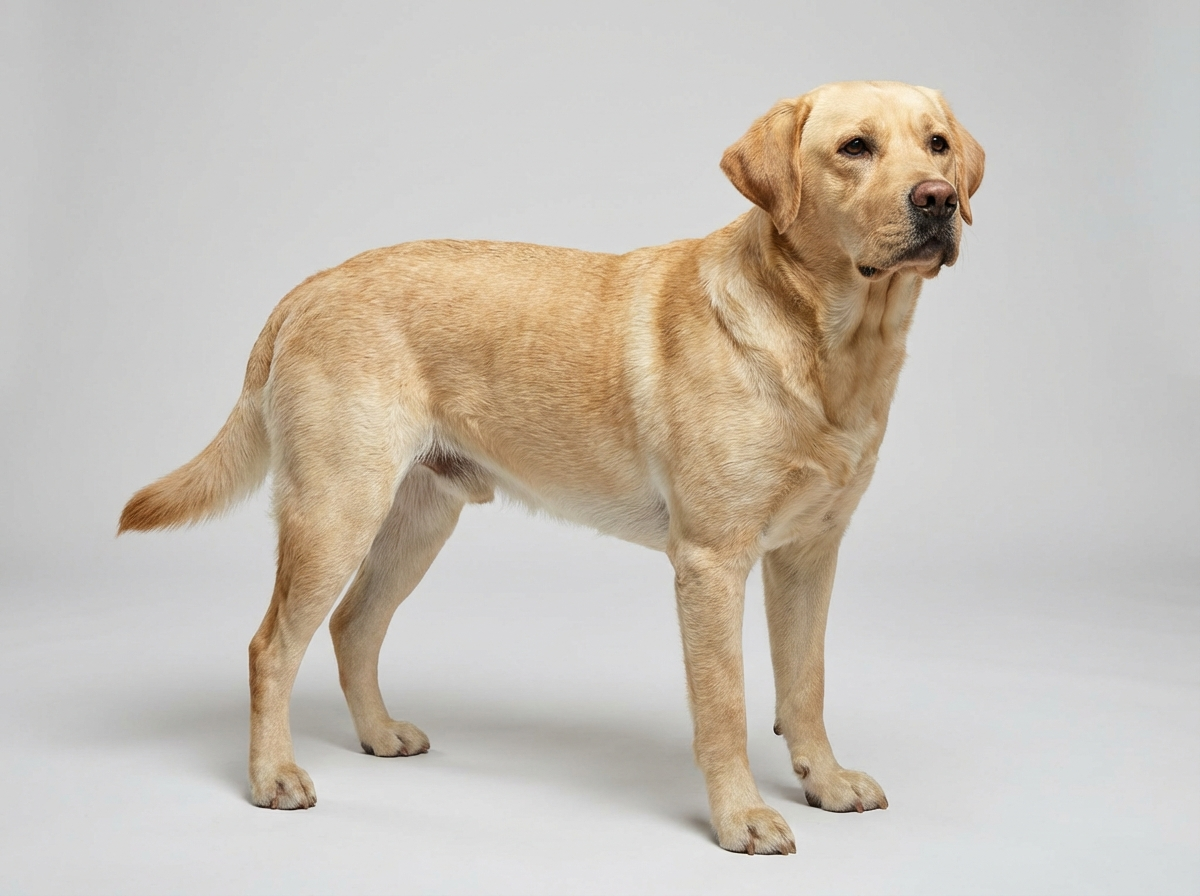
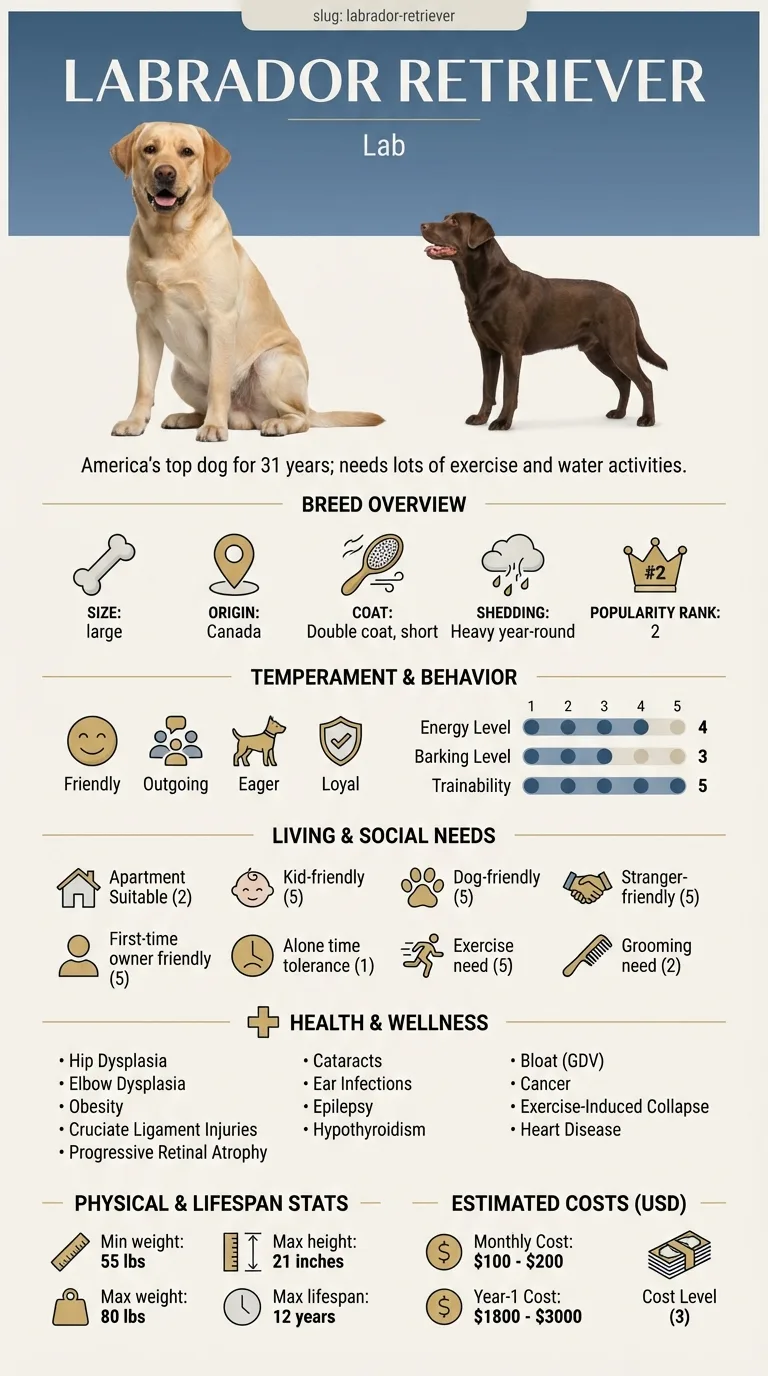
Labradors don't carry the documented predisposition toward Perthes disease that certain small breeds do, which is exactly why this diagnosis would be unusual in this breed. Their 55 to 80 pound frame and large-breed skeletal development pattern is simply a different growth context than the small-breed cases typically described in veterinary literature.
There's no well-established environmental trigger specific to this condition beyond the disrupted blood supply mechanism itself, which appears to be primarily a developmental and possibly genetic issue rather than one driven by diet or activity level in the way some orthopedic conditions are.
See a vet for any persistent hind-limb lameness in a young dog, even if it seems mild or intermittent — while Perthes disease itself is unlikely in this breed, the more common alternatives like hip dysplasia and OCD also benefit significantly from early diagnosis and management.
See all Labrador Retriever health problems, which breeds are prone to legg calv perthes disease, or the full Labrador Retriever breed guide for temperament, exercise needs and ownership costs.
If diagnosed, surgical recovery from a femoral head and neck excision typically involves a structured rehabilitation program over eight to twelve weeks to rebuild muscle around the altered joint.
Success means restored comfortable mobility, since the surgical goal is a functional, pain-free joint rather than restoring the joint's original anatomy. Given how rare this diagnosis is in the breed, most Labs investigated for hind-limb lameness will end up with a different, more common diagnosis instead.
Legg-Calvé-Perthes disease involves a loss of blood supply to the head of the femur (the ball part of the hip joint), causing that bone tissue to die — a process called avascular necrosis. As the dead bone gets reabsorbed and remodeled by the body, the femoral head can collapse and deform, leading to pain, joint incongruity, and eventually arthritis, typically appearing in dogs between four and twelve months old.
This is mechanically distinct from hip dysplasia, where the socket and ball simply don't fit together correctly from a conformational standpoint but the bone tissue itself isn't dying. Perthes is overwhelmingly documented in small and toy breeds — Yorkshire Terriers, Miniature Pinschers, and similar small dogs are the classic cases in veterinary literature — and its underlying cause is thought to involve disrupted blood supply to a still-developing femoral head, possibly with a genetic component in predisposed lines.
In a large breed like a Labrador, this diagnosis would be genuinely unusual, and a vet investigating hip lameness in a young Lab would typically consider hip dysplasia, an OCD lesion, or a traumatic injury well before considering Perthes disease, given how disproportionately it affects small dogs. If it is diagnosed, imaging showing the characteristic bone changes at the femoral head confirms it, distinguishing it clearly from dysplasia's more diffuse joint laxity pattern.

Because Perthes disease is uncommon in Labradors, a workup for hind-limb lameness typically starts elsewhere and only lands here if the more likely explanations don't fit.
When eight-month-old Bramble started limping intermittently on a back leg, his owner Theo had read about Perthes disease online and worried that's what it might be. His vet explained that the condition is rare in large breeds and ran hip X-rays first, which showed early hip dysplasia with mild joint laxity instead — a far more statistically likely explanation given Bramble's breed. Bramble started a weight-management and controlled-exercise plan along with a joint supplement. Theo was relieved to have a clear, common diagnosis with a well-established management path, rather than the rarer condition he'd initially feared.
Key takeaway: Researching every possible diagnosis is a reasonable instinct, but trusting your vet to investigate the statistically likely explanations for your specific breed first usually gets to an accurate answer faster.
No — it's overwhelmingly documented in small and toy breeds, and it would be considered a genuinely uncommon finding in a large breed like a Labrador. Hip dysplasia is a far more likely explanation for hip-related lameness in this breed.
Perthes disease involves bone tissue in the femoral head dying from lost blood supply, while hip dysplasia is a conformational mismatch between the ball and socket without that bone death process. They can produce overlapping symptoms but require different imaging findings to confirm.
It typically appears in young dogs between four and twelve months old, which does overlap with the age range hip dysplasia symptoms can also first appear in a Labrador.
Mild cases are sometimes managed with pain control and rest, but many cases require a surgical procedure called a femoral head and neck excision (FHO) to relieve pain from the deformed joint, followed by rehabilitation to build supporting muscle.
It's reasonable to be aware of it, but given how rare it is in large breeds, hip dysplasia and other more common large-breed orthopedic conditions are far more statistically likely explanations for any lameness your vet will investigate first.
A femoral head and neck excision surgery typically runs $1,500–$3,000 per hip, with additional cost for post-surgical rehabilitation to rebuild muscle and mobility.
Yes, many dogs regain good functional mobility after FHO surgery and rehabilitation, though the joint mechanics are permanently altered and some dogs show a subtly different gait long-term.
No — it's primarily documented in small and toy breeds and would be an uncommon finding in a large breed like a Labrador.
Perthes involves bone tissue dying from lost blood supply; hip dysplasia is a joint conformation mismatch without that bone death process.
Surgery called femoral head and neck excision is common for moderate to severe cases, followed by rehabilitation.
Typically $1,500–$3,000 per hip, plus rehabilitation costs.
Typically between four and twelve months old in affected dogs.
A one-page prep sheet for this condition: the signs, the questions to ask, what to get priced. Unlocks here.
You get: Vet visit prep sheet
No spam. One-click unsubscribe. See our privacy policy.
Preview page 1 before you decide.